



What to expect?
Episode chapters
Transcript
[00:00:00] Wouter Geerts: I think where AI is going to hit really hard in 2026 is beyond that in more of the messy day-to-day kind of operational work in a hotel.
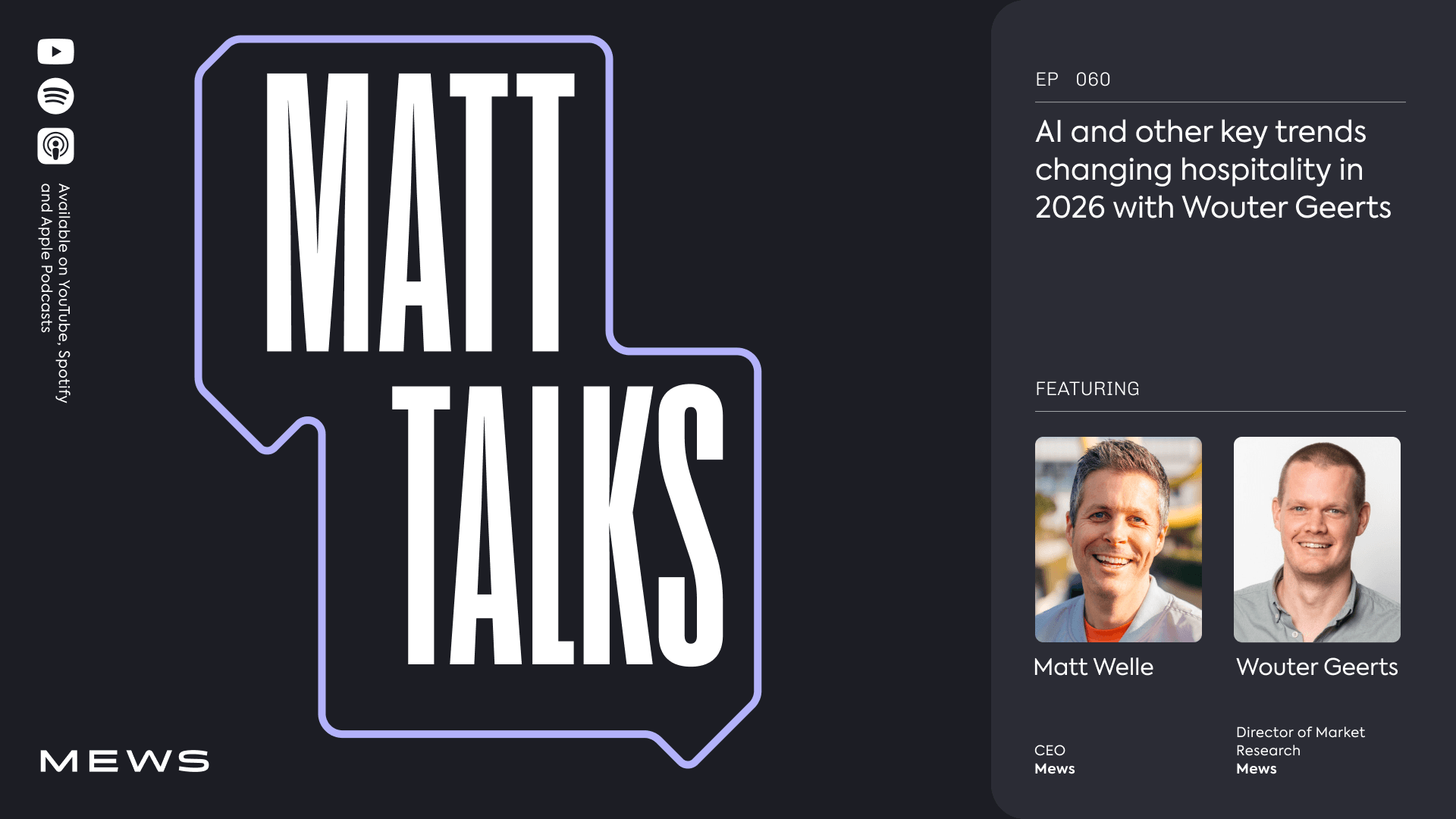
[00:00:21] Matt Welle: Hi, everyone. Welcome back to another Matt Talks Hospitality. And today, I'm joined by Wouter Geerts. He is the director of market research here at Mews, and he's led the research for the 2026 hospitality industry outlook report. For this, we have interviewed 18 industry experts. In the reports, we take a long-term view of what some of the possible scenarios are about how technology that is still nascent today will change the industry over the coming decade. I am very excited about this because it's a really great indicator of where the industry is likely going, and there's a lot to unpack. I think it's about 54 pages of kind of insights from these experts. So, Wouter, thank you for joining me. We're gonna just break down kind of what's in the reports so that people can know what they're gonna discover in there.
[00:01:02] Wouter Geerts: Sure. Thanks for having me.
[00:01:03] Matt Welle: So, tell me about how you went about the research. Like, what was the process?
[00:01:07] Wouter Geerts: Sure. Yeah. So I think everyone loves this, sort of, this is what's gonna happen next year, or the coming year's annual reports, and we do too. And we think it's a really exciting time, of course, now, especially with AI and all the changes that it's bringing. So, this is the second year, actually, that we're doing this big trend report where we look ahead, help the hotel industry to understand what's coming rather than just sort of relying on our own knowledge. And, I know people like you, you're always talking about what's happening in the industry, and that's very valuable. But we wanted to have a very objective view of what's happening. So, we actually got a group of experts together. Like you said, 18 people. And they range from hoteliers, operators, to tech vendors. We've got some journalists. We've got some consultants. So, it's a really wide mix investors of people that took part in this research, and we sort of said, it's quite hard to predict, right? Stuff is moving so fast. So, let's put some scenarios to them. So, we actually put, I think it was something like 15 scenarios to all of these people and said, what's the likelihood of this going to happen? And not just in 2026, but say in the next five years. What's the likelihood? What's the impact of it? And what's the desirability of it? And so everyone sort of provided feedback on those things. And then, actually, after we collected all of that, we went back to them again and asked some deeper questions. So, it was quite a rigorous process of really trying to eke out what exactly do people, or do these experts believe is going to happen in so the next five years? And from that, we created this report, and I think there's some really interesting things in there.
[00:02:54] Matt Welle: Yeah. Like, what I like about qualitative research sometimes is that you go really deep. Whereas when you look at quantitative research, you just have to trust the numbers, and then you have to form an opinion about the numbers. Whereas here, you get lots of proposing views in a room, and you've actually, some people feel like, loyalty is dead. And then on the other side, you get someone like, no, no, Loyalty is for MCP is the best thing that you have because it will always book through the Bonvoy program. And it's really great to get all of those views because we all have to form a view of the future, and we all don't know what it is. So, quantitative research is a really great method to do that.
[00:03:27] Wouter Geerts: Just to touch on that, I think the process, and that was really the way we went into it as well. What we wanted to get out of it is exactly that. By asking people about the likelihood of something and the desirability of something, you can see that in some scenarios, there's a lot of consensus amongst people, and they just say, yes, this is going to happen or no, this is definitely not going to happen. Whereas others, there's a lot of sort of differences, and people believe different things. And I think both provide a really interesting story because, obviously, if there's a lot of consensus, we can say, okay, this is likely going to happen. If there's a lot of disparity in the answers, it doesn't mean it's not going to happen. It just means that people don't know yet how this is going to look. And I think that's a really interesting story in itself as well.
[00:04:12] Matt Welle: And what I liked about some of the people that you interviewed were these are the people that make a decision. They're not the ones that sit back and wait for something to happen. These are the people that say either I believe that this is the future or I believe that this is the future, but they're making a decision and they're making a move in that direction, whilst most of the industry is sitting back and watching and waiting. But you need a few of those early innovators who are saying, this is what's gonna happen, and we're gonna go after that. And that's what makes it exciting to be interviewing these kinds of people that are at the kind of, like, preface of, like, the innovation that's going to happen. And some of them will be wrong, and that's okay. But at least they're moving, and I think movement is really, really important.
[00:04:46] Wouter Geerts: Totally. And I think yeah. We're really at that in an article that I wrote about the report as well, that's in Hospitality Net. I refer to it as the inflection point of sort of saying, we're at a point now where AI is starting to make a real impact. And with that, I mean, I don't mean to disregard all of the AI stuff that's happened before. But if you look at all of the AI innovation that's happened up to now, especially in our industry, it's quite siloed. It's relatively easy to put some AI on a revenue management system to help improve pricing, optimize it. Not saying that I can do it, but there are people who can do that quite well. I think where AI is going to hit really hard in 2026 is beyond that, in more of the messy day-to-day kind of operational work in a hotel. And that's where things like agentic AI, which we've talked about before, that's where that can really make an impact. And it becomes much more interesting to look at how AI can help there. And I think that's why it's an inflection point for hoteliers as well to sort of say, okay, we really need to start looking into this now because it's going to have an impact not just in the background of some tool that I'm using somewhere on the side. It will actually have an impact on everything that you do from day-to-day.
[00:06:05] Matt Welle: Because there was this great chart in the report that showed all of the different stages from the making, like the discovery, to making the booking, to the in-stay to the post stay. And it showed that we're all using AI at the early stages. We're all doing discovery. We're all asking a question, saying, like, I'm going to this beautiful destination, like, what are you recommending in terms of hotels? And it works really well there. But once you get to in-stay, once you deal with all the legacy tech stack that hotels have, it breaks down, it no longer works. Did any of the hoteliers or the people that you spoke to have a strong opinion about how the in-stay will change with AI?
[00:06:39] Wouter Geerts: Yes. I think there's a lot of comments on that, and I think we can probably split it by back of house and front of house. Right? And I think especially back of house, there's a lot of understanding or anticipation, I guess, of AI will start to have a bigger impact on that. There's so much manual work that's still being done. I know you talk on this podcast a lot about sort of automation, and AI is a great tool to help automate certain things. But up to now, it probably hasn't lived up to expectations or potential. With agentic AI, we really believe it will. And I think in the interviews, that really shone through as well things like answering emails, guest communication, but also, predictive maintenance, housekeeping scheduling, all these kinds of things. A lot of that can be automated more, and AI will have a really big impact. Of course, front of house, like I said, guest communication, but also things upgrades, automated upgrades, and recognition of your most loyal and valuable guests. All of these things should become much better as the technology becomes better as well. So, yeah, there's definitely a lot of impact that this can have.
[00:07:58] Matt Welle: Like, one of the challenges that our industry has built itself towards is that we've got the PMS, and then you've got all kinds of integrations. And then you've got a data lake that takes all of the data from all of these systems and sits outside of your PMS, but the PMS is the action driver. And I think once we bring that data back into the PMS system as we have done, and I think some of our competitors are probably also doing the same thing. Once all of the data resides inside the core system, and then you've got the AI semantic layer around it, you can really start to action it. But it's really hard when it sits outside of your silo to make that actionable. And MCP kind of agents, like, that automates all of these really complex workflows, non-standardized workflows, need access to the pure data inside the system that is the system of action. And the system of action is one of those things that we'll be talking about a lot more in the coming year. As we go back to the start of the journey, when a guest discovers and books, what are you thinking is going to happen in that kind of early stage of the booking process?
[00:08:58] Wouter Geerts: There are a few things that we already see happening, and I think there's some clarity around it, but there's also let me say this outright, there's also a lot of unclarity on exactly what's going to happen, but also what happens today, and how it all works. Right? Because a lot of it is a black box, and if Google itself says that they don't really know how an LLM comes up with these answers, then then who are we to say that we understand the whole process? But I think what's happening is more and more people, and we refer to this in the report as well. There was a recent study and a few different studies actually show pretty much all the same, about a third of people now use LLM, so ChatGPT, Perplexity, Gemini, to discover and search for travel, get their inspiration through these AI assistants. And very soon, and this is already starting to happen, booking probably also starts to take place on this. So, Expedia is working together with ChatGPT or OpenAI, I should say. Perplexity has its own Comet browser now where you can book travel directly as well if you use that. So, there's more and more AI coming, generative AI coming throughout those different stages. It will start to move into the booking experience. But how exactly this AI assistant finds the information about your hotel, why it decides to show one hotel over another, we don't really know, and we also don't really know who's going to be the winner of this. Is it going to go directly to hotel websites? Is it actually still requiring an aggregator in form of an OTA, for example, to find that availability information? Obviously, the OTAs are busy making sure that that's the case. The latter is the case. But we do believe there's also opportunities for hotels, individual hotels to benefit from this move.
[00:11:03] Matt Welle: Like, I think one of the things that was true in the pre-AI age when we were optimizing for search engine optimization is that, you know, if there was no content about your hotel, people couldn't find you. So, we were all just pushing out enormous amounts of content to drive traffic. That doesn't change because AI needs content, and it needs lots and lots of data about your hotel in order to surface it in the first place. So, I don't think there's this dramatic shift from an SEO to driving content to suddenly just ignoring content. Like, we've gotta push out relevant content, and it needs to be positive. It needs to be people talking positively about your hotel because if there are lots of negative sentiments, then the AI is not gonna recommend this to a user because if they serve you a hotel that is terrible, you're never gonna use that AI model again for the next search. So, the one thing, I think, that will remain the same is that you need to push out content work. You know, guest review platforms are a really critical components to capturing what people loved about your hotel and then doubling down on that as a strategy for your hotel, saying, right, they talk about, you know, the wonderful lake that we are on. I was in a hotel by a lake over Christmas. So, lean into that experience. Like, how can you make people talk more about that? Because when people look for a lake holiday, they will find your hotel. So, there's no diversion. Like, you still need to push out as much narrative online about it. It's just it's shifting to how you service it, and how do you drive that strategy, and that's the pit that no one really knows what's going to happen, but there's no shift away from content.
[00:12:34] Wouter Geerts: No. I totally agree with that. I do think that there is, there should be a heightened focus on accuracy of content, especially when it comes to the static information about your hotel, making sure that any platform that you're on and that information is on has the same information. Because, obviously, a person will go to one platform, maybe two platforms, and compare maybe information there, and that's it. The LLM can go to 20 different platforms. If there's one platform that has different information than the rest, there's uncertainty, and so it might then decide not to offer you a spot. We don't really know.
[00:13:13] Matt Welle: So, if I'm pushing my hotel saying we are wonderfully dog friendly as a hotel, but if all the reviews say about how terrible the experience was for their dog as a dog owner, then that is a disconnect from the real world. And whereas in the past, you could get away with that as an SEO strategy. You just push out content about, you know, how dog-friendly you are. Now that doesn't work anymore. So, you actually have to go and read the reviews and build a digital strategy around what guests are saying. And if you want them to say something, you need to make sure that what you're saying is true. And that's really, probably one of the big shifts.
[00:13:45] Wouter Geerts: Yeah. And it's about remembering that most people use an AI assistant to ask it questions. And the question can be book me a hotel, but it could also be once you have a hotel, you wanna know more. Or when you're trying to book a hotel, is this hotel dog-friendly or not? And being proactive as a hotelier and actually offering the LLM, say, a list of your 50 most frequently asked questions with clear answers so we can answer those questions very confidently is becoming more important. So, making sure that you have something like that available to the AI assistant is very important.
[00:14:28] Matt Welle: Can we talk about bookable services like, upsells or cross-sells of different services of the hotel? Do you think that's going to change dramatically?
[00:14:36] Wouter Geerts: I think they'll become more important. And I think, especially when we're talking about how do you distinguish your offering from an OTA, and why would an LLM choose you over an OTA? It’s similar to a person in a way, but again, bookable services and having something that distinguishes your offering from what's available on the OTA will become more important. So an LLM might know that the person that they're an assistant of a person. Right? So, and they know a lot about that person. So, they might know that they like breakfast at a specific time, they might know about their allergies, they might know that they like history and sightseeing or any other activities. They might know that they're on a pleasure trip, so wanna have a workspace. If as a hotel, you could offer all of these types of services as part of the booking experience when the room is being booked, that will put you a leg up against an OTA that can only book a room. And today, let's be honest, the experience of booking ancillary services, like we have in the airline industry, it doesn't really exist in the hotel industry for most hotels. And if it exists, often it requires a phone call to the hotel. Can I book this as part of my stay? Or you need to do it while you're there, hoping that it's still available. If a hotel can offer this as part of the booking experience and the LLM can book that as well as part of the experience, we really believe that sets hotels apart from other channels. And, therefore, actually these AI assistants can help drive direct bookings in our view.
[00:16:27] Matt Welle: And we've seen, you know, sometimes not everything is about AI. We've actually seen hotels put their parking inside Mews. Previously, they're like, well, if they came with a car, they would have parked it anyway. And, actually, once they deployed parking with Mews, they started seeing that the revenue went up, and they started investigating why the revenue went up. And they're like, oh, because they actually would have parked it down the road where it was free. But because you make it bookable at the time of booking, they now decide to prebook it at the hotel, and that's what's driving the revenue increase. So, making all of your different services bookable through booking engines or through upsells throughout the journey. And there are different products in different parts, right? So, at the time of booking, I may not wanna book an early arrival because I don't actually know what time I'm arriving. But at the online check-in stage, I may wanna offer that. And we've made it really easy to segment kind of the stages and what kind of products you would like to offer at the different stages to customize. And this is, like, way before you even touch AI. You need to start thinking about the kind of journeys that you're going through. One of the hardest things in a hotel is to, every year, increase your room rates, like, it's expected, right? The owners will be like, I want a 5% increase of the room rates, but you can't. Like, you cannot like, with the product that's aging every single year, and then you're getting this push for a room price increase to match the inflation, and preferably a little something. So the only way to drive an increase in revenue sometimes is from ancillary services, and you've gotta be really smart about how you leverage every square meter of the hotel. And we just try and enable that through the platform, but you do have to do the work to figure out, okay, so what are the services that a hotelier that a guest at my hotel would want to buy? Bike rentals are one of those great services that we've deployed, but we don't yet see enough hotels actually putting it in the system. And I think it could be a real driver to some of that incremental revenue.
[00:18:11] Wouter Geerts: Yeah. I love the example of the Paradiso Hotel, one of our customers in Paris that has karaoke booths and a cinema on the rooftop and things like that. Like, really, really interesting, almost quirky ways of using unused space, and the revenue increase is dramatic for them, so, yeah.
[00:18:31] Matt Welle: One of those rooms in the basements that is now a storage room in most hotels, they turn it into a karaoke room. They put a QR code in. If you wanna order any drinks, you can order that directly through the point of sale. So, there's not a waiter who has to constantly check in, but they'll just come when the order is being placed, payment is automatically taken care of, and this is what you get when you build an ecosystem text that is payments, PMS, point of sale with a bookable service of karaoke rooms. That's the power of kind of what you can do, and it drives real revenue. But, also, it drives real experience because now these guests are gonna go online and say I had the best karaoke experience at this hotel. These reviews start to surface, and then people that are looking for a fun night out on a Friday night in Paris will find your hotel, and it's differentiated from whatever, some budget hotel down the road that doesn't do anything special. So, all of these pieces come together, and then AI feeds off it to kinda tell that story really well.
[00:19:21] Wouter Geerts: Yeah. And I think one, to latch onto that, one mistake that we see quite a lot in the industries is to expect that AI will solve all of our data problems. You mentioned it earlier as well. If you have a data lake somewhere, it needs to be accessible. And I think don't expect that this latest technology will actually solve that problem for you. It's a really difficult problem. And having unsiloed data that can be utilized by AI agents is extremely important, but AI isn't going to necessarily solve that problem. So, it's a step that, going back to the inflection point, it's a step that hoteliers need to start seriously looking at that. If you wanna benefit from the potential of this latest technology that's coming, or that's already here, make sure that you do invest or look into what does your tech stack look like today? What are the data flows? Where is your data stored? And is it accessible? Because the true potential of generative AI and agentic AI is if it can grab data and can touch everything and impact, and and play with with everything that you know about the customer, in many cases, in many hotels, there's just a lot of silos, and data isn't freely available. And so that will hamper the impact that AI can have. And so, making sure that you solve that problem first and focusing on that in 2026 is actually a really important thing to do.
[00:20:56] Matt Welle: We often see a lot of RFPs, request for proposals coming in from hotel groups who are asking us to fill in an Excel sheet with, I don't know, 500 questions about what they had in their old system to see if the new system can supply that, and then they also want something else. And we don't do well on Excel sheets because we haven't built the legacy features that you may have had in your system that were needed ten years ago. And there, I hope that we'll see a shift of CIOs who are listening to this, who are thinking, let's do the RFP in a different way. We still need to know what the critical problems are that we want the system solved, but I won't tell you what the features are to solve those, because maybe there's new technology that's come in. And thinking about the data lake and MCP should be questions in your RFP that you ask about to uncover whether you're buying, honestly, best of breed for 2026, or if you're buying best of breed for 2015 that has been lifted into the cloud but hasn't actually done the innovation. Before you start an RFP process, really think about will this scale in the next couple of years, because there has been a shift since 2022, since AI came in, but there's been a significant shift in 2025 when MCP started coming in. And you wanna make sure that you can confidently answer the yes to all of the questions, your 500 questions in your RFP in three years' time. And I think a lot of those RFPs won't hold up anymore. And that's really where the shift is gonna come from, where CIOs need to shift their thinking towards AI, and they need to ask the right questions, and they're not being asked today. We still get those Excel files with hundreds of questions with antiquated feature requests that we don't build because they don't make sense to us anymore as an industry. So, I'm hoping we'll see some of that shift in RFPs going forward.
[00:22:35] Wouter Geerts: Yeah. And I think that's also why we talk quite a lot about the semantic layer. And I think it's worth spending a minute on that because it's not a term that's well known. And you've mentioned MCP a few times now, and MCP, you hear more and more about. And it's almost put out there as sort of the solution to all of our AI data problems and connectivity, just like the API was before, the sort of solution to all of our data problems. And, eventually, it isn't because it's just a connector. MCP, again, it's connecting, allowing for connections between different systems. We talk about the semantic layer as an additional layer, I guess, if you like, of understanding of data. And the semantic layer to us is really like a dictionary in technical terms called the ontology of all the data that you have. It's important to be able to connect different systems together, and that's what the MCP allows, and the MCP allows for AI to connect to different systems. But to understand exactly what a data point means and what it means in this system versus what it means in this system, and if the definition of those are the same, for that, you need an additional dictionary, if you like. And that's what the semantic layer is, so that we can connect different systems, and we can be assured that ADR means the same in this system as this system or that we refer to a booking by the hour or by the by the day or whatever it might be, in the same way across different systems. And that's a missing piece that we don't have yet, and that's why we've been talking about that.
[00:24:26] Matt Welle: To make that real, like, if today, you can engage with the chatbot of the hotel, and it will search a database, an LLM, large language model, where it just gets an answer, and it can answer your question. However, if you're asking for something from the hotel, it can't action it. So, a human now has to step in unless you have an MCP connected. So you say, right, if the guest asks for shampoo, you need to have an integrated system, which is the housekeeping system, so that they can take that information and turn it into an action to the housekeeping system, saying, “Hey, housekeeper on Floor 1, go and deliver this shampoo to Room 101.” Knowing which housekeeper is on Floor 1 is where your semantic layer comes in. That's the understanding of how does this hotel operate? What are the rules of operation? So, we've gone from LLM to MCP to the semantic layer that kind of becomes this level of understanding that can make it real. So, whilst I think a lot of hoteliers have not yet seen this in real life, this is coming in 2026. And it's going to make life of hoteliers significantly easier because this is where we deploy humans to be the semantic layer today. Today, the humans are the semantic layer, but a lot of that understanding, 95% of that, we can actually know because we know what's happening in the system. So, we can actually connect the dots through AI in the future. Besides AI, what else was there in that report? Because I feel like we've just been talking about AI. Was there anything else interesting in there?
[00:25:48] Wouter Geerts: There is. Well, I think, to be fair, that obviously, it's related to AI. But if you talk about AI, what always comes up is what does it mean for the human touch and the human element of hospitality? And I think that discussion has been going on since probably the Internet, and technology coming into hotels, and where do you find that balance? And I think it's not a secret that we are obviously innovative as a company, and Mews, and we want to see technology ingrained throughout the throughout the hotel experience to make it better. But we also believe that, actually, technology can enhance the experience significantly from both, the the guest point of view and the staff point of view. And I think that's a very important thing to say. And, actually, the interviews that I had with the different experts are really aligned to that where it's important to keep that human touch and keep that human element. Obviously, depending on what kind of business you're operating, there's a sliding scale of how much and where you want that human touch to be. But it's an important aspect of the hotel industry and arguably more important today than it was 10, 15, 20 years ago when we didn't have mobile phones and social media.
[00:27:16] Matt Welle: Yeah.
[00:27:17] Wouter Geerts: Lots of people now actually go to hotels for that human experience. So, I think that's extremely important, but it doesn't take away from the fact that some of the things we've already mentioned around automation, that also takes away from the human experience. If you need to type in a check-in, type in tons of details rather than being able to talk to someone and explain the layout of the hotel or some fun things to do in town. So, AI should be an enabler of more human touch rather than that.
[00:27:46] Matt Welle: I was saying, I was scrolling on TikTok. Sorry. I was gonna say I was watching an educational video, but I was scrolling on TikTok this morning, and Rory Sutherland, who's this marketing kind of expert, you see him all over TikTok with these great stories. And he said, you know, you got these hotel brands who are looking at this doorman, and they're like, this doorman who just opens doors is no value. And then McKinsey comes in, and McKinsey says, right. We'll just put a revolving door into that thing, and we get rid of the doorman, and we save lots and lots of money. And, yes, initially, it does. And then over time, you see guests starting to complain because the doorman does so much more than just open a door. They pick up your luggage. They give you recommendations. They hail your cab, and they create what’s the magic of hotels. So, if you say, like, right, we've automated it. We don't need the humans. But, actually, you do need the humans even more because they now need to get insights from the hotel. So, I arrived at a hotel the other day, and they welcomed me. And they said, how is Beyonce, your dog, doing? And I was like, how do you know? And it was our system that served them this information in a tooltip. And it allowed me to have a conversation with the receptionist about my dog instead of my passport and my credit card, and it changed the experience instantly. So, I don't think we're removing humans. We need to lean into them, and we need to just make sure that we leverage them in the best way possible. I had Kevin, who is the CEO of Machefert Hotels, and I met with him the other week, and he was talking about how they were hiring actors. He said, because now I don't need them to know how the night audit runs. I don't need them to know how to scan a passport from a guest, but I do want them to engage with customers. So, he started going to theater schools to hire actors because you kinda want that experience. You wanna lean into the experience and double down on it because you wanna create these memorable experiences that guests then talk about online, that then feed the LMs, that then feed your booking engine funnel. And I think that is such a smart way to approach this.
[00:29:35] Wouter Geerts: I can't say too much about it just yet because we don't have the final results, but we're always searching for the latest and the greatest, of course. And we're actually looking at sort of the workforce and what kind of skills does the workforce need today, and in five years' time, and how does it change with AI, and all the tools that are out there. And I think a very clear thing is soft skills will become more and more important. And you see that talking to universities as well, and they see that it's actually the soft skills that are more important. And a lot of different industries want hospitality school students because that's where you learn soft skills. The analytical capabilities and technical capabilities are important for certain jobs. But for a lot of jobs, it's the soft skills that are important, and especially in a hotel, that will continue to gain importance. So, yeah, for sure. Not getting rid of the human element for sure. That's not what we're looking forward to doing here.
[00:30:39] Matt Welle: So, as you spoke to all these experts, did you get a sentiment that they all believe that 2026 is the year of change? I feel like we've been talking about gonna happen this year, but do you think that there's a real shift happening?
[00:30:50] Wouter Geerts: That's a tough one to answer. I think there's always this natural sort of expectation at the December that next year is going to be totally different. Right? I mean, that's just human nature that you believe that. I do think that, I think, like I said at the beginning of the call, the agentic AI potential is great. It's strong. I'm hopeful that it can actually have a big impact. And I think it's the first piece of technology that can be ingrained in all the tools that are already existing in our industry, but that can have a real impact on some of the lingering legacy processes that continue to happen in the industry. So, yeah, I do believe talking to people that there is a real expectation, that with the speed of innovation that we're seeing with generative AI and now, like we said, agentic AI coming up now, that things will actually happen. If it happens in 2026 or maybe into 2027 and beyond. That's always hard to say. But looking at how quickly Gen AI was adopted, let's be honest, four years ago, it didn't even exist, and now, a quarter or even a third of people use it already to find.
[00:32:13] Matt Welle: Now have opinions about it. And, like -
[00:32:15] Wouter Geerts: There you go.
[00:32:16] Matt Welle: I got cut off from ChatGPT over the holidays. And I thought, oh, this is a great opportunity to switch to Claude or to try out the Google model. And I immediately switched on two subscriptions. And after two days with Claude, I was like, this is not for me because he doesn't understand Dutch. So, we couldn't switch between Dutch and English as natively as ChatGPT could. And then I went to the Google model Gemini, and same, they struggled with my language differentiation and said to show me images. And, like, we can't do that here, but here's something. I said, no, no. ChatGPT can do it. So, I've been testing for the last two weeks all these different models, and I went back to ChatGPT because it served me in a really good way. But it's interesting to see how many opinions people have about all the different LLMs and what their preferred one is because, you know, we all look for it, and use it in a different way. And I think so much is going to happen this year. I get excited about it, but it'll be interesting to see which other hotel brands are truly, truly going to innovate. And, you know, if you are already innovating, we would love to speak to you here for research. So, if you do something really interesting, please reach out to us because I wanna tell those stories. I think it's important that we tell stories of hotels that do something really innovative. Where can people download this report? Because I loved it, but it's, you know, you really need to sit down with it for half an hour to just consume all of the content in there.
[00:33:33] Wouter Geerts: So, I'm sure we can add a link somewhere to -
[00:33:36] Matt Welle: Down below. Up above.
[00:33:38] Wouter Geerts: Somewhere on the side. To the website. There's a landing page where you can get it. We'll actually have translated versions as well. So, we have exact summaries that are shorter, only six pages instead of 45, or so, where you get all of the main things, and they'll be in German, and French, and in English and a few other languages, but yeah, the full report can also then be downloaded on the same page. And there is a lot of interesting stuff, but like we said before, there are really three sections. So, focus on the section that's interesting to you. Each section is sort of built up separately. It has its own key takeaways and a checklist and things that you can start doing today, going back to what you were saying about your LLMs. I think in the coming years, every hotelier, not necessarily should be trialing LLMs, but should be doing things like building your own bots, like, I know there's a there's a podcast episode from you where you do that with Lovable. Every hotelier should probably start doing that if they haven't done yet. Just start experimenting with different tools and different systems. Look at the technology you have today and see what AI they're implementing and start understanding that. So, back to the report, three sections: one is on that sort of booking experience and how that's going to change, one is on this agentic AI expectation and what that's going to mean, and the final section is very much on the human touch and the human element in hospitality and how that's going to be impacted. So, if you don't have time to read 50 pages, pick a section and focus on that.
[00:35:19] Matt Welle: Like, there are nice charts. There are nice elements to it. I think one of the things I always struggle with because I like to consume information in different ways. I always struggle when I see 50 pages. But, actually, once I've read it, I've gained information. And it was what I liked about the report was the differing opinions. It was really interesting just to hear that some people just thought, for example, loyalty was dead, and some people didn't think it was dead. And I think you just need to have these perspectives in the back of your head when you design the experience at your hotel or your brand. So, read the reports. Give us your feedback. And if you do something interesting, reach out. We would love to have you here on Matt Talks. Wouter, I thank you.
[00:36:00] Wouter Geerts: Thank you very much.


