What to expect?
Episode chapters
Transcript
[00:00:00] Charlie MacGregor: Then my hope is that I can stand on a podium to all the other CEOs or investors and say, look, you should be doing this as well because it's a good way to make money.
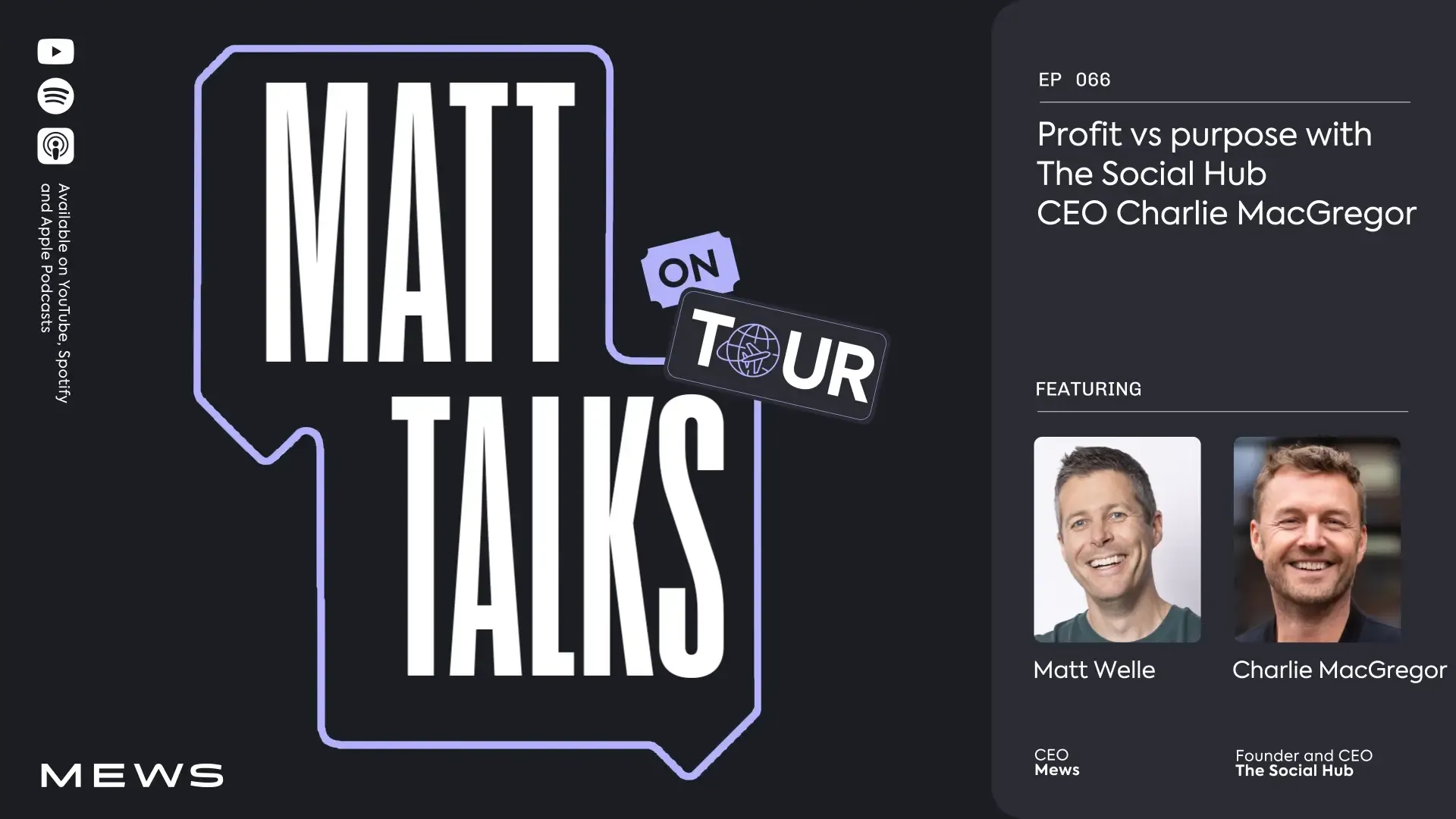
[00:00:19] Matt Welle: Hi, everyone. Welcome back to another Matt Talks Hospitality. And as you know, I like to explore different kinds of concepts in this kind of podcast. And today, I have Charlie MacGregor joining me. Charlie MacGregor is the founder and CEO of The Social Hub, which you may have remembered as The Student Hotel back in the day, and they've rebranded recently. They are B Corp certified. There's so many stories here that I would love to explore with Charlie. Thank you for joining me.
[00:00:46] Charlie MacGregor: Thank you for having me.
[00:00:47] Matt Welle: So tell me, when did you first think about The Social Hub? What was the first time you had a thought and thought, I wanna do this thing?
[00:00:54] Charlie MacGregor: Yeah. It's such a boring story. I mean, I wish it was, like…
[00:00:57] Matt Welle: Make it up then.
[00:00:58] Charlie MacGregor: Okay. The makeup story. So, I was sitting in a bar. I'd just been fired from a job. I was sitting there thinking, what could I do next? And I thought, why don't we bring students together with parents dropping them off, which would turn into leisure and B2B travelers? We could add some co-working there. That would be great. We could connect for the locals, you know. And then, hey, well, the co-workers would be really inspirational for the students because, you know, they're next generation talents and stuff like that. And then we could open the doors to the locals, and everybody would just get along swimmingly. And then I thought, yeah, let's do that. Let's do this, Student Hotel, and now, The Social Hub. So, that's how it started.
[00:01:34] Matt Welle: But that sounds like a wild dream that will never work in reality. The first building that you opened…
[00:01:41] Charlie MacGregor: Yeah. But it's interesting because the wild dream was never possible like that, like, everybody starts these things. You know, I started a student housing. When I came to Holland, I wanted to do student housing, which was impossible because of the housing rules and regulations. They've overregulated the housing market, but I bought some buildings with the intention to do it, and I was convinced I would find a way around it. And the way around it was to lean into a maximum stay for one year, which is the UK model of student housing and to turn yourself into a hotel. And a hotel, like offices, is very unregulated. There's no rules and regulations saying how big or small your room is or how much you need to charge. But my first thing was really student accommodation has such a bad reputation. If I dared to invite moms and dads to come and drop, you know, little Johnny or Sarah off and stay a few days, check they’re okay, and settle them in, then hallelujah, this must be the best place in town. And the evolution for us was I knew I would disrupt student housing, but I didn't know the hotel sector. And what I discovered was that the hotel sector needed to be disrupted. We had built hotels based on business hotels, leisure hotels, well-being hotels, whatever. And what we did is we broke those rules of bringing different demographics together, which really worked. And then, of course, indeed, we did add co-working, and we did invite the locals in and stuff, but it's just…
[00:03:00] Matt Welle: Which was the first hub they opened?
[00:03:02] Charlie MacGregor: The first one we opened as a student hotel was in Rotterdam in 2011. And then we quickly opened Amsterdam West in 2012 in Rotterdam. And those first three were my first investors, and we saw within those first projects that we started to get hotel guests that were not related to students, that were not related to universities. There's a famous story in TSH about the 60-year-old lady we met, who was in Den Haag, and I saw her, and I gingerly went over to her to say, you know, what the hell are you doing here? You know? You're not part of my target...
[00:03:35] Matt Welle: You're welcome, however.
[00:03:37] Charlie MacGregor: And she said, “Oh, I stay in all of your student hotels because you take my age away.” I was like, flabbergasted. I just fell on the floor. I thought this is the best, I mean, marketing line, but what does she mean? And that's really when we started to pay attention to what was happening, and we realized that the atmosphere, and still is today in our Ground Floors, is created by the community feeling. So, that means that in a hotel, it's very difficult to, I would say impossible, and you can't have a community with people coming and going and not connecting. But, of course, when you have longer-term residents or coworkers, they connect to your staff. The staff connect to each other, they connect to the guests, the locals come in, they connect to each other. So, there's a community vibe, like what you have here in this co-working space we're in, that the hotel guest customers feel. You feel it when you walk into Soho House. You feel there’s something in the air.
[00:04:28] Matt Welle: Yeah.
[00:04:29] Charlie MacGregor: And that's what we discovered. We have that in…
[00:04:32] Matt Welle: And did you have that with the first hotel in Rotterdam, or did that evolve? And by the tenth one, you feel like now it feels right?
[00:04:38] Charlie MacGregor: No. It was from day one. And it took us three hotels to realize this was not a fluke. This was something that we as a team have in our DNA to really, and again, there's a community already built by students. There's a community already built by coworkers, so you don't need to do anything. We did do a lot. We did a lot of curation. We did a lot of connecting. We brought people together. We have a massive events calendar and stuff like that. So, we did a lot of work. So, we realized after three that this was not a fluke, and we really started to get confident with our fourth one, the one we built in Amsterdam City, to purpose-build four-star hotel rooms instead of just using the bigger rooms for hotel guests and to really double down. So, I would say that the student hotel proper was born actually on our fourth hotel because we saw that we needed to upgrade our spaces, and then we could get B2B clients and everything else, so.
[00:05:36] Matt Welle: So, you do see corporate guests staying there, you see short-stay guests, you see students that are there for the semester, for example, and they're all just seamlessly blending, or you separate them out into separate parts of the building?
[00:05:46] Charlie MacGregor: No. And then indeed, when I started, everybody from the planning department, the architects, the engineers, the banks, the city, my dad as well, was saying, hey, you need to have two entrances. You can't mix a hotel customer with a student. So, we actually built two entrances for our first building, and we just closed one off. We said this is not an entry.
[00:06:04] Matt Welle: So, one of the hotel entrances and the other is the whole street entrance?
[00:06:06] Charlie MacGregor: Yeah. And we just use one entrance, of course. So, everybody comes through the same door. And just like a hotel, if you're on the 6th floor, you get your electronic key. You can get out on the 6th floor. You can't get out on the 5th floor because it doesn't stop, you know, so we divide each other by using design to make people flow in their own spaces, but everybody comes together in the Ground Floor, which means we have genuine connections between a 60-year-old B2B, or a leisure traveler, or a local connecting with the next generation talent, whether that be students or coworkers. And that vibe, I would argue, is definitely the secret of our success, but it’s what we're looking for in society. We like to go to spaces that are not single profiles, single demographics, I mean, that's the most boring thing in the world. So, I think what we've just dared to trust our customers and to trust human beings, that, actually, we're all good and we'll all look after each other.
[00:07:04] Matt Welle: But you're competing for real estate with your typical hotel chains, I would imagine. So, if you take that concept that you have, where it's very vibrant, but I don't know if they're spending money, versus, like, one of the big brands of hotels, like, is your concept making more money for your owners than something more traditional?
[00:07:22] Charlie MacGregor: Yeah. I'm pleased to say, good question. Yeah. No. It is. Absolutely. And what's interesting, I think we've gone through the curve as well. So, we had a lot of education to property valuers, you know, to explain to them how this all works. And generally, I mean, just to maybe take a step back, we generally don't compete with, like, a Hoxton or a normal sort of hotel size because we're looking for buildings that are generally about twice the size. And then, of course, when we underwrite a building, we allocate a number of rooms that will either be always student, or student hybrid that will, students during the academic year, and then they turn into hotel rooms in the summer, or full-time hotel rooms. So, there's kind of a three-dials, if you like, to our occupancy, and we can change those dials depending on the market. So, of course, COVID, you flip off the hotel and you, of course, you're full student. What's interesting now is we will, on a comparable size, so, like, a 600-bed, I don't know, Novotel, we would have less revenue, but our margin is much stronger. So, we'd have a much higher NOI.
[00:08:26] Matt Welle: Yeah.
[00:08:27] Charlie MacGregor: And what we're seeing now is we're getting a stronger valuation yield because we're not having a 600-bed hotel exposure, which is pretty risky, you know, there needs to be a couple of changes or a couple of political stings, and suddenly you're struggling to fill those rooms. We have maybe a 250 or 200-bed hotel exposure, a 100-bed extended stay exposure, and a 200-bed student exposure. So, and then you've got co-working as well, which is very, very consistent. So, because we have limited exposure to more markets, we're getting a stronger valuation on a higher NOI. So indeed, we're able to prove and generate more value for landowners.
[00:09:04] Matt Welle: Well done. That's amazing. You went through this rebrand a couple of years ago from the student, and it sounds like you started in the student space and then evolved to open it up. Can you talk us through what the reasoning was behind going to The Social Hub and what the impact is that you're trying to drive towards the future?
[00:09:23] Charlie MacGregor: Yeah. I mean, you know, the student hotel is a massive part of our history. We're very, very proud of it. You know, it broke down and changed a lot of things certainly in that industry, but we had, we still have, of course, coworking, we have meeting and events, we have theaters, we have rooftop bars with pools, we've got restaurants, we've got massive gyms, I mean, we've got everything, and I think the name, The Student Hotel, at some point…
[00:09:51] Matt Welle: Didn't stretch, or?
[00:09:52] Charlie MacGregor: Yeah. I mean, you know, could I persuade you or your PA to book your room in The Student Hotel? The good news is that when you came in, you were so knocked off your feet by what you saw that, you know, it worked to our advantage, but I think we realized as well, coming out of COVID, you know, opening up a portfolio of 20-odd hotels in 8 countries, we're missing opportunities because of our name. Let's hold on to our heritage.
[00:10:14] Matt Welle: So, your cost of acquisition to get a customer in the door was much higher than it would be if you had a hotel or a hub name. Yeah.
[00:10:20] Charlie MacGregor: Exactly. And we felt as well the price that people would be prepared to pay for a room called The Student Hotel, versus something else, was also suffering. So, we felt it was time to kind of embrace our heritage, but move on, and that's why we really wanted to have a name that still had the initials TSH. And TSH, my brand team will kill me. It's not a name we should be talking about, but it's a name all of our members, all of our residents, all of our staff, we use. I mean, you use it as well. Just TSH.
[00:10:45] Matt Welle: Yeah.
[00:10:47] Charlie MacGregor: So, I think we wanted to keep on to that, to you know, the business model's not changing. The team are not changing. The customers are not changing. And we fell upon The Social Hub. And for us, The Social Hub was great for two reasons. One, because we are very social in terms of, you know, connecting people together. That's the core of our brand. The core of our community is connecting students to next-gen talent, to existing talent, to the coworkers, bringing in the locals, and really just connecting that community together. And then, of course, social, we've always been socially driven, purpose-driven company, whether that be with the organization, moving on the ground that I started a long time working with refugees, whether that be with helping out locals and doing volunteer days or whatever, or Amsterdam Cleans Day, that type of thing, you know? And we felt that it was time to put our name where our mouth is, if you like, so social being in the middle of our name. We embraced, as part of that, a commitment to become a B Corp, which we did.
[00:11:49] Matt Welle: I didn't know what that was until it's everywhere in your branding. So, I went down that rabbit hole to figure it out. Can you explain it, maybe to people that listen who don't know what a B Corp is?
[00:11:58] Charlie MacGregor: A B Corp. Yeah. So, B Corp is effectively a label, an ESG label. I think it's one of the most sexy, and fun, and inspiring ones. It's one of the only labels that ticks boxes or asks you to score points in E, S, and the G. So, I think most of us will know the BREEAM, and the GRIMSBY, and the CRME, and the Green Key and all these sorts of operating or building labels.
[00:12:22] Matt Welle: E is environments, S is social, and…
[00:12:25] Charlie MacGregor: G is governance.
[00:12:26] Matt Welle: Governance. Yeah.
[00:12:27] Charlie MacGregor: And B Corp gives you points for all of them. And you need to have a certain number of points to become a B Corp. And we knew, I mean, we've been building sustainable buildings for some time, especially with the investors we have, so, you know, being very good and trying to get up to excellence and things like that. And that bar is moving up quite rightly, but we excel in the S, and B Corp is a charitable organization started in the States. It means benefit corporation. And it's designed that every business who's a B Corp is benefiting the wider community, the direct community or the wider community. It's not just for shareholders' benefits or for staff benefits; it's benefiting a wider group. And I think for me, it really spoke to me because I really feel that governments are drowning in providing many of the social services that we all want, and I think it's time for businesses to step up and play that role as a local neighbor, and take responsibility for the neighborhood. So for us, it was perfect.
[00:13:28] Matt Welle: It's pretty good.
[00:13:30] Charlie MacGregor: That was part one of our social quest, and then we also committed to carving out 1% of our gross revenues every year towards our own foundation. So, we created our own foundation. It's called TSH Talent Foundation, and there we pay, we help with scholarships, students going through the scholarship program, we help them with their accommodation, mentorship, and guidance. We do that in partnership with all of our universities.
[00:13:57] Matt Welle: Great.
[00:13:58] Charlie MacGregor: So, I think this year, we have 150 scholarships going through our place, and next year, the run rate's about 220 per year. So, it's quite a serious commitment.
[00:14:06] Matt Welle: Because I understand that you care deeply about this, and that's where the culture comes in. How do you balance that versus what a shareholder wants, which is profit? Like, is it impossible to match those and merge those two?
[00:14:20] Charlie MacGregor: No. I hope not. I mean, it was part of our, when we pitched this story to the investors; of course, they don't really like the idea that you're taking 1% of the gross revenue.
[00:14:31] Matt Welle: Money.
[00:14:32] Charlie MacGregor: Exactly. But we framed it in a way, look, we think this is adding value to us. It was difficult to prove. I mean, you have the Tonys and the Ben and Jerry's and the various anecdotes, and they say as well, you know, B Corp's very proud if you become a B Corp, then other B Corps will start doing business with you. So, you'll generate revenue from it, which we definitely see, but I think my personal mission indeed is to make that intangible much more tangible. I'm very aware that we're in a capitalist world, and I'm embracing it, and I love it. And we've got to, you know, we make a good return for our investors. But I know that if I can prove to them that by giving 1% away, by investing in the community and the locals and doing all the stuff we like to do, if I'm generating 4%, 5%, 7% revenues and I can really make a mechanical link to it, then my hope is that I can stand on a podium to all the other CEOs or investors and say, look, you should be doing this as well because it's a good way to make money. And I think that's definitely my personal challenge in the next 3, 4 years.
[00:15:34] Matt Welle: Is anyone who has stayed at a social hub aware that you give back and that you try and change the world for good, or how do they become aware of it?
[00:15:42] Charlie MacGregor: Yes. I mean, I think the bigger question is how to make people aware without drumming it down.
[00:15:47] Matt Welle: Without faith.
[00:15:48] Charlie MacGregor: You know?
[00:15:49] Matt Welle: Like, oh my God. Here we go again.
[00:15:50] Charlie MacGregor: You know, because I've stayed in some of the sort of more e-labeled hotels, and everywhere you go, you know, this glass is recycled, or this water is, you know, it's like, at some point, it's like, God, I just wanna relax, you know?
[00:16:00] Matt Welle: I just wanna drink a glass of water.
[00:16:01] Charlie MacGregor: Yeah. Exactly. And I think we're definitely, as part of The Social Hub, we committed to the social side of things. We're now rolling out our product upgrade. We're launching some big community events next year, and then I think we're gonna be shouting about it a bit harder. So our tactic is, especially on ESG and with the B Corp side of things, is to get it embedded, get it done and make sure it's running properly, and then start shouting out about it from the roofs. But it's a good question because I mean, I am not convinced. I think there's a statistic, like 87% of corporate travelers want to sleep in a sustainable hotel.
[00:16:41] Matt Welle: Yeah.
[00:16:42] Charlie MacGregor: I don't believe. I haven't seen enough evidence that that's really a decision that…
[00:16:46] Matt Welle: Although they actually, they might want it in their head. They don't actually want it.
[00:16:49] Charlie MacGregor: Yeah.
[00:16:50] Matt Welle: Because that means they have to actually do it.
[00:16:51] Charlie MacGregor: Exactly. And would you rather go to a place where they're gonna have a fun bar and meet someone in the evening? You know? So, I think there's a balance there, and I think we, as part of our new, The Social Hub branding is really to find that balance of when do we tell our story about social. And, personally, I think I would rather have a very nice, fun, sexy, whatever ironic brand campaign that people just smile at and like and get to like us, and when they're in their stay, they discover, wow, these guys are really trying to have a positive impact on society. And that, for me, is probably the right way to do it.
[00:17:28] Matt Welle: Yeah. When you started, what was the first hotel that you opened?
[00:17:33] Charlie MacGregor: Rotterdam.
[00:17:34] Matt Welle: 2011?
[00:17:35] Charlie MacGregor: Yeah.
[00:17:36] Matt Welle: So back then, we didn't exist.
[00:17:38] Charlie MacGregor: Yeah.
[00:17:39] Matt Welle: 2011. So, I don't know what technology stack did you have back then?
[00:17:41] Charlie MacGregor: Oh God.
[00:17:42] Matt Welle: Do you remember?
[00:17:44] Charlie MacGregor: Yeah. I mean…
[00:17:45] Matt Welle: Wasn't Excel either.
[00:17:46] Charlie MacGregor: It was a nightmare because, I mean, basically, I went to a hotel PMS system, and I said, “Hey, do you have a calendar that goes for 365 days?” And they were like, “No.” So I think the first system we had, we had two bookings per calendar year because their calendar was, and then, of course, I'm asking stupid questions like, “Hey, can you just change your calendar length?”And they were like, “All the tech people were like, no.”
[00:18:09] Matt Welle: I mean, that's not how technology works.
[00:18:11] Charlie MacGregor: Foundational tech. And then we found, I mean, we met each other on the choice between our second and third PMS, and we thought, okay, this is perfect, what you were saying, but we felt a little bit, just too early. And we chose a PMS. It was trying to get into extended stay, and I think one of the differences was that some of these older student systems, they can't handle the OTAs. So, you needed to block rooms to handle the way that you have rooms.
[00:18:43] Matt Welle: Like, humans get in the back office.
[00:18:44] Charlie MacGregor: Exactly.
[00:18:45] Matt Welle: Yeah.
[00:18:46] Charlie MacGregor: We had, like, 20% rooms that were blocked because the PMS were releasing the rooms at the wrong time of day. And, again, we couldn't change it, so we moved PMSs. But I think what we were looking for is something that just didn't exist. I mean, we were looking for a room, again, one that didn't care about the history of the room, but looked to the guest, but being able to book a room for a year or for a day, and ideally a co-working space for maybe an hour or something, you know, so it was a big ask.
[00:19:12] Matt Welle: Good luck. Yeah.
[00:19:13] Charlie MacGregor: I think when we met each other, we were like, okay, this is a room.
[00:19:16] Matt Welle: There was a room filled with vendors. I remember, Jirka at the time was our chief product officer, and he said, oh my God, there's a room with, like, 20 vendors that they've cobbled together because, you know, co-working, different system. Long stays, different system. And that must have been so hard, and it sounds like there's quite some humans in the back office that are manually correcting for the lack of systems.
[00:19:34] Charlie MacGregor: Yeah. It was. Yeah. I mean, and still booking for a co-working space was still quite a manual process. And indeed, the reliance on trying to, and then, who is your customer? You know? I mean, and you see it in some places as well if the POS is not linked up. And we made it even more complicated. When we started, we didn't know where we would end up, of course. So, we created our co-working was a separate company in our hotel because maybe we would sell the co-working company or something like that. So, we had intercompany transfers and all that type of stuff. So, but again, I mean, that's part of the journey, I think. And from me…
[00:20:13] Matt Welle: And it's quite brave, I have to say, that when you picked us, we were much younger and our system wasn't able to do all the things that you could do today.
[00:20:22] Charlie MacGregor: That’s a great story, Matt. You’re a great storyteller. I was like, I love these guys.
[00:20:26] Matt Welle: But that's the pitch. But then what you got was different from what we pitched, I'm assuming. Did you worry about deploying Mews at that time?
[00:20:32] Charlie MacGregor: The team did.
[00:20:33] Matt Welle: Yeah.
[00:20:34] Charlie MacGregor: They were like they're promising the world. This is impossible. But, yeah, I mean, you know, again, starting the business, you build your tech stack by yourself. You know? So, I was building websites and tech stacks and all that type of stuff with companies. So, I understood all the architecture. So, I felt, but I guess I believed that this was the future. So for me, it made sense. And I'd spoken to so many operators of PMSs before, and they were in the dark ages.
[00:21:05] Matt Welle: Yeah.
[00:21:06] Charlie MacGregor: So, for one of you guys, and the why of Mews really spoke to me as well as a very powerful why you started the business. But understanding how you wanted to connect to customers is number one, and facilitate their journey through a hotel and the idea that they have to stand behind a reception desk typing whatever the fuck they type in those things, you know, and getting rid of that. So, I think we connected on a dream basis, of course. And we did, we chose to go with somebody else in those really early days because it was really, really early. Then we came back, I think, two years later, and you guys had grown a little bit, delivered some of the very early promises.
[00:21:48] Matt Welle: But you challenged us to the max, honestly. Like, the way you thought about hotels or blended spaces was like, yeah, that's great, but we don't do that. But because you challenged us, suddenly, we now have access to segments that we couldn't before. And it was very painful in the moment because, like, TSH wants this thing again, but in hindsight, I'm so thankful that you pushed the limits of what we can do because it just makes our platform better. But, yes, like, the way that you were worried, I was just as worried at the time. I didn't say it, but I was definitely that worried.
[00:22:20] Charlie MacGregor: Because I think, I guess, one of my concerns was that if we didn't do it quickly enough, because there's a window, of course, when you were fairly small in that sense, you know, and getting through that pain point. And if we tried to do it now, of course, you'd say no, whatever, guys. You know? So, those were moments when our model was ideal for your ambitions, and we were very, you know, I don't think we still are today because we've both grown step by step. And that's why I get excited about it, because the influence that we've had on you and the ease that you've had on us has helped our business. We've grown because of you guys, and we've helped facilitate hybrid hospitality to the max to other people. So, I think it's a win-win for us, of course, but for the industry, I hope as well. And I think, you know, looking at a sneak peek of where you're going and stuff like that and knowing where the future of Mews is, I think it’s very, very exciting.
[00:23:13] Matt Welle: You are on our customer advisory board, so we actually tell you what we're doing. But most of the time, we don't share where we're going just because we're worried about sharing it, but I think we wanna get input from people like you on some of our roadmap items. And it was pretty exciting, actually, when we met in London.
[00:23:27] Charlie MacGregor: It was great you’d do that. I mean, it's also for I think everybody who's invited there as well to see different segments of the industry, all leaning into Mews and why.
[00:23:36] Matt Welle: It was fun because we blended. We had the largest hotel without windows, a thousand rooms underneath Oxford Square, all the way to the Dorchester collection in the room. And it was just interesting to see the dynamic of these different hoteliers. Because normally, you think about your comp set and you hang out with the five-star hotels or the four-star hotels, but they're not gonna teach you anything. I think it's really great to go out of your comfort zone a bit, and we try and push that conversation. It's like, have you thought about removing the windows out of your hotel? And I think sometimes you're like, great, sometimes you're like, yeah, that's not for me. But at least you know that it's not for you.
[00:24:08] Charlie MacGregor: That was pretty impressive.
[00:24:09] Matt Welle: Right?
[00:24:10] Charlie MacGregor: I never thought I would see such a cool concept without any windows in any of the rooms.
[00:24:14] Matt Welle: Yeah.
[00:24:15] Charlie MacGregor: That was pretty cool. But I think for me, there's a, you know, if you look at that group and everybody I've met on Mews who's using Mews, or wants to use Mews, for me, there's a red thread of hotelier as well who realizes we need to focus on the customer, and we need to focus on how to service that customer in the best way to do whatever they wanna do with the most ease possible. And that's a certain mindset. And so everyone I've spoken to, and that room was very symbolic of that as well, is fully aligned on where we think the industry is going.
[00:24:51] Matt Welle: Yeah. So, where is The Social Hub going? Like, you briefly mentioned that you're doing some investments in upgrading some of the rooms. Can you share what the future of TSH looks like?
[00:25:01] Charlie MacGregor: I'm getting the trouble. The truth is…
[00:25:03] Matt Welle: Yeah. You're like me. I wanna say everything.
[00:25:06] Charlie MacGregor: I say it all, for sure. I don't mind about that, but I generally feel that I'm just getting started. It's like, we're now carrying out, we're sort of a few months into a two-year complete refit program. So, we're spending 200-300 million euros across all of the 21…
[00:25:23] Matt Welle: 200, 300 million?
[00:25:25] Charlie MacGregor: Upgrading everything.
[00:25:26] Matt Welle: Wow.
[00:25:27] Charlie MacGregor: So, the hotel rooms are getting a big upgrade. All of our corridors, the lifts, all the in-between spaces as well, we're now really making a big feature of those spaces. We're really upgrading our well-being, our low fees…
[00:25:39] Matt Welle: And the gym as well. I care deeply about the gyms.
[00:25:41] Charlie MacGregor: Yeah. Exactly. All that type of stuff. And I guess we've now got the confidence that our model's working. We know we're a very, very good connector to the locals. We've got some great reports coming out and proving that our model is more social and environmentally positive to a city than the standard hotel model. So, it's giving us scope to really do that. And so the refurb program or the upgrade program is really creating the social hub product, and identifying that. And we've had a couple of years, of course, under the name Social Hub. It's going very, very well. We see that the ceiling of that brand, we haven't found yet, but we know that at the moment, our product needs to catch up, to upgrade it, to get up to where the customers want it to be. And I think when we start looking at that, and then at the same time, we start realizing all of the things we're doing to invest in the community, the community dinners, the ambassador program that we have, and really investing in that community and connecting next generation talent, the students, to the existing co-working communities is one of our big pushes there, and that combines with the local network. So, I get really excited about where we're going as a hotel company, but also the effect that we're having, bringing people together and making everybody conscious that we should be more social.
[00:27:07] Matt Welle: Yeah.
[00:27:08] Charlie MacGregor: And when we're more social together, magic starts to happen.
[00:27:12] Matt Welle: I agree. Which are the upcoming cities where we can expect nice new hubs soon?
[00:27:18] Charlie MacGregor: Yeah. Nice new hubs. I mean, we're up, so the first seven that we're upgrading are gonna be at Rome and Florence, Glasgow, Amsterdam City, Barcelona, Vienna, and Berlin. They're getting our focus by next year. And then I think our goal is by 2027, all of the TSHs will be to the social hub spec, and that should lead into the pipeline that we have. So, we just signed an acquisition in Edinburgh. We have a project in Turin and Lisbon, which are amazing, amazing cities. I mean, Lisbon and Edinburgh, and Turin as well is gonna be super cool. So, they should roll into the 2008, 2009 openings and stuff like that, and we can really start growing again. So.
[00:28:06] Matt Welle: So good.
[00:28:07] Charlie MacGregor: I always get impatient with these pauses, you know, with COVID, and you sort of take your feet off the gas and stuff like that. But, in retrospect, I'm very thankful for all the lessons learned and the time that it's given us to land this brand and to really identify what it is and slow down a little bit to speed up.
[00:28:27] Matt Welle: Thank you for trusting us when you did. We did nothing to deserve that trust, like, because, yes, we were a young company, but you've helped us be a better company. So I really appreciate doing business with you, but thank you for just sharing so openly. I really find it inspiring when I meet a hotelier who thinks outside of the box, who doesn't just do what everyone else is doing. And I think most of our industry is just not very exciting. And I think what you're doing is so incredibly exciting, and I'm just, I'm gonna be out on the outside watching what you're doing and cheering you on.
[00:28:58] Charlie MacGregor: You're gonna be on the inside, holding it all together.
[00:29:01] Matt Welle: You'll be pushing me for more features. No. Thank you. Thank you so much. Yeah.
[00:29:04] Charlie MacGregor: Thank you, mate. Nice to be here. Thank you.


