The hospitality industry doesn't have a software problem. It has an intelligence problem.
Over the past two decades, hotels have adopted dozens of specialized systems: property management, revenue management, point of sale, housekeeping, guest communications, payments, hotel booking engines, channel managers, CRMs, and more. Each one solved a real problem. But the result is an operating environment where context is scattered across silos, staff spend their time navigating screens instead of serving guests, and the "single view of the guest or operations" remains aspirational for most operators.
Layering a chatbot on top of this fragmentation doesn't fix it. It just gives you a friendlier interface to the same disconnected reality.
At Mews, we believe the next era of hospitality technology isn't about adding another tool. It's about building an intelligence layer that unifies the entire operation. One that doesn't wait for instructions but anticipates needs, recommends actions, and orchestrates workflows across every department. This is the promise of agentic AI: a fundamental shift from reactive software to proactive co-workers that understand context, anticipate needs, and act across the entire operation.
This isn't just a technical challenge. It's an organizational one. Building effective agents requires tight alignment across product, engineering, solution architects, and customer success. Teams grounded in real hospitality pain points, not abstract AI capabilities. The biggest gains come from understanding how a front desk actually runs at 3 PM on a sold-out Saturday, not from chasing the latest model release.
The Enterprise Reality: Why AI Chatbots Aren't Enough
To understand why agentic AI matters, you first need to understand the environment it has to operate in.
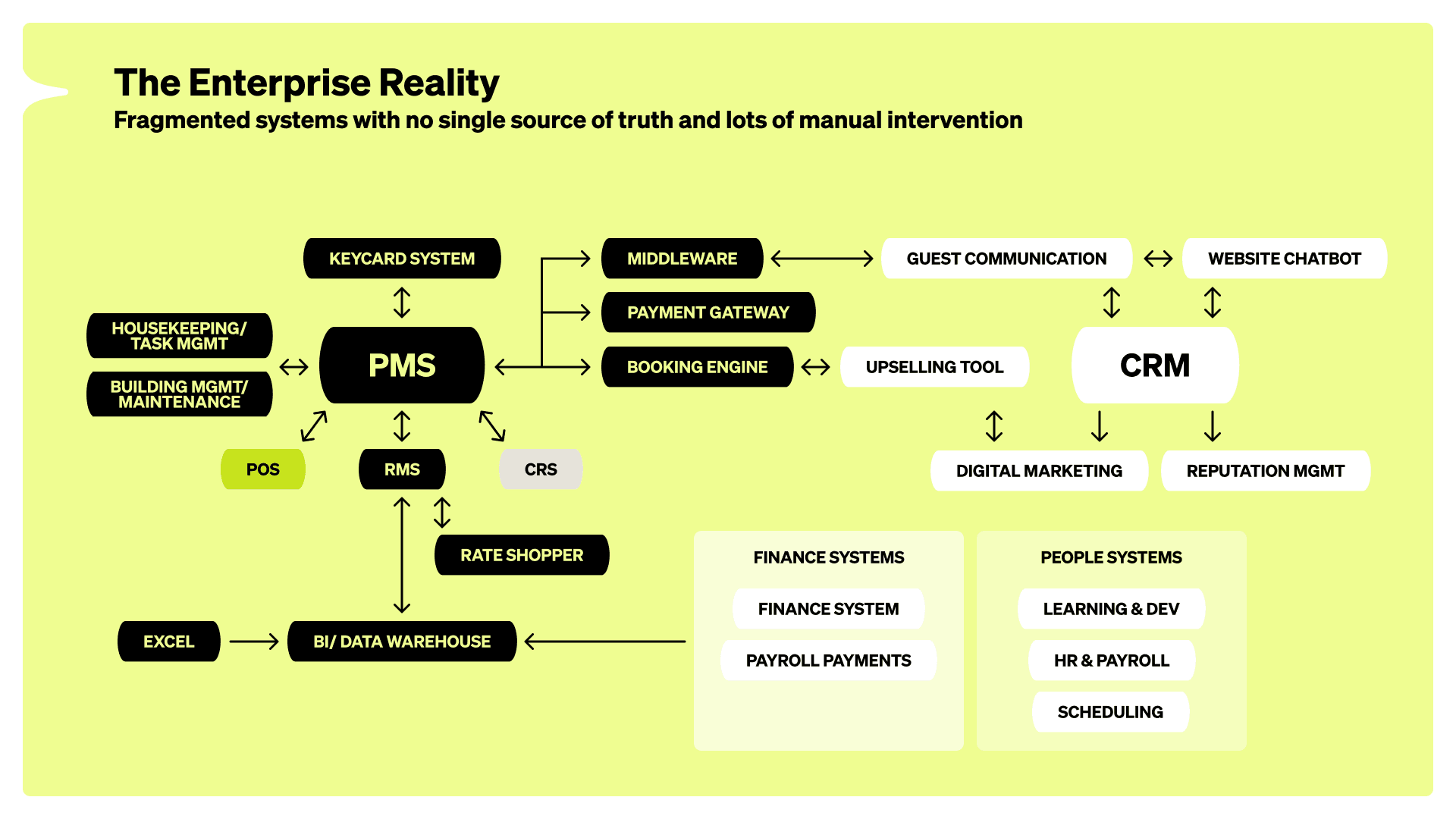
A typical hotel, even a well-run one, operates across a sprawling ecosystem of disconnected systems. Property management, revenue management, point of sale, housekeeping, guest communications, payments, keycard access, CRM, reputation management, business intelligence, finance, HR, scheduling. Each lives in its own world, connected by middleware, manual workarounds, and more often than anyone likes to admit, spreadsheets.
There is no single source of truth. There is a lot of manual intervention.
This is the reality that any AI system has to contend with. And it's where most approaches fall short. A chatbot can answer a question if you point it at the right database. But an agent, one that can actually do something useful, needs to reason across all of these systems simultaneously. It needs to understand that a maintenance delay on the fourth floor affects housekeeping schedules, which affects room availability, which affects whether you can honor a VIP's early check-in request, which affects revenue.
The barrier isn't technical access to APIs. The barrier is meaning. Without a shared understanding of what a "reservation" or a "rate" or a "room status" actually means across all of these systems, every AI deployment becomes a bespoke integration project. Every hotel we talk to, regardless of size or segment, runs into the same problem: the systems have the data, but no system has the full picture. The agents can reason, but the enterprise context they need is trapped inside fragmented systems with no shared language between them.
The Hospitality World Model: A Unified View of Your Operation
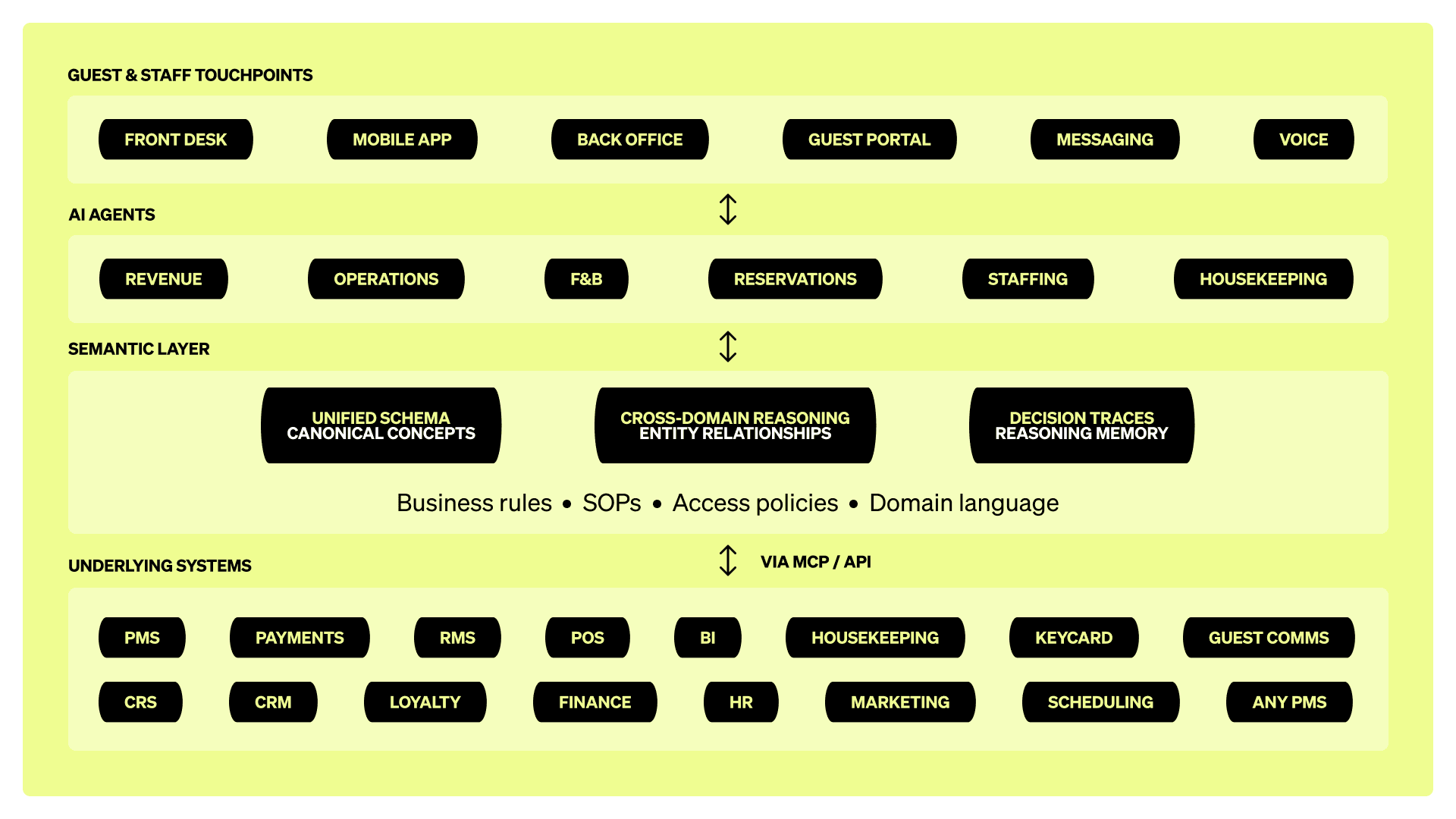
At Mews, we think of agentic hospitality as building toward a world model — a continuously updated, shared understanding of everything relevant to running a hotel: guests, reservations, rooms, rates, tasks, staff, and the live relationships between them. The world model isn't a single system or database. It's what emerges when AI agents, a semantic layer, and the underlying technology stack work together coherently. At any point in time, it holds the full operational picture that no single system currently provides.
The semantic layer is the mechanism that makes this possible. It sits between AI agents and the underlying systems, translating agent intent into system queries and system data into business meaning. Through it, concepts like Guest, Reservation, Room, Rate, Folio, Charge, Payment, Task, and Shift are standardized into a canonical model, so "reservation" means the same thing whether the data comes from a PMS, a central reservation system, or an OTA. Agents speak the language of hospitality, not the language of individual software systems. In the same way that a common language enables collaboration between people, the world model enables collaboration between agents — a shared representation of guests, rooms, rates, and operations that any agent can reason against without needing to understand the systems underneath.
This matters because it enables something that isolated integrations can't: cross-domain reasoning. An agent doesn't query one system in isolation. It traverses the full business context, understanding how a rate change ripples into revenue projections, how a staffing gap affects service levels, how a guest's history across multiple stays should inform tonight's room assignment. And because every connected system maps to the same canonical concepts that agents already understand, connecting a new data source automatically opens new reasoning paths without rewiring existing agents.
The semantic layer also carries each property's unique business rules, standard operating procedures, and access policies. A luxury resort in the Maldives operates differently from a lifestyle hotel in Berlin. These differences are encoded directly into the semantic layer, so AI actions always reflect how each property actually runs — not a one-size-fits-all model imposed from outside. The result is a world model that is both unified across systems and specific to each property.
Crucially, the architecture is PMS-agnostic. It integrates most deeply with the Mews platform, but it's designed to connect with other property management systems and partner ecosystems. This isn't about locking hotels into a single vendor's AI. It's about building an intelligence layer that works across the entire hospitality technology landscape.
Industry standards like the Model Context Protocol (MCP) are making it easier for agents to connect to systems through a common interface. This is important infrastructure, and the semantic layer is designed to work with it. But connectivity alone doesn't solve the core problem. MCP gives an agent a standardized way to call a tool. It doesn't tell the agent what "available" means when the PMS, housekeeping system, and channel manager system each define it differently. The semantic layer sits above the connectivity layer, translating raw tool access into the shared business meaning that makes coherent reasoning possible — and in doing so, keeps the world model current and accurate across every connected system.
What Agentic Hospitality Actually Looks Like
The vision is a constellation of specialized agents, each focused on a core hotel function: revenue, operations, food and beverage, reservations, staffing, housekeeping. All reasoning against the same world model and working in concert.
Here's what that looks like in practice. Some of these agents are already in beta with customers. Others are in active development. All of them reflect real hospitality workflows we've validated with hotel operators.
From Insight to Proactive Execution. Mews Smart Tips already surface relevant guest information so staff can act on it. The next step is moving from insight to action. A Smart Actions agent monitors guest context and operational signals, then proposes concrete next steps. A guest is celebrating a birthday? Instead of simply flagging it, the agent suggests a room upgrade and prompts the team to prepare a welcome amenity. Staff review and execute immediately. Personalization becomes consistent and systematic, not dependent on who happens to be on shift or what they remember.
Intelligent Room Allocation. Managing early check-ins and late check-outs is a real-time optimization challenge that front desk teams navigate under pressure, often with the guest standing right in front of them. The Timeline Assistant agent evaluates room readiness, operational constraints, and guest preferences simultaneously, surfacing primary and alternate options with revenue-aware fallbacks. A guest requests an early check-in for a standard room? The agent identifies that Room 814 is available, matches high-floor and space preferences, and flags downstream risks. The front desk acts in seconds rather than minutes, with confidence rather than guesswork.
Cross-Department Task Routing. A guest messages the front desk: "The AC in room 302 is making a loud noise, and could we also get extra pillows?" Today, a staff member stops what they're doing, reads the message, determines urgency, and manually creates separate tickets for maintenance and housekeeping. The task agent handles the triage, identifying intent and urgency, categorizing each request, and routing the appropriate tasks to the right departments automatically. Critical guest needs are addressed faster. Administrative overhead drops.
Rate Management at Scale. Managing rates across a portfolio of properties is high-stakes work where small mistakes have outsized revenue impact. A rate adjustment that seems reasonable for one property can violate a corporate contract on a connected channel, and the error only becomes visible once it propagates across distribution. The rate management agent serves as a single control point for portfolio-wide rate changes: search, create, and update rates across properties from one interface. Every change is reviewed and approved by a human, ensuring accuracy and control while dramatically reducing manual data entry and the risk of costly pricing errors.
Global Guest Communication. Hospitality is inherently global, yet most operators lack the infrastructure to communicate with guests in their native languages. The average hotel communicates in fewer than two languages, leaving international guests underserved. The translation agent processes content in batch while maintaining brand-specific tone and context. Teams can deliver a localized experience for international guests without the administrative burden that has historically made multilingual communication impractical at scale.
The AI-Orchestrated Guest Journey
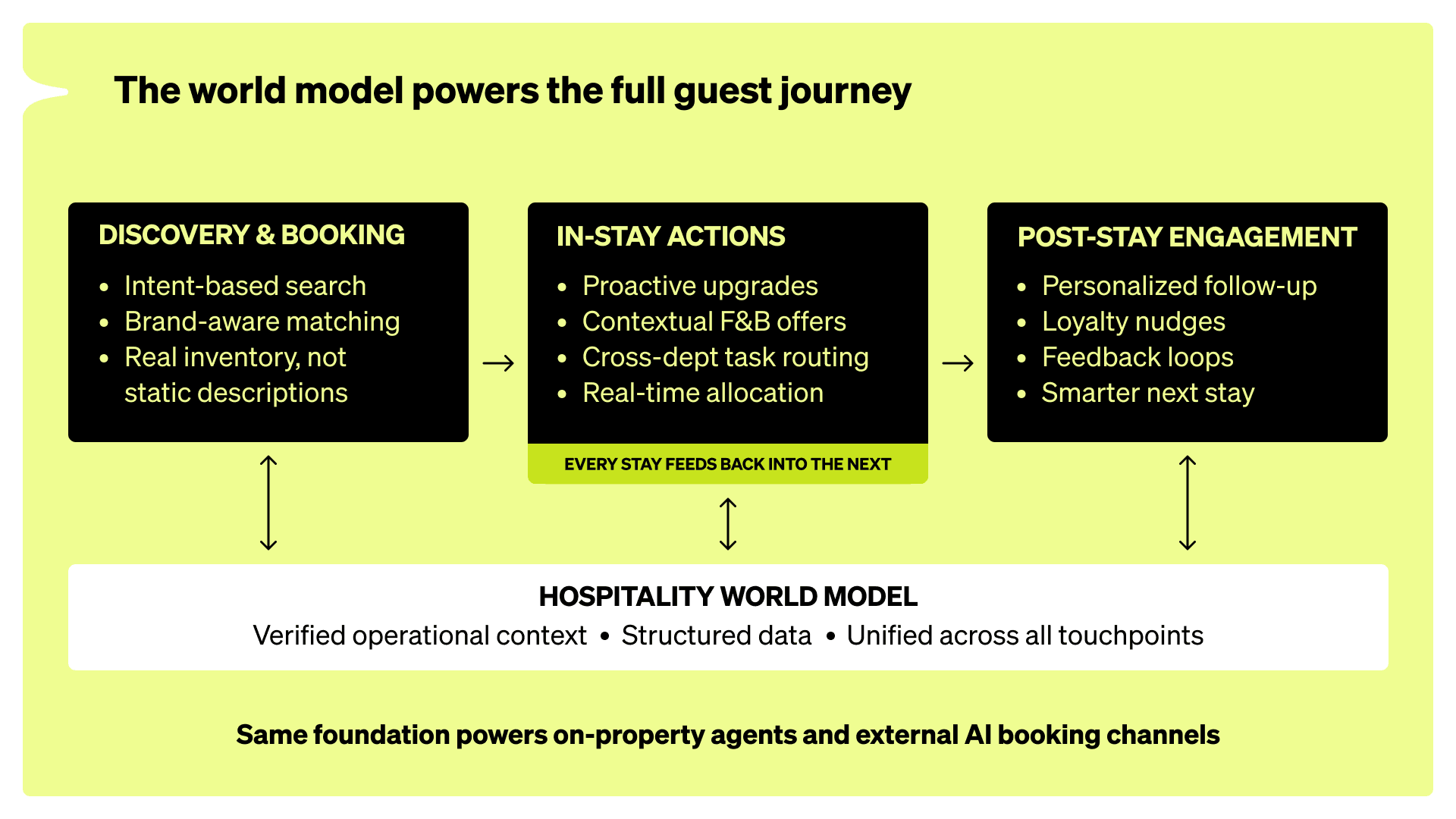
The same world model that agents use to run on-property operations also describes how a hotel presents itself to the outside world. This is where the impact of agentic AI extends well beyond hotel operations and into how guests discover, book, and engage with properties across the entire journey.
Discovery and Booking. The way people search for hotels is changing. Instead of filtering by star rating and amenity checkboxes, guests increasingly describe what they want in natural language: "somewhere quiet and restorative near the coast" or "a celebratory, social atmosphere for a group trip." Today, an AI travel assistant handling that request is working with whatever it can pull from distribution feeds: room types, star ratings, amenity lists. It has no way to know that a particular property just renovated its spa wing, that the ocean-facing rooms on the fourth floor are the quietest, or that the evening turndown service includes a curated aromatherapy selection. That context exists inside the hotel's systems, but it's not accessible in a form an external agent can reason against.
Through the semantic layer, the world model makes this context accessible to any authorized agent — whether that agent lives inside the hotel's own app, on a partner booking channel, or inside an emerging AI travel assistant. Not just what rooms are available, but what makes them distinctive, what services are active, and what the property actually delivers. The same unified logic governs availability, offers, and policies across all of these touchpoints. As AI-assisted booking grows, this becomes a competitive advantage: hotels with richer, more structured operational data will be more discoverable, more accurately represented, and more frequently recommended.
In-Stay Actions. Agents act beyond the reservation, surfacing contextual, timely opportunities for upgrades, late checkout, F&B recommendations, and ancillary offers. These aren't generic upsells. They're grounded in what the system knows about the guest's preferences, current stay context, and property availability.
Post-Stay Engagement. Every interaction feeds back into the system. Loyalty nudges, feedback loops, and personalized re-engagement become smarter with each stay, building a compounding relationship between guest and property.
The world model isn't just an operations tool. It's the foundation for how hotels operate internally and how they're discovered externally. In Part 2, we turn to the question that matters most for any operator considering agentic AI: how do you make it safe, trustworthy, and ready for high-stakes hospitality operations?