
The Oracle's loophole
Around 547 BCE, Croesus, the famously rich king of Lydia, was considering war against the rising power of Persia. He sent envoys to the Oracle at Delphi with lavish gifts, asking for guidance. The Pythia (Greek priestess who delivered prophecies) gave him a single sentence: if he crossed the river Halys and made war on Persia, he would destroy a great empire.
Reassured, Croesus crossed the river and waged war. He was defeated, captured, and his kingdom dissolved into Cyrus's growing realm. A great empire was indeed destroyed, exactly as foretold. The Oracle hadn't lied. She'd simply omitted a small but rather important detail: whose empire.
Twenty-five centuries later, we're still building systems that confidently answer the wrong question. A lot of the AI being sold to hotels today works exactly the same way. Technically correct. Completely blind to what you actually meant.
The semantics of communication
Semantics sounds like a word for linguists, but I'd argue that it's the cornerstone for a successful hotel business. Every time your front desk and your revenue team have argued about what counts as a "walk-in", that's a semantics problem. When a guest books an "ocean view" room and then complains that it wasn't what they expected, that's a semantics issue. A "VIP" flag means three different things in three different departments. The word “semantics” sounds technical but the thing itself is the most ordinary part of running a hotel with other people.
In communication, meaning is more important than structure. Even in real life, we can all understand the language you would use in a text message even though it's not essentially “correct grammar”. What holds up the communication is semantics, which cares about whether both parties agree on a shared meaning. The Oracle's response was grammatically correct, but she never agreed with Croesus on what truly mattered, a shared understanding.
What is a semantic layer?
Imagine if Croesus and the Pythia each had access to a magic tablet. The tablet would surface words being spoken and provide helpful explanations and additional context around key words. History might have unfolded very differently.
A Semantic layer is a manifestation of this magic tablet. It contains the meanings and definitions that give words a shared conceptual understanding. Any system that has to interpret information the way humans do needs one of these underneath it. Semantic Layers have been around for a long time in the data analytics domain and have gained exponential popularity in the age of AI due to the importance of providing accurate and timely context to AI agents. Context is king when it comes to AI applications and if you feed in garbage context, expect garbage outputs. Let's look at how semantic layers have evolved in this space.
A tale of two semantic layers
If you have chatted with a colleague or a friend who works in BI or data analytics, chances are that you have heard them talk about a semantic layer. Semantic layers initially rose to popularity in BI applications to standardize business KPIs. So terms like REVPAR and ADR would be calculated the same way across different departments as long as they used the same semantic layer. The semantic layer in BI sits under dashboards and reports. It allows users to ask questions in plain English and get a consistent answer back by acting as the magic book of context. Without it, every department ends up with its own slightly different version of "revenue this month", and the meeting where everyone compares numbers turns into an argument about whose spreadsheet is right. This is the world of Business Intelligence(BI).
Now let's zoom out for a second. What the BI semantic layer is doing is modeling how a specific set of concepts (the metrics) should be understood. That's one slice of a broader idea. The general version is what we'll call an ‘AI semantic layer’. It models your hotel itself and how it runs, broadly enough that whatever's plugged into it (a dashboard, an AI agent, a product nobody has built yet) is working from the same picture and coordinating with everything else attached to it.
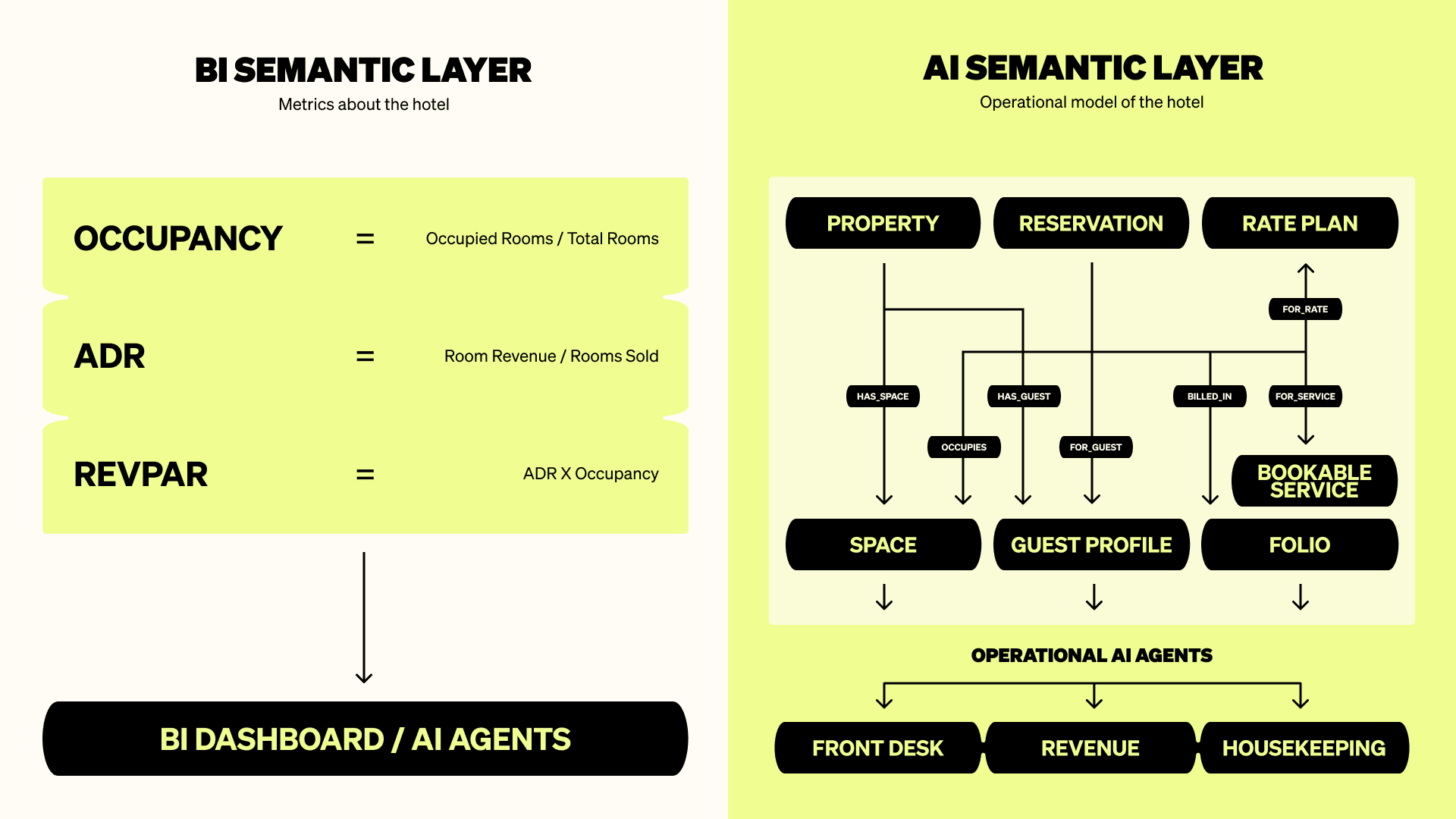
The AI semantic layer encodes your hotel's operational reality: the reservations, the guests, the spaces, the SOPs and how they all relate to each other. The BI layer needs to know what "occupancy" means as a number. An AI semantic layer needs to know what a reservation actually is, what state it's in, who it belongs to, how it connects to a space and a rate and a payment. It's a model of the hotel itself, not just the metrics you read off the hotel.
The BI semantic layer therefore is a special case of the broader AI semantic layer, focused tightly on metrics.
These two layers are built to meet. The BI side answers historical questions: what did revenue look like last quarter, how did ADR move year over year. The AI side answers operational ones happening right now: can we honor a late checkout for room 412? Is housekeeping done with the suite the next arrival is booked into? Does this group inquiry fit the rules we've set for corporate blocks? A front desk agent confirming the late checkout and a housekeeping agent planning the next turnover both need to mean the same thing by "checkout time" and "room status," or one of them is going to be wrong. There's one hotel underneath, and ideally one shared understanding of the operations in it.
The piecemeal AI trap
Let's say a hotel decides to dip their toes in the AI race by starting small. They roll out two separate agents, a sales agent for driving room sales and a separate agent for revenue. Seems reasonable, they each handle their own domain.
The revenue agent looks at next Tuesday and sees strong demand: healthy pickup, a busy market, every signal pointing up. So it recommends a strong rate. The sales agent reads it, and quotes it to a corporate caller. The booking gets confirmed. Two hours later, someone realizes Tuesday already had a group hold on most of the inventory, and the room the caller was just promised was effectively already gone. Neither agent did anything wrong. The rate passed from one to the other through the rate table, but the group hold sat outside what either of them could see.
Each agent was right on its own terms. The revenue agent saw genuine demand, and a high rate was the correct call for what it could see. The sales agent had a published rate it was allowed to quote and a caller who wanted the room, with nothing in its view saying no. What neither of them had was a shared notion of "availability". The demand the revenue agent priced against and the inventory the sales agent sold from were never reconciled into one holistic picture of that Tuesday. That's the Oracle and Croesus story all over again.
This is what siloed AI looks like in practice. Adding isolated agents one at a time feels like progress. But in reality you're just stacking up more confident voices, each one right in its own little world, with no shared picture of the hotel between them. What's missing is collaboration, without which any system of AI agents is doomed to fail. Collaboration between AI agents needs the same things collaboration between humans needs: A shared vocabulary, so "reservation" and "guest" and "available" mean the same thing in revenue, operations and finance. And the right context handed over at the right time, so no agent has to be briefed on the entire hotel before answering one question. That's what a semantic layer is. A shared vocabulary for your hotel, and a way to hand the right context to the right agent at the right time. This is what Mews has set out to do. Our approach to establishing a robust AI agent ecosystem for hospitality is predicated on setting up a foundational semantic layer, which we call the Mews Semantic Layer(MSL).
What this means for your hotel
Once your AI is built on a semantic layer, a lot of things change for the better.
For one, your AI tools stop contradicting each other. When the revenue agent learns there's a group hold for next Tuesday, the sales agent already knows. When the sales agent commits to a rate, the channel manager respects it. The disagreements that produced the rate-mismatch story above just don't happen, because there's nothing left to disagree about.
Secondly, adding new AI capabilities also stops being a from-scratch exercise. The next agent you add (housekeeping, F&B, groups, whatever comes next) inherits everything the existing agents already know about your property. You teach the AI once, not once per tool.
With a semantic layer in place you stay in control of how your hotel actually runs. Since the semantic layer is where your policies and exceptions live, the way you handle late check-ins or no-shows or overbookings doesn't have to be buried in a vendor's prompt or scattered across configurations you can't access. It lives in one place that you actually control. It also becomes immensely easier to manage changes. For example, think about a planned update to hotel policies or hotel branding. This can be changed in the semantic layer once and the knowledge flows instantly to all agents.
Without it, you just keep buying point solutions that eventually age into a tangled mess.
So, whose empire is it anyway?
The Oracle didn't lie. She just didn't agree with Croesus on whose empire would fall. Most AI being pitched into hospitality right now does something similar. The sentences sound confident and they're technically accurate, but there's a disagreement underneath that nobody bothered to surface. A great empire will be destroyed, and it might be yours if you miss this detail.
The Mews Semantic Layer is your answer. It's the AI semantic layer for hospitality, the first one built specifically for this industry. The idea behind it is simple. Your agents should finally speak the same language your hotel does. And next time the Oracle answers, you should know whose empire she's talking about.