What to expect?
[00:00:01] Pat: We're the guardians of our customers' investment. But as leaders, we're the guardians of our employees' careers, and you have to look at it like that. It's a responsibility. It's a privilege. It's something that we chose to do. And if you're not treating it that way, then you're not doing it right.
[00:00:18] Naomi: Welcome to the Future is Human. I'm Naomi Tricke. And in this podcast, I talk with leaders from tech and hospitality businesses about how both they and their people are navigating the edge between humans and technology in an increasingly automated environment. We break out of the mould of a standard business conversation to hear more informal perspectives and reflections to understand what people are really feeling about the future of work.
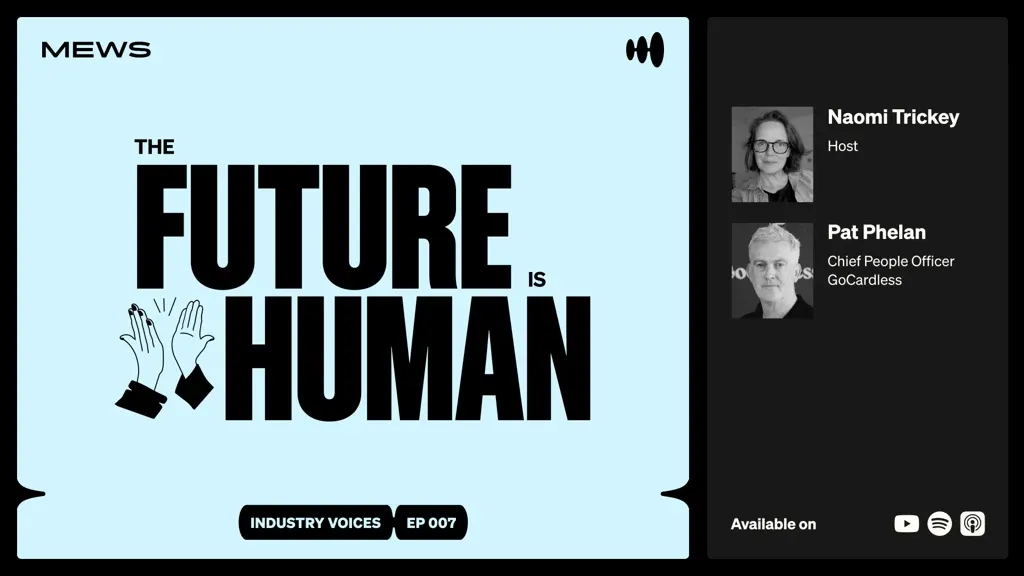
[00:00:47] Naomi: Welcome to The Future is Human. Today, we're joined by Pat Phelan, Chief Revenue Officer at GoCardless, a global payments platform which is trusted by over 100,000 businesses worldwide. Wow, that is a milestone. Now, full disclaimer, Pat and I worked together a few years ago, so I really do know that Pat is a deeply human leader. And you've always been really focused on the development of your people, first and foremost, I think, alongside the customer, obviously. But you've got decades of experience, am I allowed to say that? Does that make you feel ancient?
[00:01:20] Pat: No. I've accepted that a long time ago. I've accepted that a long time ago, but, yes, decades. At least two. Yeah.
[00:01:26] Naomi: Yeah. Yeah. That's scary, isn't it? So, Pat's got decades of experience building, operating, and scaling global teams across Europe, the U.S and the APAC, actually. And you've led cross-functional teams, not just customer success teams, especially now when you're covering the whole revenue piece, I think, and cross-regional customer organisations. And you've always been, I think, about driving growth. That's always been sort of central, but keeping people, empathy and creativity, and I think development at the centre of performance. So, what we're gonna talk about today is we're gonna explore how global leaders can scale teams and technology without sacrificing the human side of work. But, also, I'm very interested in your thoughts on the relationship between the customer journey and the employee journey. And maybe we'll get to hear how on earth you ended up selling Irish carpets in Dubai.
[00:02:19] Pat: That's always an interesting one. Funny, everyone goes back to that. I need to change my bio a little bit because it's definitely quite distracting.
[00:02:26] Naomi: Well, feel free not to talk about it.
[00:02:29] Pat: Oh, I'm happy to talk about it. It's a hell of an experience. It shaped a lot, that's for sure.
[00:02:33] Naomi: So, we're thrilled to have you on the show, Pat. Thanks so much for your time.
[00:02:36] Pat: Yeah. Thanks for having me, Naomi. Good to see you again.
[00:02:38] Naomi: So, I'll kick off. As I've said, you've worked across lots of regions, lots of teams throughout your career. Maybe let's start by if you could share one moment that shaped your leadership philosophy the most. Was it the carpets?
[00:02:53] Pat: No. It wasn't. That just proved I had a lot of determination and grit and a flexibility to not necessarily need a structure in order to achieve what I wanted to achieve. That was the joys of youth. Sometimes you're better off not knowing half the things you know now in terms of what good looks like. But that's a good question, and it's difficult to pinpoint a specific moment. I think the way I think about how I lead and the principles, I guess, that I apply to it is more about knowing how I felt at particular points in time. And in many of those instances, it wasn't necessarily an instance. It was a progression. It was a series of things or a series or a period of time. And, like, early on in my career, I was kind of very fortunate to land with what I would classify as a strong leader very early doors. He's a guy that definitely took me under his wing. And when I first came to London, and whilst I wouldn't have said he was, I mean, I've said it to his face before. It wasn't that he was deliberate in terms of his leadership. He was just a very reflective, very empathetic guy who just sort of knew what to do, if that makes sense, as opposed to it being super deliberate. And really, from that point afterwards, I then really started to experience what I would define as not very good leadership, because the bar was set reasonably well for me early on. And most of my leadership philosophy genuinely is more focused on the things that I felt at particular points in time in my early career that just didn't feel right. They felt like missed opportunities. They felt like things that would be very logical to me, that just didn't seem to be logical to anybody else. And really tried to just always apply the opposite, if that makes sense. And the playbook I would say that I have is probably more born out of the things that I would say to myself, like, if I ever have that, if I'm ever in that scenario, I will never do that. So, how do you remember these things? How do you sort of commit them, like, literally on a piece of paper or in your mind? And that's what drives me enormously, because I have experienced what it feels like to come into an office and have that sense of just pain in your stomach because you just don't want to be here. And it's not because you don't like the work or you don't like the purpose, but it's because of individuals or because of environments and things like that. And, like, that's what drives me, because I know what that feels like. And it's awful. And I also know what the opposite feels like. And it's awesome. And I think that's ultimately how I think about leadership, because I am in the position now that I can create either one of those environments and those experiences. And I need to choose every day, which one do I want? Because as soon as I stop thinking about that, then things start to fall apart. And that's the connective tissue, I guess, between my earlier experiences and really how I think about it on a daily basis.
[00:05:44] Naomi: I love that. So, there's a real intentionality to how you show up at work every single day as a leader, and it's not about coasting through leadership. It's very deliberate. I love that. And I think you always talk, and always have done in my experience, you use your own development and your own sort of career pathway as a way of sharing insight with others. So, you just did that in the answer you gave me. Why has the development of people always been so sort of critical to your approach in building teams? Why is that such a key component of what a leader does every day?
[00:06:21] Pat: Because it's a privilege. Like, and I don't mean that as a truism. I mean that to my core. I get goosebumps even saying it now. Like, it is an utter privilege to play a part in somebody's career. And if you treat that as a sort of thing that you're supposed to deal with, then you're just missing such an enormous opportunity to not only develop yourself, but to develop others. And I think when I think about the intentionality of how I lead, there are certain things that, on a daily basis, I will reflect on. And that is one of them. Like, do I feel that the people under my watch are in an environment where they can look back on and say, that was not transformational is a strong word, and sometimes it is, but most of the time I'd settle for an impactful period of my career. And I'm really glad I did it. And it caught me where I am today. And I think if you can actually play a small part in that, and a lot of it is born now as you go into different roles and you move further away from the baseline of the teams, you have to make sure that your leaders are doing that, and they feel the same way about that. And that's been an interesting kind of evolution for me, kind of stepping to one side a little bit in terms of the execution of it. And really coaching leaders to lead in the way you want to, whilst also recognising that people are different and not everybody operates the way I do. But that's why it's so important.
[00:07:45] Naomi: That's what I always wanna know. Just do it.
[00:07:47] Pat: Yeah. It is. And I guess the intentionality, the development side of it, is I see development just in so many different ways. I start from the baseline of the people themselves. It's a contract that I have with my teams that they come here for certain things, and it's my job to give them certain things and expect certain things of them. And that contract needs to be upheld like any other contract. And I feel very passionate about that. The development of individuals also varies enormously. Some of them see it as very formal, I want to be, you know, PRINCE2 qualified. I want to do this qualification technically. Others see it as a journey. And it's just marrying development in a way that kind of, as much as possible, ticks the boxes for most people. And usually it's a combination of multiple things. And that's where you gotta spend your time, and that's where it has to be explicit both on a personal level and on a strategic level. Like it's a pillar of our strategy. It's very clearly outlined. I don't try to do everything. But I try to hold myself to account every quarter to say this is what we delivered, this is what we're doing. And, yeah, just the intentionality, I think, shines through with people that even if you don't get it right, they believe that you are thinking about them when they're not in the room, kind of thing, you know, which is something I try and do as much as I can.
[00:08:56] Naomi: Yeah. And that's interesting that you were talking about that sort of accountability, and also that point about delegation, actually, because you also, I think, sit on a board. And obviously, in your role at GoCardless, I'm sure you have a lot of interaction with the board there. How do you determine the value of development in a very metrics-driven environment, and for people like board members who don't have that on the ground view? Like, how do you do that?
[00:09:26] Pat: I think it's an art and it's a science as well. It's a bit like I always compare it to the other conversations I have a lot in terms of influence. But if you think about, like, top of funnel pipeline generation, you know, the marketing qualified lead versus the outbound lead, like, there's no binary kind of 100% answer to either one. They cross over. They interplay. They interlink. But you fundamentally have to believe that both play a purpose. And, yes, the measurement will come, but fundamentally, you have to believe that if you develop people, better things will happen. And kind of that from a principle perspective is where I start because I think no matter what the push is, I have to believe that. Because sometimes people won't believe a metric I put forward, sometimes people will need to see different things, and you can lose sight of the intentional purpose of it. So, from a metrics perspective, as it's evolved here, we look at it through three lenses. Employee engagement is one. So, we measure employee engagement on a regular basis. So, for me, whilst it influences that number, it's not in and of itself a direct correlation to, let's say, development. But employees are engaged when they feel they are learning and earning. And from my perspective, I want to give them both. But most of the time, I'll settle for one, and it's their decision as to whether or not that's the right one for them. But if I can provide the acceleration in one of those areas, I do. So, employee engagement is a large part of that. The second one, from my perspective, is around management and leadership feedback. So, the other aspect of how I think about the leadership side of things is that I always want there to be channels for me to validate that my leaders are actually showing up the right way, too. Because it isn't just solely about the individuals. Right? Part of the contract is that it is a good environment, and that is driven a lot by the leaders that people have. So for me, the leadership quality and the employee engagement overall are two of the metrics that I would look at a lot in terms of do I really feel that development is having an impact? And then the last one is retention. Ultimately, the more you can retain your top performers, the more you feel like you're putting yourself in the best possible position. And there's no doubt about it. Like, development plays a very kind of pivotal part in that. So, as I kind of would articulate it, it is around those three areas, depending on the audience. And I'm fortunate enough at GoCardless, where Hiroki, particularly as a CEO, is very engaged in those metrics as well. And he's very acutely aware of the correlation between performance and engagement, basically. So, the conversations are probably at a level further, maybe than I've had to have in the past. But more and more, you see the results directly correlated with those two metrics more generally.
[00:11:58] Naomi: I love that. And, yeah, it definitely makes a difference, doesn't it? When you've got a CEO who really understands that sort of the relationship between the people and the performance, and what you need to do to get the most out of people. So, you're starting to talk a bit about that relationship between how you think about customers and how you think about people, because your job is customers, and GoCardless, you've really helped to drive massive improvements in profitability and retention and so on. Help me understand how you ensure that technology and automation empower teams rather than dehumanise the customer experience? And how do you sort of balance the use of automation and technology in managing customers?
[00:12:40] Pat: It is difficult because, obviously, that's one of the areas that I get a lot of push on from various parts of the business, including investors and boards, in terms of, like, what role is AI gonna play in how we operate. And 9 times out of 10, it starts with efficiency and scale. The way I genuinely look at it, similar to how I would look at most things, is you start from first principles. And usually, first principle for me is what problem are you solving for. Like, fundamentally, what is the problem that you're solving for? So, efficiency for me is a lagging output of solving for the correct problem. Because if you do that, then you become more efficient. Then the process speeds up. Then all the things that AI is gonna bring to the table will actually kick in. So, I fundamentally believe that it is and will continue to play a huge part in how certainly my org is gonna evolve, but based on that is what problem we're solving for as a first principle. When it comes to, actually, the non-dehumanising aspect of it, like, I can't remember who said it. But again, going back to being intentional about leadership, one of the phrases that I always repeat in my head, again, on a daily basis, is around “People don't remember what you said, but they do remember how you made them feel.” And I think that's always been in terms of the non-dehumanisation of both employees and customers, a real guiding principle for me as well. So, if you think about what we do, there are kind of two lenses. And lens one is that we collect direct debits for merchants from multiple people's accounts in accurate and efficient way. That's the transactional view of what we do. The non-transactional view, which is the way I prefer to look at it, is that we deal with what I would classify as the kind of third most important asset that any individual has outside of their family and their health, their money. Now, when you think about it in that context, you can't help but have a human element to that, because you're dealing with an emotion as much as you are a transaction. And what we see on a regular basis, in every support call that we have when we deal with our merchant customers, we deal with people that care very, very much about this commodity. And it's not enough to be efficient, or it's not enough to be transactional. You have to be empathetic, and you have to be human about how you engage from a customer's perspective because it's not a small thing. And, you know, when I think about the employee experience, it's the same thing. Because your career as an individual is not tangible. Like, it's not something that is ones and zeros. It's a journey that people go on that, yes, you can onboard them faster, you can probably get them smarter quicker, but you're never ever going to be able to replace what it feels like the first time you close a deal, or the first time you get promoted, or the first time the CEO knows your name, or your pick for, you know, these things are they will always be human. And I think from a leadership perspective, it's the separation of those things that is really, really important that one does not replace the other. Which is why I feel that technology plays a huge role in my org. And we'll continue to do that, particularly around AI and what that can bring. But it's got to be underpinned by a journey that is also a very human journey. And that applies to both customers and employees. And I feel very passionate about that because you can overlook that side of it very, very quickly in pursuit of the gain, the promised gain of, like I say, efficiency, profitability. I'm not saying they're not what you should be going for, but it can't be in isolation.
[00:16:02] Naomi: No. I completely agree. And especially because customer relationships and the employee relationship is based on trust. And especially in financial technology, the regulators have something to say about that as well. So, how do you actually maintain that human connection and empathy in a world where transactions are like, you sell this concept, like, they're seamless, they're automated, they're invisible? How do you maintain that sort of human side of things with your people, but also with your customers?
[00:16:31] Pat: Well, for me, it's the purpose. Like, if you can't connect the people in your team and customers to a large degree, as well to the actual purpose of why you're getting engaged in this exercise, it's just very difficult to then not make something very, very transactional. And I think when I think about GoCardless and probably most of the orgs I've ever worked in, one of the things that is always super important is the kind of quality of the interaction that we have with people. And it may not be that there's anything material to talk about. It may not be that it's any different to what it was maybe last week. But it's just still really important to make sure that both customers and employees, from their leaders' point of view, feel very, very confident that when they're not there, somebody is representing, somebody understands every aspect of what they're trying to deliver on. And that ultimately, they might not get it right all the time, but they do care about it in some way, shape, or form. And I think that's kind of something that, for me, is driven top down, and it's something that I've always tried to instil across the business. And then underpinning all of that is the environment of trust. And not just an articulation of it, but a sort of day-to-day execution of it. And that's a really difficult thing to do because that's built up over time. And it comes from consistency in those situations where it's very easy to go down a different route, let's say. I mean, we've all been in positions where we're stressed out, or maybe our temper's a bit short, or things are not going well. Like, if you react wrong as a leader in that scenario, despite telling everyone that the environment is safe to take chances and get things wrong, but your reaction is the opposite of what they see, gone in a heartbeat. So, that goes back to the intentionality of it all, that whilst it's important to drive the culture of people being at the core of what we do. I mean, we use that term a lot, customer at the heart of the business, people buy from people. Like, that is true, and it will continue to be true in my opinion for as long as I'm in this seat. But at the same time, it's the intentionality of building the platform as to what all of that is built on, which is an environment where people feel that they can thrive, they can take opportunities, they can take chances, and that they're encouraged, whilst at the same time having an expectation of we're here to be in business, and we're here to be successful. So, yeah, it's an always-on kind of motion that can be fluid, but it's super important.
[00:18:46] Naomi: I think it is very much your point about following through. And I know you've actually done a lot of training of your own teams over the years on the journey that you take the customer on, but what is central to it is actually continually showing up for the customer and doing what you say you're going to do. And if you can't do it, then explaining that you can't do it and why, and that builds trust, doesn't it? Whereas disappearing or pretending that it's not a problem.
[00:19:13] Pat: It doesn't work. And the same applies to leadership. Like, I would use the exact description that you just gave when I talk to my leaders. Like, there isn't any word I would change differently there. It's the same thing. It is exactly the same thing because lazy leadership is easy. It's super easy. And the easiest thing to do as you kind of evolve that side of your journey is just bury your head in the sand. And just until something explodes, everything's going well. Like, it's super easy to do that. Similar to customers, if they don't escalate, then it's all good, but that's not how it works. So, yeah, I think they're super transferable, and the skill is quite a lasting one. I've had feedback from gosh, it was only maybe, I'd say three months ago, like, a leader I worked with 7 years ago sent me a LinkedIn message just telling me that she literally was in a scenario where she used one of the frameworks that we'd done 7 years ago in a difficult conversation, and it worked. And, like, stuff like that just blows my mind that, wow, like, that was a long time of no interaction. But knowing that those kinds of conversations still matter and linger, and people fall back on them when they need them.
[00:20:15] Naomi: We're both big fans of the crucial conversations, aren't we?
[00:20:18] Pat: Honestly, it's game changer. Like, it's so simple, but yet so so effective. So, that is the commonality of the language, the commonality of expectations. I think that's a super, super important area. And if they see that I'm the one doing it, then it just adds that extra layer of, well, look, if I'm holding my hat and putting my hat in the ring, then clearly, it's something that they need to have trust in, is gonna be something we care about.
[00:20:39] Naomi: Yeah. So, that idea of mutual purpose and a shared mutual purpose, is there anything else that you think we can learn from customer experience and the management of the customer when applied to the internal customer, i.e, the employees?
[00:20:53] Pat: Yeah. Going back to what I said, like, the main one being that the kind of requirement, if you like, to wear someone else's shoes. When you're unclear about what the next thing to do is, like, think about, tell the rest of that story. Tell the rest of the story as to why someone's on the other side of a line, and they are acting the way they are, or they're upset the way they are, or they're asking the questions that they're asking rather than jumping to judgment. Like, think about what would you do if you were in that scenario? And honestly, that's super, super powerful. And it's the same kind of scenario here. When you have people that might be underperforming, let's say, or people who are frustrated about the level that they're at or the lack of progress, rather than sort of jump to a conclusion, as to, I hear it a lot, like people are very entitled, or they come into a room and they want this and they want that and the other. But, like, the question I would ask is, like, “Has anyone told them that this is not necessarily the way to approach this?” Like, have they ever had that experience before? Similar to a customer, why would somebody who clearly just wants to go ahead and do the job be in this position? Like, they wouldn't choose to be in this position. They're clearly there for a reason. So, I think that side of it is really, really important. And then the balance side of it is really important as well, that we all have tendencies to jump to certain conclusions, to have biases, to sort of tell our stories. It's the skill to be able to stop that at the point before it becomes a fact in your mind, and actually reengage on another story. And I find personally, that's the one as a leader of both customer and employees helps me kind of ground myself a little bit, and be a lot more balanced in how I would approach things. And then the third one is, we are, I've used the phrase again many times, we're the guardians of our customers' investment. But as leaders, we're the guardians of our employees' careers. And you have to look at it like that. It's a responsibility. It's a privilege. It's something that we chose to do. And if you're not treating it that way, then you're not doing it right. It's quite simple. So, they'd be the three kinds of areas that I think there's a lot of crossover as far as my experience is concerned.
[00:22:59] Naomi: No. I really like that. And I think, like, there's implicit within what you're saying is an agility, it’s an ability to change. And I think as leaders, we can often lock in on a version of the truth or a version, a set of behaviours. Because based on our experience, decades, and all the rest of it, this is now the truth. And, actually, it may be your truth, but it might not be someone else's truth, right?
[00:23:24] Pat: Yeah. It's so true. There were strong opinions loosely held. I think I love debate, and there will come a time when I probably have to make a decision. And we may not all agree, but you've got to be open to being wrong, or to have a different path, and that doesn't mean that as a leader, either of a customer experience or an employee experience, that it's a sign of weakness or lack of thinking things through. It's quite the opposite. And some of the best decisions I've ever made have not been ones that I've made. If I'm honest, they've been ones where my mind has been changed, or logic has prevailed. And it's the humility to be able to accept that that has to be part of how you operate is tricky. It's tricky when the expectation is that you kind of do have the answers, or you should have the answers, or you should be totally buttoned down.
[00:24:11] Naomi: Yeah. Absolutely. And I think it's interesting when you start looking at not just individuals and the development of individuals and understanding one-on-one what matters, but also when you start looking at teams. And I'm wondering if you could maybe talk about, you're building these individuals to contribute to a team agenda and a set of team objectives, how do you build cohesive, high-performing teams when people are spread across different time zones, backgrounds, and have different communication styles? I know we've talked a bit about the kind of development that you do of your teams, but we've got this other layer now of remoteness, and we've also got AI. So, how do you go about that scaling?
[00:24:50] Pat: Well, I think I would have probably had a different answer pre-COVID than I have post-COVID. I think pre-COVID, the geo spreads was definitely kind of high on the priority list in terms of how you bring it in under consideration. Whereas I think post COVID, the people's ability to be able to form with remote kind of as a norm, I think, has accelerated enormously. So, there's probably a layer of work that I recently have found becomes less of a focus than maybe it would have been historically. But I think for me, and I've done this probably three times over the last 7 years, at GoCardless, especially, and I'd encourage, I mean, anyone who's been part of my process will know it is a process. I genuinely start with tearing it down. Like, whenever I think about how you build teams, you have to break them first if they currently exist. And I mean that in a productive way. Or if it doesn't exist, you have to start at a level, I think that most people miss, which is the individual drive and motive that each one of those members has as it relates to this journey that they're about to go on. What matters to them in terms of what good for them looks like, and then how close or how far away are they from what that good is going to be within that team, and really being very open about that. So, usually, the process would very much be around understanding each other, but at a level that isn't superficial. So, I love for people to be able to tell their story. So, for example, the last team that we built 2 years ago for the UKI group, the first thing we did was a life chart. And it sounds really fluffy, and it sounds like a waste of time, but we literally spent a day where each one of us told our story, the highs and the lows. The highest point in your life, the lowest point in your life, what you learned from it, what you're scared about from it. And as you think forward, like, what are the areas that we as a group need to watch out for you, both good and bad? When you show up poorly, what does it look like? When you show up well, what does it look like? And, like, really encouraging that level of openness. And there's no outcome to it other than you walk away thinking, that's interesting. I know this about that person. So, that's where it starts. And I know kind of in my gut if we've gotten to a level where I need to get to, and if we haven't, we do it again, and we keep doing it until we get there. And you know what, if people are not comfortable, I completely understand that. But even the fact that they say they're not comfortable is important, because then everybody in the room knows that there's something just to be mindful of, and be respectful of with an individual. Doesn't mean it's good or bad, but also allows them to get a good sense of the level of openness and transparency that I mean when I say we are transparent. I'm not talking superficially. I am genuinely talking at an individual level. And then from that, you start to build a shared purpose. And that's something that I'm not prescriptive about. So, the next version of that will be, again, as a team, what is our charter? And I break that down to three very distinct levels. What's our charter for each other as a group? How does that manifest itself externally? And what do we need to be able to support that development on an ongoing basis? So, things like the governance around that. The governance around how we show up, the ability for us to be able to call each other out if we're moving away from what we said the charter would be. So, for example, one of the core elements of our charter in terms of how we show up internally is what stays in the room, stays in the room. And that's not meant to be coercive or secretive. It is like, if we are going to be brutally transparent with each other, there are a couple of things that that means. It means you cannot take things personally if you're on the receiving end. You gotta be ready for that. It means that if you are on the giving end, you have to come at it with data and facts and not opinion. And then the third bit is we have to leave the room with no grudge and a willingness to look at how we resolve this problem. Now, that is so hard to get to. And it took us two years to get to a point where I genuinely felt we were even maybe 80% there. There's still another 20%. There's still times when I know in my heart, we're not really saying what we wanna say here, but I'm not gonna push too much because maybe people are tired and…
[00:29:01] Naomi: A lot of reasons.
[00:29:02] Pat: Yeah. Do you know what I mean? Like, it's not a game-changing issue. But when that happens, and when you come out of a meeting, and it's happened, it's just such a cathartic moment that you think, yeah. I really think we're not leaving anything on the table here.
[00:29:17] Naomi: You're driving the business forward as well in that regard, aren't you?
[00:29:20] Pat: Exactly. Solving problems, talking about the right stuff, not avoiding issues, and growing as a team. And that's where the real power comes from. Because if you have a team where you can achieve that level of transparency, challenge, and care about outcomes, then the kind of KPIs, in theory, take care of themselves. It's not that you need to focus on them. It's the leading indicator. So, that's taken different shapes over the years, but that's the way I kind of operate. And then obviously, as new people come into a team, I start again. I don't just evolve the current team because, in my mind, it's a new team. It is a brand new team, and it's a different dynamic and different people. So, it takes a lot of work, and it's effortful. No doubt about it. And it's hard to maintain because you get lazy and you think, oh, yeah, we've cracked it, and then you just carry on the way you are, but you can't do that. But when it happens, it's very powerful. I love that. That gives me a lot of energy.
[00:30:15] Naomi: Yeah. And I know the people that have worked for you, so I know it works. And it's interesting that you see individuals almost as kind of building blocks to success there. And it also, well, the other thing that sort of sings out from your answer is the level of self-awareness, actually, from you to get there. And so I'm really interested in what you've learned about yourself over the course of this career and how you then go on to apply that to managing people.
[00:30:42] Pat: Yeah. It's one I've grappled with a lot, if I'm honest, because I find it very hard to draw the line between being self-aware and self-critical. Because I would say there's an interplay between the two. Sometimes it can lean more on one side than the other, but I think I will always default back to what I said at the beginning, is how would I want to feel if I work for me? Like, what do I want people to say in 10-years-time when they're having a drink in a pub, and my name comes up? Like, the worst thing they could say is, yeah, really nice guy, liked him. That to me is the worst thing that anybody could say who's ever been in a team of mine. And I know I'm very clear in my mind. What I want them to say is that it was a really challenging period. I learned a ton. I got things right. I got things wrong. But I took a lot away from it. And there's things that I'm gonna take away if I'm lucky from maybe the way I led that people might incorporate into their MO as well. And I think when you frame it with that, then that's kind of my reflection on how I engage and how I deal with people. And then the other aspect to it is, honestly, like, I know what I'm not good at. That's the wrong way to put it. I know either where I don't get energy from or where I'm not the best person for, if that makes sense. And I'm never ever shy of hiding it. I will be very open and honest with people. And my team now, genuinely, they know me so well in terms of they can tell when I'm switching off in a one-to-one. And they're empowered to say it, Pat, like, I had it a couple of weeks ago. And I could tell they're just checking that I'm engaged, and I'm awake, and I'm listening. And if they're not, then they'll say it. And I think that helps enormously because not only then is it my responsibility to be self-aware, it's also a shared responsibility amongst my team that says, the things that I'm missing, you folks have to call it out. And they know that it's a safe environment to do that. I have very little ego. I don't take things personally. And candidly, I'm always very open about the fact that I have a lot of gaps, but I'm not always aware of the gaps that I have. And it's just really important that people keep me honest. And it's not rocket science. It really isn't. But it does come with an element of ability to live by what you're saying. And there have been times where my first reaction to feedback or the level of directness that has come my way because of what I fostered hasn't, the first reaction in my mind is like, oh, but then that's the bit that I think I'm very strong at, is holding that back now and being very aware that if I react poorly here, this is not walking the talk. So, yeah, and I think people appreciate that.
[00:33:14] Naomi: They do. And I would say you get to a point in your career where your utterances become, they land with people, and so you can't give a casual utterance after a certain stage because people are listening deeply and carefully to everything that you say. And so that it becomes with a degree of responsibility, doesn't it, to be mindful?
[00:33:35] Pat: Very much so. And that's the keyword. It's not being polished or being corporate. It's being mindful. And it's not that you're not being yourself. It's you being the best version of yourself. Like, that's the way I would look at this, and that's the thing that I've learned so much from the people that I've worked with. And the more aggressive and the more punchy I get in terms of the type of org I want to have, in other words, like brutal transparency, we leave nothing on the table, the more that holds me to account in terms of how I receive that and how I react to that. Because it's not that it's mediocre or a little bit aggressive here or safe just at this bit, but not this bit, it's across the board. So, that comes with puts, and it comes with takes, you know. And I've really enjoyed that over the years, especially here. We've evolved a couple of really good teams, and we've been on some incredible journeys, tough ones sometimes. But the core of it's always been based around those as principles.
[00:34:32] Naomi: And so what comes from self-awareness is that, or maybe what comes from it or what contributes to it is vulnerability. And I can hear vulnerability in your answer. And maybe this is a disingenuous question because you've already answered it. But what role do you think vulnerability plays in leadership, especially when you're used to operating in high-pressure data-driven environments? Does vulnerability play a role?
[00:34:56] Pat: Massively. For me, it's never been a learned behaviour. It's been kind of just at my core. Like, I've never seen it as a thing. It's just the way I've always been. What has been difficult as you go through different iterations of your career is not seeing that as a weakness, and holding true to the fact that it is something you bring to the table that is a positive, even though you might be the only person in a room who's comfortable with it, or there's lots of people who are good at things that maybe you're not, or that's not viewed as a skill, or dah dah dah. And I've kind of worked on myself quite frankly, quite a lot over the last two or three years to sort of be more deliberate about some of these things. That vulnerability for me is a core of how I lead. It is just a fundamental core. It's not something I need to be taught or trained on. And I know how it shows up, but it's not deliberately showing up. It's just part of who I am. And then I marry that very much with being acutely aware of the fact that how people feel, both from an employee and a customer perspective, is a huge add-on to that. Like the combination of those things, if you think about that on a regular basis and that drives a lot of your interactions, usually that's what just brings people on a journey with you. And I said it, when we work together, like, I've said it multiple times there as well, that you can make a lot of mistakes in your career but still have followership by being vulnerable and by being very open. It affords you flexibility that is invaluable. Because again, people value that far more than being right all the time. And I did when I was, early stage in my career, but I just didn't see a lot of it. So, that's another example of the opposite, I suppose.
[00:36:33] Naomi: Yeah. I think people will afford you a generosity, won't they? It's a kind that, if you extend it to them and if you express vulnerability, then people are more likely to return that.
[00:36:44] Pat: They are. And as a senior leader, you have seen it as well multiple times, the impact that being openly vulnerable about certain things has on people who have such different expectations of a title with a C in front of it. I love watching people's reactions when I tell them about the time that I screwed this up, or I screwed that up. Or I can tell like the path you're gonna go on, and here are the mistakes I made. And it's just especially like when people come into an org, and all they know of you is an ex-co. I forget like that, that's what people see. I just forget it. And it's quite funny and, you know, it gives me, again, a lot of energy to watch the, wow, you can see, like, the people are reacting in a very different way when you show them that side of you.
[00:37:25] Naomi: Yes. You are human after all, Pam.
[00:37:27] Pat: Yeah. Exactly. It's really interesting. It is fascinating to see the connectivity that it gives people to show them that's normal and it's okay. And, yeah, it's just a different level of relationship, I suppose.
[00:37:38] Naomi: So, we're getting into this sort of more quick-fire questions as we get to the end. And I'd love to know, based on that, actually, what's one human aspect of your work you would not automate in the customer journey? Like, what would you not automate despite the increasing and overwhelming tide of automation?
[00:37:58] Pat: The number one thing that I would never automate is the relationship aspect of the customer-supplier element of that journey. Going back to what I said earlier, in terms of, you can make a process more efficient, you can make it more accurate, you can scale it, and you can measure it as much as you want. But unless you really do understand the purpose and the reason why this person, either has joined a company or is buying from you, and you anchor everything you do from that, it's very difficult. You can automate it in the context of it. It could be a form that you get somebody to fill out, but it will never ever have the same impact as an actual conversation where you're asking the right questions, and you dig in deeper than maybe the primary objective. That's critical to me. That first interaction and understanding just will never change.
[00:38:43] Naomi: Yeah. The whites of the eyes. So, what's one universal truth about people at work?
[00:38:49] Pat: That they care less about the content of what you say, and they care very deeply about why you're saying it. I think that as a leader, it's just a cardinal rule to live by. That will never change. And some people will show it more than others. Some people will be impacted by it more than others. But why you say something or engage with somebody is always, from my experience, the first thing that's either questioned or understood, and everything flows from that.
[00:39:20] Naomi: God, there's so much in that about assuming good intent and behaviour and why we measure behaviour and things like that.
[00:39:27] Pat: That's exactly what I mean. Yep. But I don't think it'll ever change with people, myself included.
[00:39:31] Naomi: Yeah. I love that. If you could introduce a new sort of seemingly impossible culture into every workplace, what would it look like?
[00:39:38] Pat: Again, a very good question. I think it would be a very diverse, disparate group of thinkers who are very, very clear and engaged on the purpose of the collective and are obsessive in pursuit of getting there through ruthless transparency, openness, and trust in each other. And I say that very deliberately because the bias towards people like me when it comes to building teams is very strong, right? We all have that bias because to have people who are not like us, it's hard to manage high performers, it's hard to manage people with different opinions, it's hard to have those conversations five times a day, but if it's coupled with everything else, having that diversity of thinking and individuals, magic happens. And I think hard things are hard for a reason, but if you get that right, that's where I think things really take off. And they're the elements that would be a magical sort of collective of variables that happen at the same time that I think would be ideal for me.
[00:40:40] Naomi: Okay. I'm aware of time, so I'm gonna ask you the last question. If you could give one piece of advice to future leaders about scaling organisations without losing their soul, what would it be?
[00:40:53] Pat: Don't ever underestimate or deprioritise the impact that you as an individual can have on all aspects of your team by how you show up and how you communicate the purpose of this group. That to me is really core. So, you can't control every aspect of your organisation, but you can control the endpoint and the end purpose. That's so critical. And that people connect with it, understand it, and everything you do filters down from that. And then in parallel to that, the connectivity that you have to your teams on an ad hoc or non-day-to-day operational basis has a huge impact that goes way beyond anything you'll ever understand once you've had that interaction, but it lands. And that's the thing I think, as people move up and up and up in their careers, you kind of forget because you go farther and farther away from kinda what made you good in the first place. But those kinds of aspects are really, really important. So, I think those two things from a connectivity perspective matter a lot to me. And you'll achieve them in different ways, but as long as the endpoint is the same, then usually it'll converge to the right place if you do it the right way.
[00:42:04] Naomi: Fantastic. Thank you so much. Great insights, and I really appreciate your vulnerability and the depth and thoughtfulness of your answers. Actually, I think other people will really benefit from hearing that, because you're absolutely right. We move up in our careers, and we have this huge responsibility to share how to operate with others and develop others. But we also have a responsibility to make sure that we don't lose sight of the sort of human aspect of work and why we're all here.
[00:42:34] Pat: Exactly.
[00:42:35] Naomi: Thank you.
[00:42:36] Pat: Oh, it's a pleasure. Lovely to talk.
[00:42:39] Naomi: The Future is Human is brought to you by Mews, the cloud-based hospitality platform. If you want to learn more about what we do, visit mews.com. And if you'd like to listen to more conversations like this one, find us on Apple Podcasts, Spotify, YouTube, or wherever you listen. Subscribe so you don't miss future episodes. Thanks for listening.