What to expect?
Transcript
[00:00:01] Noemi: Remote working is important because I get really, really sick and anxious when I have to use public transport. And sensory issues, putting on comfy clothes makes me 10 times more productive. And these are such small things that don't need a lot of accommodation, and it makes all the difference.
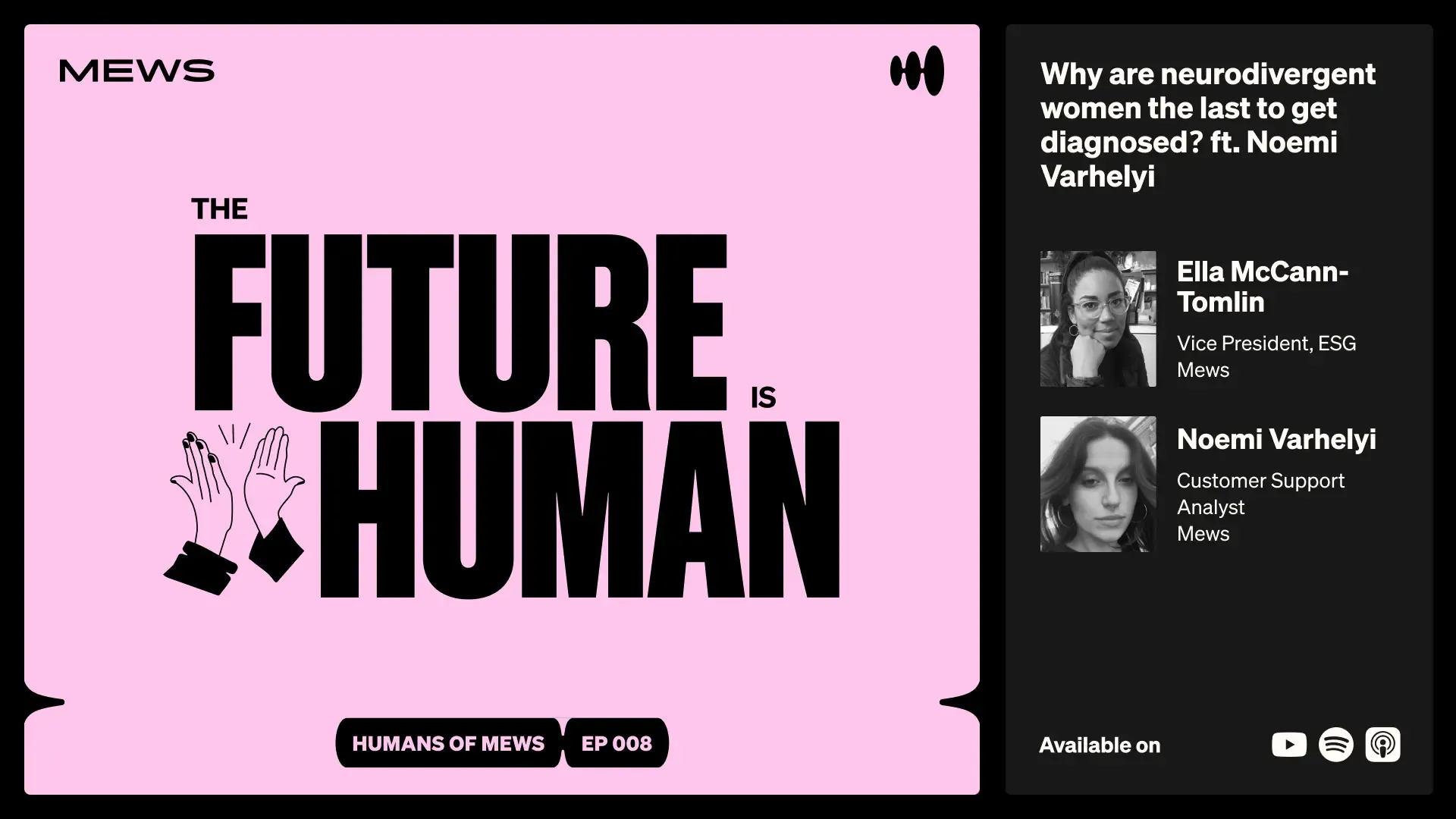
[00:00:26] Ella: Welcome to Humans of Mews, part of the Future is Human podcast. I'm Ella McCann Tomlin, and this is where we surface the human stories that often go untold at work. The turning points, the unconventional past, the things that shape who we are beyond our job titles. These are the intimate conversations with people across Mews about their journeys told on their own terms.
[00:00:49] Ella: Welcome to The Future is Human. Today, we're joined by Noemi Varhelyi, a customer support analyst at Mews and a passionate advocate for neurodiversity in the workplace. So, Noemi's journey with neurodiversity started a bit later in life with a misdiagnosis of bipolar, which is unfortunately pretty common for women. Today, she uses her experience to shape her work, her relationships with colleagues, and her perspective on creating more inclusive human-centred workplaces. Thrilled to have you on the show, Noemi.
[00:01:20] Noemi: Thank you. I'm happy to be here.
[00:01:22] Ella: To sort of dive straight in, you were diagnosed, I believe, last year, February 2024, which means that you'd been at Mews about a year at the time. Can you take me back to what prompted you to seek a diagnosis, and what were you noticing that started that journey for you?
[00:01:41] Noemi: So, I was actually misdiagnosed in 2024, and then I was already in therapy with my psychologist. I've been in therapy for like a decade. So, we talked about that, and she didn't really understand why I got that diagnosis because she didn't see, like, with bipolar, you basically, just to like, dumb it down, you have either a manic or a depressive episode, and they sort of come and go after. It's like a constant roller coaster. And I did have those episodes a little bit, but it wasn't like I sat in the doctor's office for 5 minutes, and the doctor was like, okay, you're so hyperactive. You must be manic. And he gave me a diagnosis. He prescribed me pills, and I left the office. And I was like, what is going on? I know what bipolar is, but I've never thought that I'd have it because I don't think that I have that set of symptoms. And then my therapist, actually, my psychologist, so not the doctor, but the psychologist I've been going to for, like, 5 years. She went to, like, an adult ADHD autism clinic for, like, a weekend course, like a top-up course. And it was just like an introduction. And then we had therapy the next week, and she was like, hey, how about we look into this? How about we dive deeper? And this was 2024, I would say, like, yeah, beginning of 2024, like a month after the misdiagnosis. And it took me, actually, until September to go to that clinic and to write them an email and to call them and to be like, I wanna see if I actually have ADHD or if I'm actually autistic. I don't know what's going on. And it would be helpful if I got the right answers. Let's put it that way. So, that's how it started.
[00:03:32] Ella: Did you feel immediately after you got misdiagnosed, did it feel inherently that that was the wrong diagnosis for you? And what sort of prompted you to wait those 6 months? Was it trepidation about getting misdiagnosed again? What was the sort of hesitation?
[00:03:49] Noemi: When I left the doctor's office, I cried immediately. In the elevator, I was like, no one ever told me this. Like, why? What is going on? And it was my first time at a psychiatrist's office as well, so it was like the double. I was kind of shocked, but I was also in a pretty difficult, my life was pretty difficult at the time, my personal life, like, family-wise, I lost my mom. So, it was like, it was quite difficult, which means that I was grieving and depressed. And when I got the meds, I took the meds, and they just weren't right for me. I was like, something's wrong. I have way too many side effects, and it's not really working, so something must be wrong. And then the reason why I waited 6 months after then having the conversation with my psychologist that this might be something else, enter ADHD and autism. I waited 6 months because I was scared, because I thought, and I think this is really common, but for me, this is really difficult because I was like, what if I'm not autistic? What if I don't have ADHD? What is this? What is, like, I was so scared of them telling me that I don't have that and that I'm actually just neurotypical. Everything's fine with me, and that I'm struggling because of me, and that's why I waited so long, because that was scary.
[00:05:07] Ella: Interesting. And so does that mean that it was actually a relief to get the diagnosis that you got in the end?
[00:05:15] Noemi: It was. I don't want to, I wanna say life-saving because I think if I kept on going like this, because the diagnosis doesn't solve everything, right? But even just, like, having the idea in your head that you might be neurodivergent, for example, I think I would have suffered way more because this going untreated can cause such bad depression. And I developed it's called generalised anxiety disorder, which means you have anxiety everywhere. It's not just social anxiety. It's not just in social settings. It's everywhere. And depression as well. Like, I have a diagnosis for that as well, and those came from my ADHD being untreated for so long. And this really, really helped me personally. I know that this is different for everyone, but it was needed for me, I think.
[00:06:07] Ella: From everything I know and have read on this topic, it seems that there's increasing recognition that ADHD and autism, in particular, have been historically, chronically underdiagnosed in women. Did that factor into your journey and your experience here?
[00:06:42] Noemi: 100%. And that's why I'm researching this at university, like, outside of Mews, in my psychology studies, because there's such little knowledge on women with ADHD or women with autism, and then a third set of completely different symptoms for women with ADHD and autism. Because it's not like the two add up and then you just have both. That is a different set as well. And I'm kind of learning by doing because there's, like, very little research. So, I'm trying to research it for myself and for others as well.
[00:07:25] Ella: Which is interesting in and of itself, right?
[00:07:28] Noemi: Yeah. But I've also read a lot about, and researched a lot about, like, what you also mentioned, like, previous research and experiments that everything was the majority of research included men and not really women. But I feel like this is like for medicine and for psychology; this is pretty standard, and now it's changing. But I've looked into one topic that I wanna research within this, about women and ADHD and how women's hormonal cycle affects it. And I found fifteen (15) articles total on it, which is, I think, crazy. And most of my friends are neurodivergent because I feel like you kind of, you know, surround yourself with the people you understand best and who understand you best. And three of my close friends were like, okay, I got a borderline diagnosis. That's a really common one for a misdiagnosis for women. But I have another one who also got the bipolar, and a third one who has no diagnosis, but she's depressed. And all of them were like, dude, I have the same symptoms as you. This doesn't make any sense. And even at university, in my master's studies, girls from class come up to me, and they're like, hey, because I always really openly talk about this in class, to kind of ask for me and also for other people. And it's working because two girls came up to me and they were like, hey, we have VPD, but do we? Both of them separately were like, I resonate with you so much. Can we, like, have a chat about this? And it's crazy because I'm studying. I'm not a psychologist or a researcher with 30 years of experience, and people still come to me because there's so little. It's not in the curriculum. So, it's crazy.
[00:09:15] Ella: And that's a classic example of one of those things where if something is so under-researched, the lived experience becomes seemingly much more trustworthy for people than necessarily even the opinions of their doctors, which isn't to say anything about whether or not people should get diagnosed and what that journey looks like. But I went to a book launch for a comedian called Fern Brady. She's a Scottish comedian, probably a couple of years ago now. And she was talking about her journey with autism and her schooling and everything, all the way that it presented for her. And one of the things that she said in her journey, I believe, if I'm not mistaken, she did try and get a diagnosis when she was a child and didn't get diagnosed. And one of the things that a doctor told her at one point was, you can't have autism because you've got a boyfriend. You present as a social person or an extroverted person, or you know, there were some wild things she said. There's something about how much she reads. There was all these kinds of weird stereotypes about how it was presenting for her that just meant people dismissed it, and people in clinical settings dismissed it.
[00:10:20] Noemi: Yeah. That totally resonates with me as well, because it's not my therapist. She's amazing, thankfully. But people around me, everyone. Because I'm a very, very high achiever. I'm gonna call myself a workaholic because I'm quite the career woman. I love working. I'm working full-time, studying full-time. I have good grades. I'm doing my third degree. And people are like, you wouldn't be able to do that. How are you gonna be a psychologist? Like, how do you wanna work with people if you're autistic? How do you get good grades if you have ADHD? How is that possible? And then, like, we could sit down and dissect it and go through everything. It's not that easy. I think the most important thing that I want everyone who cares about this, or who reads about this, or who may think that they have something like this, to remember is that this is not an illness. I'm not struggling with autism. I might be struggling because of ADHD sometimes, but this is not an illness. This is not something that has to be healed or can be healed. It's just the society we live in; the structures we live in are not made for our brains. And that's why I might be able to have really good grades. I might be able to do that. But then, when I'm really, really stressed or really busy, I might be able to stay organised. But I might talk so much that people are like, what is going on? It manifests completely differently. It shows differently for everyone. Both ADHD and autism are on a spectrum. And it's just so important. I really want people to understand that we're not different in that sense. The structure we live in is just not the right one for us. Like if I could build my own structure, for example, working from home, not going to an office, I have this option. But if I could use that for everything in life, then I feel way better, and that's not because I'm sick or I'm ill or whatever, because people are telling me, no, you don't have anything. Like, no, you're fine. It's because, to me, it's like this is something I'm really passionate about, because we could thrive if we had the resources from outside.
[00:12:40] Ella: What does that look like? Because in the Mews context, you've mentioned flexibility. You've mentioned working from home. We have that. But what, from your perspective, are the sort of accommodations that would really make a meaningful difference? And what's the line between what you will adapt to as an individual and the things that need to be more systemic, the things that a company or an organisation needs to put in place on a more systemic level?
[00:13:08] Noemi: That is a really good question, and I think it's really difficult to answer that because, again, it is so different. Like, it manifests in such a different way for everyone. But I feel like the most important thing that's already in place is remote working. Like, I could not get anything done in an office. Like, I would just talk to everyone. And that's not because there are distractions. It's because it's fun. I go to the office, I get a coffee, I have a little convo, we work together, we get stuff done, but I would not be as productive as I am at home. And the unlimited holidays that we have is also really good for me because it prevents me from getting, for example, an autistic burnout, which doesn't have to last very long. It could just be one day. But still, if I can like take a day off and just recharge, that's really good. One thing that I do think would be really good is if management, or basically everyone was just aware that this is a thing. And that if you don't know how to approach something or if you don't know how to approach someone about, let's say, now, ADHD, autism, ask, ask, ask. I know a lot of people don't like to talk about their personal life, but you can still ask, in my opinion, if I'm not sure if someone wants to talk about something. I'm just like, hey, I'm really interested in this. I wanna know how I can, like, best accommodate you. Or if something happened, like I saw you look really sad. Like, I've noticed this a few times. I've noticed a pattern, whatever. Do you wanna talk about it? Do you feel comfortable talking about it? Because I'm really interested to know about it, because maybe you will feel better if I were someone's manager, for example. If I, as your manager, knew that once every two months, you might have a day where you burn out or have an autistic burnout, important because it's different than a corporate regular burnout. But just being open and accepting of the person's boundaries, if they don't want to talk about it, but still being proactive. I feel like being proactive is super, super important. I'd love a proactive approach from above because, in my experience, if you feel comfortable with your manager and if you feel comfortable with higher-ups, for me at least, it's easier to talk to my colleagues about this as well. And that's like one thing that I think would be great, just awareness. And, you know, if something feels off or someone's behaving in a different way than you would in a situation, to not judge, to first be like, okay, I've no idea what's going on. I've no idea what that person is going through, what's in their mind. All I can do is assume. And that's kind of a thing that I tell most people whom I communicate with. I'm like, ask. Don't assume. Always ask first. And if I feel comfortable talking about it, I will talk to you. That is, I think, the bottom line to start with.
[00:16:17] Ella: And do you think, from a management perspective, that's about education? Do you think it's just about psychological safety and creating an environment in which someone in your team can talk to you? Because for the listener, Noemi is one of our ERG ambassadors for our Mind ERG. And one of the things that you implemented this year was user manuals for people. So, that's not necessarily a new concept, but the idea that we would have, like, a templated document that says, this is my working style. This is when I work best. This is the best way to communicate with me, all of that kind of stuff. Do you think things like that are part of the solution?
[00:16:57] Noemi: Yes. Definitely. I mean, we implemented it, so I'm convinced that it is a really good approach. I also think what I would love to see is, I think we're unintentionally treated differently, because there is this superpower phrasing that people with ADHD, and autism, and whatever have superpowers and struggles. No. I have strengths and weaknesses like everyone else. What you call a superpower, and I don't mean to, you know, I don't mean to sound bad or anything, but what you or what a person might think is a superpower of mine is actually my high IQ. I'm sorry to put it this bluntly, but it's like, it's a strength that I have. It came with me when I was born. I have a really high IQ, which is kind of not everyone who has a high IQ is autistic. I'm not saying that. But when I got diagnosed and when I went through the process, there was this really, really long IQ test. It was horrible. I mean, it was great, but it was horrible because it lasted, like, 4 hours, and everything was included. And with that being said, I think we could also focus on more from a company perspective that everyone has their strengths and weaknesses, and especially, let's say, people with autism and/or ADHD might have different strengths, and strengths that show in a different way, that are skills that you don't really know how to put in one specific drawer. Like, these are people skills. These are, I don't know, hard skills, soft skills. Like, it manifests very differently. For example, for me, I'm a very creative person. And because I'm very creative, a lot of times people say my superpower is that I'm very creative. It's a trait of mine. I'm happy that I'm creative. I mean, I've been feeding it my whole life. I've always had a lot of hobbies, but it's just me. And I feel like if we, from a company perspective or from a team lead management perspective, kind of focus more on what are everyone's strengths, individually, obviously, we have to focus on KPIs, OKRs, and everything for the business, but also just individually. Let's take me. Noemi has difficulties with talking less. Okay. That's awakeness. I get it. It's okay. But I might seem completely disorganised and very chaotic and very all over the place. But when it comes down to it, I'm the most organised person. My team lead literally told me two weeks ago that she's never met anyone who's as organised as me. Who, me, a person who goes outside without putting shoes on. So, like, I try to emphasise the word different, but put it in a very positive, like, light. And I want us not to, you know, have superpowers, but just to have our strengths. That might be superpowers, but they're really just strengths because we have them because we're cool. So, I think for a lot of people I've talked to, and I read a lot about this on Substack, for example, I read a ton of neuroscientific articles and actually serious articles. And this is such a thing for so many neurospicy people that we're just treated differently. When I'm asked about, like, why do you do this? I've never met anyone who can do this as quickly as you can. That's your superpower because you have ADHD. No. I'm just good at that.
[00:20:39] Ella: Do you get more questions like that now that you have a diagnosis and you have a label for it yourself that people sort of pathologise and make it about that aspect of you, rather than just seeing it as just a part of who you are, or has that been a feature all your life?
[00:20:57] Noemi: It has been a feature, but in a different way. Before my diagnosis, I was just weird and smart. And after my diagnosis, when someone mentioned something, and I'm like, no, actually, I'm autistic. “Oh, okay. Now, it makes sense.” What do you mean? Like, especially if it's a man who's neurotypical and knows not because he doesn't really know how it manifests or what it looks like. And I'm like, okay, it's not like on the TV shows. It's not like, I don't know, The Good Doctor, which I love it, but that's a white male who's a really good doctor and who's like freakishly smart and has Asperger's or is on the spectrum. Let's say it like that. And he's really bad with people. And his superpower, because everyone knows that he's on the spectrum, his superpower is that he's really smart. And then after I got my diagnosis, I have almost perfect pitch, and I play the piano, like I've played it for like 20 years. And after I got my diagnosis, that was also a thing. “Oh, my God. Your superpower is that you can just listen to a song, and then you can play it. But how can you play piano when you have ADHD? How can you focus?” I've gotten that question multiple times, and I always tell the people who ask me these kinds of questions. “Honey, write your question down, read it out loud to yourself, try to answer it, think about it again, and then rephrase it and ask me again.” Because I try to educate people everywhere so that this doesn't happen to other people.
[00:22:25] Ella: But is that also burdensome, having to educate people a lot? Part of the reason we're having this conversation is that you are quite outspoken. You like to talk about this topic in order to sort of spread the word about your experience, and I think that's fantastic. But does that get burdensome to be talking about this topic to educate, in particular, neurotypical people, all the time?
[00:22:47] Noemi: This is a very good question, and I think it's important to talk about it because I want to say, I don't wanna speak on behalf of other people, but I want to say, in my circles at least, I'm quite alone with loving to educate, but it's kind of what I want as a career. I wanna be a spokesperson. I wanna publish. I wanna research this. I want to be on a podcast and talk about, like, this is what I want to do. I want this to be my whole life's work. But the minute someone doesn't study psychology and doesn't want to write a book about this and whatever, it might get burdensome. I don't really experience that myself when it comes to educating multiple people or a group of people or anyone, but I do see how it can be difficult. What for me is kind of exhausting is when I kind of have to educate someone when they assume, like, something. For example, what I just said, like, “You cannot have ADHD because you're a straight-A student.” And then I'm like, “Okay, I'm gonna explain to you what this actually looks like.” I do it, but when it happens multiple times and when it comes from the same person multiple times, I've had to kind of come up with coping mechanisms and strategies to just, you know, switch a flip off of my brain and just be like, no, it's okay. It's not on you. Maybe they just don't understand, which is also not on them. Maybe they don't want to, which is their business. Completely fine. And if it's not a close person to me, I might just say, “You know what? You're right. I don't play piano. You're completely right. I'm lying.” I've done that as well. I just play these games because I love challenges and because I find this also very helpful for my future and current research, because I see what the public or what general people actually think. I mean, in my microenvironment. But still, it's a start. So, I kind of try to look at it from that perspective, but it can be difficult. Like, it can be exhausting, yeah, sometimes.
[00:24:55] Ella: Yeah. I hear you. I mean, in a different way, I guess I have a similar experience because this is my job. So, I can kind of channel difficult questions or stereotypes or misconceptions into, well, it's this is my job. And I do have to separate those things in my mind because, I mean, certainly around race, let's say, a couple of years ago, there was a huge burden, I think, on people of color to educate white people and to share their experiences and to put their vulnerabilities out there in order that people who haven't had those experience can, like, listen and learn. And, you know, I do think a lot of that was very problematic and not what, necessarily, people in the community wanted to do. I've got a friend who I was speaking to about that once, and she just said a black friend. And she just said, “Ella, I don't speak to white people who don't read.” She was like, if they're not gonna read, I'm not gonna educate them. And so that was her sort of response. I don't have quite that response because, as you say, I'm interested. I don't mind the challenge. It's part of my role. It's a reason I went into this kind of work. But it can be an exhausting thing, and I think it's important for people to know that you or I are not necessarily typical of how everyone wants to talk about their journey or their experiences or these kinds of topics.
[00:26:16] Noemi: Yeah. I mean, I think that's, like, also kind of how I try to, like, when it comes to people I don't know very well, I also kind of try to be like, okay. If it's ignorance or if it's because they assume, but they wanna, you know, they don't, they also don't care about what's the actual truth, that's not my business. I don't have the brain capacity. I have to learn because it doesn't come naturally to me. I have to learn what to just filter out and what not to even look through, and just, you know, mentally just be like, uh-uh, goodbye.
[00:26:49] Ella: Some people are just trolling.
[00:26:50] Noemi: Yeah.
[00:26:51] Ella: And that is not a good use of energy.
[00:26:54] Noemi: No. My favourite was when someone, a guy, told me that, “Oh, you're so pretty. You cannot be autistic.” There are so many people who are like, “You don't look autistic.” I'm like, “Okay. Let me just, I don't know, what am I supposed to do? Put like a band-aid here? I don't know. So, yeah. And those, like, in those situations, I'm also like sometimes it's not worth educating those people. But most of the time, I'm also glad that this kind of stuff hits me and not someone else because I can take it. I don't care anymore. Like, I don't care. And if I can, you know, help someone in the future with telling an ignorant person off and with actually trying to explain it to them and with asking them, “Okay, what did you understand?” Really, like, really educating them. I'll gladly do it anytime.
[00:27:47] Ella: I wanted to ask, is there one change that you'd like to see in how workplaces approach neurodiversity and inclusion? And what can people do, whether that's leaders or individuals, to make that kind of shift happen?
[00:28:04] Noemi: I want the awareness to just be higher. I just want people to kind of acknowledge that this exists. It's also a good time for me to be alive in a sense that I can, like, this is the time to educate people, but it's also kind of sad that this still is not known. And leadership and management always have to start with these things because this has to be top down. It’s just to hear us, to be like, okay, there are people who have ADHD or autism in this company. There are people or individuals who have both. And we know that this is different for everyone. And if I'm told one more time that I have to work on my focus, it's different for everyone. We have certain personality traits that we just cannot change completely. And that's also okay. I'm okay with not always being able to focus a 100% because other times I can hyperfixate and hyperfocus on something on 500% for 2 hours. And I get all of my work done in a day, like all of a week's worth of work. And I think that to start this and to just get the ball rolling into a better direction for the future within companies, we need to make them aware that this is a thing, that we are all individuals, and to kind of just ask more and assume less. And I know that this sounds like a very small thing, but in my opinion, it makes all the difference. And that's what I kind of want from companies, to just be more open, proactive, and to ask more questions and not assume.
[00:29:44] Ella: And that obviously requires a sort of flexibility of mindset in the first place, right? Like, I've worked with companies and in companies that have been very rigid in their ideas about what good looks like. And to your point, your output can be immensely high in one day. But the way that you get there and the way that that happens might look different for you than for everyone else. And so it occurs to me that if you are boxed into this is the way that we need you to work, this is the specific hours that you need to be doing, or these are all the meetings that you need to be having. Obviously, within any organisation, there's a degree of ritual that you have to abide by. But the more flex there is around that, it sounds like the more you'll have lots of different people able to thrive. I did a piece of consulting work once for a company who were very, very office-based. And I went into their office once, and I was like, there is no way I could work here. 9 to 5, every day, no option to work from home, no privacy, no quiet space. And their attitude is very much, this is the way we work, and if you don't like it, then you're not the right kind of person for us, which meant that they had a very neurotypical workforce, believe it or not.
[00:30:57] Noemi: I was born and raised in Hungary, so mental struggles or neurodiversity doesn't exist there. Basically, it was very difficult to get my diagnosis. But what I am currently figuring out, like, this is the path I'm on right now, is to figure out, like, what is actually causing me difficulties. And for example, with this example of this company and that office, for me, remote working is important because of many things that people wouldn't necessarily think of. For example, I get really, really sick and anxious, and it's pure horror for me when I have to use public transport, which I would if I had to go to an office, number one. Number two, which is why I hated going to school when I was a kid and which is why I just don't like to go to an office either, is sensory issues. I don't wanna wear uncomfortable stuff. How am I gonna focus if I cannot wear comfy things? And I've never thought of this. I was always like, oh, no, I just can't, you know, work in an office because I cannot focus. No. It's actually because my pants are uncomfortable. These are such little things that make such a big difference. And literally, putting on comfy clothes makes me 10 times more productive. And these are like, I'm just circling back to the point, like what can companies do? These are such small things that don't need a lot of accommodation. And the flexibility that you need is just to be a bit open to be like, okay, we have individuals in our teams. We have 10 individuals. All of them are a bit different. This person is really good with customers, really good at social interactions. This person has an insanely analytical brain. They're so good with background work. They might be in the same position, but they just have different strengths and weaknesses, and that's always gonna be a thing, neurodivergent or not. Like, it's always, we're all so different. And I feel like by just accommodating that we're all different, regardless of what your brain looks like, it would help everyone, including neurodiverse people. So, it doesn't have to be like, oh, yeah, we're taking this tunnel vision approach. No. Everyone could benefit from this.
[00:33:26] Ella: I've got a friend who is neurodivergent, who I was speaking to about this once. She also does work in this space. And she said, “The things that I need, the accommodations that I need to be able to thrive are actually, for the most part, things that everyone would benefit from.” They're not necessarily, you know, she was like, light, I'm very sensitive to lighting. Bright strip lighting is not gonna do it for me. What you said about comfortable clothing, those kinds of things. So, she was like, these are easy things that are good for everyone in a way. So, that's always stuck with me as a comment. The final thing I'd quite like to ask you. So, I know we've talked quite a lot today about neurodiversity. The broader strokes, I guess, of this podcast are we're also talking and thinking about in this world of AI and technologies that are coming out all the time and things that are sort of hitting the workplace. What are the inherently sort of human aspects that we want to preserve? And I think this topic fits really nicely into that. But I was wondering from you, as we sort of are all navigating this new world of work, is there a single human thing that you think workplaces should never automate, and why?
[00:34:39] Noemi:I don't think it could ever, like, as you said, I work in support. I don't think it could ever replace the human touch. And I feel like this is, like, on the broadest level you can imagine. We should keep on using AI as a tool and not as something that will replace humans because we're not wired that way. We're wired in a way that we naturally need to have social contact with other humans and animals, and contact with nature, because that's how we are biologically wired. And also to not use it for, like, therapy and just self-help, and to not use it in specific fields or specific aspects of your life because it can be quite dangerous. So, I think with the right education, AI can be used as a tool by people, by humans, in a way that we don't lose the human touch. We just need to educate people.
[00:36:58] Ella: And this is, I think, this is a good point to end on in a way because it's such a topical and ongoing conversation at the moment. Like, I don't, I'm having versions of this conversation with lots of people. And to your point about the human touch, I couldn't agree more, but also, it's creating this existential question about what does require the human touch and what doesn't, and what is the human touch and what isn't. And from a support perspective, you know, I do want to know that a person has helped me with my issue, and I can come back to that person if I need, and that they go, you know, there's an emotional connection there, regardless of what's happened in the back end with how that person's figured out how to solve that problem. I want to speak to you. I don't want to speak to a chatbot or whatever. But, you know, there are things that I could self-serve for, so finding where those lines are, I think, is an interesting, ongoing question.
[00:37:51] Noemi: Definitely. Critical thinking is what we're losing because of AI right now, because my 18-year-old, my 20-year-old and my teenage cousins are using ChatGPT to write their essays in school, and they're not learning critical thinking. And I know it's super annoying to write homework, but if you use AI for everything, you're not gonna be able to phrase a simple sentence when you're an adult. So, critical thinking, like, we need to be so careful with that, in my opinion.
[00:38:28] Ella: And in a work context, if we outsource all of our thinking, then we're not gonna be able to solve all of the complex problems that we need to solve because we've stopped working that muscle, I guess, in our brain.
[00:38:40] Noemi: Exactly.
[00:38:41] Ella: I could talk to you all day, but thank you so much, Noemi, for talking to me and for being so open and vulnerable about your own journey in the workplace and in your personal life and everything else with neurodiversity because I think this is gonna be a really useful and valuable conversation for people to listen to. So, endlessly grateful. Thank you so much.
[00:39:02] Noemi: Thank you for having me. I really hope we can educate or help some people, or give some valuable insights. So, thank you.
[00:39:10] Ella: The Future is Human is brought to you by Mews. If you want to learn more about what we do, visit mews.com. And if this conversation resonated, you can find us on Apple Podcasts, Spotify, YouTube, or wherever you listen. Hit subscribe so you don't miss future episodes. Thanks for listening.