What to expect?
Transcript
[00:00:01] Samir: We need to protect everyone within the community, and we need to address that concern because it's also happening inside the LGBTQ+ community. And I think sometimes we kind of forget, I mean, I'm not attacking our community that I absolutely love, but I think sometimes we're thinking that it's not happening in our community.
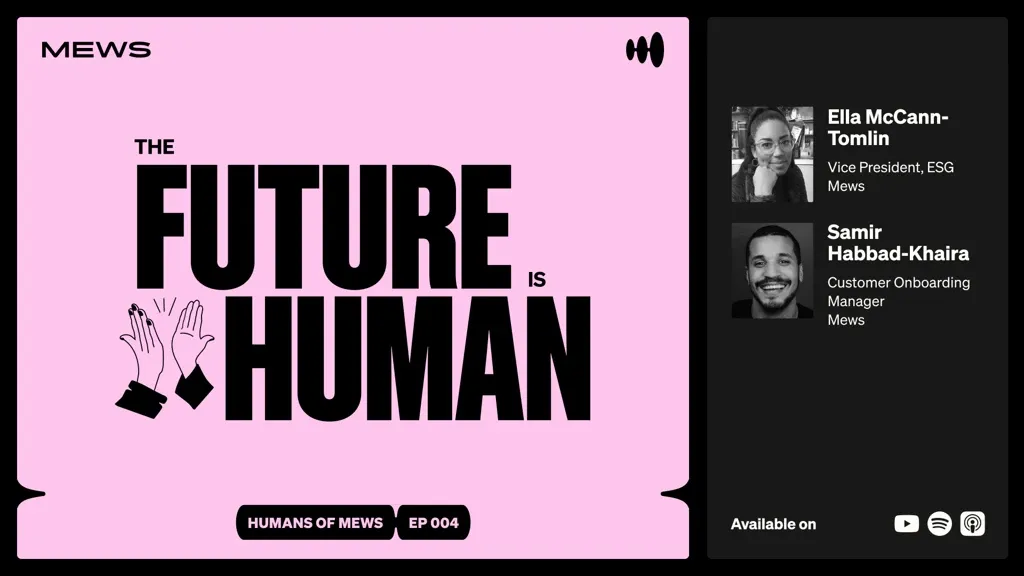
[00:00:21] Ella: Welcome to Humans of Mews, part of The Future is Human podcast. I'm Ella McCann Tomlin, and this is where we surface the human stories that often go untold at work. The turning points, the unconventional past, the things that shape who we are beyond our job titles. These are the intimate conversations with people across Mews about their journeys told on their own terms.
[00:00:45] Ella: Welcome to The Future is Human. Today, we're joined by Samir Habbad-Khaira, who is our customer onboarding manager at Mews. He works closely with customers to help them successfully adopt technology that transforms how hospitality teams operate and serve their guests. But, actually, in this conversation, we're gonna be looking more through a personal lens, so identity, belonging, resilience, exploring experiences of racism within LGBTQ+ spaces and Samir's experience of that, the impact of political anxiety on mental health, and the emotional toll of activism and burnout. So together, we're gonna reflect on these realities and how they show up at work, how they shape who we are, and what it really means to build workplaces where people feel safe, seen, and supported. So, thank you for coming, Samir. We're really thrilled to have you on the show.
[00:01:34] Samir: Thanks, Ella, for the invitation. Very glad to be here.
[00:01:36] Ella: Just to kind of jump straight in, obviously, I know you pretty well, but our listeners won't yet. And when we were talking in advance of this, we were talking about identity, and you described your identity as existing at multiple intersections. You're from the LGBTQ community. You're also from a North African background. You're living in Paris. Can you help me understand what it feels like to navigate the world from that place?
[00:02:02] Samir: I will be lying if I'm not telling you that it was kind of challenging. It's kind of three identities into one, same person. So I think the first thing is just that, you know, it's kind of the sense of incompatibility between those three identities. The fact to be, first, a gay person, then second, having a North African culture, and also due to the fact that I'm also part of a Muslim family, and then being a people of colour. So, I think this is the first challenge, this kind of fact that those kinds of identities don't always feel like they can coexist peacefully. I think also growing up as a gay person, it's the fact that there is a lack of support. So, I grew up kind of without any role model. I think regarding the North African culture, you don't have any role model you can identify with. Also, because part of the culture, you know, it's really kind of private where we talk about feelings, when we talk about dating and those kinds of things. So, I think it's also due to the culture. But being gay, I think, is the thing that you keep. I was even thinking to keep that my entire life private, never coming out, which is something that is really hard to deal with. And I would say being people of colour, we're gonna, I think, talk about that during this podcast. But I think, nowadays, it's kind of challenging, you know, with all the rising of far-right movements across Europe and all that kind of thing. So, I think with those kinds of three reasons, it's really, really, really challenging. But at the end of the day, it's making yourself kind of unique, and I think this is the most important thing - unique. This is all about uniqueness.
[00:03:49] Ella: I actually really resonate with some of the things that you're saying. We don't have exactly the same background, but that feeling of living at multiple intersections, not all of which you feel necessarily completely 100% comfortable in. So, my grandma and granddad on my mom's side came to the UK as part of the Windrush generation in the 60s, dealt with a huge amount of very horrible racism at the time, but also, interestingly, weren't immigrants in the traditional way that we think about immigrants because they were from the colonies at that time. So, my grandma came to the UK with a British passport and is actually very British in her identity, feels very British and supports Britain in the Olympics. But also that sort of paradox of the fact that she's never been really made to feel at home completely here. And when you add, we're both queer, you know, when you add queerness to the mix, I've not always felt a 100% comfortable in all cultural contexts and in all family gatherings and all of that kind of stuff. And so it's a very, as you say, unique experience existing in different spaces that don't always feel, oh, I can bring this part of myself to this space, and I can bring that part of myself to that space, but not necessarily, I'm always, not necessarily masking, but always bringing some compartmentalized version into a lot of spaces. You said to me something, which really stuck with me when we spoke before this. You said that when you were a young person, you were told that being gay is for white people. What did that do to you? How do you make sense of a statement like that?
[00:05:28] Samir: I mean, it was kind of, I mean, first, now I'm thinking about that. It's like, you know, not making any sense, but it was kind of you're part of a North African family, and there are no gay people here in North Africa. And I think with everyone, kind of part of other countries in Africa, I'm just like we're talking, and we had, I think, the same education where our parents were telling me, there are no gay people here. So, I mean, it's just all about Europe. It's just about, you know, the U.S, and it's not existing in the continent. So, I was kind of hurt because then you need to hide yourself more. And I think this is how I grew up, just hiding myself my entire life. I kind of came out at the age of 22 years old. Actually, you're looking. It's like more than I mean, now it's eleven years. But, you know, I kind of regret that in the sense that probably if I were having more, like, context, more role models, these kinds of things, or, like, without this kind of statement that it's only for white people, I knew that since five years old. So, I think my entire life, I knew that I was different from others. I mean, that I was gay. And I think this statement was, yeah, kind of very, very hard to hear because, no, you can come from different countries. There are gay people everywhere in the world, and we keep seeing that.
[00:06:48] Ella: One of the things that almost breaks my heart the most about that statement is that, as you say, there are obviously gay people everywhere in the world. There are queer people. There are trans people everywhere in the world. And, historically, actually, a lot of cultures, indigenous cultures, be that in Native America or in Africa, were very welcoming and tolerant and revering of the queer people in their communities. They might not have used the modern language that we use, but that was actually often people who existed outside of the sort of heteronormative binary were really respected in a lot of indigenous cultures. And, actually, it's more recent and more colonial history that has erased some of that reality. And so there's a real tension there and a sort of a historicalness to that statement of, actually, it's often the laws that were brought in by the white people, which are the sort of homophobic laws that we see in a lot of these places. So, it's such a shame that that's what a lot of people think or what a lot of people have been brought up to think.
[00:07:55] Samir: Yeah. And I think it's kind of crazy because, you know, then they will say, and I think this is what I'm hearing also, because we're seeing on Netflix, you know, now series where you can see, like, proud queer actors. And now everyone is like, oh, look, this is because of Netflix, this is because of what we're seeing on TV, that now there are gay people. But actually, no. No. It's part of, I think, the beginning of the world, that's, you know, there are queer people, and I think this is why it's kind of frustrating to hear that, yeah, it's from white. I think when you look at the story, it's everywhere.
[00:08:33] Ella: Yes. It's a sort of misunderstanding, isn't it, of what that representation is doing? What that representation is doing is potentially creating a space where people can see themselves and say, oh, that resonates with me, or maybe it's okay. This thing that I thought I had to keep a secret, maybe I don't have to keep a secret. It's not, oh, I've seen a gay thing on TV, and therefore, it's made me gay. You know? And it's like, yes, of course, it's influential, but fundamentally not in the way that people are necessarily thinking. It makes me think of, I can't remember what the years were, but there's a graph that you can look up online that is basically, like, how many left-handed people there are in society. And there's a moment in time where the number of left-handed people, like, shoots up. And the only reason for that is that it became less taboo to be left-handed. And so people who were naturally left-handed just started being left-handed rather than forcing themselves to use their right hand. It’s not sudden that there was a phenomenon or there was something in the water that, yeah, made people left-handed.
[00:09:31] Samir: Exactly. Completely agree.
[00:09:33] Ella: Obviously, we're talking a little bit about your experiences in your cultural context and of being gay and of not necessarily knowing whether you could come out. But to just move to LGBTQ+ and queer spaces, I think that they have a positive reputation for being these sorts of universally safe spaces, right? You know, there's a broad church, there's a metaphorical rainbow of people, and everyone can feel comfortable in those spaces. But you have told me that you've experienced racism within some of those spaces. If you don't mind, could you tell us a little bit more about those experiences?
[00:10:12] Samir: Yeah. Yeah. Definitely. The story was going to a gay club, ordering a drink, and then having someone just saying out loud, “Oh, be careful. There is a Moroccan guy. He will probably rob your jackets or rob you.” So, basically, that moment, I was really frustrated, and I think, you know, the anger was kind of very intense because I was thinking going in gay spaces was kind of, you know, the safest thing. Everyone can come to gay places. We're super open. We're super accepting of everyone. We are kind of still discriminate by the society most of the time, so how? You can go to a safe space and then discriminating other people just because of, you know, the colour of their skin. And with everything happening with the kind of political context that we're having, it's just that I kind of saw a switch into the LGBTQ+ movement, where now it's kind of normal to be racist and gay, probably. I mean, this is probably me making assumptions, but I keep saying like that in a lot of queer spaces, and I think this is not okay. And this is also why the LGBTQ+ needs to be very, very, very, very, very mindful of that. Because even when you're dating sometimes, I mean, you go to dating apps, sometimes you feel like people are just kind of sending you weird messages where they say really bad things to you just to make you feel bad or just like, no white. No, I mean, it can come also to, you know, the opposite. You can have, like, people telling you no black people, no Asian, no that kind of thing. I mean, why? Or no white people. We're kind of a super beautiful community. And I think with everything happening right now, we just keep seeing racism, and everyone I'm talking with faced up. And I think there is kind of an emergency, and we need to take that into account because I think it's probably gonna get worse, and probably our movements, it will be completely different. Now we're probably gonna have far-right activists and LGBTQ+. Why not? If you know, we continue like that.
[00:12:26] Ella: Well, you do see a lot of, for instance, transphobia in some queer communities. This is a kind of very, sort of, niche small thing. The broad statistics on this are that, actually, women and queer women in particular are the most trans accepting group of people that there is in society. But to your point, there is also a sort of burgeoning movement in, quote-unquote, feminism. We won't go into the, you know, we won't pull that apart, of women, and in some cases, lesbians, being very transphobic and being very hateful towards trans people. So, you do see that sort of fracturing, I guess, seems like what you're experiencing at moments of polarisation and at moments of intense kind of sociopolitical conflict. There's this fracturing and this, well, we're LGB, but no T, or we're gay, but no blacks here, you know. And that sort of loss of solidarity, I suppose, seems like, is a real risk. And it's a shame as well because, as you say or as you've alluded to, I think solidarity is the thing that we need in moments like this. Like, we absolutely have to have a real broad church because the people who are marching in the streets and making people of colour and people from immigrant backgrounds feel unsafe are not going to be suddenly accepting of all of the white gay guys. They know when they're done with the immigrants, they're not gonna be like, don't worry about it. That's not the way those things tend to go.
[00:13:54] Samir: And I think, if I may add, you know, when you look at the story, the LGBTQ+ movement, when we talk about, for example, Stonewall, I love this example. We talk about Sylvia Riviera and Marcha Johnson, which is trans women, and Marcha, which is, you know, a black trans woman.
[00:14:10] Ella: Yes. And a Latina trans woman.
[00:14:12] Samir: And that's kind of really intense because, basically, if you look at the history, we were all for each other, and this is, you know, why we now also have this beautiful community and things like that. But I think inside the community, this is why it's important to educate outside and inside that we need to remind that some people of colour were activists and part of our freedom and our rights right now. And I think this is why I want people to be aware of that and to keep that in mind because it's really important. And then, regarding that kind of bad experience, the only thing I was kind of proud of when I addressed this person that was saying a racist sentence; everyone around was supporting, which was kind of great. I would say probably in some other spaces, that would have been different. So, I felt that I was hurt, but still, I never, never, never expected that in a gay bar where everyone is super fun, you know, that I will experience that.
[00:15:14] Ella: There's sometimes a sort of double-edged sword to some of these really scary experiences or hurtful experiences, isn't there? When there were riots in the UK last year, racist riots in the UK and really dark, you know, people were being stopped in the street and beaten up. And there was a moment where I felt I was supposed to go for dinner, and it was the night when there was supposed to be a lot of marching in London. And there was the first kind of moment, I really think, in my adult life that I can remember where I texted my family and said, “Do you think I should go? Do you think I should cancel, or do you think this is fine?” And I was it was fine, but I hadn't had to have that thought before. And as it turned out on that night, there was all of this news that all of these far-right marches were due to happen. And, actually, what happened was hardly any of, or very, very small numbers of those people, came out, and a huge, sort of, anti-racism marches happened in Brighton and London. And they were kind of overwhelmed by this sentiment, a very diverse group of people coming out to kind of reject that. And so, again, it's a similar kind of dual feeling of that was a horrible day, and it was a really inspiring and heartwarming day at the same time. And both of those feelings kind of coexisted at the same time. I'm aware that you've given quite a lot to activism externally outside of work and to building community, and then also in a kind of more corporate context to ERG work. When you see these kinds of factions forming, when it feels like maybe there's less solidarity or the ground is shifting, how do you process that in relation to some of the work that you do and the activism that you do?
[00:16:56] Samir: I think it's a little bit, it's really hard, to be honest. You're still a little bit hard because you're, like, educating people. You give everything outside, you know, the pride month and all year-round things in everyday fights and activism. So, I would say I feel a little bit hurt, but then I think this is where I feel probably more motivated to change that and to be, you know, addressing that concern. And, you know, for example, that podcast is kind of the opportunity to spread out and to send that to that person or to more people, just for them to be aware that inside the LGBTQ+ community, you have some members that can be hurt. And we need to be careful. And we need to stand for each other, especially in 2026, where, you know, you see all that kind of backlash within the community. So, you know, it's first process with because, you know, we're all humans. And I think, you know, I was a little bit hurt because also this person was telling you that all Moroccans are like that, which is, you know, making kind of assumptions and just putting everyone into the sandbox. This is also horrible for that because what the meaning behind it is like if tomorrow, I would say, like, all black people are like that. This is really wrong, and this is horrible, you know, I was not expecting to hear that in 2026. So, that's the first thing. And then the second is just to, okay, we need to address that, and we need to protect everyone within the community, and we need to address that concern because, yeah, it's also happening inside the LGBTQ+ community. And I think sometimes we kind of forget, I mean, I'm not attacking our community that I absolutely love, but I think sometimes we’re thinking that, you know, it's not happening in our community.
[00:18:41] Ella: Yes. It's not to say to your point, most of my experiences in queer spaces have been extremely accepting, extremely positive, and extremely much more so than pretty much any other spaces I've been in. But I think your point is a really important one, which is, we can't think that the work for us is done and that we don't have any interrogating to do, because I think it's quite easy. And this happens along lots of different lines. It's very easy to go, well, I'm a woman, so I've got no work to do, or I identify as progressive in some way, so I don't really have to, I can't possibly be sexist, racist, homophobic, whatever the thing is. You know, we've gotta all collectively, you know, you and I and everyone included, keep interrogating those sort of instincts in ourselves to be exclusionary or to be tribal, especially when we're fearful, because I think that's what often comes to the surface, and that's why we're talking about it in this moment, really. It's what comes to the surface in times of fearfulness, is, oh, how do I close down, protect myself, protect my tribe? What is my tribe? Is it being a woman? Is it being queer? Is it whatever? And people kinda tend to go inward. And I think it's a really important point that, broadly speaking, there's still a lot of work to do in a lot of different spaces. And that might be a family context. It might be a queer dating app. It might be whatever, but it's an ongoing process. Just to kind of talk a little bit about your ERG work, that's obviously the context in which I've worked with you a lot over the past year or two. You founded, you were the OG founder of Proud at Mews, which is our LGBTQ+ ERG, one of our most active, most engaged ERGs. And you've also led ERG work in other companies. But this year, you're stepping down and stepping back, which, by the way, is part of the system that we've set up. It goes in cycles so that people can step forward and step back as they need to. But you've decided to step back for this year, and I'd just love to know, talk us through that decision, particularly in this moment.
[00:20:49] Samir: I think the first reason was mostly because to give a new dynamic with new ambassadors that also, you know, since two years leading all the activities and everything. So, I think it's good to have a new dynamic and to have probably changes into the way we can organise initiatives and everything. But I think the second reason is also, because everything happening right now, and you know, the fact that I'm really, really, really involved within our community. So, it's more of that, you know, I think right now, I was also thinking to protect myself. I'm still working aside, you know, I'm still having a lot of initiatives and everything, but I think now, I think it's okay sometimes to just protect yourself because, you know, I'm processing all those information from TV, from newspapers, and everything. And I think, you know, the anger that I have, I think it's good probably to be a little bit aside, process it, and then probably deliver. And I think, you know, if I had to continue, as I told you, I'm probably gonna be in protest every single day or every week. I'll probably gonna literally change companies or even be, like, totally LGBTQ+ activists. But I was kind of still working, because I think we need to support and to protect our LGBTQ+ community more than before. But it's just about, you know, those kinds of two things, change the dynamic of the group and also protect myself from everything happening.
[00:22:18] Ella: You know, you're making a really good point, which I don't think is necessarily talked about enough, which is the toll of not only ERG work, but the toll of showing up to work as a person who might exist at multiple intersections at a time when, you know, society is scary. We've got colleagues all around the world in Mews, and there's lots of different political contexts at the moment that people are existing in. Some people might be showing up to work scared. They might have family members who are scared. There's so many different things happening in this moment on a societal level. And, I mean, this is a sort of question I ask myself as much as anything. But how do you show up to work with those things really at the forefront of your identity? And in both of our cases, we’re out at work, you know, so people know that we're queer and they can see that we're brown. How do you navigate the fact that you've decided to wear some of those things on your sleeve, I guess. You've decided to be quite open about them. You've decided to talk about them at work, to help others, really. And at the same time, needing to kind of put in place a little bit of self-protection and a little bit of boundaries because, you know, there is the adage of, like, people should be able to show up with their whole selves to work. But, you know, I'm not sure how much whole self is healthy at any given time. There's a lot of vulnerability in showing up with your entire self at work all the time, especially in a moment like this.
[00:23:46] Samir: This is why the RGI are important, and I still promote it even if, you know, we see that some companies are, like, kind of backlashing DNI departments because this is because of that. Because the thing is, you have the, you know, you have what you see on TV, and then you need to go back to work. I won't tell you that some days it's easy to go back to work and just to do to kind of pretend that nothing's happening in the world where, you know, you feel rejected. You feel that kind of, probably, some person wants to erase us from the world, that probably you don't belong in the world. So, you know, you're kind of thinking, what should I do? This is where, you know, then your mental health can be impacted. And this is why we say that ERGs are important, because this is how we can, you know, have this kind of sense of community, this safe space. We can have those people that, you know, we can talk about. They can be from different countries. But for example, we have at Mews, we did, like, this kind of mug mingle, product Mews, mug mingle, where every Friday, we can meet each other. We can discuss. We can just say, like, okay, have you seen what's happened yesterday? And then we're like, yeah. Okay. How can we support each other? And I think this is why it's super, super, super important even if I don't know who is probably gonna come and tell me, oh, no, we don't need that. It's not really important. There is only a social impact. There is nothing economically that we can do. So, that's why we cut the budget, we cut the cost, and we don't need DNI departments. Now I'm the proof that how those kinds of, say, stasis, those ERG, DNI help me to perform. And, yeah, I'm very glad to say that I exceed expectations when it comes to performance review because I'm very comfortable into my work and what I'm doing because of that, because I feel in the company hurt, I have support, I have, you know, also a manager's support. I know that I can reach her. She's super open to the community. So, when you have all that kind of combinations, then this is why I'm not that overwhelmed when it comes to work, because I know that I have a point of contact. I can also easily reach out to you and talk about what's happening, and I know that you will support me. There were, like, a lot of things happening. I already reached out to you, telling you, yeah, my mentor is not okay. Imagine if you're not here, then I just need to perform. I just need to be, just not a human, probably someone, you know, just being here at work.
[00:26:14] Ella: You know, I'm really glad, obviously, selfishly. I'm really glad that you said that, though, because I think it hits the nail on the head of what can be really difficult about the work that I do in particular, which is how do you prove the quantitative business impact of it? And there's lots of measures for lots of different aspects of the work. And, of course, we look at the impact of the work, and we have KPIs and all of that kind of stuff. But there has always been, I think, and there will always be an almost intangible and not very easily measurable qualitative aspect to this work, which is people can deliver more and can deliver higher performance and, crucially, retain much more diverse talent because we're creating this space where people can simultaneously find community spaces, talk openly about their mental health, know that there are other people like them here, etcetera, etcetera. And that enables them even in very difficult times, maybe for them in their personal lives and in their family lives and whatever else, to show up to work and still perform at a really high level. But exactly to your point, that's an amalgamation of lots of kinds of cultural pieces that we're constantly trying to build and constantly trying to maintain and evolve, but it's not a, you kind of almost can't pinpoint it to a single initiative or project or anything. It's just that kind of knowledge that this is the kind of culture of the place that I work, and these are the kinds of people who I can trust and who care about me as a human being and who are doing work to make this environment a really positive one for me and for people like me.
[00:27:54] Samir: And also, it was kind of beautiful as an ERG ambassador. Sometimes I just receive private Slack messages with people telling me, thank you for all the work you did. I came out to my family, and now I'm super happy, and I feel supported. And then you will see that they will be better. They will perform. They will, you know, and I think now what the world is trying to say is just that, yeah, now there is a positive discrimination that, you know, we need kind of mixing everything. And it's kind of sad because, basically, some companies invested a lot into the DNI, and now there's a backlash. So, now you cannot be your true self at work. So, now you need to hide yourself. So, yeah, you're just here to do work, but you're not very happy. Your mind is a little bit kind of, your mind is not connected to work because you're scared. And I think people are not saying that. I mean, you know, people from, like, big leaders or investors or things like that. And this is what I want to say. It's just that we cannot, of course, measure the economic aspects within the DNI work, but we can literally see the social impact. I'm the proof that, you know, that social impact helped me to perform because I feel heard, and I feel that I can give everything to a company that is just accepting me. And this is the kind of statement that I wanna say very, very loud because it's really important.
[00:29:25] Ella: And, you know, I didn't tell you to say that. Non-rehearsed. We didn't have that in the plan.
[00:29:33] Samir: Exactly. It was kind of out of the blue.
[00:29:36] Ella: You just spilt the cup. In the kind of conversation we had before this, one of the things that you talked about, it relates to what you just said about companies investing in DEI or an inclusion work and then pulling back. You mentioned that people in DEI networks that you're a part of are quite quiet in this particular moment in time. And I suppose there's a question hanging in the air. I can guess why they might be quiet. Is this a moment to be loud? Is this a moment to protect yourself? I think that's probably what is going on: people are scared in this moment. But what do you think about that? Because, arguably, the reverse is true in terms of what's needed.
[00:30:12] Samir: I think it's really a tricky question because, yeah, basically, from all the DNI networks that I follow, I don't see a lot of things, not a lot of things, not a lot of initiatives back in the time. They were, like, every month, the meeting, connecting different ERGs and everything. And this year, especially, I'd see something very quiet, but I think there is one important point, I think it's really, from DNI perspective, VP leaders, I think it's important to protect yourself. Because when you're a part of DNI, you're having a lot of pressure, I would say. And especially everyone that I know from DNI, like VPs and everything, they want to act. They want to do tons of things, but it's also important that they are also overwhelmed with what's happening in the world. So, they need to protect themselves. And I think this is why they're quiet. It's not meaning that, you know, being quiet is bad. It's absolutely not the case because they're still working on a site, but I think it's the main reason. And I think, you know, then we put a lot of pressure. Yeah, what are you doing? So, probably I can reach out to you and saying, like, why are you so quiet? You know, we need you more than ever, but you know, it's also important to think about you to protect yourself because, you know, it's very, very overwhelming, and we still, you know, we don't know what's gonna happen in six months, in one year, because everything changed super quickly. To be honest, I'm very lost with what's happening in the world right now. So, you know, we're targeting one day these, we're targeting the trans community, then gay people. Then I see that we removed the T from the movement. I mean, this is very overwhelming. So how, you know, we can put high pressure on DNI VPs, for example, where, you know, they're trying to also understand what's happening because everything changes super quickly. So, I think it's important to say that to protect yourself.
[00:31:58] Ella: It's a really important point, that kind of quick evolution of everything that's going on and also, you know, the overwhelm of what's happening in the world. And that sense that I think also when you're a leader in any specialism, you do tend to put this pressure on yourself that you need to know the answers. You need to be a sort of, people should be able to come to, and you're the kind of subject matter expert. And you are, but I think that it's a really challenging thing to go. There's so much newness to what we're experiencing every minute of every day at the moment that I actually don't know how we should respond to this thing. I don't know whether we should say anything about this thing that's happening. Because if we say something about that, does it set a precedent that we should say something about this, this, this, and this? And then are we gonna just be flooding our comms channels every second of every day? And how and when should you talk about things? What support should you provide for people when the specific set of circumstances they're experiencing hasn't been experienced before? There's a lot of that, to your point, that is ever-changing. And then I think also the broader last five years or so of this kind of work, since, you know, 2020, I guess, six years now, is also, I think, that there's been some changes and some evolutions in how people operate, which I think are not necessarily negative. So, for instance, to the point about being loud or quiet, you know, we saw an explosion in 2020 of loudness. Everyone was being extremely loud, and there was something positive about that in some ways. We were having conversations we'd never had before, certainly in a corporate context. And at the same time, there was a lot of hot air and not necessarily a huge amount of just diligent under-the-surface work. And from the people in this space that I continue to speak to who are still doing this work, because some people don't do it anymore or have dropped out of it, they're still doing the work. But to your point, the shouting about it, the PR around it, all of that kind of stuff has changed. But perhaps in some senses and in some context, there's almost more substance.
[00:33:56] Samir: The main point I remember, I had a lot of opportunities back in the time to be panelist into, like, cross collaborations, ERGs. And I remember that back in the time, it was also challenging from DNI point of view, where for all the DNI departments, where companies were saying that, you know, DNI are kind of part of the culture of the company, but DNI work is not to promote the values of the company. It's something completely different. So sometimes there is high expectations on, oh, DNI needs to participate in the culture of the company. In a way, you're making safe spaces for different communities. But, you know, it's two different works. So, I would say now it's good to be quiet. Not that quiet because I think, you know, there is a lot of work to do, but I think we need to be resilient and just not being, you know, having high expectations and being like, oh, why you're not delivering that? You know? You know me. That's back in the time, I was kind of like that. Why? We need to do this and this and this. And you were like, always kind of calming me down a little bit because, you know, I will organise a quiet parade every day. But now, and especially because I'm also struggling as, you know, a gay person, but also as an ERG member and ambassador and everything, I think it's important to protect yourself and, you know, to kind of process everything, all the information. So, that would be my biggest, biggest, biggest advice for DNI.
[00:35:22] Ella: Fantastic. And we've talked about you stepping back. But when things feel heavy, as I think we can agree they do right now, what sustains you? What keeps you going? Do you have any rituals, or practices, or habits that kind of keep you resilient?
[00:35:37] Samir: First, I go to spinning classes. I love spinning classes because I can just be crazy on the bike and just be like, okay, I don't need to hit anyone. I'm just like…
[00:35:48] Ella: Get that energy out?
[00:35:49] Samir: Yeah. And my teacher is also part of the community, so she just puts on fantastic music and everything. So, we're like, yeah, okay. That's the first thing. And second, I think it's basically to connect with people from the community. I would say this is what helped me a lot to have, you know, call my best friends and just being like, okay, let's, you know, have conversations, talk about the topics. And I think this is what's helping me a lot. And then, as I say, internally on an everyday basis, because, basically, when you look, we spend more time at work than you know, we're, like, eight hours at work every single day. So, I think this is where, you know, I'll have this opportunity internally to connect with people from the ERGs and having this kind of connections. I think this is how I'm kind of handling things, even if, you know, it's still in mind because it's really, really hard, as I say, when, you know, you don't feel like you belong to the society and things like that. But I'm still with that, it helps, and I'm handling better the information.
[00:36:50] Ella: That's great. And I think that it's such a good reminder of joy is important. And those of us who care so much about social justice and care so much about fairness and care so much about the state of the world, it can be really demoralising. You try really hard not to give in to despair, a lot of the time. If you engage with the news, it's hard to know how much to engage in a healthy way, etcetera. And I similarly feel that. Sometimes what kind of fills my cup is something more activist is going to a protest. And often, I feel quite emotional at protests, not necessarily in a totally negative way. Being in community with people who are also doing something can be kind of rejuvenating. But at the same time, as you say, just exercising, hanging out with friends, doing things that keep your own body and your own mind healthy, I think, is so important.
[00:37:41] Samir: And I think connecting, and why I'm saying connecting with people from the community. I mean, basically, it could be people from the community are a lie, which, you know, will help you and kind of will understand why you're challenging. Sometimes, I have with my manager. I was speaking earlier, but, you know, I have one where I say, you know, I'm processing that information. Have you seen what's happening right now? And I feel a little bit, you know, low in energy. And, you know, I know that my manager normally is not supposed to do that, but at least, you know, she kind of cheered me a little bit up and being, like, you know, saying how valuable I can be and everything. So, I think it's like a game. Everyone has a role to play, and I think if everyone is like that, yeah, then the planet will be fantastic.
[00:38:26] Ella: Final sort of question, because we've talked about, what we talked about was personal, but one of the things that I'm trying to ask everyone who comes on the podcast, because we're talking a lot about the humanness at work and the importance of humans at work. Is there one human thing that you think is so central to the workplace, I suppose, that you would never automate it?
[00:38:50] Samir: The thing is, about that question, I'm more into that technology can create connections. So, there are three things. But I would say that the technology won't be able to kind of replace the emotional intelligence, won't be able to replace how to create to save space, and having this kind of empathy. Because, you know, this is all about the work of DNI and everything. So, we will still need a human touch. So, I think we can use the human OS to kind of create connections, make sure that we can have faster connections. That's the first thing. But I say that we will definitely need the human touch to support each other because, without that, technology won't be able to replace the empathy that we have for each other.
[00:39:37] Ella: Beautiful. I will leave it there because I couldn't say it better. Thank you so much, Samir, for coming on the show. We always have great conversations. I knew that this would be a great conversation. It would be no different. I really appreciate your openness and vulnerability always, and really grateful. Thank you so much.
[00:39:56] Samir: Thank you, Ella. And yeah, next time is gonna be on Tuesday then. No?
[00:40:00] Ella: Of course. We get our own TV show.
[00:40:02] Samir: Exactly.
[00:40:05] Ella: That's what's next. Thanks so much, Samir.
[00:40:10] Samir: Thank you, Ella.
[00:40:13] Ella: The Future is Human is brought to you by Mews. If you want to learn more about what we do, visit mews.com. And if this conversation resonated, you can find us on Apple Podcasts, Spotify, YouTube, or wherever you listen. Hit subscribe so you don't miss future episodes. Thanks for listening.


