What to expect?
Meet Madeline at Unfold
Meet your speakers

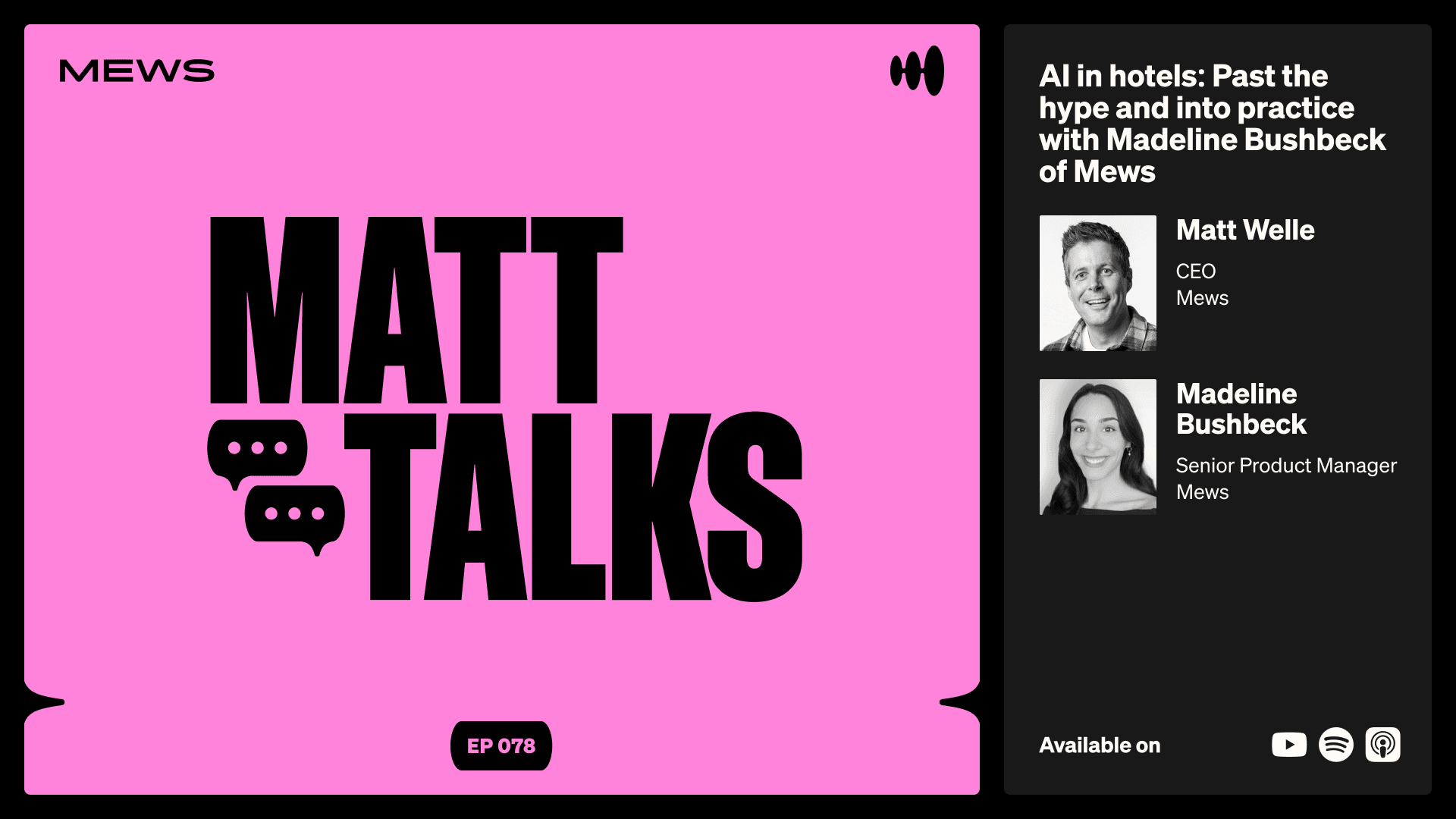
Matthijs Welle
CEO, Mews
After years in the trenches of hospitality, Matt joined the Mews journey during its early days in 2013. Since then, he’s been our fearless CEO, leading the company and the industry forward.

Madeline Bushbeck
Product Manager, Mews
Madeline joined Mews through the acquisition of DataChat, where she spent five years in the data and AI space. Her work sits at the intersection of AI and hospitality, turning complex workflows into simple, outcome-driven products.
Episode chapters
Transcript
[00:00:00] Madeline Bushbeck: The hotels that will win with the new AI space aren't the ones who found the best vendor; they're the ones who actually understand their own operations well enough to know what to automate, what to protect, and how to make AI technology actually theirs and work for them.
[00:00:29] Matt Welle: Hi, everyone. Welcome back to another Matt Talks Hospitality. And today, we're gonna talk about AI. Like everyone else, AI is already everywhere in hotels. Our recent industry report shows that 98% of hoteliers are using AI in some form. But there's a big difference between using AI and using it well. Most properties are still at the stage of plug-in tools that don't really understand how their hotel operates, things like pricing logic, guest preferences, and the stuff that makes your property yours. Today, we're talking about what it takes to go from experimenting with AI to making it a core part of how you run your business. To talk about this with me is Madeline Bushbeck. She is the Senior Product Manager at Mews, and she came to us through our acquisition of DataChats, which was an AI company, a native AI company that we brought into the fold. And there, she spent five years in the data and AI space. We're gonna get into where hotels should start, what should stay human, and how to make sure that AI works in the way that your property needs it to. Welcome.
[00:01:30] Madeline Bushbeck: Thank you for having me, Matt. Really excited to be here.
[00:01:33] Matt Welle: So, you started at DataChat as a technical writer, translating very complex AI models and machine learning for end users. Now, you're deciding what gets built. How does that background of always asking, you know, but will anyone understand this? Like, you're writing for an audience that you wanna make sure that they understand it. How does that then shape the products that you're today making?
[00:01:57] Madeline Bushbeck: I think that that's a great question. And, honestly, for me, I think it keeps me pretty grounded, actually. When I was writing docs, I had to understand something well enough to explain it simply. And now I kind of use that same bar for product decisions as well. If I can't explain why we're building something in plain terms, we probably haven't thought it through. I think, in addition to that, it also makes me a pretty big skeptic of jargon. To me, saying AI-powered effectively means nothing. Here's what it does for your front desk actually means something.
[00:02:33] Matt Welle: I love that. And you actually haven't worked in hotels before. Is that an advantage, or is that a disadvantage?
[00:02:42] Madeline Bushbeck: I think it's a little bit of both depending on the week. For me, I genuinely just don't have that "that's just how hotels work" reflex. When I first joined Mews, I started sitting in on some customer calls, and I found myself asking a lot of questions that maybe some hoteliers might find rather rudimentary. Like, why do you guys do things this way?
[00:03:06] Matt Welle: Like, what was crazy? Like, what's the thing that we did? You're like, that makes no sense to me.
[00:03:11] Madeline Bushbeck: How much of the processes aren't documented at all? Like, everything is institutional knowledge. If you want to know something, you have to go to the manager, or the GM or someone who's been at this specific place for ten years or longer.
[00:03:25] Matt Welle: It's like the tale that you tell your grandkids that gets passed down generation from generation.
[00:03:30] Madeline Bushbeck: Right. Exactly. But adding on to that, I think that it really forced a lot of these hoteliers to have useful conversations with me because they've had to articulate things that they've never really been asked to articulate before. And I think, in addition to that, too, for me, curiosity is a competitive advantage. It's something that we say in product all the time, and I think that that absolutely rings true in this industry as well. So, despite not having a hospitality background, I think coming into it from a first-principles perspective has been a really big change overall.
[00:04:05] Matt Welle: So then, like, you came in fresh and green into our space, but you're native to AI, so you've thought about products deeply. But what surprised you about what most hoteliers think that they want versus what we, as a tech industry, think they want? Is there a disparity between those two?
[00:04:22] Madeline Bushbeck: A little bit. In the tech world, and I say this coming from it, they tend to assume that the goal is to remove humans from as many steps as possible and that automation is the ultimate destination. But when I started talking to hoteliers, I kept bracing for the conversations to go that way, and more often than not, they simply didn't. What they actually want is to help their staff. The hotels that are the most excited about AI are the ones where the GM says something like, "My front desk team is spending two hours a day on operational tasks that have nothing to do with the guests, and I wanna give that time back to them."
[00:05:06] Matt Welle: And do they then have clarity on what that team will do with that time?
[00:05:10] Madeline Bushbeck: It's about focusing on the guest, like, what they can actually do to build those relationships and connections when they're not buried with operational overhead.
[00:05:18] Matt Welle: Yeah. I love that. I'm so glad to hear that that's what hoteliers are actually looking to do. So, we ran this survey, and we found that 98% of hoteliers are already using AI in operations to some degree, and 92% feel optimistic about AI. Does that match the research you're doing? Because you're speaking to a humongous amount of hoteliers now, or is there a gap from what we see in the survey and what actually happens in operation?
[00:05:45] Madeline Bushbeck: I think, overall, that 98% number tracks. But I'd push back just a little bit on what that actually means in practice. Because if you count someone on the team using ChatGPT to write marketing copy, that's technically AI adoption, and it's real, and it's fine. But it's a long way, I think, from having AI that understands how your specific property operates and is actively helping you to run it better. What I see is a huge variance in the depth where some properties are genuinely sophisticated, and they're using AI across pricing, and communications and operations. And then you have properties where the AI conversation starts and ends with, "We tried a chatbot on our website and turned it off after a month because it kept saying wrong things."
[00:06:34] Matt Welle: Well, chatbots, like, objectively four years ago, were being sold as the solution. But four years ago, LLMs weren't there, and they were objectively awful. And it moves at such a pace that, you know, and even I do this when I've used something and, again, that doesn't work. And then I don't go back to that for another year. But actually, it moves now at a pace where chatbots are objectively better at answering questions than most humans are. So, it is really important that if you saw something that doesn't work today, you go back to that very quickly instead of waiting a year, right?
[00:07:06] Madeline Bushbeck: Yeah. And that's something that we look at too. Like, with any AI feature or agent that we build, obviously, we wanna get it as close to perfect the first time. But things are moving rather quickly, and I think iteration is important. And I do think that if something doesn't work for you for the first time, that doesn't mean that you should drop it entirely.
[00:07:24] Matt Welle: Because do you feel a hesitation? So, like, obviously, hoteliers are very happy to have a revenue management system that takes over automation or some of the back-office processes. But when it starts to touch the reception desk, you're starting to really infringe on their relationship with the guest, potentially. Do you feel that there's a hesitation once it starts to go into that guest experience?
[00:07:46] Madeline Bushbeck: I think so. But I think that the root of that issue is because the stakes are asymmetric. So, like, a pricing algorithm that makes a suboptimal call on how you should price your room might cost you some revenue on a slow Tuesday, and that's certainly not ideal. But in many ways, I think that revenue is still recoverable. But an AI that mishandles a complaint from a guest who drove four hours for their anniversary weekend to stay at your specific property, that's a relationship that you might never get back, and those reviews end up on TripAdvisor. And I think hoteliers understand this intuitively, and I think they're right to have that caution and discomfort around automating guest-facing moments. It's certainly not going to go away overnight, but we're getting better at it every day.
[00:08:32] Matt Welle: Because how do we bridge that? Because right now, there's this hesitation. So, hoteliers are like, right. I'm not touching this until I've seen other hotels prove it out in some way. But somebody has to be first to really say, “Like, right, we're gonna transform this space because actually, I think it can be good.” But how do we bridge the time in between when there's just this massive hesitation when you just wanna switch on the autopilot, but hoteliers are just very hesitant to automate everything?
[00:08:58] Madeline Bushbeck: Yeah. I do think that hoteliers do want the automation, but the point that we also need to acknowledge with that is that hospitality is, by definition, an innately human-centric industry. And the connection that you make with your front desk staff, you know, the first moment at check-in is incredibly important, and how people make you feel is incredibly important. And so the framing that we use internally is a copilot in that AI should surface the right information, draft the right message, and flag the right moment, but ultimately, a human is going to decide. And, overall, I think the efficiency in this automation comes from removing the friction around decision-making, not removing the decision-maker themselves.
[00:09:41] Matt Welle: Right. So, it's about we give the suggestions and the human can say, yes, this feels right. And then we will learn from the things that they accept versus the things that they reject. And then the algorithm starts to learn, like, okay, we're now at a point where, actually, 95% of the things that we are suggesting are accepted. And at that point, we might ask them a question saying, “Are you comfortable now to switch on the automation?” Is that it?
[00:10:02] Madeline Bushbeck: That's absolutely the angle that we're taking, but we have to build that foundational trust first. Obviously, we want to get to a state where a lot of things can be automated because of the learning loops that we can implement and how staff actually interact with AI. But from a foundational perspective, we need that compounding trust over time in order to do that.
[00:10:24] Matt Welle: Because a lot of hotels work very, very differently or, you know, they have their own ways of working or their own rules that they've created. Like, how do we deal with that different context between different hotels? Because if you deploy chatbots to one hotel, it needs a very different context than when it does in another hotel.
[00:10:42] Madeline Bushbeck: Yeah. It absolutely does. And I do think that that's going to be largely dependent on how different hotels operate. There are some hotels that are, of course, going to prioritize efforts towards guest experience, while there are other hotels that are more focused on revenue. And applying AI to those specific domains that you care the most about is an effective way to start. But also, I think that touches on the idea of the semantic layer and being able to configure AI to function the way that your property actually operates.
[00:11:11] Matt Welle: So, can you explain what you meant with semantic layer?
[00:11:14] Madeline Bushbeck: Yeah. So, the semantic layer, you can think of it as a contextual knowledge layer that AI agents sit on top of in order to actually reason the same way that anyone at your hotel would reason. A good example, perhaps, is that I was working with a property in Chicago late last year. And when I was chatting with the front desk staff, one of the things that they noted was that all of the rooms that end in 10 are suboptimal rooms. They like to fill those rooms last. They don't want to put guests in there unless they absolutely have to, but that information doesn't exist anywhere in the PMS. And so when you're interacting with an agent that's making suggestions on how to best accommodate this guest or what type of room to put them in, it needs to have that knowledge in order to help you make those decisions.
[00:12:01] Matt Welle: So, isn't that just a knowledge base? Do I just document that, and then once I've told you, you just know this thing, or is it something different than just a knowledge base?
[00:12:10] Madeline Bushbeck: It's different than a knowledge base in that the semantic layer also serves as a learning loop as well, whereas knowledge bases don't. So, depending on the actions that your front desk staff take or your revenue managers take, it can continue to learn and improve over time rather than just having, you know, a static set of definitions that it's supposed to follow.
[00:12:29] Matt Welle: Right. So, as and when things happen at the hotel that contradict maybe what was in the initial kind of draft of the knowledge base, the AI starts to update that understanding of how the hotel operates. So, the semantic layer is like a growing creature or an evolving creature that follows the staff team.
[00:12:47] Madeline Bushbeck: Yeah. Yeah.
[00:12:48] Matt Welle: Sorry. That was maybe not the most beautiful description. So, a lot of hotels have tried probably a chatbot. I'm imagining that they have, at some point, tried a chatbot. Maybe they've tried an AI pricing tool, and they're asking some questions to ChatGPT or Claude for writing some emails, but how do you go from those scattered experiments that are happening in a hotel to actually writing out an AI strategy for a hotel?
[00:13:12] Madeline Bushbeck: I think that I would say that it needs to start with your data. I think, ultimately, at the end of the day, what we're seeing is a big data fragmentation problem. If your systems aren't talking to each other, then your AI certainly won't either. And I think the hotels that are getting the most out of AI are the ones where reservations and guest profiles, operations, communications, you name it, are all living in one place or at the very least connect cleanly. Once that's done, you can build on top of that instead of trying to duct-tape these different pieces together.
[00:13:44] Matt Welle: Yeah. And I think you're completely right. I think what we've seen is that historically, because the systems are so fragmented, the data lakes that a large hotel group would create are sitting outside of the operations, because they just wanted to run reports, right? So, they would connect to all of the different systems and get all of these pools of data, and then they'd have one source of truth where they would run reports from. But the reports are not actionable. So, what we did with Mews is we've moved a lot of the logic of the data storage inside the PMS with our new Mews BI product. So, we actually know a lot of the things about how the hotel operates, and we've allowed flexible reporting tools for hotels to modify. But it also means that everything we know sits at the heart of the PMS now, which is the heart of action, right? So, the property management system is where the action happens, versus when you think about a central reservation system, that is not where the operation of a hotel is being run from. Maybe it's where the reservations are housed, and the CRM are housed. But the system of action, the PMS, should actually know what to action and what triggers the sends to which system because a typical hotel has between 5 to 15 different types of integrations. So, we've started building this architecture where we're housing a lot of the data, so that now when you come in with these solutions on the AI side, actually, the data becomes incredibly valuable to the point of we now know if you spend money in restaurants, even by paying with Apple Pay, that transaction gets tracked back to your guest profile. So, we actually know a lot more about guests than we would have known historically because, historically, we couldn't connect those data points. But because we are the PMS, we are the point of sale in the restaurants, we are the payment solution, all the dots start to connect, and that's when AI can have its way with it.
[00:15:23] Madeline Bushbeck: Yeah. 100%.
[00:15:25] Matt Welle: What does using AI badly look like for a hotel right now? So, what are the big traps that you think hotels are falling into?
[00:15:35] Madeline Bushbeck: I think this is a great question and one of my favorites to answer because a lot of the same principles that happen in the data and analytics space are definitely applicable here as well. The most common version is automating something that's already broken. You just get bad outcomes faster. We followed a principle that is called ‘garbage in, garbage out’, which is that if you don't have good data and you don't have good information, if you're trying to throw AI on top of that, you can't expect the results to be good either. The second point of that is sprawl, I would say. So, having five different AI vendors with no shared context doesn't translate to good results either. None of these AIs know anything that the other AIs know. There's no central logic.
[00:16:24] Matt Welle: Yeah. Because you gave an example. I think it's something about a wake-up call, and then another example I'm referring to.
[00:16:29] Madeline Bushbeck: Yes. Yep.
[00:16:30] Matt Welle: Can you share that?
[00:16:32] Madeline Bushbeck: Yeah. So, I've been working with a couple of properties in closed beta for this feature that we'll be releasing. I don't know how much I can say about it specifically.
[00:16:41] Matt Welle: A little bit. Give them a little bit.
[00:16:42] Madeline Bushbeck: Sure. So, we're working on this feature called Smart Tasks, which basically takes what Smart Tips currently is in use today and makes them actionable, number one, and number two, grounded in your property's context. And we had a tip come back at one of the properties that suggested a wake-up call. And the issue with that is, although most properties might offer wake-up calls as part of their services, oftentimes, it's not documented in the PMS. It's just a complimentary service that the hotel will provide. And this hotel actually operated with no front desk. And so there wasn't anybody there to actually service that wake-up call. And so that becomes a tip that's not actionable and not relevant to that property, so…
[00:17:24] Matt Welle: So, that knowledge would then go into the semantic layer, then, of…
[00:17:27] Madeline Bushbeck: Yes.
[00:17:28] Matt Welle: Right. I was thinking that’s where you're going.
[00:17:30] Madeline Bushbeck: Totally okay. Essentially, the root of that issue is suggesting things that don't exist or misrepresenting what the property can actually offer. So, that forms kind of an immediate trust problem with the guest and also reflects badly on the hotel as well. And so the fix there isn't just better AI. It's AI that's grounded in the actual reality of how your property operates. So, to your point, that would be the semantic layer and the type of knowledge that is stored there.
[00:17:58] Matt Welle: And because we made some assumptions, obviously, before we started going into beta with some of the hotels, so some of this is running in hotels already today. Were there any other surprises that really stood out from what we thought was gonna happen to what actually happened?
[00:18:14] Madeline Bushbeck: I think that the biggest surprise to me is that hospitality is basically an industry of edge cases, and so there's always going to be fragmented data, or they're going to operate in a very specific way. For example, one hotel only wanted to see relevant action items for their VIP guests. They don't need to see everything for all of their guests. So, we need a way to configure that for that property so that we can make Smart Tasks work better for them.
[00:18:40] Matt Welle: I love that. So, taking a step back, the AI landscape seems to shift not even every week. It feels almost daily that there is a new model that's going to change everything, and there's all these capabilities that are happening in this hype cycle that we're in. But how do you, as a product team, build a conviction of a direction when the technology keeps changing?
[00:19:01] Madeline Bushbeck: Actually, I think the answer is pretty straightforward in that you have to stay anchored to the problem rather than the solution itself. The model landscape, like you said, is constantly changing, and it's changing at a rate that, honestly, we haven't seen before in the tech industry. But what doesn't change is that hotels need to serve guests better. They need to operate more efficiently, and they're trying to do more with leaner teams. So, as long as you're continuously building towards that, the specific AI infrastructure that we use, the models that we use, almost become a detail in that, rather than the actual core problem.
[00:19:39] Matt Welle: Yeah. There's so much marketing around AI, and everything seems to be powered by AI. And sometimes I look at it, I'm like, that's not actually AI. But, like, I can recognize it. But how does a hotelier who isn't super tech-savvy recognize when something is just marketing, but actually there isn't a real AI beneath it and when something is real?
[00:19:57] Madeline Bushbeck: I think you could probably just ask one question. And that question being, does the AI know anything specific about my property? And if the answer is not really, but you could train it, I would consider that to be bolt-on and not super effective. But if the AI knows your room types and your services and your guest history and your policies and all of the institutional knowledge that lives in the heads of your staff, without you needing to do a bunch of manual setup, that is more of an embedded way of looking at AI and AI as an integration rather than just a product.
[00:20:33] Matt Welle: If I'm a hotelier, like, I just get the nice marketing message. I'm like, that sounds amazing. But what kind of questions should I ask this AI vendor or this software vendor to actually understand whether their AI is really good or if it's just really good marketing?
[00:20:49] Madeline Bushbeck: I think that that's a great question. And if I were trying to evaluate AI products, I think I would look at it from the perspective of what am I actually going to get out of this? What is the end goal of using this AI feature? How does it impact my staff, and how does it impact my guests? And who is it actually for the benefit of?
[00:21:10] Matt Welle: Like, really, I think something you said there triggered me, like, outcomes is the critical thing. We get enamored by the promise of something really sexy and something cool. But what actually is your business strategy, and what's the outcome that you're looking to drive? And can you measure that outcome? And then when you start deploying it and going into a pilot phase, is it actually driving the outcome that you're looking for, or is it just a gimmick that doesn't really drive business value? Because AI is expensive. Like, it's not a cheap thing. So, you wanna make sure that that investment actually drives an outcome to the business. And let that be revenue on the one side, but it could also be higher guest satisfaction, so that you get more return guests, which then second command is, like, you get higher revenue. But different hotels have different missions. But you definitely need clarity from a strategy point of view to be able to go and figure out what's the AI tool for you, because everything seems to be AI, but you do have to pick which is the thing you deploy. And I think that very much aligns with kind of what's the ROI metric that you're looking to drive.
[00:22:15] Madeline Bushbeck: 100%. I think one of the ways that I look at it is that it's very easy to find an AI vendor that can provide a bolt-on solution. Like, if we look at something like guest communications. Just because an AI can respond to a guest inquiry doesn't mean that it's actually providing value to the staff member or to the guest. If it's answering incorrectly or not even able to answer a guest's question and then has to surface that to the front desk staff, you're just adding additional work. And I think that that work becomes more noise and frustration than actual value to either side of the parties.
[00:22:47] Matt Welle: I love that. So, my last question is, you're actually gonna be speaking at Mews Unfold. Mews Unfold is our annual event happening on May 27. And if you haven't got tickets for joining us in Amsterdam, you can follow it online as well. But without giving too much away, what's one idea that you would love every hotelier in that room to walk away with?
[00:23:07] Madeline Bushbeck: If I could give one idea to walk away with without saying too much, like you said, I would say that AI is not a product that you buy. It's a capability that you build towards. The hotels that will win with the new AI space aren't the ones who found the best vendor. They're the ones who actually understand their own operations well enough to know what to automate, what to protect, and how to make AI technology actually theirs and work for them.
[00:23:39] Matt Welle: That's great. Thank you so much for joining me. I always enjoy talking to you because you have such clarity of voice, and I think a lot of hoteliers will enjoy it very much because I do know what you're gonna talk about at Unfold, and I'm very, very excited to start releasing that to the world. But if you are excited, then make sure that you all sign up for the online sessions so that you can follow live what Madeline and some of our other product teams are going to talk about. But thank you so much for joining and sharing this story.
[00:24:03] Madeline Bushbeck: Of course. I'm really happy I could share some details here.


