What to expect?
Episode chapters
Transcript
[00:00:00] Vicky Irwin: Everything we do has to feel inviting because we have to prove that we understand hospitality, we understand making somebody feel welcome and invited.
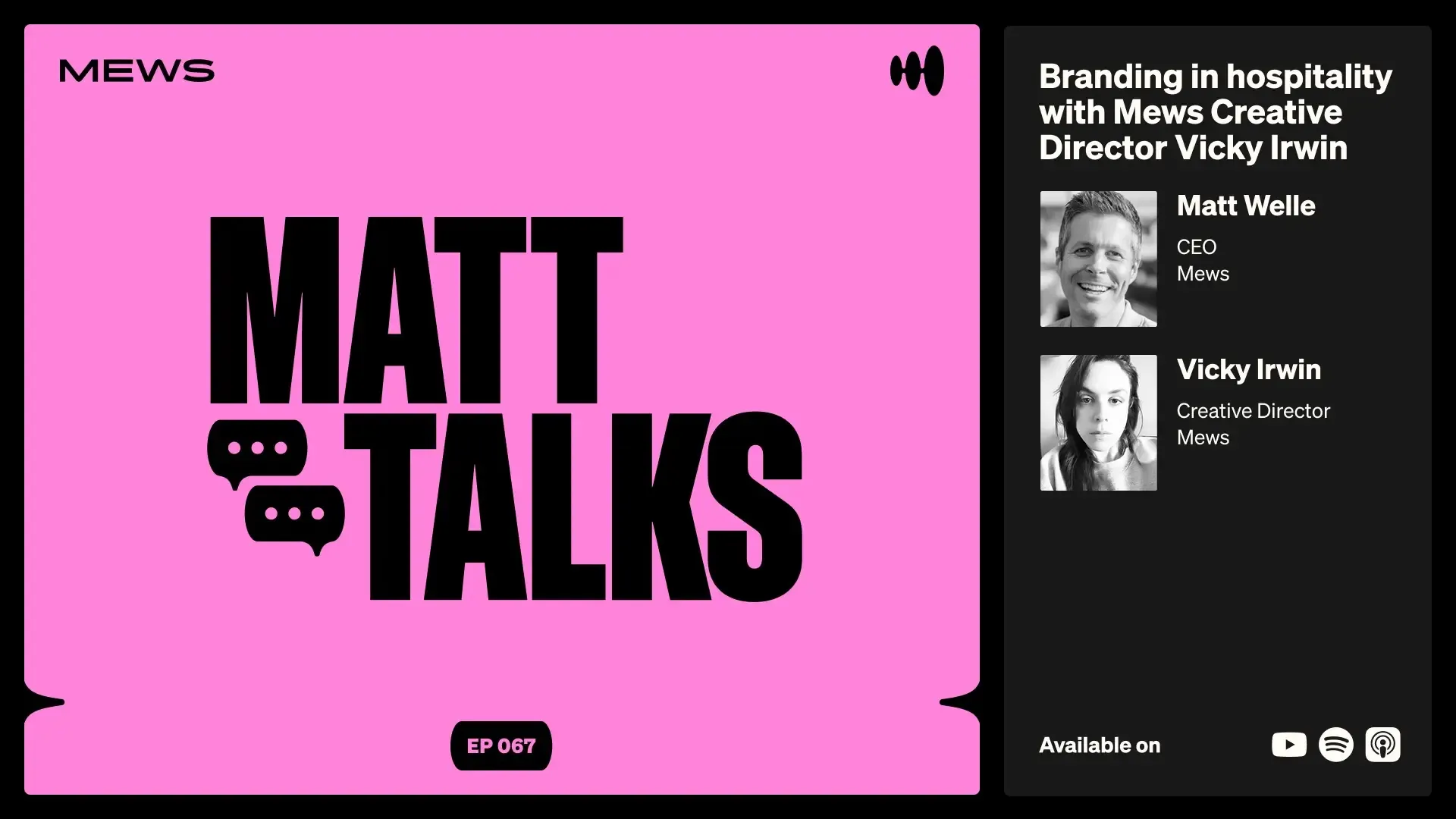
[00:00:20] Matt Welle: Hi, everyone. Welcome back to another Matt Talks Hospitality. And every week, I say I have my favorite person that I wanna interview, but this week, I really mean it. Like, Vik is one of my favorite humans that works at Mews. And Vicky Irwin is our creative director at Mews. She spent over six years shaping how our brand looks, sounds, and feels. Before Mews, she worked across several creative agencies and studied at the University of Arts in London, and Vik has built a career around clear and confident creative vision for Mews, and that's what we love. So, we're gonna dive into our new brand because Vik has been working hard in the shadows on our new brand. And Vik operates from the shadows. She doesn't like the limelight, and this is the first time she's ever appeared on the interweb. So, I'm so thankful that you're allowing me to pull you into this podcast.
[00:01:07] Vicky Irwin: Thank you for having me. Thank you so much. This is the first time I've been on a podcast, but no…
[00:01:11] Matt Welle: For the last or maybe the…
[00:01:13] Vicky Irwin: Well, let's see how it goes, but you can't ,I couldn't say, because this is like being on Hospitality Oprah. You can't really say no to Oprah. So, here I am.
[00:01:21] Matt Welle: When you joined Mews, six years ago, our brand was yellow and black. Did you love what we had done with the brand before you arrived?
[00:01:28] Vicky Irwin: I absolutely loved it. It was beautiful. When I first arrived, my background is, I come from bigger brands, that's my background. It's quite, actually, my background's quite consumer. So, I was working on a lot of fashion brands and some hospitality, a lot of consumer brands, and when I came to Mews, which I was only meant to come for a 6-month project, when I arrived, there wasn't really a full brand. There was a logo that Richard had created with a designer that he knew, and there was a lot of yellow for some reason everywhere. And it was getting inconsistent, and I think that's fine because you were at that stage in your development. Those were your formative years, so you were still kind of, you know, figuring out the product, trying to get it into people's hands, you know? There weren't many of you, but it was a really, really juicy challenge for me because when I came in, I realized that that strategic work that needs to happen underneath a brand hadn't been done yet, and that was really the opportunity. But there was such an atmosphere when I arrived, and a lot of that came down from you and Richard, and I could tell immediately that we were gonna be able to do something really different. So, that was exciting.
[00:02:41] Matt Welle: So, when you thought back to what Mews was back in the day, which was a logo and a few colors, what to you is brand? Like, what encompasses a brand?
[00:02:50] Vicky Irwin: Yeah. So, it wasn't a full brand. A lot of people think that, you know, the brand are those surface items like the logos and the colors and the nice typography. And obviously, that's the entry point, and that's part of it. But really, a full brand is how you make, you know, the customer or the audience feel across all touch points. So, for us, that's, you know, the product, that's our customer service, our website, it's, you know, how we behave at events. All of those things are distilled down into the brand. I don't know if, there's a saying, “People always remember how you make them feel.” It's a saying about people, but I actually think that really applies to brands completely. People always remember how the brand has made them feel. But, you know, the visuals are really, really important. You know, like, we dress a certain way. That's our surface way of expressing ourselves. We wear makeup. You probably don't, but we wear makeup, you know, we wear clothes. But you also express yourself with the language that you use, how you speak to people, you know, the way that you hold yourself, how you're making people feel. And you evolve over time. And that might seem to some a pretentious view of, you know, looking at a brand, but I really believe that that's how a brand should behave. I think they should evolve. But I think that everything comes down to the feeling that the audience gets and the customer have when they walk away. That's the most important thing.
[00:04:06] Matt Welle: And you talked about a brand evolving. So today, we're in the middle of a rebrand. What did you feel we were missing that, or had we just outgrown our brand and we just needed to evolve into something else?
[00:04:17] Vicky Irwin: Yeah. We outgrew it. We started to feel stagnant. You know, there were copies in the industry, which is sort of flattering, but great. But also, you know, a sign that, okay, maybe it's time to do something different. I think we're trying to communicate something very specific with Mews. We're trying to communicate that we think differently, so that you can think differently with your property. That's really, really important to us. So, we can't recreate another B2B brand. So, when it's starting to feel stagnant, and people are starting to copy us, and it doesn't feel fresh, we've got to change, and we've got to pivot. It's really formulaic. It's really easy to create another B2B brand, but if you want to tell the world and the industry that you're thinking differently and you're here to make change, you can't look like every other storefront. So, it was starting to feel a bit tired. We had a lot to say, and we didn't give ourselves the mechanisms within the brand to be able to be really very creative, which meant that we were looking a bit inconsistent in places.
[00:05:12] Matt Welle: Like, I didn't think the distinctive tone of voice that we had a few years ago carried as far once we started expanding internationally and spoke all the languages around the world.
[00:05:22] Vicky Irwin: It didn't. You know, the strapline was starting to feel a bit tired. It felt very British-centric to us. And there were things that I think maybe we would have done differently as well. And that's completely normal, right, as the brand evolves. So, it was time to make a change. And I also think that, you know, we were really, we were suddenly really excited. We were like, okay, we're gonna do a new brand, and I think that…Have you seen Men in Black?
[00:05:45] Matt Welle: Yeah.
[00:05:46] Vicky Irwin: The film. You know, when Will Smith and the other guy, and they come and they do ‘bruuuuhhhh’, and you forget everything. Like, creative directors have that. So, the last rebrand that they did, which was really, really difficult and really painful and really hard to get through, they have that happen and they have no memory about how hard the other rebrand was. And then they skip into a new rebrand. They're like, this is gonna be easy, this is gonna be great, this is gonna be smooth, and it never is. But it's important work, and I think I'm really excited about what we've done.
[00:06:12] Matt Welle: What does that process look like end-to-end when you really do a proper rebrand?
[00:06:16] Vicky Irwin: When you do a really proper rebrand, you've got to get the foundational work right, and that is distilling what we spoke about earlier with your first question is, like, what are we standing for? What do we need to say about how do we wanna make people feel? Right? That's the most important thing. I've heard the
[00:06:33] Matt Welle: I've heard the hard process really frustrating.
[00:06:35] Vicky Irwin: It's really, really frustrating. Yeah. It's frustrating for us because we're actually quite a complicated proposition. We landed on the brand idea. So, you know, what I said earlier about every touch point having to follow, you know, create the same feeling, it's why in the end, instead of having a strap line, we decided to go with a brand idea, an internal brand idea, like our internal kind of warrior cry, which I love so much. Its impact you can't ignore. You know, when you're asking me what I felt when I first came to the company, I was only gonna stay here for six months. I was like, tech.
[00:07:08] Matt Welle: I'll do a gig.
[00:07:09] Vicky Irwin: Yeah. I'll do it. You know, like, I was freelance at the time, I was like, okay, well, yeah. It's probably not really my jam, but fine. I'll come for six months. Six years later, I'm still here.
[00:07:17] Matt Welle: Chat chute.
[00:07:18] Vicky Irwin: But there was something, you know, when I walked through the door, yes, it was scrappy, and it was messier to work than what I'm used to, but there was something, I already sound like I'm drunk on Kool Aid here. But there was just this kind of essence, this energy when I walked through the door. Everyone was just so pumped, so raring to go, but also not afraid to be bold because you felt you had so much integrity behind what, you know, you've really felt like you had the goods to back it up. And I felt that from the beginning. And a lot of that came down from you and Richard. And then you were hiring people who were, you know, feeling the same way. Everybody was really, really on this mission. And six years later, we still have that, and that does still come down, you know, a lot of that filters down from YouTube, but we still have that. And we try to be countercultural within our space. If you've ever visited, for example, our space at ITB, you will know that we don't do whatever…
[00:08:11] Matt Welle: That’s easily the once a year. The biggest trade show for travel companies.
[00:08:15] Vicky Irwin: It's the biggest trade show. And honestly, it's dry as hell. You walk around, and it's just, you know, navy blue everywhere. A lot of this exposed brick vinyl, which is just flat.
[00:08:27] Matt Welle: Yeah, book foe, exposed brick and/or.
[00:08:30] Vicky Irwin: Yeah. A huge deal. A lot of mints, very nice. You know, it's very dry, and we go there, and we do something completely different. We create a world, and we'll talk a bit more about that. Last year, we created a radio station using AI. We did, you know, this enormous space with giant speakers. Everything was music-themed. We had, you know, CGI everywhere. You walk through the sea of boring, and then you see us, and you go, ‘what the…’ I'm not allowed to swear on here. But yeah, what is going on here? You know, this is different. This is really, really creative. And, you know, we do that because it's us. We also do it because if we stopped now, everyone would be like, are you guys okay? So, we have to keep doing it. But coming back to this impact you can't ignore, it's so us. Like, everything we do as a company is to create a ripple effect. Now, why I love it is I love it because I love the theatrics of, you know, the big experiential things that we do and the impact that we make visually. But it doesn't even have to mean that. It can mean, like, a really juicy piece of data. It can mean something that we do that nobody else does. You know, impact you can't ignore, can be the impact that we have on the guests because, like, the guest experience is so elevated. It can be, you know, revenue that we've unlocked. It can be so many things, but it's very much about having the integrity and having the confidence to really put your money where your mouth is. And whether it's big visuals, whether it's a small detail, it's creating impact that nobody can ignore. And, actually, nobody has ignored us since I've been at the company. Well, I don't think anyone's ever really ignored us, but we're not ignored. We're a big voice in the industry, and so, it’s…
[00:10:11] Matt Welle: It's been worrying in three days. But, like, it is nice to be able to have a voice and have the goods to back it up as well. And that's why I am so confidently on the Internet because I share openly what we do, and product demos because I'm so proud, and because it's genuinely good and it's so much better than anything else that I've seen in the industry. And that's really the impact you've got to have.
[00:10:32] Vicky Irwin: Yeah. And so there's a confidence there and we're very bold. And sometimes that rattles people, that rattles our competitors because, you know, we've got a bit of hook to butt because we feel really confident in what you do. But that, you know, going back to that statement, so simple impact you can't ignore.
[00:10:47] Matt Welle: Yeah. But it took us apart to get to that statement. It must have been six months before we got to that statement.
[00:10:52] Vicky Irwin: It was months. It was months. We were going, Raul, what?
[00:10:59] Matt Welle: We were standing, like, at the top of our booth, and we were debating it and, like, back and forth. And we had multiple kinds of different statements, but this one was the one that landed and felt strong. But that was March. We finally agreed in March.
[00:11:11] Vicky Irwin: Yeah.
[00:11:12] Matt Welle: And we are now, what, at the end of the year, early next year, kind of timeline for the launch. So, what happened in the 9months that's in between there?
[00:11:21] Vicky Irwin: So, we spend a lot of time coming up with a strategy, getting very tired, getting some quite heavy bags under our eyes, feeling like we're going a bit crazy. Then you land on the strategic idea and instinctively, you know it's right. Suddenly, you feel very excited. So, then you move into the visual phase. And that's where it gets really, really interesting because we worked with a fantastic agency, Koto Agency. They did a great job. And we start working through the visual identity, how that feeling that we've identified and that strategy, how we now communicate that visually. But what's the really interesting thing about us and a brand like ours is that no shade to someone like Itsu, but a brand like, I always use them as an example because they're so formulaic. A brand like Itsu, they're the same everywhere, right? The communication is exactly the same. It's very formulaic. We're not. Like, we have a lot of range within the brand. I always say that our brand isn't flat. So, there are areas that we can make a really, really bold impact, but we also have to communicate that we're trusted. We know what we're doing. Like, your property is safe with us. Like, you know, we're a trusted pair of hands. There are areas in the sales funnel, you know, it's not a good time to joke. You know, we have to be more serious. So, the really interesting part of that visual challenge for us was then, how do we show this big personality and make this punch, make it tone appropriate when we need to? And that took a lot of refinement. The strategic part, I think, was actually the longest part, hitting on our positioning and our principles and all of that good stuff. The visuals took a little bit less time, but you know, it was still, that's the problem you're trying to solve. And it was a really, really nice process because we worked with Koto, who is a fantastic agency. But actually, we worked very closely with them, and we directed a lot of that. And it was a real exercise in actually knowing that we really, really do understand ourselves very well, and we directed it.
[00:13:13] Matt Welle: How do you feel about designing by committee? So, in the beginning, we had a large group of people that we wanted input from. And at some point, we said, right, we've got enough input. We're gonna go back down to a smaller group to try and move forward faster. How do you feel about designing by committee?
[00:13:28] Vicky Irwin: It's tough because noise is bad when you're trying to get, what we're trying to do in those early exercises is gain clarity, and when you're hearing a lot of noise, it's really, really hard to distil that down. That being said, you need the input in that discovery phase at the beginning. You do need the input of a lot of people because you need to understand the business, and the agency needs to understand the business. When it comes to opinions, that's where it starts to get really, really tricky because visuals are so visceral, you know, like, we're all a product of our experiences. We react to visuals completely differently. I don't like that color. It reminds me of my school uniform. I really hated school. You know? All of that kind of thing gets really tricky. Suddenly, everyone's an art director. You know? It gets hard, and that's when you've got to, you know, talking of integrity, that you've got to make some tough decisions and go, actually, you know what? We're gonna distil this down to a small group of people. It's gonna be me. It's gonna be you and Richard. It's gonna be my design director. We're really, really gonna go over our instincts on this. Then we're gonna communicate it to the people that matter, sense check it if there are any big alarms, but that's when you've really, really got to focus because just the noise that you're trying to get clarity, and the noise can be too much.
[00:14:42] Matt Welle: So, the last question about our brand before we switch over to the hospitality space, what are the elements that you're really proud of in the end that you're excited to see out in the world?
[00:14:51] Vicky Irwin: Well, I love Impact You Can't Ignore because I just think it's, I just love it so much, which is, I think I know it's instinctively right for us. We've got a new brand, Cymbal, which I love, which you're showing off here on your very beautiful microphone. We didn't have one before we created it. And what I really love about it is that we were trying to communicate so many things into one symbol and this idea of, you know, connectivity through the product and amplification and moving forward and and a gentle nod to the name Mews as well and the origins of that and, you know, of a Mews of, you know, similar buildings, you know, connecting into into one Mews. And I think we, again, it took far longer than anyone wants her to take, looking at Shay. Okay. Oh, I don't know. This one doesn't make me feel right. This one doesn't communicate the right feeling. There's a lot of that, you know, like classic creative director chat. But how does it make you feel? Is it really communicating the right thing, but that stuff's important? We ended up landing on this, that actually we ended up taking a very early design and just flipping it on its side, and it didn't work originally. It's very simple. We just put it on its side, and we're like, oh, it's perfect. And we instinctively knew it was perfect, and I love it. And I absolutely love it. It communicates so many things. And, you know, finally, I love the fact that, not that we were fighting it that much, but that we did really just succumb to the fact that we're very pink people. It's just really…
[00:16:17] Matt Welle: It started at ITB three years ago when we did a pink booth. And somehow that pinkness just, like, permeated through the last few years and just kept coming back to us.
[00:16:28] Vicky Irwin: People love it. But, like, the event you know, that was in ITB, which we've mentioned before. It was so different to what everyone else was doing. It was so memorable. But also pink as a color, like, it does so many good things. You can be playful with it, but it's warm. It's a warm, inviting color. You can also be really, really sophisticated with it, but that kind of warmth is really important because we are in the business of hospitality. Everything we do has to feel inviting because we have to prove that we understand hospitality. We understand making somebody feel welcome and invited. I think pink does that. You can turn it up and down, but I just think it's, not to be a cliche, but I think pink's a bit of an attitude. And I think we have that attitude internally, which I love.
[00:17:09] Matt Welle: Sorry, I do have one more question. I can't…
[00:17:12] Vicky Irwin: Please.
[00:17:13] Matt Welle: The logo. We had a logo, we designed it a couple of years ago, and now it's the same logo, but slightly different. What is missing?
[00:17:21] Vicky Irwin: Well, this is a point of hilarity across the company because we had a beautiful logo crafted by an amazing studio that I work with often called Sawdust. And we decided to refine it. Hope the spacing on it was very wide. We decided to make it feel a bit more compact. We worked into the ‘s’. We narrowed the ‘w’. So very, very subtle changes, but they make it feel more compact, and it's easier to work with because actually it was very, the spacing was quite stretched out before and it was difficult to work with. And it sits better now with our typography and all of our other elements and our brand furniture. The reason it's a point of clarity who
[00:18:01] Matt Welle: roll their eyes at what you just said and they're like, yeah, it's just on the same logo. They bet that 24 slightly different logo?
[00:18:08] Vicky Irwin: Daily. I people roll their eyes at me daily. Because when I presented it, you know, we presented it to the company, I was really excited. I was like, oh, the, you know, the craft that's gone into now.
[00:18:17] Matt Welle: It's curvy. Yes.
[00:18:18] Vicky Irwin: The other curvy you know, and a lot of you know, there's this w, does the width on this w really communicate what we wanna communicate? How does it make you you know, a lot of this. And I and we presented it, you know, to the company on our on our weekly call on boosh. And there was just millions of messages in the in the in the boosh Slack chat just going, I I didn't see a difference. Because I was the same logo. I was like, oh, okay. Fine. But, you know, I it's gentle. You know, it doesn't have to be a big difference to communicate something different, but it is that I I get the eye rolls very often.
[00:18:48] Matt Welle: So switching to hospitality. Yeah. Who are hospitality brands that inspire you or who get brand rights?
[00:18:53] Vicky Irwin: There are a couple of hotel brands that I love. So I love Puro. I think that it's so beautifully curated. It celebrates creativity and good design. So from every location they work with, uh, sort of the best architectural and interior talent that we have. I say we because I'm Polish, although I don't sound it. I appreciate that I don't sound it, but I definitely am. They curate art collections. They work with local fashion brands. Like, everything is really beautifully created. The design is is gorgeous. It's quirky, but it's very elevated. So you've got this whole brand that's really entrenched in design and art, but it's completely warm and welcoming. It's not, you know, elitist in any way. It's very accessible, and I love that. And the service is very elegant. And so what we were saying before, everything really pulls through that brand. There's another brand
[00:19:46] Matt Welle: It connects the digital and what you see online to what happens in the real world. There's a real connection that they built. Yeah.
[00:19:52] Vicky Irwin: And it's very elegant and it's elevated and I really love it. But there's another brand that I really love, and it's Tuber in Marseille. And they only have five rooms. They have a restaurant that they're really famous for. And they do what so many other brands and hospitality brands struggle with so badly is that they've created such a character, like, such a world. It's so beautiful. But it's also there's kind of social emotion when you go there. Like, the staff are very particular. You know, there's a real vibe when you go there. The location, the design, the interior design, the music, the soundtrack, the website, they're not just selling the restaurant and the rooms. They're actually selling a world that you want to step into, and I love it. It's one of my favorite places to eat. But it's just it's such a vibe. Like, they do that so well. So out of Hos Elfen actually in Marrakesh does that really well as well. They create this entire world, and that's really, really beautiful. So in terms of hospitality brands, I like those guys. When I'm looking for inspiration, though, I'm not always looking in hospitality.
[00:20:54] Matt Welle: In our space. Yeah.
[00:20:55] Vicky Irwin: Yeah. So, you know So
[00:20:56] Matt Welle: what do you got?
[00:20:57] Vicky Irwin: On the functional side, I look at tech, but not necessarily hospitality tech. So we're looking at brands like Spotify, Figma, looking at how clearly they differentiate themselves and how they evolve. But we I also look at performance brands. Nike on. You know? Like, the the thing about Nike is they make you feel so powerful. That's their currency. How can we do that? How can we make the hotelier feel powerful? You know? There's lots of things. And also, because my background is consumer and very fashion based and a little bit of beauty. Beauty brands at the moment are doing the best experiential stuff. You look at Glossier, you look at Rhodes, look at fashion brand Jacquemus, they're doing the best experiential. Like, they're creating entire worlds. They create these worlds. So within our brand, it it like, if you know us, you'll know this, but if you don't, we give ourselves permission with events that we create, anything that we do that's experiential to really create worlds within our brand. So if you've been to ITB, you'll see that. If you've been to Unfold, you'll see that.
[00:21:52] Matt Welle: Like, every detail that you flow through about the experience once you step into our booth to how you leave? Like, that entire experience end to end is thought through.
[00:22:00] Vicky Irwin: Yeah. And we create a specific world. We've given ourselves that create that allowance to be creative because I think as a brand, people think we're we deal in hospitality and we deal in tech. I actually think we deal in creativity and creative thinking. Creative thinking isn't just what I do visuals and that. It's problem solving. And we are thinking creatively so that you can approach your vision for your property differently, and you can unlock things that you didn't see before. So that parallel with the creativity that we're allowed to, um, execute when we're doing events is that's what that parallel is there for. And we create these worlds, and they're grounded within the core brands, but it's a real experience. Like, it's a real visual experience, like you say, from from detail from start to finish. And those beauty brands at the moment, they're doing the most incredible job at that, so they're a real inspiration as well. So
[00:22:53] Matt Welle: So if you go back to hospitality and you look at some of the big names, the Marriott's and the Hiltons, they have twenty, thirty, 40 different brands. They're all slightly the same. One has breakfast with, some without eggs. That's the only distinct difference. How would you approach if I gave you the task to rebrand the Marriott and their 30 brands and making sure that you understand what each brand stands for? Is it an impossible challenge to solve?
[00:23:17] Vicky Irwin: It's not an impossible challenge to solve, but the challenge that they have is a clarity issue. Same as we spoke about before, it's a clarity issue. So they have all of these brands, but it's not clear to the consumer what they represent. So if I was gonna approach that myself, first of all, I'd like quite a big team, please. Then I'd go through
[00:23:33] Matt Welle: Immediately with the budget asks. I'll know what you like.
[00:23:35] Vicky Irwin: Immediately with the budget. Um, she's so high maintenance. But, you know, we would have to look at every one of those offerings and look at what their emotional territory is. Like, what's the job that we're giving them? Like, what are we wanting them what's the feeling we want those brands to create? Where do they overlap? Where are those overlapping principles? And then so you wanna give each brand its own role, and then make sure that's reflected in the visuals, but also in the service and the experience when you get there. But make sure that all of those ladder into, you know, one backbone of a philosophy at the top. It's a big, you know, that would be a huge job. Could you
[00:24:14] Matt Welle: do the design without actually impacting the way that they run? Meaning, you just have an outsourced design firm, they just design a beautiful logo, they slap it on, and then they they walk away to the next project. Could that work
[00:24:24] Vicky Irwin: for them? You could do that, but then it's just ornamental. Yeah. Which is something that a lot of you know, hospitality brands get wrong that they think that branding is just a marketing exercise. It's not. It's the whole experience. Many, many, many hotels that have a beautifully branded. They've just slapped on the logo. The guest goes in, and the experience in the property is different. They're gonna listen to that. I've been to a hotel that's beautifully branded. I'm never going back to that hotel again because it was all superficial. We joke about your apples. You are now the face of apples in the hospitality industry.
[00:24:59] Matt Welle: I got invited to a podcast to talk for thirty minutes about my opinions about apples and ourselves. I was like, great. I'll have opinions.
[00:25:05] Vicky Irwin: The fact that you managed to do that for thirty minutes, by the way, amazes me. That's that's really impressive. But in all seriousness, that's brand. That weed what does that say? We don't really care if you like these. These are just ornamental. We're not really thinking about you. We just need to put something here. Yeah. If you want a nice apple, go and buy your own apples. I don't really care if you like these.
[00:25:25] Matt Welle: Exactly. That's
[00:25:26] Vicky Irwin: brand. Horrible, waxy apples. Yeah.
[00:25:29] Matt Welle: So we're not gonna solve the big brands today, but we might help a small independent hotel who has a limited budget with some idea. If you had a limited budget, then to you, a limited budget is different from than an independent hotelier because I've been working with you, and I know that your budgets are slightly bigger than independent hoteliers. But I'll give you €5,000 for your small five bedroom hotel in Marseille. Um, if you do something, what would you do? What's the first thing you would do?
[00:25:55] Vicky Irwin: I'd love to open a small hotel in Marseille. So thanks for the budget. The biggest thing I'd invest in at the beginning is focus. Like, focus. Like, define what makes you different, what feeling you evoke that makes you different. Not functionally better, but what's your ownable area? What makes the guest feel different when they come to you? How do they feel when they come to you? Define that. Get really brutally honest about that. And there's a reason for that. Because once you've got brutally honest about that and really define that focus, that is gonna help you spend that money wisely. Then you spend that money on, you know, some light branding, the website, those immediate touch points that really are gonna have an impact on the guest, The brands, the website, and then, you know, those first ten minutes even when they walk through the door of your property. That's where you want to invest. But if you wanna use that money well, you need to start with the focus. That's really important.
[00:26:50] Matt Welle: And can you do that yourself? Or could do you need to bring in someone who's a specialist in that field?
[00:26:55] Vicky Irwin: I think you can do it yourself. Like, I think, you know, it's your property. It's your vision. You know, what's your when you thought about building this, when you thought about creating this, what did you want to create? I don't think anybody well, maybe some people do, but I think many people who create who are starting a business, like, they do really have a vision inside of we all do because we all have opinions. We all, you know, want to feel a certain way. It might just be that it's how you wanna feel in a hotel, and that's fine. That can be your vision.
[00:27:24] Matt Welle: I think a founder or a creative owner of a hotel often has it in their head. And they might say it, but they never write it down in the documents so that they can communicate it clearly to others. And that it doesn't last somehow or dilutes down, which is a pity. And I think a lot of hotelists have not written down their strategy for their brand or how they want people to feel when they leave the hotel. And writing it down sometimes is a really good distilling function.
[00:27:52] Vicky Irwin: Yeah. It's really, really important because when people understand the principles and the ethos, then the integrity will hold. If you don't communicate that anywhere, there's nothing to follow, but it's not just about guidelines and rules. Yeah. It's also about the principles. That's really, really important, and that will hold the integrity. But it's critical. If you don't have that, you just everything is just ornamental.
[00:28:16] Matt Welle: If when you look at some of these hospitality brands that you love, what makes them stand out? What's the thing that excites you about those particular hospitality brands?
[00:28:26] Vicky Irwin: Well, for me, personally, I mean, it will be different for everyone. The I love to travel, which is such a controversial statement. No one likes traveling. You know, I love to travel to the point where I wanna step into a different world, where I actually just want maybe even a bit of a culture shock. And to me, my favorite brands in hospitality are the ones that curate their experience to be an extension of that community and an extension of that world, which is why I love tuba so much, which is why I love Elphin Elphin so much, and it's also why I love Puro so much. You feel like you're walking into a really, really, like, hyped up curated world that they're creating, and that is so magical for some as, you know, as somewhere to stay. That's not the objective of every hotel. Some hotels are just, you know, somewhere to lay your head, you know, business trip. And that's fine. That's absolutely fine. But for me, those are the ones that I find that are just really, really special to me. And that can only, only be done with a really, really clearly thought out very mindfully thought out positioning Yeah. And very clear principles.
[00:29:28] Matt Welle: Well, I'm sure you've seen bad branding. But can you give an example of when a brand really didn't land for you as a customer?
[00:29:35] Vicky Irwin: I mentioned it earlier that I remember there was a hotel that was I was expecting big things because it was really beautifully branded, um, and it felt very detail oriented and warm from the branding. And then when I sat through the door, the experience couldn't have been Yeah. Any different. And, actually, the first brand touch point were were the staff. You know, they didn't carry through those principles. They were really rude. They were really unattentive. They made me feel bad. They made me feel, you know, that they were annoyed that I was there, which is a bizarre way to feel when you're paying to stay in the hotel. I met somebody once. I say at Loch often. This is Loch is not the hotel I'm talking, but I love Loch. I say at Loch Bermondsey a lot, and I met somebody who had randomly met someone who had been in the interview process to work there. I love staying at lock because there's such a social environment when you go there. Like, the staff are so cool. They're so chill, but they're so attentive. And I had spoken to which is why I repeatedly say that, and I I love their brand. And I'd spoken to somebody who had been through their interview process, and he was saying that there was a huge part of that interview process that was around culture and and staff culture. And I thought I that was beautiful because that's that is brand that is brand work. It's more than the visuals. That's exactly it. And that's why when you go there, you feel good. You feel yeah. You feel like you feel it. You know, you feel that energy. And I did not feel it in the other place, and and I would never go back there.
[00:30:59] Matt Welle: Because I I stayed this weekend at a hotel, and it was amazing. The logo felt like one of those old brand logos, you know, like this real luxury, a bit gold ish, but like that kind of sense of it. Stuffy. And it was a brand new hotel that felt much more like modern luxury. Um, it was incredible, but it felt disjointed from the logo that was on the on the roof with the twirls and the things in that logo. And I was like, oh, that's that old luxury, but the hotel feels like new, modern, like understated luxury. And Yeah. I wonder how you marry those two, if you can marry them.
[00:31:35] Vicky Irwin: I've seen that before. And what may have happened is, potentially, is that they've had that logo for a while.
[00:31:40] Matt Welle: Something like that. Yeah.
[00:31:41] Vicky Irwin: Yeah. But then they've just changed the interiors, whereas they haven't evolved the brand. They may have been I don't know if this hotel was maybe quite established or had been there for a while. Yeah. You have to evolve what's underneath the brand. If you don't and that's why brands feel stuffy. That probably felt very stuffy to you even though the hotel was very, very beautiful. Whereas a brand that that's gonna feel more timeless is constantly working to evolve the brand itself and redesigning just the surface, like, really addressing the identity underneath. The your example that you've given me now strikes feels to me like it's the opposite, that they just kept the old branding, but they've just redesigned the interiors. And you have a disconnect, and that means the brand job hasn't been done properly because as properly because as we, you know, have said now so many times now, it's just like it all filters down from the same positioning. And that disconnect is sad because they have, you know, they possibly have the opportunity to do something very beautiful at that brand.
[00:32:30] Matt Welle: One thing that I've learned from you is that there's a difference between your brand and the campaigns you run, and they can be distinctly designed. How would that work for a hotel brand? How they would run campaigns that would look different and still making it feel like it's part of the brand?
[00:32:43] Vicky Irwin: Yeah. So you they can feel different, but they still have to be grounded within the brand somehow. So you can start with the creative, you know, with the really, really creative idea. We give ourselves a lot of permission in this brand that wouldn't necessarily work with all brands. We have to when we have a really, really we go for high impact, for example, ourselves. So when we have a, like, a really, really crazy idea, we really indulge in that for some time, but then we've got to take it through the brown filters. Now taking it through the brown filters doesn't mean, okay. Now we have to make it all this color, and we have to make it what it that whatever. It's following again, it's following our principles and grounding it within the brand itself. And that if your brand is strong enough and your principles are strong enough, you can give yourself quite a lot of creative leeway within it, and it will still feel like it's come from you. The sweet spot for us is always that if it feels really surprising, but it always feels like mused it. And that doesn't mean the visuals have to be the same, and that doesn't mean that the, you know, the filming style has to be the same. Well, photography style has to be the same, but there's always something within it. There's that essence within it. Yeah. It's maybe the language that we use or, you know, the style of humor that we use. We always if we use humor, it always has to be very elevated humor. It always has to be smart humor. And there are filters and and there are values and principles and filters that you can apply, which will allow you to be very flexible within your creative, but always it will always be very clear that it's come from your brand if you've done the adequate brand work to start with.
[00:34:16] Matt Welle: Because if you think about a hotel so you've got your core brand. You go to the website, and you always get that sense of feel, okay, this is what that brand stands like, and it's consistent through through time. And then you run a summer promotion and it can feel distinctly different. But as long as it's still you recognize the brand in it, but you want it to stand out and a campaign is there to stand out. Because if you always communicate the exact same message with slightly different words, at some point, people don't see it anymore. And the campaign helps you stand out in some way. Right?
[00:34:46] Vicky Irwin: Yeah. You can be disruptive in a really, really positive way without compromising the integrity or the core principles of your brand. I think it's really, really important that, as you say, that's exactly what a campaign is there to make waves. And, you know, there will be depending on brand, you will have different allowances for that. If I, you know, if I go back to my Itsu example, Sorry, Itsu. Everything always looks the same. It feels the same. You know? It's all you know? And that's totally fine, but there are some brands where you've got the flexibility.
[00:35:16] Matt Welle: I don't want it to change. I just bought my sushi in a certain way, and I just, you know, I walk in for the exact same experience because it's convenient for.
[00:35:24] Vicky Irwin: And it's perfect for you know, it's perfect for what it is. Yeah. They are not trying to shake up an industry. They're trying to deliver reliable food, uh, you know, reliable price point, you know, lunch from work, whatever, all of that. We're not doing that. We're trying to do something different. We're actually trying to shake up an industry, and we're trying to cause some ripples, you know, and and show people that we think differently. And that's why we have a bit more, you know, flexibility and freedom. So it really, you know, it also really depends as a brand how comfortable you are and how much of a need you have to shake things up. Not every brand needs to shake things up, and that's okay too.
[00:36:03] Matt Welle: As a last question, if you were to give advice to hotelier, there's this thinking of rethinking their brand, what one piece of advice would you give them?
[00:36:10] Vicky Irwin: I think that is very similar to my previous answer. It's just get very, very, very clear about what you are delivering and how you want the guests to feel. Yeah. Like, what is your emotional territory? How do you want them to feel when you're there? And then everything goes from that. That is that is the the most important advice because anything else you do is just gonna be surface level. It's just gonna be ornamental. It's gonna feel disconnected. And you know what? The guest is gonna feel that immediately when they walk through your doors.
[00:36:39] Matt Welle: And I can tell you that that is not what people do first. The first Right. Most exciting thing is to start designing the logo. Right?
[00:36:45] Vicky Irwin: Right.
[00:36:45] Matt Welle: That that's always where you start, but it's so true. What is at the core of your heart when you think about the brand that you're building? And write that down, and then start
[00:36:56] Vicky Irwin: to work
[00:36:56] Matt Welle: from that point forward.
[00:36:58] Vicky Irwin: Right. Exactly. And a lot of brands don't do that because the logo is easy to see and experience is very hard to measure. So, oh, we'll make a beautiful logo and we'll put it up. Great. You're gonna follow through? No. Guest comes? No. This doesn't feel right, you know. No. They'll all you know, they always know.
[00:37:12] Matt Welle: Yeah. Vic, you did fabulously for your first and only possibly only ever podcast, but I hope you'll do more of it because I can talk to you for hours. But, unfortunately, we don't have hours. Um, but it's exciting to see your work come out and to really start to see it come to life because I've been working with you in the last year on this new rebrand, and it's such a process. And I really appreciate the curving of the s, which I didn't do before. But because you've made me fall in love with it, um, I'm excited for the rest of the world to see the curving of the s, but also the rest of our brand.
[00:37:44] Vicky Irwin: Thank you so much for having me. I actually loved it.


