What to expect?
Meet KP and Mews at AAHOACON
Episode chapters
Transcript
[00:00:00] Kamalesh (KP) Patel: The reality of hospitality today is it's not as lucrative as it once was. Who better to look out for the owner's bottom line than fellow owners? And that's kind of how AAHOA is structured today.
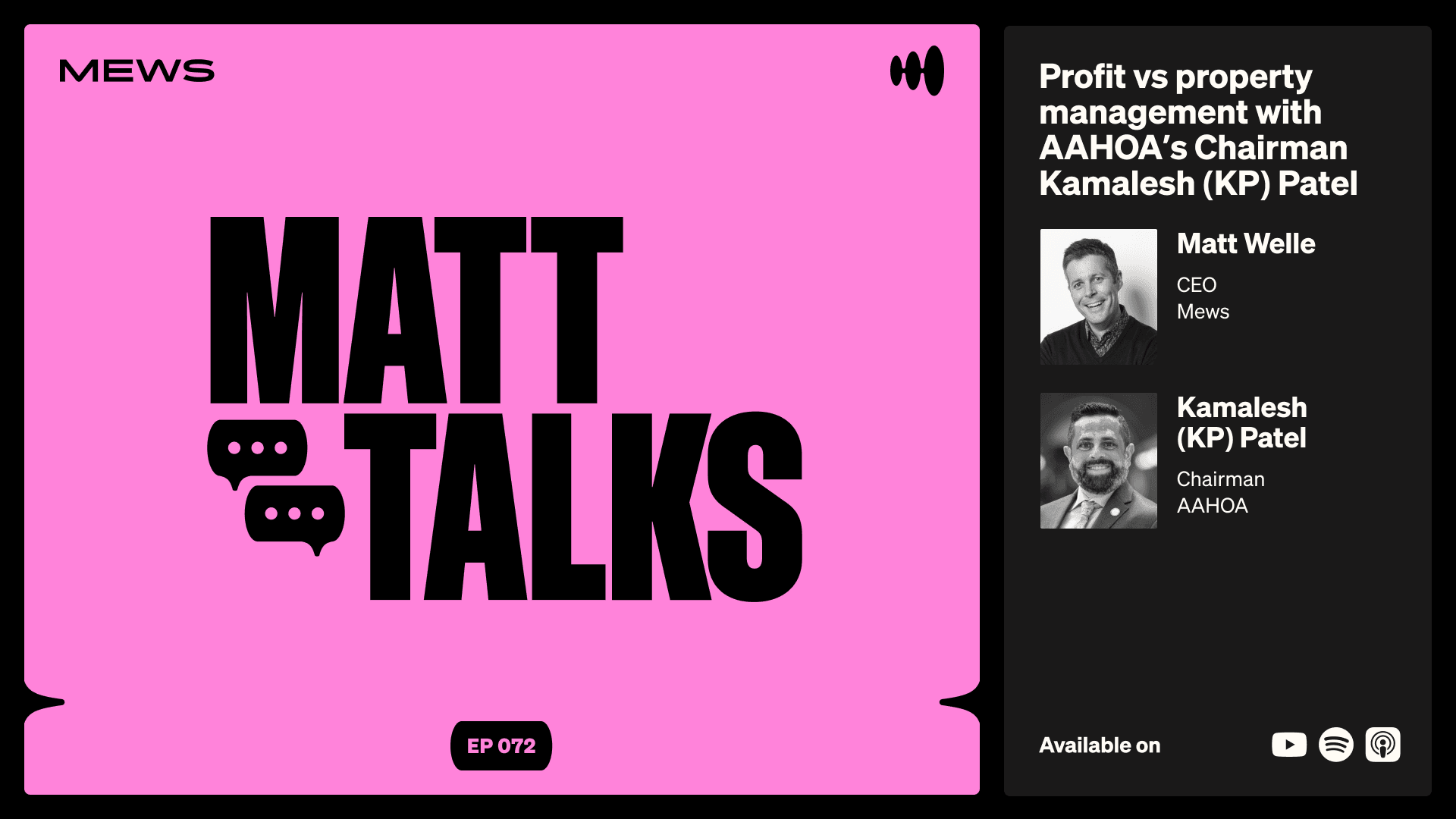
[00:00:23] Matt Welle: Hi, everyone. Welcome back to another Matt Talks hospitality. And today's a special episode because it's about a special partnership. Today's guest is Kamlesh Patel, or KP as we call him. He's the chairman of the Asian American Hotel Owners Association, also called AAHOA, as you can see on his shirt, the largest hotel owners association in the world, and Mews has recently become the AAHOA official PMS. A second-generation hotelier, KP, grew up in the business and today still owns and operates hotels with his family in California, alongside running the properties. He spent years working inside AAHOA, serving as an ambassador, Regional Director Secretary before becoming the 35th chairman. So today, we'll talk about that partnership and what does it mean for the nearly 20,000 hotel owners of AAHOA, and what they get as a benefit from this partnership. Welcome.
[00:01:16] Kamalesh (KP) Patel: Thanks, Matt. Appreciate the opportunity to talk to all of your great fans out there.
[00:01:21] Matt Welle: Thank you. You chair the largest hotel owners association in the world, but can you just, like, I think a lot of people have probably not heard of it because a lot of listeners might be from different countries, but also maybe in the U.S. What does AAHOA do?
[00:01:34] Kamalesh (KP) Patel: I think the better question, Matt, would be, what does AAHOA not do? We're very unique. And what AHAOA stands for today is anything in the interest of our members, which is ultimately the owners of the property. We advocate, we negotiate deals, get into great partnerships, pretty much anything like a home owner operator does today. We're a jack of all trades association for our owners.
[00:02:04] Matt Welle: Great. So, like, you go into purchasing contracts and, like, sales contracts, like, everything across the board, basically, to make the business a better business?
[00:02:12] Kamalesh (KP) Patel: Yeah. No. Absolutely. Look, the reality of hospitality today is it's not as lucrative as it once was. And who better to look out for the owner's bottom line than fellow owners? And that's kind of how AAHOA is structured today.
[00:02:27] Matt Welle: What's the origin story?
[00:02:29] Kamalesh (KP) Patel: Of AAHOA, or the…
[00:02:31] Matt Welle: AAHOA. Yes. When did it start? And what was the premise of it? Is it still the same premise today as it was at that time?
[00:02:38] Kamalesh (KP) Patel: You know, it's funny you asked that way. I think full circle coming back, yes. So, AAHOA is roughly 37-ish years old today. Matt mentioned that I have the honor of serving as the 35th chairman of this incredible association. AAHOA literally started with two simple premises: get insurance for our members, for actually hoteliers at that time, because we weren't quite formed, and work with the brands on allowing us to get into the system. That's literally the two simplest ways that we got started in the association. And it'll come back 37 odd years later, we're still having some difficulty with the brands. Granted, we own, you know, more than 60% of every hotel in this country today.
[00:03:24] Matt Welle: So, 60% of American hotels are owned by Asian hotel owners. Is that correct?
[00:03:30] Kamalesh (KP) Patel: AAHOA members own over 60% of every single hotel, be it economy through luxury in this country today. And we're probably over 70% of every single brand's pipeline growth as well today.
[00:03:46] Matt Welle: How did that happen? I think, like, people looking outside in, they don't know what the story is, how that happened, but I'm sure you know more about that, right?
[00:03:56] Kamalesh (KP) Patel: Yeah. I mean, you know, part of learning the business is understanding the history of it as well, right? I'll keep it at a high level, but early 50s, we got into the industry simply by mistake, by accident. It wasn't planned. It wasn't intentional working at a property, we're talking about our forefathers at this point, working at a property, and the current owner, who just didn't understand the business model of why they're not being profitable. So, the way we became profitable overnight is we lived on-site, we were housekeeping, we were maintenance, anything that needed to be done, our own accountants, we were able to consolidate and save money doing that, and that was washed, rinsed, and repeated, and finely tuned over the last, you know, 50-ish years. More than that.
[00:04:47] Matt Welle: Like, and I hope the people realize how hands-on you are still with your own hotels. And just before we got on this call, you told me the story about how you went back for a boiler, and you went to fix it yourself, right?
[00:04:57] Kamalesh (KP) Patel: Yeah. Well, I mean, I was planning on being in Atlanta and actually had to cancel that flight because we had a boiler go out on a busy, sold-out weekend and couldn't get the correct people in place. So, me and our maintenance guy, it took us about 6 to 8 hours, and it probably would have taken a professional a lot less. But yeah, it's a hands-on approach, and you know, we're always there and ready to step up.
[00:05:25] Matt Welle: I love that. And we recently announced special partnerships between Mews and AAHOA. Can you describe what that partnership looks like for hotel owners?
[00:05:35] Kamalesh (KP) Patel: So, one of the things that I think is fragmented in our industry today is technology. It's an area that, just quite frankly, nobody's really got their hands on and taken full control over. If you look at any other industry today, there's an underlying technology that kind of runs it, and then there's, you know, this spider web effect, right, of which direction it goes in. But at the middle of that spider web is an underlying technology. Today, you don't see that in hospitality. So, when the AAHOA went down this path of partnering with a property management system, it was simple. How do we bring all that technology in-house? How do we utilize that technology? And most importantly, how do we make that technology save on our bottom line and make it profitable? And quite frankly, it was Mews who understood what we were trying to achieve and didn't wanna be just the provider. They wanted to be a true partner in that and to help our hoteliers get the best out of the technology. So, it was quite frankly an easy decision at the end of the day.
[00:06:41] Matt Welle: I love that. Like, it was a hard process. You guys really, you made us go through the wringer, but it's important, I think, when you buy or start a partnership about such a critical component of your technology stack for, hopefully, 10 years. Like, you shouldn't be changing your core PMS solution every so many years. You should stick with it, but it's a big decision. But what was, like, the bar? Like, because I know how painful it was because, like, we wanted to win this, but you guys really just put us through the wringer. But what stood out for you with Mews? Obviously, we came out victorious from that process, which is what I'm very thankful for, and we still have to prove ourselves, but what was the thing that stood out for you?
[00:07:21] Kamalesh (KP) Patel: So, there were a few things, but if I had to pinpoint one, it was flexibility. Understanding that our members' needs today may not be the exact needs that it's tomorrow. Understanding that sometimes, what is in front of us today may not work for us tomorrow. That understanding was that, hey, if we have to pivot this product or if we have to make it more tailored for what your members are looking for, that was an open conversation. And, honestly, the most important part to me personally was helping us build out this beautiful ecosystem we're trying to ultimately achieve.
[00:07:59] Matt Welle: So, if you think about, you know, we're going into a lot of mid-scale and economy segments, that's where the properties are kind of operating in. Where do you think owners will feel the biggest impact of Mews?
[00:08:12] Kamalesh (KP) Patel: Honestly, I think they're gonna see Mews and be like, this is what a property management system is supposed to do. I've had many, many systems over the years of my properties here, and Mews is completely at a different level. Look, I don't wanna say anything bad about the systems I've used. They've worked for their purpose. But in today's technology, today's OTA world, although you know, getting into AI ChatGPT, how to utilize all those additional channels, I think Mews actually puts technology ahead of, as a priority. I don't wanna say ahead of the system itself, but as a priority. And I think that's truly gonna help our members understand that PMS is no longer a property management system. It's truly a profitability management system, and Mews hits all marks on that.
[00:09:01] Matt Welle: Yeah. We've really tried to, like, if you think traditionally about these kinds of systems that operate in hotels, they were just a system that you had to enter data into. But me and Richard, we started Mews, and we were just hoteliers who were struggling with the existing systems. And we just wanted something that made our lives easy so that we can actually focus on the job at hand, which is to run a great hotel. So, everything we do in Mews, we always try and think, like, does this make the life actually better for the hotelier, or is this just another way to get more data entered into the system by hand? Which, like, nobody wants to type data into a system. They want something that actually makes their life easier and makes them more profits, both on the revenue side or on the cost-saving side. So, I'm just so happy that you picked up on those things.
[00:09:45] Kamalesh (KP) Patel: Well, I mean, I have an inside view of a lot of this stuff, right? But, again, so here's the thing when it comes to AAHOA members and AAHOA itself. We are very uniquely positioned because not only am I representing 20,000 members in our industry, I'm also an operator. I'm also an owner. So, I'm not gonna tell my members to use something that, quite frankly, I'm not gonna use. I'm not gonna go out there and promote something that I can't personally believe in, because I'm ultimately your end user. I am your customer at all, right? So, it makes it very easy.
[00:10:19] Matt Welle: So, I read somewhere, and I don't know if this is true, that you actually didn't wanna be a hotelier when you were younger. Is that true?
[00:10:25] Kamalesh (KP) Patel: That is absolutely the case. I had zero interest in this industry.
[00:10:30] Matt Welle: What happened? Like, when did the switch happen?
[00:10:33] Kamalesh (KP) Patel: So, going back to school…
[00:10:35] Matt Welle: ‘Cause now, you're running the largest organization in the world.
[00:10:37] Kamalesh (KP) Patel: Yeah. I know.
[00:10:38] Matt Welle: Like something went wrong there.
[00:10:40] Kamalesh (KP) Patel: So, when people hear that story, they're just like, well, it doesn't make sense. How do you go from not wanting to be a part of the industry to literally being the chairman of the largest owners' association in the world? Growing up in the hospitality industry, I literally grew up in it. I lived at the motel behind the front desk. We had, you know, a two-bedroom apartment. Even though we lived in such close quarters, mom and dad were not really around, which is odd to say, you know, when you're in the same room, but they're not there, because they were working their butts off to ensure that we had, you know, the best possible life that they could provide at that time. So, their business is, again, you're hearing this from a perspective of a 13-year-old at this point. Mom and Dad don't care about me; they care about their business, which, obviously, now understanding where I'm sitting today, that's absolutely not the case. They just wanted to make sure that they were able to provide and give me the best life possible. Growing up, all I saw was mom and dad being away, right? Either at the motel or, you know, doing something in regards to the motel, waking up in the mornings or waking up in the middle of the night to rent rooms. I'm like, Dad, really? You are waking up at 2 O’Clock in the morning to rent a room at that time for $40, $50 dollars? Like, really? And you know what? He said, “KP, one day you're gonna understand.” Didn't yell at me. Didn't get mad at me. Didn't say, you know, you're an ungrateful SOB. Nothing like that, right? He just said, “One day, you'll understand.” And going through high school, I didn't get to go out and, you know, hang out. I live in a beach town, Santa Cruz. My weekends were working behind the front desk, you know, all my friends are at the beach, bonfires, having fun, you know, the whole works. And I'm literally working till, you know, until the hotels are sold out. And I don't even just sell out one property. It's my responsibility to make sure all of our properties in Santa Cruz were sold out before I get to go to sleep or go out. So, again, the whole hospitality world to me then was work, work, work. There was no real pot of gold at the end of this rainbow. So, went to college, I'm like, you know, what? Mom and Dad gave me this opportunity to get an education. I'd be a fool not to take advantage of that. So, I got my undergrad, dual degree, and then went to law school at UC Davis. And I'm sitting at law school at the end of my final final, you know, 01:30, 02:00 in the morning, eyes drooping, books stacked up, and it's literally like an epiphany hit me. I could probably be what? Top 2, 3, 4% of lawyers in the country, and I'm gonna make, what if I'm lucky, 5, 6, 7 thousand dollars, and I'm still working for somebody, and I'm still working these crazy hours, and I'm not building a portfolio. I'm not building any assets. It's whatever I invest, right, ultimately. So, man, I mean, I literally took my final, went home, and said, mom and dad, if you guys are okay with it, I'm sorry for wasting thousands and thousands of your dollars on law school, but I think it's time for me to come home and get involved in the family business.
[00:13:57] Matt Welle: But did the background in law, or you know, doing something completely different, like, it sounds like you came back more motivated than ever, but did that background help you in running hotels in any way, or was that a waste of money?
[00:14:10] Kamalesh (KP) Patel: No. No. Look, I think anytime you have an opportunity to better yourself, you'll utilize it either directly or indirectly. I think going towards a formal education allows your mind to look at things in a different way, getting out of the hospitality industry. And remember, I still worked in hospitality while I was going to college, right? Even though mom and dad paid for my college lifestyle, and thank you for that, obviously. But even though they paid for my lifestyle, I still came home almost every weekend. I mean, I understood where the bills are being paid. I still respected what the industry gave us, but I'm just like, I can't do it like that.
[00:14:46] Matt Welle: Like that work ethic that you have, that you grew up with, does the next generation have that same ethic?
[00:14:51] Kamalesh (KP) Patel: I don't think they have to. I mean, look. I mean, you'll meet my kids at the AAHOACON here in Philadelphia in a matter of a couple of weeks now. But my kids have never lived at the, well, very shortly, but for a couple of years. But my kids are growing up in a house. They have a completely different lifestyle. And here's what I tell our young professionals. We have this great initiative at AAHOA called HYPE, right, Helping Young Professionals Evolve. They don't need to do what my mom and dad did. They don't need to do what I did. The one thing I always say is don't look at hospitality for what it is or what it was. Look at the hospitality of how you want it to be for you, right? Many of our young professionals are never gonna be property managers. I would like to say they're probably gonna be asset managers. So, it's just a completely different way, it's not a bad way or a wrong way, it's the natural progression. You evolve into something bigger and bigger and bigger.
[00:15:46] Matt Welle: And if your kids come to you in a couple of years and say, dad, I do not wanna be in this industry, are you okay with that?
[00:15:52] Kamalesh (KP) Patel: I'll just say, “Yeah. You'll be back.”
[00:15:55] Matt Welle: I love it. You'll go to law school, and then you'll come back, and you'll run this business.
[00:15:59] Kamalesh (KP) Patel: It's not as profitable as it was, but the beauty of, and I'm gonna say it just like this, the beauty of my people is we are resilient. We absolutely know how to run the most efficiently, the best way possible, on anything we touch. We are, I mean, if you look at just America today, the top 2% or 3% of doctors are from Indian origins today. Some of the biggest tech companies' CEOs are of Indian origin today. I mean, Matt, no other way to say it. We're damn good at what we do.
[00:16:34] Matt Welle: I love it. I absolutely love it. If we go back to business, sorry. I find this really fascinating. But if we go back to the business of a hotel in America, you guys are the owners of hotels, but then there's the friction between the owners and the brands. And the U.S is mostly an asset like model. So, you buy a brand that you put on the roof, but then you actually operate it. But how do you navigate the tension between what the brand wants versus what AAHOA wants, and how to operate the hotel?
[00:17:01] Kamalesh (KP) Patel: Yeah. I mean, I think you're asking a question that initially started 37, 40 years ago now, right? Then we're still trying to answer those questions. A person once told me, “KP, you're not gonna change the industry overnight. You're not gonna change it in your one year as the chairman. What you hope for is incremental change. It gets a little bit better day in, and day in, and day in.” Ultimately, what's happening is, and this is public information, so any brands here and out there? Yeah. You guys talk about it to Wall Street all the time. How does a brand go to its shareholders and boost record numbers? But the majority of your franchisees are not making the same amount of profit. We're not making the same amount of revenue. Our margins are shrinking. So, it's concerning when you hear brand executives say record numbers, record growth. It's never been better here at, you know, brand a, b, c. And I'm looking at my P&L's and balance sheet going. Yeah. I don't know where he's getting this number.
[00:18:05] Matt Welle: Not over here.
[00:18:06] Kamalesh (KP) Patel: Numbers are coming from, but it's not me. The problem here, Matt, is you're gonna hear a lot more of what I have to say. The stories I'm just telling you are gonna resonate throughout the membership today. And it's a double-edged sword here. The problem here is that we are damn good at what we do. We know how to be efficient, we know how to prioritize where money is gonna go, and how do we make our payments, which is also probably our greatest weakness at the same time, because a lot of people say, hey, it doesn't matter how much we squeeze, they're still gonna do business with us. That model, that business understanding, absolutely has to shift.
[00:18:44] Matt Welle: Yeah. Because where do you think that gap comes from? From what the brands say publicly, and they're thriving, to the actual P&L or the business operator, where are the costs going up significantly that's making that difference so much worse today?
[00:18:58] Kamalesh (KP) Patel: Look, without getting into the nitty-gritty, I can tell you my fees have never gone down. Doesn't matter how much I've made. My fees have never gone down. I've got brands out there. And if you look at my fee structure year over year over year, it doesn't matter if my revenue's gone up by a dollar or gone down by a dollar, my fees have never gone down by a dollar. So, ultimately, you know, math is math that's coming out of the franchisees' fees. It's squeezing us for every single penny that is squeezable.
[00:19:30] Matt Welle: Yeah. So, how do we solve that together? And, like, what's the impact that we can have through this partnership to make those businesses more successful going forward?
[00:19:40] Kamalesh (KP) Patel: So, I mean, I'd be the chairman for more than a year if I could exactly answer that in one easy sentence here. But the truth is, there's a place for boutique independent properties, and there's a place for branded properties. What I'd like to clearly state to at least my members in future, prospective hoteliers, do your due diligence. Understand the business very well. Do not rely on any single brand, entity, or AAHOA person to make your business decisions for you. Just make sure you're well educated, and you're making the decision on your behalf. Now switching over to Mews, which is ultimately why we're here today. Mews helps us put a platform together for our boutique independent hoteliers, um in a way that, quite frankly, AAHOA has never offered its members, right? Going back to what we had started earlier in this conversation is the technology is fragmented. Today, if you look at it, your PMS does what? Check-in, check-out, rate management, give me some reports, but if you want to get into an RMS, you're looking for an outside provider. Well, Mews has that offer baked in. If you wanna try to get other services integrated into the PMS, well, you're at the mercy of the PMS provider. Mews had over a thousand ready to go today. And a lot of those, you know, obviously, doing our due diligence process with you, saw that, hey, a lot of these are already vendors we were working with today. Ultimately, what we're trying to say is we're gonna utilize our partnerships, our vendor partners, and technology to come in with an ecosystem that, quite frankly, lowers our operating cost. And Matt, if you're okay, just touch on a couple of things here. Think about something as simple as your lock. If you go to the front desk today, the lock is something we don't really think about. But there's an encoder, a key machine, or a program that has nothing to do with the PMS. It's literally a separate part program or a box that doesn't talk to anything. How simple is it to say, if you wanna be a part of the AAHOA services or the AAHOA certified program, all you need to do is put your program and connect it with Mews. So, when I click check-in, guess what? I'm making the key. I mean, it's basic. Or we're looking at working with energy-efficient partners that, when somebody checks out of the room, all nonessential items turn off. You know, if I'm in Texas in the middle of August and I don't, you know, as an operator, don't want my room to go below or above 85, 90 degrees because I still want my customers to be comfortable, I can set that. Somebody calls me at 3 O’Clock in the morning saying, “Hey, man. This next-door neighbor, the TV's way too loud. I don't know what's.” Guess what? I can lower the volume or turn off the TV right from my PMS. It's the little basic things like that that are gonna cut our cost, and most importantly, give our guests a much better experience.
[00:22:54] Matt Welle: That's a great answer. Thank you for that. A brand new build, a new hotel that starts from the ground up. It's very easy to, because they'll be natively in the cloud, but a lot of operators operate an existing hotel and have to migrate into the cloud. What do you think the hesitancy is of a lot of operators to actually make that decision? Because, like, it's kind of working. It checks in and checks out. It does a bill. We're good. What's the critical moment? Say, no, actually, it is no longer good. Like, there is a movement, and it will make you a better business. But what do you think is the thing that's holding those operators back from moving into the cloud?
[00:23:29] Kamalesh (KP) Patel: So, one of the most important parts of our business today is the PMS portion. And one of the things we look for all the time, and I hear this time after time, and I'm one of those people that say it. I just know the system. I understand it. I can be away from the property, and my manager can have a problem. And I can talk him through the whole thing in, you know, a couple of minutes, and I'm good. Also, I don't know if people actually are in tune or have been experienced to what technology can actually provide to the bottom line. And one of the things that AAHOA is gonna work on heavily this year, in Rahul's chairmanship, which is coming up in a few days, is making sure our members do understand ultimately two things: why did AAHOA decide to partner with Mews for this particular partnership? And how is this actually gonna benefit them? And I think that is gonna be the part that we're gonna, you know, have to help educate our members with, that it's important to utilize these things. It's a whole new world.
[00:24:30] Matt Welle: Yeah.
[00:24:31] Kamalesh (KP) Patel: I mean, it's more than getting your iPhone and doing this, right? We're talking major changes to the industry.
[00:24:36] Matt Welle: Like, it's the little things. Like, if you're at a restaurant and you just wanna log in to the hotel, like, yeah, you just use it with your iPhone. And I remember when we started 14 years ago, when we were running our PMS on an iPhone, we would be in meetings, and we would just log in to the system to show people. And they're like, what? Like, how did you get into the PMS? I’m like, that's what it was, how easy it is. And I think a lot of operators don't realize that until they see it, and then they never wanna go back to the time of having a server in the back office, like, obviously, the cloud is the future, but what you can do once you've deployed it, like you said, through the API integrations, but also with AI, we deploy AI features natively. Like, you wake up one day, and then you have a new feature in that system, and it's those things that people get really excited about, that there isn't, like, some downtime to deploy a new version of the system like we used to get. It literally happens multiple times a day, and then buttons appear, or features appear to make your life easier.
[00:25:34] Kamalesh (KP) Patel: No. Look. The beauty of a cloud-based system and going away from SaaS is exactly what you just said, Matt. It's ever evolving. We're not stuck in this box or sandbox of sorts, right? It's, hey, we don't like the way this feels? Let's update it. Our members are, you know, our hoteliers are looking for a specific type of report. Let's build it out, and you're able to launch it in real time. I think we use cloud on a day-to-day basis; we're just hesitant, allowing that service into our industry to a certain degree. And quite frankly, I mean, there's no other way of looking at it. You gotta move forward and utilize technology in our favor.
[00:26:15] Matt Welle: Yeah. Yeah. We just launched. So, you just said something that triggered me. We just launched Mews BI because one of the things we also get from Adele is, like, I want this very specific report. And this column needs to say this, and this row needs to say this. And we're like, yep, we have new reports. And hoteliers, they want things in certain ways. So, with Mews BI, we're like, great. Now, you can drag and drop, and you can create a report the way you want it. And it's been such an epiphany for hoteliers who are like, oh, finally, I can actually just upgrade your old report, but keep the core of what I wanted and then add new data fields to that or widgets in some way. And it's just wonderful to be able to drag and drop and build everything from the ground up in a way that even I can do it. Like, you don't need, like, to hire an IT department to build your reporting. You can literally just go in and just do it yourself.
[00:27:00] Kamalesh (KP) Patel: No. I mean, look. Every hotelier is special. Let's leave it at that, right? Everybody wants things done in a certain way. I wanted a simple report that helped. This is before we could do it online. Just allow me to print out my transient occupancy tax report, TOTs. I said, here's the report, just let me do TOTs, give me a button, and literally, you'll dump all that information into this. And I couldn't do it, right? It's like, oh, well, you know, this and that and whatever. So, I'm sitting there, and it didn't, it wasn't like it took me a long time. But every few minutes here, every few minutes there, it all adds up. And you wanna be able to say, if I'm going into the future and if I'm going into technology, I'm hoping that there's some customizations available to me, right? So, that's a big deal. I didn't realize that BI was coming that quick and I didn't know it was launching.
[00:27:55] Matt Welle: So, in a couple of weeks, AAHOACON is coming up. And probably when we publish this, we're right at the cusp of AAHOACON. What is it? And what can attendees expect?
[00:28:05] Kamalesh (KP) Patel: Well, I'm hoping that all the attendees have already been to at least one, if not multiple AAHOACONS, but we're doing AAHOACON 26 in the city of brotherly love, Philadelphia, Pennsylvania. It's an incredible time for us to be there. It's the 250th birthday year of America. AAHOACON going into its almost 40th birthday as well, 38 to be exact. Just again, it's very fitting that a hole is there for America's 200th birthday. We are the epitome of what our forefathers fought for. We are there for the pursuit of the American dream. Look, you're gonna have the biggest and best trade show any organization can offer you. We’re at over 500 booths, vendors already committed to being at AAHOACON, two and a half days of great food, great entertainment, great speakers, and education. I just don't know who else is gonna give you curated materials that is actually gonna help you today and not hypothetical information that may or may not happen in the future. That's a key difference between us and other organizations.
[00:29:21] Matt Welle: KP, I wanna thank you for today. I've really enjoyed our conversation, and I'm very excited to meet you in Philadelphia at the AAHOACON. I mean, if you are an AAHOA operator, come and see us. We are close to the door, and we're like, there's no way you'll miss our booth. Like, I promise you. We're gonna have a great time.
[00:29:37] Kamalesh (KP) Patel: No. It was a pleasure being here, Matt. Thank you for the opportunity. And just a message out to our members. Give all of our partners an opportunity to earn your business. We're never gonna tell you you have to use them because, quite frankly, we understand how it is to be a part of the brands. We don't want more mandates. But I can promise you one thing, anything AAHOA puts its name behind is owner-certified like myself, and I always wanna make sure we bring the best to our members.
[00:30:04] Matt Welle: Nice. Thank you, KP.
[00:30:06] Kamalesh (KP) Patel: Thank you, Matt.


