What to expect?
Episode chapters
Transcript
[00:00:00] Miru Schuurman: So, I'm also a big fan of SOPs, but I think nowadays, we really are too much focused on structure and SOPs. And, unfortunately, therefore, we are creating more robots instead of creating personal surfaces.
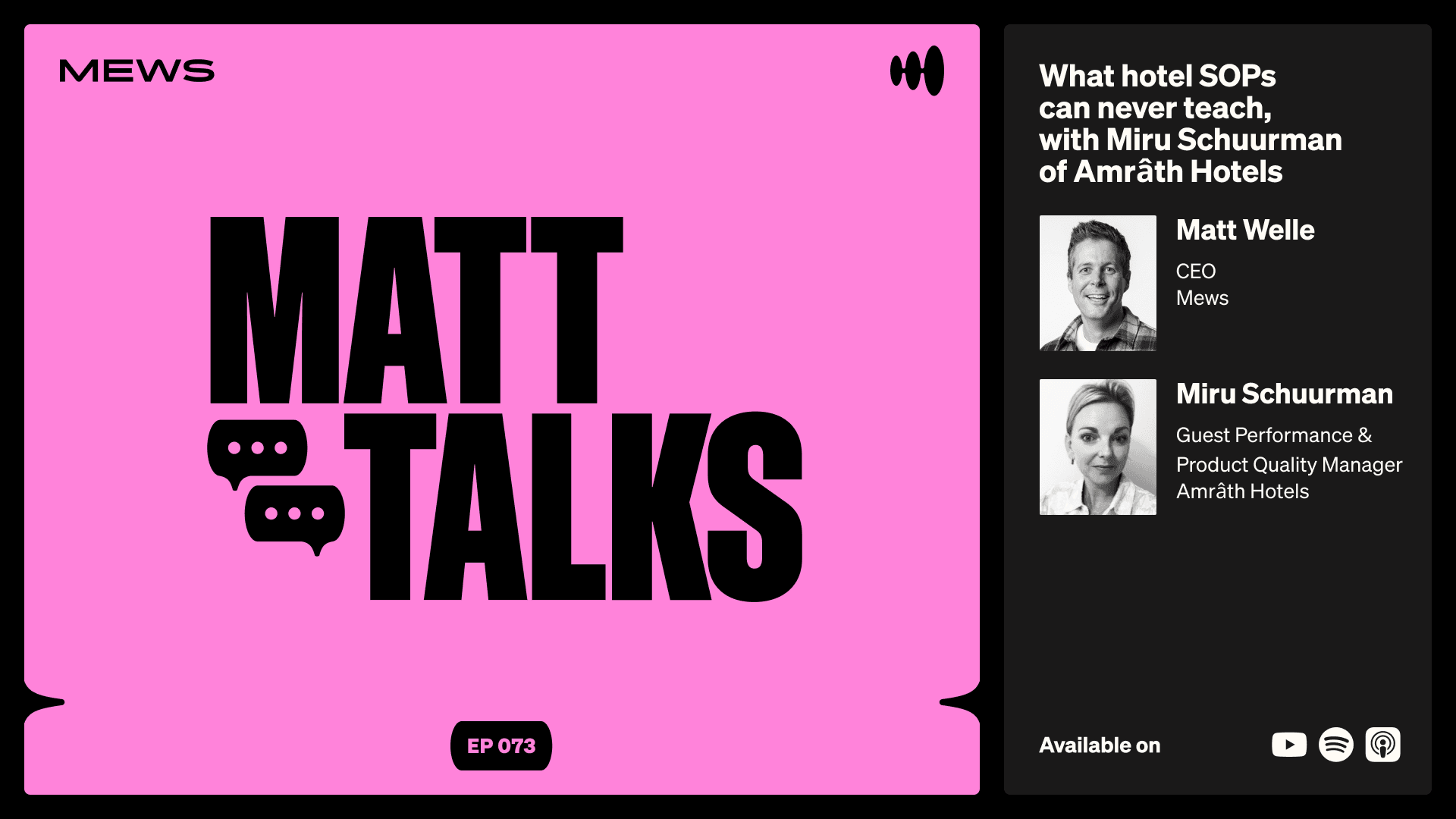
[00:00:26] Matt Welle: Hi, everyone. Welcome back to another Matt Talks hospitality. And this week, I have a guest that my team got so excited about once they had met her, and they said she needs to be on Matt Talks. So, today's guest is Miru Schuurman. She's the guest performance and product quality manager at Amrâth Hȏtels, which is a collection of 12 hotels spread across the Netherlands. Miru has spent her career deep in hotel operations, including more than a decade with NH Hotel Group before moving into a role focused on guest experience quality and training. Today, Miru works at Amrâth Hȏtels, where she helps the team improve the processes and details that shape a guest's stay. And their focus is simple, teach people to notice more, listen better, and turn everyday interactions into memorable guest moments. Amrâth is also a Mews customer, and our team recently ran a guest journey workshop, which is where they met Miru, and that is also the inspiration for why she's here today. Thank you for joining me.
[00:01:19] Miru Schuurman: Thank you. Thank you for the nice introduction.
[00:01:22] Matt Welle: Did you always want to be a hotelier?
[00:01:24] Miru Schuurman: Yes and no. Since I started working in the hospitality industry when I was 13 years old...
[00:01:34] Matt Welle: 13?
[00:01:35] Miru Schuurman: Yeah. 13. Yeah. I really started in stewarding as a dishwasher.
[00:01:39] Matt Welle: It's like child labor. Is that allowed even
[00:01:40] Miru Schuurman: No. It wasn't allowed at all. But, yeah, I wanted to earn some money, so I was really happy that I could start my first job.
[00:01:47] Miru Schuurman: I enjoyed it a lot because it was really fun with all the guys in the kitchen. And, yeah, I enjoyed it. I did it for one year, and then they asked me to move to the surface parts. And I think that's the part where I really fell in love with the hospitality industry, because before that, I didn't have any clue what to do after my high school and within, yeah, that period, I fell in love with the guest interactions, and I decided to study hospitality management. Yeah.
[00:02:18] Matt Welle: And you never looked back.
[00:02:19] Miru Schuurman: No. No. No. I never did. No. And I always explain that you either love this industry or you don't. And I think that's the most simple answer.
[00:02:31] Matt Welle: Yeah. Because it's day and night. It's really hard work. And, you know, we don't pay people particularly well. But, like, if you love the industry and you love making a change in guests' experiences, like, it's worth sticking around.
[00:02:45] Miru Schuurman: Yeah. Yeah. Definitely. And also, you need to love the vibe. Every day in a hotel is different. You don't know what to expect when you walk into a hotel early in the morning. And that's something that you really need to love. And there are, of course, a lot of people that really want to have structure within their day and want to have the day being similar every day of the week, and yeah, if you like that, then the hospitality industry is not your property. No. Definitely not.
[00:03:16] Matt Welle: And I looked at your job title, which is a very unconventional title. And I wonder, it’s Guest Performance and Product Quality Manager. Is that correct?
[00:03:24] Miru Schuurman: Yeah. That's correct. Yeah. It’s not something…
[00:03:26] Matt Welle: And did you make out the title, or was there a place before that had the same role?
[00:03:30] Miru Schuurman: No. No. It's a new role within Amrâth, but it was decided back then by the board. And honestly, I always explain that I am supporting our hotels and general managers to improve their guest experience in terms of service and also in terms of quality.
[00:03:50] Matt Welle: Yeah.
[00:03:51] Miru Schuurman: And not only in terms of the level of service, but also definitely the product quality, the sleep quality, so that's always how I explain it. And within our chain, they're also making fun of my job title always, so I don't care. I don't care about titles. I just want to support and help the teams to make sure we develop the guest experience.
[00:04:16] Matt Welle: Because how do you know, how can you tell from data points at the hotel that you're doing a good job? Can you measure it in some way?
[00:04:22] Miru Schuurman: Yes, of course. Yeah. We are working with Revinate. Maybe, you know, the review management system?
[00:04:28] Matt Welle: Like the CRM that does email campaigns to customers?
[00:04:30] Miru Schuurman: Yeah. Yeah. But also, really, yeah, getting all the input from all the different OTA channels, but also our own websites to make analysis, to create quality scores, to create goals and targets. So, it's really a good system to work with because it not only giving me a lot of insights and creating beautiful reports, but it's also really easy for the hotel teams to read and to see what their improvements are, but also what they're really good at. And my job within the chain is to compare it within the hotels and to make sure that the things that we are doing well, we put a bit more extra in the spotlight, and to make sure that the things we need to develop on, we are really making a plan and working together with the hotel team to improve it.
[00:05:22] Matt Welle: I think you've previously said: “Loyalty doesn't have to cost anything. Opportunities are so simple if only you can see them.” What did you mean by that?
[00:05:31] Miru Schuurman: Yeah. I mean that loyalty is often created in the smallest human moments. In hospitality, we sometimes think that we need big gestures or expensive perks to impress guests, but in reality, loyalty for me is often built through attention and personal empathy. And for me, hospitality is really about seeing a guest and creating those special personal moments. And when you do that, opportunities to create extraordinary surface moments will appear.
[00:06:09] Matt Welle: Yeah. Can you give an example? Like, I hear you in saying, like, not everyone has to have a bottle of champagne waiting in the room. But like, what could be something small that a hotelier could do?
[00:06:18] Miru Schuurman: I think it's one of the experiences I told your team during our amazing workshop together. I was visiting one of our hotels in Amsterdam, I think a couple of months ago. And there was an elderly guy who was walking through the building, and he was really looking up and down and looking at the architecture of the hotel because, yeah, Amrâth Amsterdam is one of the most, in my opinion, one of the most beautiful hotels in the Netherlands. So I approached him, asking him if I could do anything for him, acknowledging that he was loving the architecture. So, we got into a conversation together, and he told me that he was an architect himself previously, but he retired. So, he specifically booked our hotel in Amsterdam to experience the beautiful building that we have. So, for me, that was immediately an opportunity to see what we can do extra to make sure his stay was memorable for him. Yeah. And for me, that was really, really easy. I just asked one of our porters to give him a private tour through the hotel.
[00:07:30] Matt Welle: I love that. And it sounds like, is he one of those porters who has been there for many, many years in the past?
[00:07:36] Miru Schuurman: Yeah. And he knows everything about the history. And the guest was so surprised and amazed by the gesture, which didn't cost us any money. It wasn't busy at all in the hotel. So, yeah, that's what I mean by seeing and creating those extraordinary moments yourself, which is not costing any big investments or any big gestures. It's just really simple, but you need to see those opportunities. I think that's the big difference.
[00:08:07 Matt Welle: And did that skill come natural to you? The skill to just observe and see that someone is doing something, and the ability to notice these things?
[00:08:15] Miru Schuurman: Honestly, no. I think that it's a combination of your personality, but also combined with the way you are coached and a menace. I think that nowadays, everyone who's starting their career in the hospitality industry is really trained and focused on procedures and structures, and manuals, and SOPs and whatever. We also have them in the hotels, many of them. And I think that you need to have them to create a specific basic level of service within the hotels and within the different departments. So, I'm also a big fan of SOPs. But I think nowadays, we really are too much focused on structure and SOPs, and therefore, we are…
[00:09:08] Matt Welle: To ask to get a view is sometimes a good thing. Yeah.
[00:09:10] Miru Schuurman: Yeah. And unfortunately, therefore, we are creating more robots instead of creating personal surfaces. So, yeah, for me as well, in the beginning of my career, I was really trained on how you need to check in, how you need to do this, which steps you need to take. And after that, I luckily got a really good manager above me who trained me and coached me to see those extraordinary moments, and that's…
[00:09:34] Matt Welle: And how do you, so there's 12 hotels, there's one Miru. How do you scale that kind of experience to all of these employees everywhere?
[00:09:43] Miru Schuurman: Yeah. I think in different channels, it's not only my job to do. It's a combination of the role of our HR manager, but also our general manager, our director of operation because I don't think it's something that me, as a person, am able to do within 12 hotels and so many big teams. I think it's sufficient that you need to have throughout the entire chain, that we, as a company, find it really important not to only be hospitable to our guests, but also to create a good and safe environment for our employees. Because I really believe that if we are focusing on being hospitable to our teams, they will deliver a better service. And I think it's a combination of a lot of things. You need to have good trainings and I'm really happy with the fact that we started a completely new training program as of last year, where we have many service and hospitality trainings given by…
[00:10:45] Matt Welle: Is this, like, a classroom or this e-learning, or what kind of training is this?
[00:10:48] Miru Schuurman: No. Most of them are classroom trainings, but given by external companies. So, we really hire experts to make sure that, yeah, they're upgrading the level of service within our team. But it also has something to do with keeping it as a live topic on a daily basis, mentioning it through daily briefings with the departments. We are working with one team. It's like a company, Facebook, I always explain. I'm sharing a lot of service inspirational videos on that platform to make sure that the topic will stay alive. It's not something that you are doing by just one exercise or one time; you need to focus on it, you need to keep it alive within the chain. So, there are many things that we are doing to make sure that we are, yeah, focusing on that with the teachers.
[00:11:39] Matt Welle: So, when you start to see pockets of people starting to pick up on the lessons, how do you celebrate it? How do you create this culture of positive reinforcement of it?
[00:11:49] Miru Schuurman: I think that that's, yeah, mostly my part to do, but also the part of the GM to make sure that we are recognizing those extraordinary service moments and that we are really indeed, what you're saying, celebrating it. So, I very often deliver cakes to the hotels to make it really into a celebration moment within the team.
[00:12:11] Matt Welle: You baked the cakes yourself?
[00:12:12] Miru Schuurman: No. I don't bake them. No. They don't want me to. No. They don't want me. Believe me. I ordered them.
[00:12:17] Matt Welle: That'd be torture, like, if they don't do that job well, you will bake them a cake.
[00:12:20] Miru Schuurman: Yeah. Yeah. Definitely. So, that's something that we are doing, but we are also really focused on employees who have been named in a review with their personal name, so we are really promoting that as well. But also not only personal, individual-wise, but also team-wise. One of our hotels recently reached the 8.4 ranking on Booking.com
[00:12:49] Matt Welle: Wow.
[00:12:50] Miru Schuurman: Which is quite impressive, especially when you realize that two years ago, they were still on the 8.0 level. So, that's a really great improvement. And that's something that not only I'm paying attention to and complimenting the team about it, but also our e-commerce department is making a nice story about it. So, I think it's also that is something that you need to do together as a team to create a culture, to create a vibe where guest experience and the development within the guest experience is rewarded.
[00:13:24] Matt Welle: Yeah.
[00:13:25] Miru Schuurman: And you can reward it in any kind of way.
[00:13:27] Matt Welle: Have you seen people that were very skeptical at the beginning? They're like, yeah, yeah, training. I don't really wanna do training. But then, actually, once they went through it, you saw a real differentiated change in their behaviors.
[00:13:38] Miru Schuurman: Yeah. Yeah. Definitely. And I think that's still something that we are still in the transformation period, because I think the last years, we didn't spend that much time and investments on training. So, I think that most of the teams are really happy that we now eventually have a great training program, but they are still, like you mentioned, hesitating about which kind of level of training they will get. And they rather feel it like something that they need to do for their manager instead of making it an opportunity, or as an opportunity for their own personal growth. And I think, therefore, it's really good that we are working with external experts, because now you see they are really enthusiastic about the training that we are supporting for them.
[00:14:36] Matt Welle: Was it hard for you to get funding? So, one of the hardest things about training is, you know, getting someone to fund it because it doesn't directly instantly drive revenue. It's a long-term investment in the culture and the change. But was it hard for you to get it funded?
[00:14:49] Miru Schuurman: No. I think that's yes and no. It took a while for the HR manager within our chain to change the vision within the board of the company. But that vision really changed last year. And therefore, I think she created a perfect plan at the right moment at the right time, and knew exactly when she needed to bring it back up. So, eventually, it wasn't that hard last year, but it took a while to get there.
[00:15:29] Matt Welle: And are you seeing an impact from the training, like, in the business results in some way?
[00:15:34] Miru Schuurman: I don't think we're seeing it yet in the business results, although maybe we do, but it's really difficult to really see. But we definitely see the impact on the happiness of our teams. And I think that's, for me, the most important impact that we could reach. Because in the end, if they are happy within their daily job and they have the feeling that we, as a company, are investing in their personal growth, they will stay with us, but they will make sure that their level of service and quality will increase. That's just an automatic conclusion. So, yeah, eventually, you will see it in the business results, but it's really difficult to say, okay, staff member A had a training four weeks ago, and therefore, the business results two weeks later increased. That's not realistic.
[00:16:32] Matt Welle: Yeah. Add the coins towards that.
[00:16:34] Miru Schuurman: Yeah. Yeah. Definitely.
[00:16:36] Matt Welle: I feel that there's been a real cultural change in the last two years at Amrâth, and it's also why we ran a workshop with you guys, because we're like, something is changing here, and there's this growth mindset around guest experience that we have seen at your company. And we're like, let's go on-site. Let's spend some time with them. Can you tell me about what this workshop was and why, you know, did you wanna spend time with us on that?
[00:16:57] Miru Schuurman: Yeah. It was really interesting because your team was from different expertise, and us as well, our marketing manager was present, our ICT and application manager was present, and I was present myself. And it was really like a brainstorm workshop to see, not to see where we are currently, but to see where we could reach in the future. So, it was really focused on the future, how all of us believe guest experience should look like within 5, 6 years, but also what changes the systems need to have to make sure that we could get there. But also in terms of our personal insight, because yeah, of course, an ICT and application manager looks really different in terms of the future of hospitality than I do. I will always stick to human interests, the personal thoughts, and the extraordinary service moments, and yeah, I'm not an ICT guy. Sorry, Matt. So, I'm not really focused on systems. Although I really believe that systems could make the daily, the day-to-day job of our staff members easier, which will result in the fact that they will have more time to spend on human interaction. So, it was really interesting. We really had a look at the future. We were brainstorming. It was a fun day as well. But for us, it was also really nice to see that one of our partners is spending so much time to invest in us as well, because your team was present with, like, five guys.
[00:18:42] Matt Welle: We get so much value out of it because often people like, you know, I'm a hotelier, but a lot of people at Mews aren't hoteliers. So, we like to bring in expertise from outside of the industry, but they also need to learn what does work at the front line, what doesn't work, so, like, it's super valuable for us to get the inputs. So, on the one side, you're learning from them, but we're learning tremendous amounts from speaking to hoteliers and spending a day in your hotel. And you can just talk us through the scenarios that happen at the reception because not everything that happens with hospitality is logical, you know. Sometimes, you just do things because we've always done them in that way, and then they question those things.
[00:19:17] Miru Schuurman: Yeah. That's true. That's true. I completely understand where you're coming from, but still, we are working with many different suppliers. We are working with many different partners. But yeah, really, my compliments for the fact that the time your team spent not only that day, but also afterwards, with sharing the summary, with checking again with us. And I'm talking about months later. Yeah? So, that's really what, for me, a partnership is all about. I think that we really have the same goal. Although we are coming from many different perspectives, but we have the same goal in the end. And that's something that we are not seeing really often, to be honest.
[00:20:01] Matt Welle: Nice. Thank you for saying that.
[00:20:02] Miru Schuurman: Yeah.
[00:20:03] Matt Welle: You think about technology in the scope of your role. Like, how do you leverage technology to make these guest experiences better?
[00:20:10] Miru Schuurman: Yeah. I think that technology, what I just mentioned, needs to play an important part in this in a supporting role, because I think it will, for me, yeah, in my point of view, it will always be supporting. The true impacts should eventually always come from our teams. But tech needs to help us to handle the operational side and the day-to-day job more efficiently, which eventually allows our team to spend more time with the guests, and that's something that we need. So, for example, systems could help us understand guest preferences better manage reservations more smoothly, and therefore reduce waiting times as well, because, unfortunately, not only we, but many other chains still have a lot of queues in their lobbies during the popular check-in and check-out times. So, I think that we, and maybe even more credit to my colleague, Kirsten, from ICT in application. She's always asking herself the simple question, does this technology give our team more time to connect with the guests? And if the answer is yes, then it's valuable for us. And then it's valuable to at least investigate the opportunities. And I think that's, especially from my service point of view, should always be the case. It needs to be supportive.
[00:21:44] Matt Welle: Because you talked about Revinate. So, you use Revinate so that people leave reviews, and then you've captured data. Does that data somehow get operationalized back into the hotels?
[00:21:54] Miru Schuurman: Yeah. Definitely. Because you have many, many reports that you can create, and not really, like, big Excel sheets and whatsoever. Really simple reports, where it's really easy, not only for me, but especially for the hotel teams, to really analyze the development points, but really analyze in detail also the given guest feedback because we see it in our hotels as well. We know our hotel really well. But after a few years, we are still getting blind to a lot of things. So, we believe that, for example, in our hotel in Scheveningen, at the beach, we believe that one of the biggest complaints that we always receive is the fact that during summer days, the rooms are not ready on time. That's something that we all believe as a team. But if you re-analyze the guest feedback, that's definitely not one of the top negative shared feedback from our guests. But that's something we believe. So, I really think that that's also a great example that we need tech to make sure that we are still seeing all the priorities straight and that we are not getting our personal emotions influenced.
[00:23:22] Matt Welle: Like, those are the most emotional moments when someone is angry about their room not being ready, and I think that's why it, like, sticks in people's heads.
[00:23:28] Matt Welle: It sticks.
[00:23:29] Miru Schuurman: Yeah.
[00:23:31] Miru Schuurman: Yeah. It sticks. Or when the room is not clean enough. So, I often visit our hotels, and they believe that cleanliness is one of the biggest improvement points. But honestly, our hotels are doing a great job in terms of cleanliness. And that's not something that I only see in my observations when I'm checking rooms, but also we see that in those analyzed reports from, for example, Revinate, but also in terms of ranking. But what you're saying is completely true. That's something that will stick to them because that was the big complaint from that guy who was shouting at the front desk and whatever.
[00:24:10] Matt Welle: I still remember the times I was screamed at by my guest, and that is, like, twenty years ago, but they're so emotional in these moments.
[00:24:16] Miru Schuurman: Yeah. And that's making an impact for the rest of, yeah, what you're mentioning for the rest of your career.
[00:24:21] Matt Welle: Yeah.
[00:24:22] Miru Schuurman: But that's not always straight to be focused on.
[00:24:25] Matt Welle: Yeah. The loudest person isn't always, you know, the voice of everyone else.
[00:24:30] Miru Schuurman: No. Most of the time, they're not, actually.
[00:24:33] Matt Welle: So, if you look forward, what are you planning for the next couple of years? What are the things that you get excited about at Amrâth?
[00:24:42] Miru Schuurman: Yeah. First of all, making sure that we keep on developing the guest experience because, as I mentioned, one of our hotels that reached the 8.4 in Booking.com, yeah, that's really the cherry on my cake, honestly.
[00:24:58] Matt Welle: Just the fact that you know the score by heart tells me you think deeply about these things and, like, the guest experience. I love that.
[00:25:06] Miru Schuurman: Yeah. I truly do. Because if I don't, I really believe that I should lead by example to all the hotels. So yeah, honestly, I know the ranking of all the hotels.
[00:25:19] Matt Welle: Miru, please remind me to know if I need to, so I can go revisit it.
[00:25:21] Miru Schuurman: Oh, it's our apartment hotel in Badhoevedorp.
[00:25:25] Matt Welle: Lovely.
[00:25:26] Miru Schuurman: So, it's a completely different concept. But yeah, they are doing so well. It's amazing to see. It's really good. And, yeah, I think I really, I'm curious about the developments that we can reach, especially within the new vision and the new board that we have, because currently, we're doing a lot of investments in our products. So, I'm really happy to and curious to see what the result will be in the end, guest experience-wise. Next year, we are going to open a new hotel. So, that's also something I'm really enthusiastic about in Utrecht. So, really…
[00:26:08] Matt Welle: I love Utrecht.
[00:26:09] Miru Schuurman: Yes. And we don't have a hotel over there yet, so I'm very happy with that. So, it's literally across Central Station.
[00:26:16] Matt Welle: Brand new built?
[00:26:17] Miru Schuurman: Newly built. Yeah. We are currently building. It will be a really big tower, where the hotel will be situated, but also just regular apartments. So, 250 hotel rooms, wellness, restaurant, and meeting rooms. Yeah. So, that's really…
[00:26:37] Matt Welle: Like a new real print for the future of Amrâth.
[00:26:39] Miru Schuurman: Yeah. Yeah. That is something that we're currently working on internally with the pre-act team. So that's, yeah, that's something I love as well, to decide what room types we will get, where the kitchen needs to be situated, and to really be involved. Yeah. Makes you proud as well in your daily job. And I really believe that nowadays, within our hotel within our chain, our opinions are valued by the board. And I think that that's, at least, that's making me really positive and enthusiastic about my job.
[00:27:19] Matt Welle: I can feel that.
[00:27:20] Miru Schuurman: Yeah? Oh, good.
[00:27:21] Matt Welle: Yeah. I can feel that.
[00:27:22] Miru Schuurman: Good. And that's making me, giving at least extra energy, extra power, but I'm really an ambassador of the chain as well, therefore. And I think that that's something that your team also really have. And what I really noticed when we had that great worship together, they are really, they are loving Mews. And yeah, from my point of view as a person, I really need to love my job on a daily basis. And if I don't, then it's time to do something else.
[00:27:54] Matt Welle: Yeah. Yeah.
[00:27:55] Miru Schuurman: So, yeah, there are a lot of good things coming, so. Yeah.
[00:27:59] Matt Welle: No. It sounds really exciting, and I'm so happy because I live next door to you guys. So, I always pass by the Amsterdam one as I go to the office. Because my house and the office is literally on the other sides of both sides of the hotel, so I pass by it every day. So, it's really nice to see the organization just growing and thriving.
[00:28:16] Miru Schuurman: Oh, that's good. That's great to hear. Thank you.
[00:28:19] Matt Welle: What's your advice for hoteliers who are listening, who wanna bring more guest focus or spontaneity into their businesses?
[00:28:25] Miru Schuurman: Honestly, I think it's a sad situation that, I know my job title is really, really difficult, but there are not many hotel chains that have a position like I have. So, if you call it like a guest performance report, a quality manager or a service manager or a quality manager. I know NH really, already for years have that position, but if you look towards many different other hoteliers and brands, this position doesn't exist. And I think that that's really a shame, not only because, honestly, I think it's one of the best jobs that you can have within the hotel industry, but also because it will really get you the results that you want. It's a supporting role towards the hotel teams, towards the GM, so I'm really able to help the GMs to get a bit of their workload off their chest to work together with the with their teams. But it shows, within Amrâth at least, that it will get you the results that you want. So, I think for the future, I really hope for the future that this is a position that will be just standard within at least the hotel chain, because you need to have this position. It's not a luxury job to have. It's mandatory.
[00:29:52] Matt Welle: I think in the time of AI and everyone talking about how do we eliminate more jobs from the hotels, I'm actually thinking we shouldn't eliminate them, but the jobs should change. And we should let the systems do the boring stuff. But, like, how do we use our humans in the best way possible, which is spontaneity in creating these moments and teaching them to see the man in the lobby that's looking at the architecture and then jumping into that. And it's just wonderful to hear that, you know, Amrâth is investing in a role like this. And I think 100% agree that more hotel companies should be doing this thing that Amrâth seems to be doing.
[00:30:24] Miru Schuurman: Yeah. Definitely.
[00:30:26] Matt Welle: Nice.
[00:30:26] Miru Schuurman: Yeah.
[00:30:27] Matt Welle: Thank you so much for joining me and sharing all of your insights.
[00:30:29] Miru Schuurman: Thank you. Thank you for your time as well.
[00:30:32] Matt Welle: Anytime.
[00:30:33] Miru Schuurman: Thank you, Matt.


