What to expect?
Meet your speakers

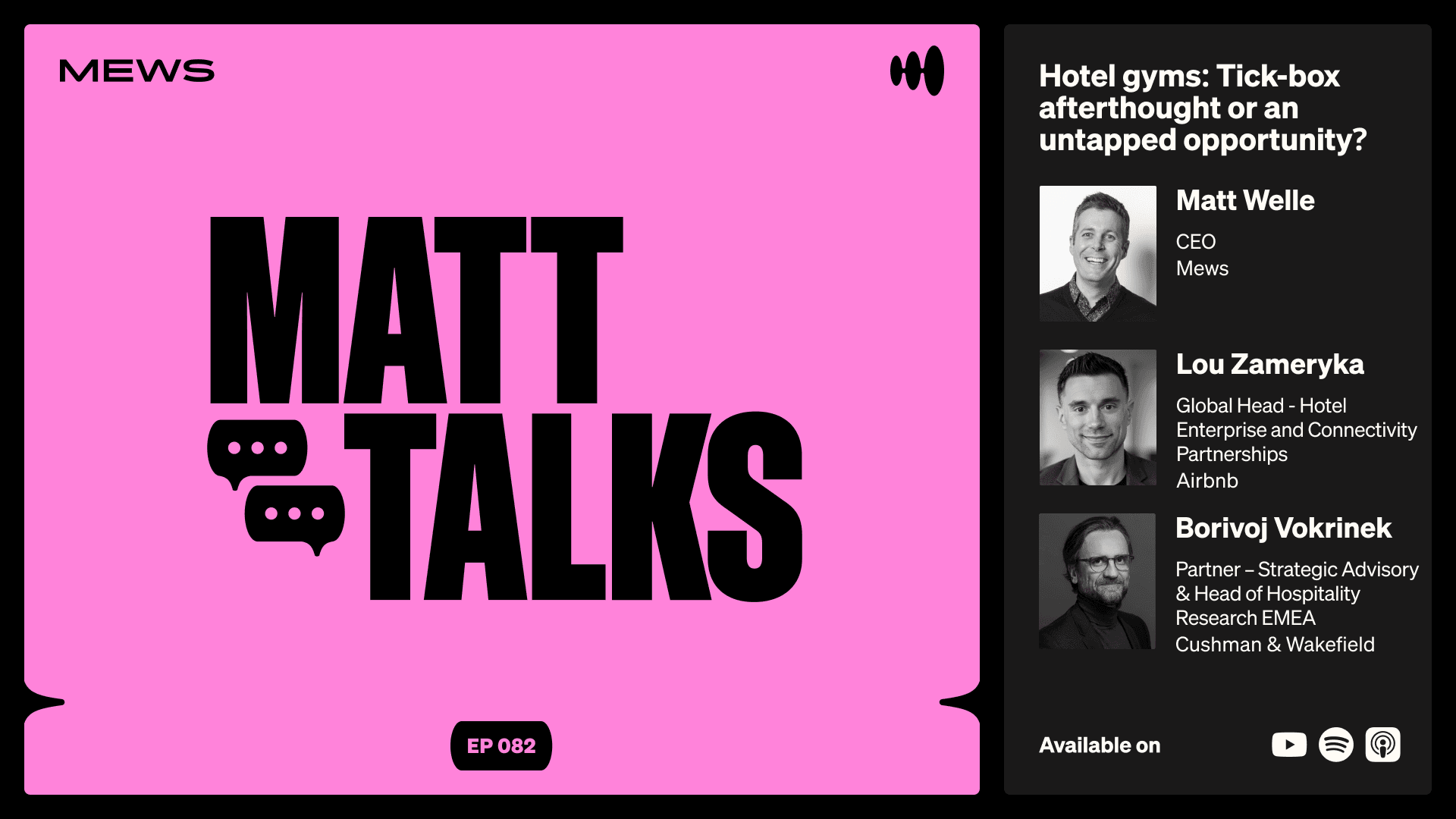
Matthijs Welle
CEO, Mews
After years in the trenches of hospitality, Matt joined the Mews journey during its early days in 2013. Since then, he’s been our fearless CEO, leading the company and the industry forward.

Lou Zameryka
Global Head - Hotel Enterprise and Connectivity Partnerships, Airbnb
Lou has worked at Booking.com for 17 years and now leads Hotel Enterprise and Connectivity Partnerships at Airbnb. He’s also a Co-Founder of Alively, a wellness platform that helps workforces build lasting habits through small, data-driven actions.

Borivoj Vokrinek
Partner – Strategic Advisory & Head of Hospitality Research EMEA, Cushman & Wakefield
Borivoj is Strategic Advisory & Head of Hospitality Research at Cushman & Wakefield, and has advised on hundreds of hotel investment projects across three continents.
Episode chapters
Transcript
[00:00:00] Lou Zameryka: You do have an opportunity to come up with revenue-generating ideas if you build the gym with intentionality. You do have the opportunity to attract share in your market. And as long as it's not forgotten like any other amenity or done with no intention, there is a market for it because the wellness market and participation in wellness is just growing, you know, at such a rapid clip.
[00:00:31] Matt Welle: Hi, everyone. Welcome back to another Matt Talks Hospitality. And, as you know, I travel a lot. I post a lot about my travels. And I also work out, and I try and work out most weekdays. So, hotel gyms are a thing that I genuinely care about. So, a couple of months ago, I posted a photo of a hotel basement that I was, like, scouring through to find this dark, hidden gym that they have that they loosely described as a gym. And they really hit a nerve because I posted about it online, and then people started engaging with my post. And it feels like there's different opinions from hoteliers, from investors and operators that have different views on whether hotels should be investing in a nice hotel gym. Lou Zameryka has spent his career in the intersection of travel and wellness. He's involved with various wellness projects, has worked at Booking.com for 17 years, now leads hotel enterprise and connectivity partnerships at Airbnb, and is a firm believer that hotels are underplaying the wellness opportunity. Borivoj Vokrinek is a strategic advisory and head of hospitality research at Cushman & Wakefield, and has advised on hundreds of hotel investment projects across three continents. And he's here to help make the case that the gym might not be worth it. And I'm really interested in this conversation to see where it takes us. But first of all, are you both avidly working out? Are you personally a believer of working out, or not really?
[00:01:52] Borivoj Vokrinek: Well, you know, since I'm a contrarian, I will start. I like sports, and I do sports a lot, but I don't go to gym frequently. Funny enough, I started my career in the gym, and I was, you know, the owner of the gym offered me a job in his hotel as a manager. So, you know, I definitely understand the gyms, but lately, I've switched more to outdoor sports.
[00:02:20] Matt Welle: Nice. Lou?
[00:02:21] Lou Zameryka: Yeah. I, myself, well, I'm an outdoor guy for sure. So, I'm still a competitive, amateur runner, and then I do go to the gym to keep up with my running. I mean, I love to run. So, to make sure I don't get injured or anything, I go to the gym. This background in theory is fake, but it's actually a real picture from my wife's home gym, where she teaches yoga and all types of things, aerials, pole dancing… The house tends to be filled with active people in the first place, but it doesn't have to be in the gym. It could be kind of anywhere.
[00:02:48] Matt Welle: So, if we turn it to hotels, and what do you think is happening with gyms in hotels? Sometimes, you get a hotel that is incredible with a gym, and they put it on the top floor with views over the whole city, and sometimes it's that basement room. Like, what are your views on investing in hotel gyms, Borivoj?
[00:03:07] Borivoj Vokrinek: Well, I think that, you know, I'm taking a contrarian role, so I need to kind of narrow the playing field here because you guys are clearly two profancy rooftop gym guys. So, you know, I think that it's challenging to justify investment in gyms that are sort of non-income-generating. Like, talking about a traditional gym, you know, 75 square meter in the hotel. You know, if it takes prime area, whether it is rooftop or floors with the views, you know, there are alternative views, right? You can do rooms there. You can do F&B, and there, you know, the math just is hard. So, you know, I understand why it tends to be in the basement or areas that would otherwise not be used.
[00:03:54] Matt Welle: But you talked about it's non-income generating. So, you're just talking about direct revenue linked to that real estate space.
[00:04:02] Borivoj Vokrinek: Yes. Obviously, indirectly, there is an argument, and I'm sure we'll talk about it. How does it impact the occupancy and guest loyalty, etc? But you know, there are membership gyms, right, that are larger, and there's a demand for it or in the resorts, part of the fitness or wellness center, it's a different ballgame. And, you know, luxury hotels is as well different ballgame. But in a typical 5-star hotel, this is a non-income-generating place.
[00:04:29] Lou Zameryka: Well, although I am on the pro side, you know, I don't necessarily disagree that, you know, I'm a pro. Anything worth doing is worth doing well, right? And with intentionality. So, if you are investing your money or your time, you should understand why you're doing it, right, not for the tick-the-box thing. And, you know, I come from a tick-the-box nation of hotels, right? I'm in the United States. I mean, it's just, like, nobody really knows why you tick the boxes at a Hampton Inn versus a Courtyard versus a Holiday Inn. And to me, I do think that you do have an opportunity to come up with revenue-generating ideas if you build the gym with intentionality. You do have the opportunity to attract share in your market. You have the opportunity to position a premium. And as long as it's not forgotten like any other amenity or done with no intention, there is a market for it because the wellness market and participation in wellness is just growing, you know, at such a rapid clip. But if you're gonna just do it to tick the box, then I agree with Borivoj that there's, you know, other boxes you could tick and make a lot more money.
[00:05:29] Matt Welle: Yeah. Like, I'm always wondering if you build a really shitty crappy gym in a cupboard or in a basement, whether it's just a tick box and whether you actually get guests that deeply care. Because I end up scouring the Internet for photos of it, because I've learned not to trust a tick box on an OTA, because I'm like, I don't know if that is a good gym or a bad gym. And I kind of want to, I wanna see a photo, but it's so hard to find it. And I'm wondering if it's this chicken and egg where the hotel is like, yeah, no one actually works out, so we don't need it. But it's because your gym is so shit.
[00:06:02] Borivoj Vokrinek: Right. I think that the expectation is low. You know? As a part of our work, when we are asked to manage hotels, we analyze the guest reviews. And, honestly, I don't recall the last time I saw any complaints about the gyms. And they are, you know, they are not great in all the hotels we are involved with. So, the expectation is low, and you know, I think that the right is that not many people actually use the gym. You know? I think that there was a research by Cornell done some time ago, but they found that only, you know, a small percentage of people use the gym. To me, it's a high percentage. They came to conclusions of 23% of people use the gym, which I was actually surprised by, but it's high. Every time I go to the gym, I see it empty.
[00:06:46] Lou Zameryka: That is interesting because, like, that does seem pretty high to me as well. And, I mean, gym membership is at its peak. Right? And so last year in the U.S, there was, about 26% of the population belong to a fitness club, right? So, it's about the same amount of the population of a hotel that, according to Cornell, that is using the gym. So, as one grows, maybe the other one grows. We don't know.
[00:07:09] Borivoj Vokrinek: You know, I mean, Matt, you travel, and you are probably sort of more hardcore gym goer, but many people, you know, they go to the gym and, you know, from my past experiences, they subscribe to gym membership and that they rarely go or they don't go every day, right? So, when you travel, and you have meetings with clients, you have dinners and drinks, etc, you know, the chances you will skip even if you are, you know, going to gym regularly are quite high. So, there's obviously a difference between, you know, the intention and going there at that one.
[00:07:42] Lou Zameryka: That's why I think it represents an opportunity for, like, hotels to actually have a true wellness point of view, right? Because there are travelers that are either in their normal routine, you know, very wellness-centric, and as a hotel, you have the opportunity to either knock those people off their game or help them stay on their game. And I do think then, again, you get value there. But if they can't rely on you for it, it's tough.
[00:08:07] Borivoj Vokrinek: I think the challenge is that, you know, you have to make tough choices when you build a hotel, especially in Europe, because, you know, the real estate is so expensive, land is expensive, you have limitations on build-up area, etc. So, every square meter has to make money, and tough choices have to be made. And, obviously, gym kind of takes the shortest straw here. I think if you are in the market, you know, London, New York, etc, where there are niches, and this niche is deep enough that you can actually fill your hotel or gain substantial advantage by catering to that niche, that makes sense. But in most of the, you know, sort of less dense or deep market, you know, you can't afford to be kind of catering to lots of niches because you just don't have that space in your hotel.
[00:08:52] Matt Welle: And do you evaluate a hotel differently based on their mix of leisure versus business travelers? Like, who is more likely to use the gym?
[00:08:59] Borivoj Vokrinek: The data from Cornell shows that, you know, a higher percentage of leisure travelers use the gym and, you know, a lower percentage of business travelers, I guess, because they are busy and they don't necessarily take all their trainers and equipment with them. Yeah.
[00:09:12] Matt Welle: Because, like, is there a level of hotel where you're like, gym makes no sense. So, like 3-star and below would never add a gym, 4-star, it's like 50-50, then 5-star, it's a must-have?
[00:09:23] Borivoj Vokrinek: It depends. I mean, obviously, brand standard, even for some economy hotels, requires you to have a gym. I have done a little analysis of Booking.com, and I look at major, you know, gateway cities around the world. And what I was surprised that if you just, you know, look at how many hotels are on Booking.com in that city, and then you take the gym, then the number of hotels drops rapidly. And actually, the average across 12 major gateway cities in the world is only 70%. That was a shocker to me. Then, if you kind of filter it out to 5-star hotels, suddenly, that goes very quickly up, and 80% of hotels have a gym. So, with the higher sort of positioning, the expectation is that there will be a gym, and the hotels need to provide it.
[00:10:09] Lou Zameryka: And it's probably also, though, the most dangerous scenario to put it in unintentionally, right? Because, to your point, like, you have a 5-star hotel. If you believe there's some other way to get a share of that guest's wallet, like you'd better be really sure that gym is the one, right? Because you still may face, maybe if you don't face investment constraint, you face space constraints, right, and things of that nature. So, it really goes back to thinking about, like, who are you serving, and are you really serving them with this amenity or not? You know? And then you could get creative, right? But if you put it there and your staff doesn't talk about it and you don't figure out, you know, how it's best used, and if it has an opportunity for revenue even in the community that you're sitting in, right? You know, that's how you lose money in any investment. It's by not doing stuff that makes sense and understanding how to use it.
[00:10:57] Matt Welle: Yeah. Like, almost, make sure that if you have one, that it looks really good, that it's photographed really well, so you can promote it on your websites, and then you can confidently talk about it. But if it's basically one of those bicycles in your, like, in a crappy space in the basement, no one wants to sit in the bicycle in the basement at 5 AM in the morning. It's the most depressing experience. So, if you commit to it, really kind of commit to it.
[00:11:22] Lou Zameryka: I have a friend that does hotel gym reviews in under a minute on YouTube, and they're gaining traction. And it's great because, like, you can really quickly see the whole gym and his perspective on, like, what it's appropriate for or not. And then I know, you know, Booking.com has the gym filters. I also did a similar exercise to just see what it was, and sometimes by percentage, it doesn't seem like a lot. But then you're like, wow, there's still a lot of hotels, like, with a gym. It's kind of interesting. But there's, like, a website that's growing fast, too, called hotelgyms.com. Right? Because I think when you're on a general OTA, the thing about clicking a filter, it's good that you, like, gym is such an intentional filter, and this is where we'll probably get with, like, AI and conversational search, right, where if you click gym on Booking.com, you just get a list of hotels to have a gym. It doesn't, like, help you immediately see the gym picture. It doesn't help you have any context. Like hotelgyms.com looks like the front end of Booking.com, except there's, like, an actual gym review right there on, like, one to five kind of stars, right? Like, how good is this gym right in front of you? So now, when you're doing your search results page, you sort, you can already kind of go, okay, like, let me see what this one has. It's a 5-star gym.
[00:12:33] Matt Welle: Book channel, or is it just informational and then you have to still go into a different channel to book it?
[00:12:39] Lou Zameryka: You can book. I think they're probably using affiliate feeds from different OTAs, but you know, that overlay at least gives you more signal, right? I think that's what we'll see with AI, right? So, if you are a hotel with a gym and potentially it's underwhelming, that'll be known pretty quickly. And if it's fantastic, it'll be understood pretty quickly, and you'll stand out much quicker than if you just hit the filter and you end up with the same hotel content, and there's just now only 30% of the hotels in the market for you to wade through.
[00:13:08] Matt Welle: Because, Lou, when you book a hotel today, and you want a hotel with a gym, what will be the process that you're going through on the Internet to get to a booking?
[00:13:16] Lou Zameryka: Yeah. Depending on where I'm at. Right? I work for Airbnb now. So, first, I'm on Airbnb, and I'm checking the filters there too. But, honestly, for me, I start with the running routes, right? So, I need to run, like, 6 days a week. So, first, I just look for the running route. Then I make sure that the hotel is near the running route that I wanna be at, and because I'm a very social person, if it's not clear to me that there's, like, maybe David did a review there or something, I would rather go find a local place and run to it. Like, I've been known to be the guy who basically runs two miles already sweaty, shows up at, like, the hot yoga class, and then runs back to the hotel. Because I prefer, you know, and that's what's nice. Right? Like, if you're only gonna do it to tick the box, look at your local community and figure out if there's a way to tick that box in the local community that adds value to many more stakeholders in this hospitality ecosystem. But, yeah, basically, I'm first looking running route always.
[00:14:09] Borivoj Vokrinek: Yeah. I mean, you know, the study I talked about, the Cornell, they as well unfortunately found that there is no impact of having gym or not having gym on intention to book before and even after. Even if there's no gym, then, you know, it doesn't really affect, sort of, the intention to book. So, I guess people find their way. Right? They either go for a run or they find something in the local community.
[00:14:33] Matt Welle: So, I'm using a GLP-1 to lose weight, and I've been using that for about two years now. And as part of that, you shift from cardio to more weight workouts that you don't get big ozempic face and, like, you know, look gaunt. I really shifted my workout routine from doing a lot of, like, biking before to now actually doing a lot of weight workouts. But you don't just do that on your own. You actually need weights in the gym and good equipment for it.
[00:14:58] Lou Zameryka: Right.
[00:14:59] Matt Welle: And I see this craze around GLP-1, which is really reshaping society, I think. Because I talk so openly about it, I find out about all these people that are secretly taking it. And I'm like, why are we secret about it? It's not an embarrassing thing. But I think that there's going to be some level of shift where people actually require to work out, but I don't know if that is statistically relevant at this point. But as you plan real estate, I'm assuming you do that much more in advance, and you just look at those trends. Do you currently look at any of that, or it's not really that relevant, you think?
[00:15:29] Borivoj Vokrinek: No. No. No. I think there is a kind of growing trend in, you know, sort of well-being and longevity, and sort of the impact of fitness and exercising on your mental well-being as well, right? It's not only about your physical, but also your mental. So, obviously, there are opportunities where if you have substantial space, you can tap into it and actually generate business on its own, right, within the real estate. And it's usually a great way of diversifying and de-risking your income stream, where, you know, the best solution is as typically as well with F&B is to outsource it, to kind of rent it out to local or international, you know, gym or fitness, operator or longevity sort of expert and then have a rent and therefore have a diversified business. So, that's definitely from a perspective. There is a trend. You see emerging brands that are really tapping into this in hotels, and you know, longevity centers, and it extends the length of stay, etc. Right?
[00:16:33] Lou Zameryka: Borivoj is right. When I left Booking.com, I left to start a wellness company, right? That wellness platform, Lively, was envisioned because of the broadening of what people consider wellness, right? So, your mental wellness, obviously, your nutritional wellness, your social connection, your actual physical wellness, all of that, your sleep and recovery, right? All of that now plays a part in broadly what people consider to be their wellness life, and they're focused on either longevity or health span. And I do find it kind of, like, that means for a hotelier, there are more ways than just the standard, like, "Hey, did I put a gym in here? Or what's in that gym?" To address all of these trends that are part of the bigger wellness trend. I find that to be really interesting. And, like, I sit on the wellness and travel and tourism advisory board as well, and we are creating standards for hotels to help them understand, like, the breadth of what these travelers do consider part of their wellness. And if they're really active in it, like you mentioned, Matt, like, they might find your hotel ticks three boxes or four boxes of what they need, but maybe it doesn't have, like, a squat rack that you could put 300 pounds up on, but they'll go find that somewhere else, right? But they're like, "Hey, this meets it." And I was pretty surprised. I also own a small hotel, up in the Catskills. Not big enough. It's on a ski mountain. Not big enough to put anything too interesting in yet. But there's such an emptiness of that wellness lifestyle reflected in brands other than 5-star brands, right? Most of the wellness lifestyle is typically wellness for holiday or retreat purposes. Or when it's not for that, it might be in an urban location, but it's, you know, extremely high-end wellness. The rest of the industry seems to have been satisfied with brand development just stopping at the word lifestyle. No actual explanation of what lifestyle really is, right? We said, oh, we have, like, branded hotels, and we have lifestyle hotels, you know, for people to have a lifestyle. And it's like, well, wellness is a big one. We could get a little bit more specific and build some, you know, mid-scale and upscale wellness brands and then attract people that go, oh, you know what lifestyle I live? I guess I live the wellness lifestyle.
[00:18:37] Matt Welle: Because if I had real estate and I picked to build a gym in that real estate, what would you buy? Like, Lou, is there a way for different hotels to decide what kind of equipment they need for that particular brand of hotel or accommodation?
[00:18:51] Lou Zameryka: I mean, I'm certain there's great, like, gym consultants out there that will help you design it from the standpoint of an actual, you know, gym design. But, also, it comes down to, again, understanding what your use case is. You know? Because if you have a certain customer base and you understand them, then you kind of wanna build to that customer base, and not to, you know, the extremes, if you will. If you believe you have, you know, like, the high-end hotels often have, like, type A personality staying in them, right? So, the more extreme gym offerings probably will get used because they're more extreme people. But I think you really gotta understand who you're catering to and then get an expert in there.
[00:19:30] Borivoj Vokrinek: You know, I have to go back to defending my contrarian position. So, you know, obviously, Airbnb is a good example where, you know, correct me if I'm wrong. I would imagine 99% of Airbnb units don't have a gym attached to them. But there is probably something very good or, in the neighborhood, right? So, then the question is, does the investor have to really spend the money in the space that is limited to build a gym that probably, you know, he doesn't have enough space to build a membership gym and with all the requirements and technology that today is available, or should we take advantage of something in the neighborhood? Right? And if there's nothing in the neighborhood, then, potentially, there is an opportunity for the investor to do it within the hotel. But then the question is, you know, what generates more income? There needs to be a demand. You need to look at your, you know, demand sources. It's not gonna be the key driver, not gonna be the guest who's staying in the hotel, it's gonna be the local community. Is there enough residential units to actually, you know, drive demand for your membership and for the usage of that facility?
[00:20:40] Matt Welle: Because you looked at projects, I think, across Europe, but also in Asia, the Middle East. Is there a real, distinct difference in how hotels are built across these different parts of the world?
[00:20:50] Borivoj Vokrinek: Yeah. I mean, we all travel around the world. So, I'm sure you have noticed that when you are in Paris or London, the rooms are shoeboxes, so you can control the TV with your foot. And when you go to Asia or the Middle East, everything is spacious and big. So, obviously, it's driven by construction cost, by limitations, and land cost, etc. So, when you have no limits on, you know, how high you can build, or the construction cost is not as high, you have no alternative cost. You know, everything costs to build, but if there is an alternative cost of I can do something else there, then it's becoming less feasible to have, like, a big gym with the views and on the rooftop. So yeah, the tendency is that in Asia and the Middle East, you have large gyms, you have lots of F&B spaces, versus in Europe, everything is constrained.
[00:21:41] Matt Welle: Like, I'm always surprised in the U.S when I walk into the gym at 6 AM that it's usually packed with people, especially when you go to the major cities like New York or LA. Whereas I don't feel that in Europe. When I enter at 6 AM, I'm like, that's just me and myself and I, and a water cooler that's buzzing in the corner. And I really wonder what the distinct differences are in workout regimes and what people expect from a hotel gym in different continents.
[00:22:04] Lou Zameryka: Well, I tell you, now all the Europeans that I know are gonna hate me because, like, 6 AM, you're a pretty early bird for a European. I mean, that's probably why you're not seeing anybody. Booking.com used to be above, in Rembrandtplein, above the Starbucks, right? And I'd go to Amsterdam all the time. Starbucks didn't even open till 8 AM, and I'm a New Yorker. I'm like, what is going on here? I'm out of the door at 4:45 in the morning, you know, like so, some of it is just the time you go, Matt. But I also do think that my experience has additionally been that Europeans are also active in many more sports than just the gym, right? And so, like, a typical American gym, if you're into sports, you're probably not relishing, like, staring at yourself in that glass mirror, you know, on the treadmill in, like, a very small box. So, you know, you could just say, "You know what? I'll play some extra sports this weekend, or I'll go to my other gym." I think that tends to be some of the issues is, like, if it's not a good gym, like, you have other things you're doing. In the States, it seems like people are more sedentary, and that gym time, while some people really relish it as part of their routine, others just are like, well, this is what I gotta do. So, I'm going to the, you know, the three-star hotel basement, then gonna…
[00:23:16] Borivoj Vokrinek: And there must be something, culture in Japan, because I look at Tokyo. And in Tokyo, only four and a half per cent of hotels seems to have a gym. I was surprised based on the Booking.com filter. So, they have a gym, and they don't say it. That would be really silly, but that was a shocking finding. Yeah.
[00:23:35] Matt Welle: I think I'm always surprised with how many hotels don't talk about it. Like, I often go to the hotel website first, and I know to go to the gallery because, probably, the wellness page doesn't talk about the gym. And then I really struggle to find a photo. And then I go on traveler review websites, and then often, I find it there. Like, with my trusty friend, ChatGPT, you can scrape the Internet and figure out whether there is a gym, and it says active photos. And I'm wondering why no one talks about it. And I'm assuming that that's also why, like, hotels are not getting the bookings. But, Lou, you've worked at Booking.com for, like, 17 years. Have you seen that a hotel that has the filter on it does actually drive more bookings? Because there is no other evidence than that little dumbbell that you can click and that, you know, see it on there. But I'm wondering whether you've seen the actual impact of it.
[00:24:23] Lou Zameryka: So, I haven't seen that firsthand during my time there, but I will tell you that, generally speaking, filtering doesn't get used that much in OTAs. And then secondly, Borivoj mentioned earlier, but really, people are still very location and price before anything, and then they get to where they get to. And I think if we saw people use the filter after location and price, what we'd probably see, and we always saw this on heat maps anyway, was how people don't read anything. They then go look for the pictures. And that's true for the gym pictures. You sometimes see that when you're looking for, you know, if you have, like, I have a few kids, and it's like you're trying to figure out, is that room a suite where, like, I get my own bedroom? Or is that a half wall? What is that? You know, like, so the things hotels kind of don't want you to know, anytime you see that obscured picture where you're like, hey, someone could have taken this picture and given me all the information, odds are it's not gonna meet your expectation when you see the real thing. And they're doing that for a reason. But I had not seen a lot of, you know, I haven't looked back then for the gym filter being used. But I do think people are still kind of price, location, and then they're using kind of photos to help them understand some stuff.
[00:25:32] Matt Welle: The way I search has dramatically shifted towards the LLM. So, it now knows kind of the hotels, I've educated it, and it knows what I'm looking for. And then it also knows to give me the photos of it because I don't trust anything on the websites of hotels. And I'm really just hoping that hoteliers listen to this, and they go to the website and, like, yeah. Actually, you're right. There are no good images, and maybe we should have more images on our website than we have on the OTAs because people do go there, but then they leave because they know the OTA usually has more images than you have because they require a certain level of images, right? We'll see if we can change some of the hotel.
[00:26:07] Lou Zameryka: I think hotels are at a unique position, too, because one of the elements of wellness, right, is social connection. And that's like the loneliness epidemic is kind of well-known around the world as a leading problem we're all facing. And we're in the hospitality industry. Like, we have the chance to do that. So, like, if you are gonna create a gym, this is the time where, like, maybe it doesn't have to be a gym. Maybe it's an unused meeting room where you could do group classes, right, and bring someone in from the outside. Maybe it's an outdoor space that you have that you could do something in, or just getting your guests to connect with, again, a local gym, a local run club, something like that. What I know, you know, there are many different ways to experience wellness, and I would encourage hoteliers to kind of, you know, think outside the box because you can solve kind of two things.
[00:26:51] Borivoj Vokrinek: And I as well was wondering if there is, you know, with today's technology and smart furniture, etc, there is a way, because I think there is this kind of void or issue with a small gym, right? 75 square meters. If you don't have a space to do a membership gym, and a swimming pool, and a wellness center, then it's becoming an amenity than generating income, and then it ends up in the basement, right? So, that's a problem. And the issue is that, you know, it's available 24 hours, but it's used only, you know, a couple of hours in the morning and a couple of hours in the evening. And all that space lies unused during the day. So, is there an alternative use of the gym space when it is not used? You know? I'm sure you wouldn't mind if somebody told you the gym is closing at 10:30 or something. You know? There is a whole day to be used as a kids' club or something.
[00:27:44] Matt Welle: What else would you do with a dark dungeon basement room? Like a large room, but without windows. What would you do from a real estate perspective to turn that into a revenue-generating space?
[00:27:54] Borivoj Vokrinek: If it is in the basement and has no windows, then, obviously, you can do a meeting space there, right? I think a gym is a good solution. You can do meeting space. You can do back of the house and make sure it doesn't take up space in the areas where there's natural light. And you know, they are, I guess, these days, you know, we can do massage rooms, etc, in those spaces. But I think the key challenge is if you are planning to do gym in the rooftop, etc, where alternative users are. But you made a point about, sort of being basement, but I think we are now even having rooms in the basements, right? I mean, in London, it's allowed. So, you have now these, you know, hotels that have hundreds of rooms in the underground, and you know, and they are busy, and they charge a reasonable price. You probably won't spend your honeymoon there, but you know, they serve the purpose. So, I think we are moving into underground, and I wonder if the definition of a good gym is not about whether it has natural light, but, you know, how well designed it is, how well activated it is, if it is a place where you can interact, etc, right? So, maybe there is a future of gyms in the basement, but well done.
[00:29:06] Lou Zameryka: Yeah. And to Matt's point, too, there are, like you know, because I'm in the wellness travel world, I get exposed to all types of new business models, right? And there's a company called, I think it's Club 100 or the 100 Club, and they do, you know, they basically will bring you members from the outside community into your hotel gym and things of that nature. And there are personal trainers here in Manhattan that'll work out deals with hotels to train their guests, but then also use that facility during the day to train their own private training stuff.
[00:29:33] Matt Welle: You actually turn a hotel space into a revenue-generating space externally, then.
[00:29:38] Lou Zameryka: Yeah. Because Borivoj's right. Like, I mean, kind of, if you close your gym at about 10, 10:30 in the morning, you probably aren't displacing any of your guests, especially weekdays, and until, you know, 4 or 5 o'clock in the evening at the very earliest.
[00:29:54] Borivoj Vokrinek: And I think as well, you know, I've been at the conference, and there was a, you know, display of gym equipment. And they had really fancy equipment, you know, which caught my interest that you can do, like, 3D scans, and you can, you know, do your health check, etc, that you know, I think lots of people obviously cannot afford it at their home, or they don't find these things at their homes or in their local community. But if this is in the gym and you can actually charge for it, then, by the way, they mentioned that you can pay, like, €400 for doing the health check, etc, or scan, then this suddenly becomes a revenue-generating facility, which, you know, is a change of the game.
[00:30:33] Lou Zameryka: I find so many hotels miss the idea that they can be part of their community, and so many communities miss the idea that a hotel is in their community, right? So, like, if you go into the old U.S westerns, right, like, when you arrived in a town, if you weren't robbing the bank, you basically went to the inn, right? And that was the bar with the rooms above it. And you didn't get into a fight with another traveler. You usually got into a fight with a bunch of locals who were also in that bar and inn. Nowadays, like, a local doesn't go to a hotel. You know, maybe we do because we're travelers and we feel comfortable in them. But most people will look at it and say, ah, that's for visitors. You know? And there's a whole opportunity to take all of those people around you and bring them into your space, too.
[00:31:10] Matt Welle: I had my, because I was working out when I arrived in Amsterdam, I was working out outside, but it rains every second day. So, we contacted the 5-star hotel that I have next door to, and we said, "Can we use your gym? We are happy to pay for it?" And they said, "No. No. We can't, because it's like a gym for guests." And it just felt like such a lost opportunity that they wouldn't even take business as just walking in the door, and they just decline it outright.
[00:31:30] Lou Zameryka: Right.
[00:31:31] Matt Welle: And I'm also wondering if you're working with gyms locally, like, because I think a lot of hotels don't leverage the local community enough. Like, on the one side, you can wanna attract them into the hotel. If you have a great gym, optimize it. But it's also if you don't have a gym, then go and walk into the gym next door and figure out a partnership with them. But how far do you think people will be willing to walk from a hotel to get to a local gym?
[00:31:55] Borivoj Vokrinek: 15 minutes a row, I guess.
[00:31:57] Lou Zameryka: Yeah. Yeah.
[00:31:58] Matt Welle: That's long, I think. Fifteen minutes.
[00:31:59] Borivoj Vokrinek: Yeah.
[00:32:00] Lou Zameryka: It depends, I guess, on the weather, right? I hate to say this, but I run to the gym. So, I run to Planet Fitness. It's two and a half miles away from my house. And people are like, you go to Planet Fitness. I'm like, yeah, it's really inexpensive. I travel a lot, so I'm not gonna pay a lot of money for a gym by my house, so I run there. It's exactly two and a half miles there, and I work out, and then I run back. I got a 5-mile run plus the gym. But, like, you said a bad example.
[00:32:21] Matt Welle: Like, you don't sound like your average hotel guest who just goes to the gym.
[00:32:25] Lou Zameryka: But I think 10-minute walk.
[00:32:27] Matt Welle: Like, for coffee, I'd walk two blocks, right? So, if you think about New York blocks, I wouldn't walk three blocks. And I wonder if it's the same for a gym or if you could do a partnership with a gym four blocks away.
[00:32:36] Borivoj Vokrinek: You know, if you go to the gym, you should warm up, right? So, you can take it as part of your kind of routine. You warm up, running to the gym, and then you can go straight away into your routine. I think we're getting somewhere, you know, because if you connect some of the points you made earlier about, you know, people having that sort of difficulty in going into the hotels, you know, I found this is really common in certain geographies, etc, and it's so hard to break. You know? You can have an amazing F&B concept and restaurant. It's just the locals would not go because they think this is overpriced, and this is for hotel guests, and it's difficult to get in. And so, it seems to me that a better direction, rather than trying to get the community in, which is very difficult, is to find a partner in the local community and send your guests there, you know, take advantage of it.
[00:33:29] Matt Welle: But is it a local cultural thing? Because, like, in the Czech Republic, for example, where you live and I've lived a long time, people do not go to hotel restaurants. However, in Amsterdam or in London, I don't see that. Like, we do go to hotel restaurants. We walk in, and they have great restaurants. And I'm wondering, what does the Czech Republic hotel scene get wrong for that? And then that could be true for hotel gyms as well.
[00:33:50] Borivoj Vokrinek: Yeah. It's a cultural thing where, you know, for generations, we have been told hotels are too fancy a place for us to go to. So, you kind of have the diversion that, and as well, I think, culturally, sometimes, you know, the Eastern European or Slavic nature is not necessarily, you know, like the Anglo-Saxon nature where they are smiling and sort of welcoming you even though they don't know you, you know? In order for me to smile at you, I would have to know you. So, it is this sort of very serious person looking at the reception, and you are already kind of scared to enter in, right?
[00:34:23] Lou Zameryka: That's true. I mean, even in the U.S, right, it's a different version of it. But, basically, you were trained until maybe the past 20 years or so, when restaurants and hotels really have been stepping up their game in certain cities and markets. But you were basically trained to think that either you're going to kind of get ripped off or it's gonna be just, like, the quality level enough to feed the people in there. And, like, you really wanna go to the restaurants in the market, right? Not that there's a restaurant hotel.
[00:34:47] Borivoj Vokrinek: Yeah.
[00:34:48] Matt Welle: So, what would a hotel have to do to, like, make outsiders from the community walk in the door to actually then join the gym, you think? What's the thing that's holding them back?
[00:34:58] Borivoj Vokrinek: Well, you know, as with the restaurant, we always advise, you know, you've got to have a separate entry. It should look like it's a separate business, right? You have entry for your guest, but you have entry for your gym. If it is a membership gym or wellness center, that usually does the trick. And there has to be some visual connection with the street, you know, with passing traffic, where people see, you know, it looks great, you know, people are exercising, it's full, you know, and you kind of think, okay, I might as well go. But if you don't have that visual approval that this is a good facility to go through the lobby and find your place to actually see it, then, you know, I think that's putting people off.
[00:35:39] Lou Zameryka: Yeah. I think that's where you need the partner, right? So, like, whether it's those personal trainers that are gonna just say, "Hey. I need some gym space. I have clients. You know, I can't bring them to their home." And by the way, I don't need much, but you have what, but I do agree, like, the street-level attractiveness and things of that nature would go a long way. And again, that comes back to, like, the intentionality of why you wanted to develop that space, you know. Again, I don't like the idea, the box ticking, you know. And I know, many of our American brands created the longest lists of boxes.
[00:36:08] Matt Welle: So, there are specific brands, and, Lou, I'm very interested in your opinion here, that are specifically targeting this audience. So, like, yesterday, I was on a call with the CEO of Gravity House, and they have a really adventurous brand. You've got Six Senses that's leading into the wellness aspect a lot. You've got Equinox. So, is that just a niche that's doing really well and attracting that niche crowd unable to pull the prices, or are some other people just missing a trend that will be much bigger?
[00:36:35] Lou Zameryka: Well, I do think that it's a niche in two ways, right? Like, the economic niche is these are very high-priced properties, right? Like, the Equinox in New York City is extremely high-priced for the idea that I'm gonna work out in an Equinox and everything like that. There's a bunch of Equinoxes in New York City, and other great gyms. So, I do think it's a mix between that because they're, of course, recovering some significant spend that they made on the equipment, on the space, and on using that space for things. But as I was saying before, like, if 26% of Americans belong to the gym, and, like, Gen Z and the 65+ crowd are the fastest growing cohorts, right? It's like 35% Gen Z and fast growing, 65 and over. That tells me that there's an entire market from the hotel perspective not being serviced, and because there are many modalities, if you go to a show, like it was mentioned before, you could see different ways to approach wellness, whether that's the gym or other things. And so now more than ever, you can be in the dialogue of wellness, I think, in many different ways. And it does puzzle me that, again, like, at the 3 and 4-star level or maybe that 2-to-3-star level, we built all these brands and soft brands that literally stopped at the word lifestyle, where it's just, hey, it's designed nicely, there's a good restaurant, it's comfortable, I mean, that's no one's lifestyle. Those are nice things. But if someone asked me how my lifestyle is, I wouldn't be able to say that. So, I do think that we are missing an addressable market. And now better than ever, you could address it without having to spend to the level of, you know, what Equinox might spend or Six Senses.
[00:38:16] Borivoj Vokrinek: But we are now talking about actually people paying, right? And as a traveler, you know, if you come to a hotel and suddenly they tell you, well, you have to pay. You know, I did my maths. And to justify, you will have to pay €10, right, for a gym, which would be 75 square meters because, you know, I assume, you know, you can do 3 rooms instead of that, and I did my maths and calculated that you would be losing about 1 and a half million of value, and you know, around €89,000 of net operating income, instead of those rooms taking the average KPIs for European hotels. So, in order to compensate for that, you know, you as a gym goer, you would…
[00:38:58] Matt Welle: €10 ADR increase you need to have for yourself.
[00:39:01] Borivoj Vokrinek: That's actually not a high percentage. I did the math. So, for a 200-room hotel, you would need 1.1% points higher occupancy, which, you know, I guess in certain markets where, you know, demographics are right, you probably can argue for that. But, suddenly, when you have a 100-room hotel, that's already 2.5%. And a 50-room hotel, you have 4.5% points more on occupancy. That's difficult to justify. But if I just take, you know, 75 square meter gym, which is obviously not gonna be a great gym, given the size and, you know, you can do 3 rooms instead of that, and those 3 rooms will be 75% occupied and would come on a €60 rate. And then you take a 60% flow-through. And, you know, you can calculate, and you take off base fees and F&E reserve, etc. You know, you're missing around €90,000 a year. So, in order to compensate for that, and if I assume that 20% of people use the gym based on the Cornell study, then I can calculate how much of those 20% that would actually go to the gym would have to pay to generate for me €89,000 or €90,000 a year, which I calculate is around €6 to €10. So, my question to you is, would you pay €6 to €10 to go to a relatively small gym?
[00:40:21] Lou Zameryka: Yeah. I think that's where it matters in the creation of the entire package of that hotel, right? Because, like, most people are choosing hotels through a kind of a very much a sea of sameness in markets. And, like, if you could stand out to one cohort as mattering, they will, like, spend, you know, the marginally more money, right, or they will afford you more time because you finally connect with them. Like, our industry is pretty, there's no people walking around going, like, "I am a Courtyard by Marriott person, you know." "Like, me, I'm an Ibis person. You know? Like, you get it? My whole life exudes Ibis."
[00:40:55] Matt Welle: But I think it also depends very much on the city that you're in and whether there's enough demand for you to segment yourself into that. So, if I'm, you know, in a rural city of Germany, yeah, like, there isn't a lot of demand. So, you're probably not gonna get the upside. But if there's real competition for that 5-star or the 4-star kind of guest, you need to figure out a way to stand out because a bedroom is a bedroom in Downtown London. I think the math needs to be done, but also with market information to be able to make that judgment, because for some hotels, I agree. It doesn't make sense to put a gym in when you're just trying to optimize for bedrooms. You're just wasting real estate, I guess. The thing is, I wouldn't mind a basement, but I'd mind, like, a badly designed gym. So, I was like, if you're gonna take that basement room, you can do it in a nice way. I've seen really nice gyms. The W in Prague, I love that gym, there are no windows, but it's beautifully done. Yeah. And I think it's just really think about the aesthetics so that you can be proud of the gym instead of it just being some rusty weights in a corner that isn't the experience that you want.
[00:41:55] Borivoj Vokrinek: Yeah. If you do it right, you know, if you do it, you should do it right and maximize the impact. And I think there, you know, then you should put visuals, you should put pictures, and you should communicate with that sort of niche market that you have that sort of differentiator. And I think this is where hotels are not doing a great job in that communication and marketing, yeah, for sure.
[00:42:17] Matt Welle: My last question to both of you is, and give me a straight answer. You're advising on a 150-room lifestyle. I used the word lifestyle because Lou said it. Lifestyle hotel in a European city center. Do you build a gym? Yes or no? And why?
[00:42:33] Borivoj Vokrinek: I say, yes, if it's in the basement. If it's to be on the rooftop, I would not do it. Because I can put, you know, three rooms? Or if you're talking about a big gym, I can put 10 rooms, and generate much more income. So, in a way, I love gyms when I do repositioning. Because every time I find a gym on the rooftop, I have low-hanging fruit for the owner, saying, you know, move it to the basement, put 10 more rooms, and here you go. Value goes up. So, it's contrarian. I keep my feet dry.
[00:43:04] Lou Zameryka: But I'm also a yes, and I'd rather see the, you know, maybe the deck is for yoga, on the roof, you know, and things of that nature. So, I'm a yes, you put it in. But again, you define the lifestyle version of your hotel even further with wellness, right? Because that's where these trends are going, so you might as well really lean into it if you're going to. And whether that's the basement, then you lean into it the right way, like you're talking about The W in Prague, or whether it's the rooftop because you got endless money bags, then that's also fine. But don't, you know, like, show it. Really talk about it and be about it. Don't just put it there.
[00:43:42] Matt Welle: Yes. I agree. And, like, I really enjoy it when I see a hotel that puts yoga mats in the room because that means I don't have to leave my room. I can just do a workout there if the room is big enough. But also the yoga deck on the roof, you can recycle that into, you know, cocktails in the evening, and in the morning, it's the yoga deck. So, just really be flexible with the real estate that you have and hide it well during the day and then put it out at night or the other way around. But there are different ways to do it. There's a new hotel that's opening in London, St. Clements, and I'm a massive fan of how they've incorporated a gym workout. That's basically, there's a chest by the bed, and it has some basic weights. And then you can go to the real gym, but I like the idea of having just some basic workout equipment because sometimes I just got 15 minutes, and I just wanna get a little workout in.
[00:44:25] Borivoj Vokrinek: But you are…
[00:44:26] Matt Welle: So, there's different…
[00:44:27] Borivoj Vokrinek: Yeah. You are unique. The study found that apparently only 3% of people use the in-room fitness equipment. So, apparently, super low usage.
[00:44:34] Matt Welle: Really? That's insane.
[00:44:35] Borivoj Vokrinek: But it's been done, you know, 10 years ago, so I'm sure that things have moved since then. Yeah.
[00:44:40] Matt Welle: It might change. And I do think that there will be some shift due to some of the changes in lifestyle that are happening, but it is a slow-moving beast. And I like I really appreciated the very thoughtful advice that you've given. So, thank you so, so much for joining me today, and hopefully, we'll have a return follow-up on this in a couple of years when everything is shifted and everything is changed, but I don't think it will change for us.
[00:45:00] Borivoj Vokrinek: Thanks for inviting me. Pleasure to be here.
[00:45:02] Lou Zameryka: Thank you for having me. We'll eventually become someone's board of advisors on their next wellness hotel development, you know, so we'll get back together like that.
[00:45:09] Borivoj Vokrinek: Sure. Sounds like a good plan.


