What to expect?
Episode chapters
Transcript
[00:00:00] Peter Twachtman: If we can't pay for ourselves and drive the property and
drive their returns and still take care of the team and do all the other pieces, then the
asset doesn't make sense. But many of the places in the markets we work in really drive
high occupancy, high ADRs. And so we can move money down through these small
assets in the P&L and fundamentally drive returns.
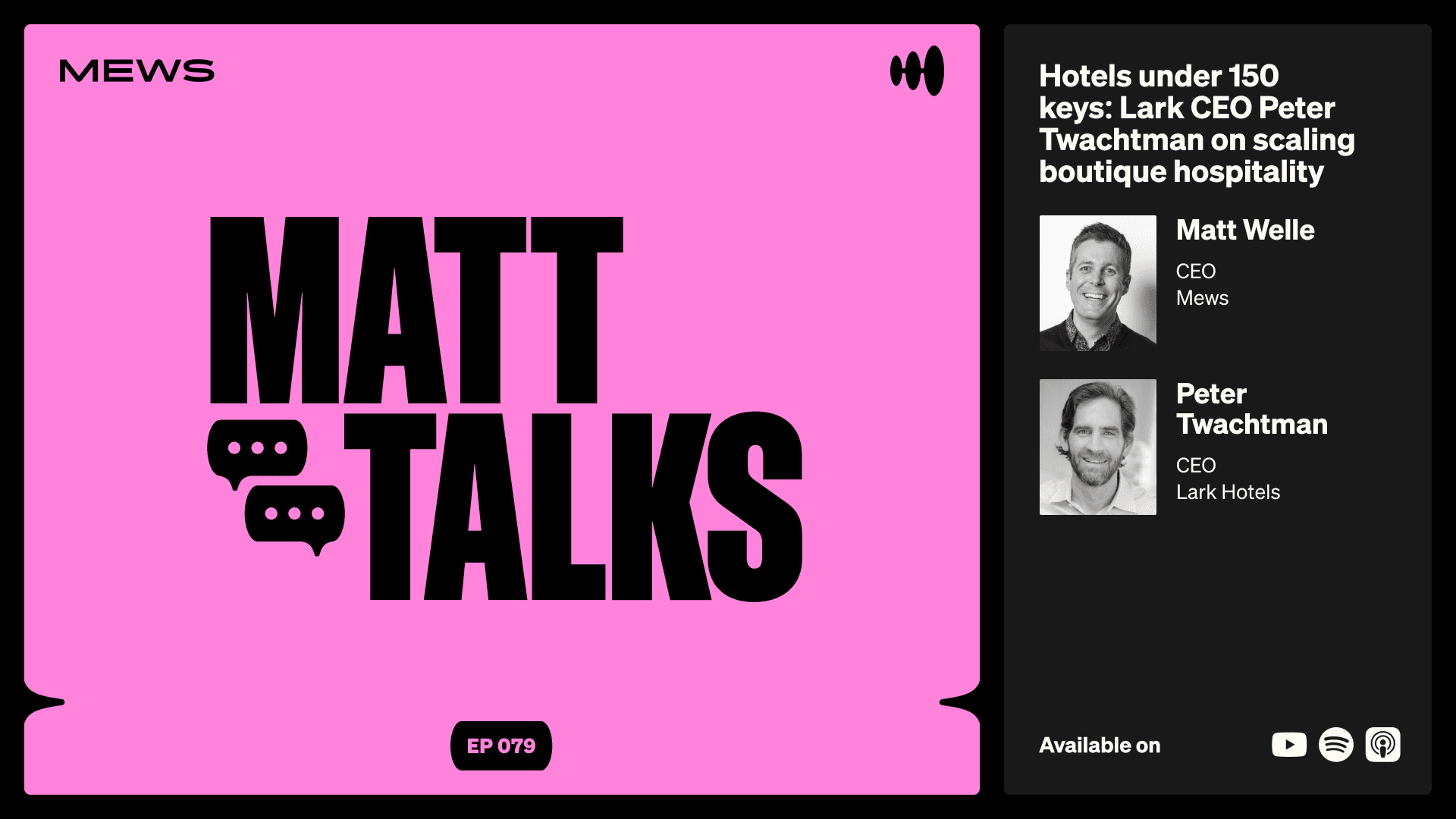
[00:00:32] Matt Welle: Hi, everyone. Welcome back to another Matt Talks. And today,
I have a guest. His name is Peter Twachtman, and he's the CEO of Lark Hotels, bringing
30 years of hospitality experience. I make you sound really old in this intro. I'm really
sorry.
[00:00:44] Peter Twachtman: I feel old.
[00:00:45] Matt Welle: But you've worked for a long time, studied hotel management,
kicked off in F&B as I have, in the early days, and then you served as the Chief
Operating Officer at Migis Hotels, which is a management hotel group. And then you
joined Lark a couple of years ago in 2020, which I'm always intrigued because I think
that that's one of those interesting years for hospitality when the whole world shut
down. Since then, Lark has grown significantly. And today, you're 85 independent
hotels, 22 restaurants across 28 states and 2 countries. So, it's really grown to a much
larger organization since you've entered the business. Thank you for joining me today.
[00:01:18] Peter Twachtman: No. Thank you for having me. Delighted to be here.
[00:01:21] Matt Welle: How would you describe Lark? Well, to someone who's never
heard of Lark Hotels, what would you describe it as?
[00:01:26] Peter Twachtman: Well, I think there's two sorts of answers to that. There's
sort of the guest side and the vendor side and the partner side, and then there's the
employee side. But what I think I would describe Lark as an open, wonderful place to
work with, and what I mean by that is, we tend to meet people in the middle. We have a
sort of the sense of place in where we work and how we work and our locations, and
we believe in healthy tension. So, we have to have good, strong dialogue. We have to
push each other. And whether that's with the teams that work with us, with the owners
that we represent, with the vendors that come through our doors, good partners like
Mews along the way. If we don't drive and strive for that place of excellence, we just
don't get to where we want to get. And so, you know, I worked in many places along
the way, and I think Lark is really, really special and wonderful. And I think we're the
best at what we do, which is running assets. We have 150 keys.
[00:02:29] Matt Welle: I love that. Because you're in this category, that's not an
independent hotel group, and it's not a massive big brand. You kind of sit in between
there. Like, how does that kind of materialize? Like, are you managing the properties
end-to-end, or are the hotels managing themselves, and you're just a brand that you
put on the roof, or you don't even put a brand on the roof?
[00:02:48] Peter Twachtman: Well, we manage end-to-end, certainly, all the way
through. And we have, we have in internal brands. And so we have the brands that we
operate, that we own, that we drive. But, functionally, we do sit in the middle now, a
little bit from our size and scale, although we're still very small when we kind of
compare it to sort of other groups. And it's an interesting dynamic now, sort of sitting
in between because, you know, we're not 10 hotels anymore or even 20 anymore, and
so that creates a lot of opportunity certainly for us internally, externally, and particularly
as we grow, I always say it's about keeping our soul. And that's always a tricky balance.
[00:03:29] Matt Welle: How do you do it, because you've scaled very quickly from 20
to 85 in the last 6 years. Was there a real point where you felt like, oh, wow, this is
suddenly a different company, and I need to maybe change some cultural elements or
structurally how we manage this organization?
[00:03:43] Peter Twachtman: Well, you know, it's always a question. So, for me, it's
always front of mind. I remember when I joined Rob, and we were talking about, for
years, we've known each other along the way, Rob being the founder. And I said to him,
sort of, the day we were, I remember this was back in August, like '19, and we were
visiting with each other on the vineyard. And, we sort of looked at each other and said,
“We're ready. Lark's ready. I'm ready. He's ready.” And I had said, “Look. You know, I will
keep my foot on the gas the entire time as long as I don't feel like I'm losing my soul.”
And I have yet to feel that way. So, from 2020 to kind of 2024, we went to about 45,
48 assets, and then we merged Life House into us. And so we've had some big
movement over time. The trick, I think, is really just keeping it top of mind. And so when
we think about that movement and that explosion of growth for us, certainly, I mean,
from the scale and multiplying sort of effect of properties, we've moved very fast. Part
of that is, is really thinking about the employee first. Obviously, guest first, owner first,
but it really has to be sort of as we think about kind of that triangle of health, right?
Balance of work, balance of personal health, balance of time off and family, and…
[00:05:06] Matt Welle: If you take care of the team, they'll take care of the guests.
[00:05:07] Peter Twachtman: Yeah. Yeah. No. And it's truly fundamental, and that's
what I want for myself. You know? I need to be able to shut down at 7 o’clock at night
or whatever that is, and be present and be home and turn off my distractions. And, so if
it's important to me, I have to believe it's important to others, and I can't just have it for
me and not allow it for others. And so that's always the place we look for.
[00:05:29] Matt Welle: And you said in the intro that you are mainly targeting hotels
below 150 keys. Is there also a minimum? Like, is there a number of keys below which
doesn't make sense to operate as a business in your opinion?
[00:05:40] Peter Twachtman: Well, we have some very small assets, 6 keys, 9 keys, 11
keys, sort of that mid-size or sort of the average is 42. If we develop and do something,
and Lark doesn't own anything to be really clear, it owns our IPs, and computers, and
phones. So, Rob is the developer as well. Sometimes, those small assets can make
sense. But, really, for us, and whenever we work with any owner, if we can't pay for
ourselves and drive the property and drive their returns, and still take care of the team
and do all the other pieces, then the asset doesn't make sense. But many of the places
in the markets we work in really drive high occupancy, high ADRs. And so we can move
money down through these small assets in the P&L and fundamentally drive returns.
[00:06:29] Matt Welle: Great. And what made a 150 keys like the cutoff point? Like,
what makes a 200-room hotel different from a 150 or a 100-key hotel?
[00:06:38] Peter Twachtman: It's really about what we're good at. And I think, you
know, ultimately, when you get into a larger scale, particularly over 150 keys, keeping
that sense of personalization can be challenging. You also move into a whole other side
of sales and groups and events, and that's not beyond that space, large, large
convention space. We think about that experiential side and really driving that transient
side much more than anything. Obviously, the group is important. We have to make
sure we fill those pieces in, but that's really why we stay in that space. And from a
business perspective, we start to bump into a lot of other management groups in that
other larger space, and so competition is just more challenging. There are very few that
do what we do well in that smaller key space under 150 keys.
[00:07:29] Matt Welle: And when you start the conversation with an owner, this is a
marriage that two sides have to feel like there's a match. Do you ever feel that there
isn't a match? And have you ever walked away from things?
[00:07:39] Peter Twachtman: Totally. Yeah. No. When we think about the idea of who
we have to work with, we have to have a place of mutual respect. And so, you know,
when you first start working with owners, it's sort of like getting married and signing
your prenup before you even get there, right, before you've been gone on your first
date. It's very awkward. But you learn a lot about people through that, and when they're
the ones to have dialogue, each in the middle somewhere, find balance. And through
that process, sometimes it's just not the right fit. And instead of saying yeah, we'll do it
and know that there's gonna be issues that we can't work through, at that time, we
tend to say no, because we know that while things go well, it's easy, but something is
inevitably gonna go wrong, right? A marketing issue…
[00:08:25] Matt Welle: You get to negotiate for the worst time, right? And, like, in that
case…
[00:08:28] Peter Twachtman: That's right. And so you have to be able to have that
dialogue. And if you can't have that dialogue from our perspective, why step into it?
[00:08:35] Matt Welle: That's great. I love that few points. So, as a guest staying at
your hotels, and it feels like there's a lot of heart in the culture, but how would I
recognize a Lark hotel? Like, if I wake up in the morning, because I always struggle
when I stay in this big brand. Last week, I was in Philadelphia and stayed at this big
brand hotel, and I woke up, and I thought, “Where am I?” But how do you make me
know that I'm in a Lark hotel? What's the thing that makes you unique?
[00:08:58] Peter Twachtman: Well, I would say, first off, they're all unique. They're all
designed differently. They all have a sense of place. The designs typically pull from
something either iconic to the building, or the location, or the market. You're not
waking up in a place where that palette and design could be in any location. And so
right when you wake up in the room, you know you're in somewhere special. When you
move through the building, you know we're somewhere special. And so, because of
that uniqueness, it already sets the stage for where you are, and the connection to the
community from there sort of forward.
[00:09:32] Matt Welle: Because how do you then take that uniqueness that the real
estate represents into the culture? How do you create local culture that, like, really
represents kind of the local kind of, uniqueness of the real estate?
[00:09:43] Peter Twachtman: Well, when we think about sort of design and branding
and operations, many times, I think, groups think, well, alright, it's been designed, it's
been branded, and now you just have to go run it. But we think about these three
things intertwined together, and so the branding story, the functional design, and the
operations all need to be part of that early story. And so once we have a building
delivered, we still have to think about the operational sort of aspects of what the brand
and the design mean. And so I'm sitting in a property called Blind Tiger right now in
Portland, Maine.
[00:10:17] Matt Welle: Why is it called that?
[00:10:18] Peter Twachtman: It's called Blind Tiger. Well, that name came from, well,
this building that we're sitting in is early 1820s, and back in prohibition, this building
had gone through many, many things, but there's this great billiard room downstairs,
and Blind Tiger's codename for a speakeasy. And that room downstairs was actually
speakeasy. And so as we were looking through history, pulling sort of that place out,
you know, sort of the threads through time, that kind of came about, and we love the
idea of Blind Tiger. And really, Blind Tiger, we think about Blind Tigers as a guest house.
And so when we think about branding, story, design, into operation, we think about
that guest house feel. And so our team here refer them as the host. We're connected
to community members. So, in each room, a local artist, a musician, somebody who had
a craft, a beer crafter, all have written notes to guests. And so, it could be however
they wanted to put it together. And so, we have one room called Event Records, and
there's this guy who's been producing music in town for as long as I've been here. I
remember I used to go see him underage in bands in town. And so he talked about sort
of his favorite music. He's the greatest record shop in. And so we also, through the
story, through the branding, through the idea of being the guest house, we also
connect people locally, sort of as an insider's guide, for places in, sort of turn right
versus turning left in town, so that you can see the things that are really unique to
Portland where, a tourist or visitor may not normally stumble upon. And so we think
about those threads of connection to all those places over time.
[00:11:57] Matt Welle: I love that. And I agree. I think you can only achieve that when
you have smaller hotels where people actually work, who know the history and the
backstory and have a passion for the local community and try and drive people towards
it. That can't be done for an 800-room kind of big block conference hotel.
[00:12:12] Peter Twachtman: I can't even imagine. That's right. That's right.
[00:12:15] Matt Welle: We have 800 rooms, and it was so hard. Like, I really struggled
as a hotelier to really find the great hospitality. And I seek it out on my holidays, but on
business, sometimes you just gotta stay at these big block hotels, but it was soul-
sucking.
[00:12:29] Peter Twachtman: That's right. And there's really good people that work at
them, and they try really hard. But somewhere, there's just this disconnect because the
departments are so big or whatever else it might be. That's right. That's how I feel as
well. Yeah.
[00:12:38] Matt Welle: So, how do you think about systems across your hotels? Like,
are they central to everything, or are you trying to make them invisible?
[00:12:47] Peter Twachtman: Well, the systems are certainly central to everything,
and so we think about our tech stack across the board. And so one of the things we do
as an operator is centralize everything. So, our accounting functions, our marketing
functions, payroll, and regional management, all those, finance revenue. And so the
systems are really particularly important to what we do across the properties. And so
when I think about systems, a couple of things. How can we get rid of systems along
the way? How can we maximize those that we have? How can we make them speak
kind of cleaner and tighter together? And the real key is ultimately defining the source
of truth so that when you build your information forward, you know your information is
tight and clean. And how do we take from a from an operator perspective? How do we
simplify it enough for them so that they're not just inundated with systems and all
these pieces they have to go into, but where can they sort of work from their hub?
That's how we think about it.
[00:13:46] Matt Welle: And how centralized are you? So, to the point of I will call the
hotel number, telephone number, and you go to a central reservations system, or
actually go local to them?
[00:13:56] Peter Twachtman: We still have a couple of assets in the local community
where we might hub some phone in. Maybe there are 3 or 4 assets like in Stowe,
Vermont, for instance. But otherwise, the phone rings the property. They know the
building well, you know, they know the nuance. They know what's happening in town.
And from a guest experience and a conversion standpoint, it's much, much better.
[00:14:19] Matt Welle: So, if you have centralized several of the functions, does that
mean that you have a singular tech stack where you basically buy a system that you're
deploying all of those equally, or is there a mix of PMS systems and channel managers,
etc?
[00:14:31] Peter Twachtman: No. I mean, there's one channel manager across all the
assets, one PMS, Mews, across all the assets. And so no, one and done, for each system
across the assets. Much, much cleaner. Easy for training, easier for connectivity across
the board.
[00:14:45] Matt Welle: Because we deployed Mews. I think we deployed, like, 44
hotels in 4 months, which is an insanely high number to do it for months.
[00:14:51] Peter Twachtman: It was wild. Yeah.
[00:14:52] Matt Welle: Yeah. Like, do you remember that period? And did you have
sleepless nights?
[00:14:55] Peter Twachtman: Well, you know, fortunately, we've got a great team, and
I want to give a shout out to a person, Isabelle, that works with us. She, on our end, was
phenomenal, and many, many others, and certainly a great, great team from Mews as
well. They had many sleepless nights, and so thank you to them. But, really, you know,
in our accounting team and matching GLs, it was quite a project. But, you know, you
know, we were under a timeline. We were under a gun. We had committed to it. And, so
you just have to sort of push for it.
[00:15:28] Matt Welle: I'm always interested because some things go wrong
sometimes. There's just what happens with open heart surgery, but did anything drop
the ball?
[00:15:36] Peter Twachtman: You know, where I guess I can speak about this now.
You know, at the time, we were a little like, but, the the hardest connection for us with
Mews in our end and sort of other vendors was really connecting the data transfer and
pull from Flyr, which is our RMS, right, in driving our rate systems. And so, it was
working forward, but it wasn't working backwards. And so we were flying blind for a
little bit, just based on pace, same time last year. We could pull other, you know,
information and sort of do it manually. But that connection took a little time, and then
once it sort of pulled across, it was all clean from there, but there was about 6 weeks,
where it was a little dicey.
[00:16:18] Matt Welle: Yeah. It's hard. Like, this is a challenge of migrating a PMS
because we don't really import historical data because we're also the billing system. So,
suddenly, you can't pollute the accounting data with a legacy system, but, like, often,
that's where the valuable history sits. So, it's like, as the history sits in your RMS, we
need to make sure that when you migrate, all of the data migrates correctly as well.
And this is like, with an RMS, you don't want to get a cent wrong. Like, you want to
make sure that the business on the books matches exactly what happened in the past,
but it's unfortunately sometimes painful there.
[00:16:47] Peter Twachtman: Yeah. Yeah. You know, but there are lessons learned, and
you get better at it every time, and you ask better questions along the way. And, you
know, it goes back to that place of healthy tension and partnerships, right? You know?
We just need to ask the question straightforwardly, say this isn't working and remove
the emotion, and solve the problem in front of us. And I think that's true for everything
that we do.
[00:17:08] Matt Welle: Do you have a strong CRM, customer relationship management
solution that you think about? How do we basically get customers to book again with
Lark and book direct instead of going through the OTAs?
[00:17:20] Peter Twachtman: So, we use a product called Ascend 365 certainly as our
CRM on the back end. But we've got a Lark loyalty, and we've had it for many, many
years. And so we've got 130,000 loyalists. And anytime we can convert the guest into
that. And so, that sits on the brand side, and so, the Lark Loyalty sits about 31 assets.
And so that's really our driver of what drives the Lark brands, the return rate for those
guests. And just like whether you're converting an independent asset and converting
somebody from an OTA and giving them the book direct the next time, it's the same
thing in terms of getting them to join a loyalty program. The other benefits and perks
could come from that, and to drive that direct revenue and reduce the OTAs.
[00:18:06] Matt Welle: So, it's a points program and with different status levels like
you would get with the bigger brands, or it works differently?
[00:18:11] Peter Twachtman: No. It's sort of the same thing. You know, we don't have
status like silver, gold, platinum, or whatever order they would go in. But it's a point
system now. You know, we continue to think about sort of what is the right thing to do.
Should we adjust it? We talk to a lot of our long-term guests and even our new guests
to say, you know, which is important to you? Is it about having points and being able to
stack up those points for free nights or earn nights, I should say? Or is it about a
discount application sort of forward, based on a percentage of the points? And most
say, we prefer the free night. Right? We stay. We want that value, that feeling that
we've earned it and that this one is on you guys because we stayed so much. And so
that's where we leave it.
[00:18:52] Matt Welle: So, how do you drive direct bookings journey? Is the loyalty
program contributing to a lot of the direct bookings, or do you have a further strategy
around booking directly? Because I've read somewhere, I think, that you do about 70%
direct books at least a few years ago.
[00:19:06] Peter Twachtman: Yeah. Well, so within our stabilized Lark portfolio, we're,
you know, 68% direct book Incredible. on the average side, right? So, that's over if
there are 30 sort of Larks, stabilized side now is about 21 of those assets. Others are
just newer into market a little bit. So, it's pretty phenomenal. And part of that is making
sure that our contact management system, really, our website structure, that we're
driving our dollars to that, really, to have it mark out front and ultimately get that
conversion on that side.
[00:19:40] Matt Welle: That's a really incredible number.
[00:19:42] Peter Twachtman: It's pretty strong. Yeah. We feel really good about it.
[00:19:46] Matt Welle: Yeah. No. No. Honestly, I talked to a lot of independent
hoteliers, and that is definitely above what I see in smaller, like, management groups.
So, like, big kudos, I guess. Are there any secrets that people that listen could take
away from what you've done?
[00:20:00] Peter Twachtman: Well, you know, I guess one thing is, is drive that loyalty
side. Right? I think there are very, very few groups who actually have a loyalty program,
and so, you know, don't want to give away all of our secret sauce. But if the guests
don't fundamentally know and then therefore believe that you care about their loyalty,
and sometimes they just need that program, right? They know that you care about
loyalty when they show up. Right? They've had a great stay. Their service levels were
wonderful. The property met all their expectations. The staff was right on top of it, and
that happens in many, many locations outside of Lark across, you know, across the
industry. But if they can't take something tangible, however they define that. And so I
would say that, for you know, they're not that hard to set up. They take a little time.
They'd certainly take some energy. They take a few dollars, and then they take a lot of
watching afterwards and making sure you're sort of in front of that with the guest and
then sourcing through the data to actually see what sort of conversions or uses you
have, or measuring how do you sort of drive those people forward. And it's really about
where you want to put your attention, but it's well worth it.
[00:21:11] Matt Welle: What other applications do you have in your tech stack that
excite you?
[00:21:15] Peter Twachtman: I think what excites me the most around it is, and so if I
go back in time a little bit, we had some disparate systems sort of across the board,
certainly when I joined Lark, and then over the next couple of years, you know, we have
four different accounting systems. Their systems weren't interconnected, our payroll
systems weren't connected, and so it was all just sort of all over the place. And, so I
started going after, first, sort of what is our source of truth on the finance side. So, we
went after a group called HIA. So, that's what we use now in the accounting side as our
driver there, as our MRP. And so I think, really, it's not so much an individual system that
excites me. It's really around how do we think about best in class for the smaller asset
side, sub-150. Do they work well? Are they open? And are those vendor partners also
driving their systems forward? And do they want our feedback? And are they willing to
work with us to make their system better, to make us better, and vice versa? And so
what excites me the most is ensuring that we find and source and secure and foster
the relationships with those vendors of that tech stack, that really, that there's a
partnership in there and not us just sort of paying to use the system. That's really the
key stuff, I think. And I think we've found that in all the vendors that we use, which is
really great.
[00:22:36] Matt Welle: Do you have a strategy around artificial intelligence?
Everyone's talking about it, but I think a lot of it is noise and marketing. But do you
think about it? And do you sleep well at night? Or do you wake up in the middle of the
night thinking, “Oh my God, I need to do something with artificial intelligence?”
[00:22:50] Peter Twachtman: Yeah. Well, you know, I, fortunately, sleep well every
night because I have an amazing ability to compartmentalize and just shut things off.
But with that, on the AI side, you know, I think, we think about applications sort of all
over. And so how can we just use, you know, Claude for a program, for instance, to sort
of pull and source and redefine our datasets to sort of give us the information we need.
But that's the basic stuff. You know, when I think about, like, LLMs, and where that will
go from a booking experience, I think that's really the next big one, more than anything.
And so, currently…
[00:23:30] Matt Welle: Have you seen your shift already in a booking experience?
[00:23:32] Peter Twachtman: We haven't seen it yet because I think we, and most of
the industry isn't quite ready for it. We're still learning. Right? And so, you know, a guest
might be saying, “I want to stay in Vermont in a place with a hot tub, and I want to be
able to get a candy bar at the front desk.” And so what we're doing currently within our
sites is working on sort of that generative side of the tagging, right? But what we don't
know yet are, you know, what are the 50 things somebody might type in? And does our
site reflect those things? And so as we're building those lists and putting it in, now
we've gotta go back and sort of chase the dataset. The real question and curiosity for
me is, as we think about that curve over time, of how fast this is gonna move to the
tech side, it's gonna go very, very steep. And so the question is, is it 6 months in front
of us? 9 months? A year? I believe it's about 6 months when we really start to see a
pretty heavy shift, and so I think we'll be ready or more ready than others. I also think
that there's a tremendous opportunity in the short term for anybody who's getting
ahead of this to drive down their OTA side, because, you know, everything is based on
listings and them outbidding us, right, ultimately to sort of be on the top end.
[00:24:49] Matt Welle: That's why the search happens. And that search is now shifted
from somewhere else.
[00:24:52] Peter Twachtman: That's right. And so as that sure search shifts as it's
really sort of pulling from our online data and our sites, fundamentally, we should be
able to cut them out until they figure it out and understand how to scrape or pull from
us. And so I think that there's a great opportunity, at least in the short term, to drive
down that OTA side. And, ultimately, potentially, that's a better way and a longer-term
way to convert those guests to the direct book side. And so it could have some lasting
effect in a positive way.
[00:25:21] Matt Welle: I hope so, especially for the independent hoteliers. I think they
they would they could thrive in this area.
[00:25:25] Peter Twachtman: That's right.
[00:25:26] Matt Welle: As a CEO, like, I often, like the proudest moments that I have as
a CEO is when I get feedback from about something that the team did. Can you talk to
us about a time that made you really proud to be the CEO of Lark? And it was a
situation where you weren't involved, but the team did something so special on the
guest experience side that you're like, wow, that was a moment.
[00:25:45] Peter Twachtman: Yeah. You know, I feel this sort of stuff all the time. And,
you know, the first place, typically, for me, there's the guest experience side, and
there's the employee side, and, you know, think about them many, many times the
same way. To me, it's the small moments where somebody outwardly shows respect
and kindness. This is internal, right? And so somebody yeah. through a Slack channel, or
emails, or gets the group and is thanking somebody out loud for their support or their
kindness, right, and sharing the joy of their success together. On the employee side
from a guest perspective, I get notes on a regular occasion from people who write in
and just say that they had the most tremendous experience or, you know, they showed
up and they had a terrible drive in and the person made them feel really wonderful and
got them settled and, you know, allowed them to be present and kind of come back to
why they were there. Those to me are the really great moments because it means that
the team has found its place of just working authentically. And we have a non-
prescribed service, and so we want guests to, we want to be able to point them in all
the right directions based on the questions they may ask.
[00:26:57] Matt Welle: So, when you say non-prescribed service, meaning there's no,
like, standards that say you must say this thing three times and, like, use the guest
name.
[00:27:03] Peter Twachtman: That's right. Because we want people to be their
authentic selves and work the way they work, right? Yeah. They have to, you know,
show somebody around the building and give them some detail, but they can do it in
their own way with their own personality, you know, sort of in their own clothing.
Right? And even for the guests, too, you know, we don't say “You have to have
breakfast at 8:00 AM, and you have to go do this.” We say, “What is the journey you're
looking to sort of go on, and how can we support that or point you in the right
direction?” And that allows for that level of service, where to really meet those guests
in the place they are, versus the place we want them to be.
[00:27:41] Matt Welle: I love that. My last question. What's something that really
annoys you when you travel and that you wish someone would fix in hospitality? And it
could be technology-related because some of it, I can help fix, but sometimes it's
something that it's just up to hoteliers to fix, you know, in the industry.
[00:27:56] Peter Twachtman: Yeah. You know, I think, and this is this might be a big
one for most people. It's either in a restaurant or when you're first checking in, and it is
you know, walk into a restaurant, it's, two. You know, that's the first thing they say to
you because there are two of you standing there. Right? Or, you know, eyes down on a
computer checking in. Yes. I think the place of annoyance for me is the missed
opportunity for a warm, gracious hello, and recognizing that it should be whoever's
standing there, their pleasure of service, right? I think that in our industry, many times,
the honorability of service and pride in service is missed now along the way. And I think
if we go back to that sort of basic idea and function of where service really came from,
when we think about the tip, right, to ensure prompt service. And so, if we don't
recognize and understand that there's real value, human value and humility in serving
whoever is in front of us, and it starts with those really, really basic interactions. It sets
the stage. Yep.
[00:29:11] Matt Welle: A great conversation starts with eye contact and, like, you
know, genuinely asking how someone's doing, and that's very rare. That rarely happens
when you're in hospitality today.
[00:29:19] Peter Twachtman: That's right. That's right. Yeah. And it's a simple thing to
fix in many ways. It just takes some focus.
[00:29:26] Matt Welle: Peter, I've very much enjoyed our conversation. Thank you so
much for sharing your insights with the Mews audience here.
[00:29:32] Peter Twachtman: I have as well. Thank you very much.


