What to expect?
Learn more about Mews products
* Accounts Receivable available to EUR currency markets from July 1st. Guest Messaging rolls out globally in August; Automations - late September. Existing Atomize customers can migrate to Mews RMS from September.
Meet your speakers

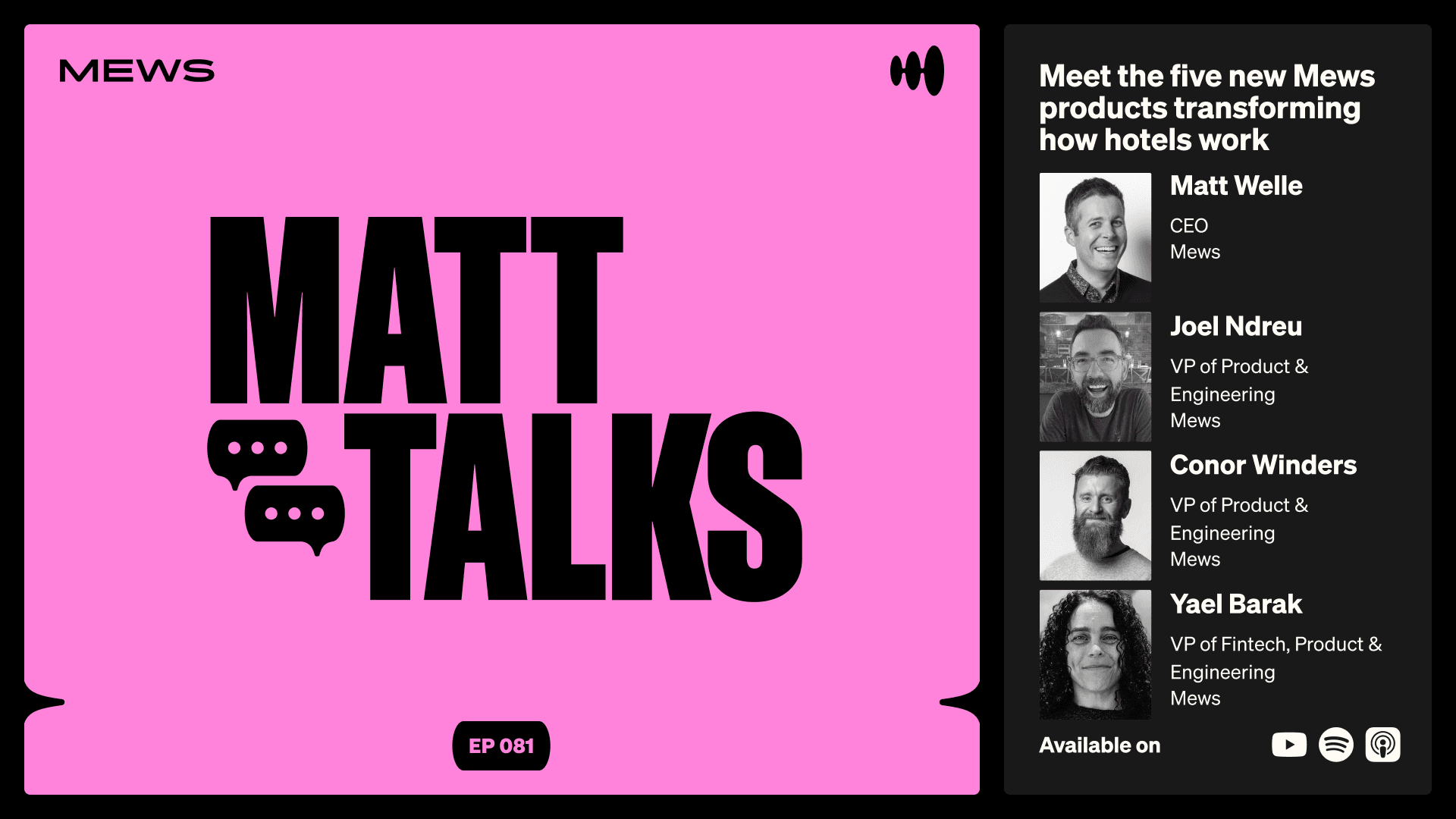
Matthijs Welle
CEO, Mews
After years in the trenches of hospitality, Matt joined the Mews journey during its early days in 2013. Since then, he’s been our fearless CEO, leading the company and the industry forward.

Joel Ndreu
VP Product & Engineering, Mews
Joel leads product and engineering for Front of House at Mews. He is a product and engineering executive with 20+ years scaling AI-native platforms at companies like CLEAR, Zoom, and Meta.

Conor Winders
VP Product & Engineering, Mews
Conor leads product and engineering for Back of House at Mews. He is a seasoned engineer building technology that powers modern hospitality. He brings a product-driven mindset to solving real hotel problems.

Yeal Barak
VP of FinTech, Product & Engineering, Mews
Yeal leads Fintech R&D team, overseeing product, engineering, and design functions at Mews. She is an experienced product management leader in enterprise solutions for Omni-Channel Payments Processing, eComerce, ISVs, and SaaS platforms.
Episode chapters
Transcript
[00:00:00] Joel Ndreu: We can see that up to a third of messages are never responded
to. And even when a response is sent from the hotel, it usually takes 8 hours or more to
send that response. And that's not because these are bad hoteliers; these are bad
people. That's because these messages are coming from a lot of different directions.
Maybe there was an email. Maybe they sent a web message. Maybe they called earlier.
It's unclear. Did someone respond? Maybe they did. Something comes up, right?
[00:00:37] Matt Welle: Hi, everyone. Welcome back to another Matt Talks hospitality,
and this is a special episode. And I do say that all the time, but this really is a special
episode because we're doing something different this time. I've brought together three
of our product leaders to walk you through everything that we're launching at Mews.
New products, new features, things we've been working on for a very long time, and I
think you're going to genuinely like this change that we're bringing to you, the
workflows of your teams today. We're gonna cover a lot of ground. We're gonna talk
about Mews automations, guest messaging, accounts receivable, Mews business
intelligence, and Mews revenue management. So, a bunch of new products. And to kick
that off is Joel. Joel is joining us as the VP, Product and Engineering of the front of
house, so really taking care of the guest experience. And we're gonna talk about Mews
automations and guest messaging specifically with Joel. Let's kick off with Mews
automations. What is this product, and what's the problem that you're looking to solve
with this?
[00:01:32] Joel Ndreu: Sure. Yeah. So I think, you know, at Mews, what we've done over
the last decade plus is try and figure out not just how to digitize Hood Health
workflows, but how to, you know, make them go away, how to automate them. And a
lot of that work has resulted in us actually building those automations where we
thought they applied to everyone. There's lots of business logic in many places. And
the more of that we did, the more we realized we should just build a tool to let hoteliers
actually build the automations themselves for all the custom bits that, you know, your
operation has that are different than what every other hotel has. So, this will basically
be a GUI (Graphic User Interface) system, where a hotelier can go in and actually build
custom things. You know, say that, when a guest, who is platinum rated, comes in, we
do a, b, c, and d every time, right, regardless of who's on shift, regardless of whether
someone remembered the system does it for me.
[00:02:28] Matt Welle: Is this, like, an if this then that tool, or is it different in that
perspective?
[00:02:32] Joel Ndreu: Different in that perspective. Right? It really is gonna be built
based off of the the actual triggers, the things that happen that matter in a hotel when
someone checks in, when someone goes to the front desk, when someone gets a key,
when someone checks out, right, when someone makes a request of housekeeping. It's
basically triggered off of, it can be triggered off of any of the events that would
happen inside the PMS, which thankfully is almost all the events, all the ones that really
matter. Right?
[00:02:58] Matt Welle: How do I build a workflow? Like, what would that look like? Is it
difficult, or can anyone do it?
[00:03:03] Joel Ndreu: Super difficult. We don't expect anyone to be able to use this
tool. No. I think there are three ways to think about this. There's what I'll call the power
user, which is, like, I wanna build a million custom flows myself. Just give me the tools.
I'll build it myself. That will certainly be possible, right, where you can view, drag and
drop the giant list of things you can do, tie them together, or build them into a giant
workflow. And we expect that'll be a minority of users. There's the classic, like, give me
the 10 basic templates, right? Like, hey, I want the loyalty upgrade flow. I want the early
check-in flow. I want the late checkout flow. So, we'll have some templates that are
prebuilt for folks who just wanna say, this is mostly where I want click, right, let me edit
two things. And then we'll also have an agentic flow where you can just tell it what you
want. Right? You can say, “Hey, here's what I want to happen. Do what you need to do,
but please make this happen.” Right? And the agent will actually build the flow for you.
[00:03:55] Matt Welle: Amazing.
[00:03:56] Joel Ndreu: It will then obviously show you what the flow is, and so you can
look through, verify it yourself, make any edits you wanna make, and then hit go.
[00:04:04] Matt Welle: So, can you give maybe, like, one or two actual use cases, like,
actual automation flows in the hotel that will make a difference?
[00:04:10] Joel Ndreu: Yeah. Absolutely. I think my favorite is what we call soft loyalty.
Right? So, obviously, if you have a hard loyalty program, meaning, you know, you have
a 3-star, 5-star, 7-star guest, you can trigger events based on, you know, make sure this
guest always gets a cocktail when they arrive. Make sure this guest always gets a room
with a view. But the more interesting stuff to us, I think, is the soft loyalty to say, hey, if
you have a guest who stayed with us more than five times in the last two years, give
them an upgraded room, and then send them a message to let them know that we're
thankful for their return business and that we upgraded them, right, so that they know
we did a special thing for them. I think it's those types of flows that are super
interesting to me. And then, similarly, you know, you could expand on that in many
ways and say, like, hey, if a guest requests an extra pillow, always follow up with them
15 minutes later to make sure it arrived, right? Please send, like, create a ticket for
housekeeping and then always send a follow-up message. And if they say it hasn't
arrived, then escalate to the front desk, right? Flow like that to ensure consistency in
how your hotel operates are the ones that are top of mind for us. And then there's
certainly one-off flows, right, where you can have strange things like, hey, if more than
five tickets are filed with maintenance for broken ACs, trigger a message to the
manager. Let me know that's happening. Right? Simple things like that can also be
useful. Basically, to just ensure that things that should always be happening always do
happen, versus that being based on the person who's supposed to do them
remembering in the moment.
[00:05:42] Matt Welle: That is so good. I was, this morning, with a hotelier, and this
room's divisions manager said, “I would love for Mews to produce a report with all the
VIP rifles so that I can manually check them.” And I said, “No. No. No. You're asking for
the wrong thing, and I can show you.” I'm not allowed to, but I did show her what we
built, and she's like, oh, I don't need the report. I just need that product because that
solves my thing. Because for these VIPs, they're putting these nice welcome gifts in
the room. I was like, yeah, we will create the task for you automatically so that the room
service knows when to deliver those things to the room. Yeah.
[00:06:14] Joel Ndreu: That's exactly correct. Right? Like, you don't want a digital
checklist. You just want it to be done.
[00:06:19] Matt Welle: Yeah. Exactly. Talk to me about guest messaging.
[00:06:23] Joel Ndreu: Yeah. So, I mentioned it a few times in our conversations that
we've had about automations. But two-way messaging is critical if you wanna actually
engage with your guests. And there are lots of great ways to do that, but we've
decided that it's really important to have that built into both so that you have one
unified place where you can view all the messages happening between you and the
guest, whether that's through SMS, through WhatsApp, through booking, etcetera,
right? All the normal channels that your guests communicate through, but also because
that two-way communication is critical to your staff's engagement wherever the guest
is. And today, most guests live on mobile devices. I don't know if you've heard of those.
Right? But most people have cell phones, and that's generally how they communicate.
They want that in the moment communication, so we wanna meet them where they
are. So, we're building a unified communications guest messaging hub somewhere
where you can view all these messages compressed into one stream. So, if you, Matt,
were to send me an SMS, while you were on a trip somewhere and then later you
switched to WhatsApp and then later you switched to our web messaging platform
and after that you switched to booking, I still know that Matt is Matt based on certain
identifiers, and I will combine all those messages from Matt from all those different
channels into a single chat thread that your staff can then view in the message center
to say, these are all the messages we've gotten from Matt. And when you respond, you
can choose, do you wanna respond to Matt on WhatsApp? Do you wanna respond
through SMS? Obviously, we will default to responding to whatever the latest version
Matt is liking to use. But once we can do that two-way communication, not only can
we simplify coordination between you and the guest, we can actually make sure you
respond to the guest. We have messaging right now in Mews, and we can see that up
to a third of messages are never responded to. And even when a response is sent from
the hotel, it usually takes 8hours or more to send that response. And that's not because
these are bad hoteliers; these are bad people. That's because these messages are
coming from a lot of different directions. Maybe there was an email. Maybe they sent a
web message. Maybe they called earlier. It's unclear. Did someone respond? Maybe
they did. Something comes up, right? Like, so unifying all those is critical to know this is
the one place we go to look to see if we have messages. And more importantly, similar
to our automation discussion, now you don't have to answer because now when every
message comes through a unified place, we can make sure that we have intelligence, a
place to always answer, right? 80% of the time, your guests are asking for something
that the system already knows the answer to. Like, hey, is breakfast included in my
reservation? Hey, can I have an extra pillow? Like, hey, do you have parking? What time
does the pool open? Right? Is diving allowed? Are my kids okay to be alone in the
dining area? Right? Those are the types of answers we can take away from the staff, so
the staff can do the million other jobs they have to do and respond quickly to the yes.
Because when that guest messages your hotel, they expect an answer instantly, right?
They expect that there's someone there waiting for their message to come through
and instantly respond. We can do that for you. And what that also allows us to do is
build in all those automations we just talked about. Right? Because now that the guest
is giving us input and we can give the guest output back, we can go back and forth.
Right? So, if that guest can say, “Hey, is breakfast included?” We can say “no, it's not.
Would you like it?’ Right? If that guest says, like, “Hey, my flight landed super early. Can
I get an upgraded room?” We can check and say, “Hey. You're a loyalty member. Sure.
We were gonna upgrade you anyway. But, yes, we can accommodate that for you.”
Right? And we can let that guest know. And then, as I said earlier with the automations,
even if you were doing stuff in the background, when you do a net positive thing, you
wanna let that guest know that you did it, right, so that they know that you're doing
extra work on their behalf. So, if I text you, in my Uber on my way to the hotel, and I
say, “Can I have, please, I love extra pillows? I need extra pillows on my bed.” Our agent
can pick up that the guest asks for extra pillows. It can create a task for housekeeping
to give those extra pillows to the guest when they clean the room. When the guest
arrives, and the cleaning is done, the room is ready, the system can then text that guest
back to say, your pillows are in the room. Thank you very much. Welcome. Right? That
closed loop can all happen automatically so that you don't have to remember that, oh,
right. Matt wanted the upgrade with the extra pillow. Let me do that for you now while
you're giving me your passport. When my guest arrives, you can just say, “Welcome,
Matt. Your extra pillars are already in your room. You're on the 5th Floor because we
know you like the view. Thank you.”
[00:11:02] Matt Welle: Amazing. So, what I'm hearing is that this is a messaging service
that's embedded into the platform that the employees of the hotel live in, right, so they
don't have to have a second tab open. Everything happens in the main platform. We're
plugging in more channels. Like, right now, we have just email, but we're adding in, like,
it sounds like WhatsApp and messaging, I heard you say, OTA channel?
[00:11:22] Joel Ndreu: Right now, we will have SMS. We'll have WhatsApp. We'll have
Booking. We'll have our web browser. We'll very shortly have Expedia, email, and then
we'll keep expanding and adding more and more channels, you know, Airbnb,
Instagram, Facebook Messenger, basically, we wanna meet your guests where they are,
however they want to communicate with you, we should let them do that and then
unify it on the other side. And I think the most interesting thing to me is our ability to
tie in our AI agents into these messaging flows. Because when a guest asks for
something, that shouldn't always mean a human in your team has to do something.
[00:12:01] Matt Welle: And I think that's the worry that hotels have. They're so worried,
like, oh, you're plugging in more channels, so I'm getting more volume to my team, who
I want to focus on the guest in-house, but actually, what you're saying is, yeah, there's
more volume, but the AI agent can handle the majority of all of that. And when it gets
stuck, that's when we can very quickly escalate in the same user interface that the
employee is in to make sure that those messages don't get missed, right?
[00:12:24] Joel Ndreu: Yeah. That's exactly correct. Like, we've made it very easy for
the employees to jump in and swap the AI on or off for any given conversation. So,
humans can jump in, pick up a piece of a conversation, and then hand it back off to
their AI coworker to say, “Alright. I answered that hard part. You keep going now.” Like,
finish what you had to do. And, again, as I said, the key part between automation and
messaging is to put them together. Right? To have that messaging agent understand
this customer is asking me to do this.
[00:12:53] Matt Welle: Well, like, it's even the thread. Right? So, when you confirm to
the customer, saying, you know, through the automation, we just say, 'Hey, by the way,
we upgraded you nicely.’ And you send a message. But then they can respond to that
message. It's not a no-reply number. They can instantly start to communicate
backwards and forwards. And that's all the communication that would normally happen
under the reception desk. We've just taken care of it. And I think that's the really
exciting bit, how all these ecosystem products work together really well.
[00:13:17] Joel Ndreu: Absolutely. And as we have that communication, we also deepen
our knowledge of that customer. And within the Mews profile, we also improve our
smart tips and smart suggestions, right, based on what that customer has asked for in
the past. So, this all really ties together into the Mews ecosystem to provide a
recurring, faster, better experience for the guest, which should also be a faster, better
experience for you and your employees as a hotelier, right?
[00:13:43] Matt Welle: Great. Joel, thank you so much for sharing this.
[00:13:47] Joel Ndreu: Absolutely.
[00:13:48] Matt Welle: So, that was Joel. Joel focuses on the front of house. So, what
happens, you know, at the reception desk and all of the guest flows. As we continue
this episode, we'll talk about the two products that sit right at the heart of how
hoteliers make revenue decisions, Mews Business Intelligence and the Mews RMS. I've
got Conor Winders. Conor Winders? Winders. I never know if it's…
[00:14:08] Conor: Winders.
[00:14:09] Matt Welle: Winders. Sorry. Irish. VP of Product and Engineering at Mews,
covering the back office, so what happens behind that door where people hide in the
back and make all of these big business decisions. Let's kick start with Mews BI. And
tell me, because we used to have a product called Mews Analytics, and today, we've
launched a new product, which is Mews BI. And how do those two compare? This is a
real departure from what we used to have.
[00:14:32] Conor Winders: Yeah. So, we've had Mews analytics for a while, and I think
it's done a good job, a possible job for a lot of our customers. But more and more, we
really believed we could do a lot better. And when we really spoke to our customers
and really tried to understand how they were using Mews analytics and some of the
difficulties they were running into. There was a lot of signals there that, you know, the
product that we were offering wasn't doing what we believed were capable of doing.
And so some of the things that we would see and some of the problems that we would
hear is Mews analytics could be slow at times, very, very hard to customize to get, you
know, the actual data that you wanted to see at a point in time. The data itself is not
always up to date. It wouldn't necessarily always be the freshest data that you were
looking at. And so when you combine those sorts of things, what we would hear and
what we would observe with customers is that they start to lose faith in the numbers.
And when you've got a data product, and you question the numbers, you know, you've
got that, that's a real, real challenge for our customers. And so, you know, there was a
lot of signals there that we could be doing better. Even beyond that, you know, Mews
Analytics struggled in a multi-property sort of setup, and a lot of our customers are
managing multiple properties at once. The other thing that we saw a lot of was
customers actually going into Mews Analytics, exporting data into Excel or Google
Sheets or something else, manipulating it in there, maybe adding a couple of other data
sources, adding some macros and formulas and things like that to try and find the
answers that they were looking for. And, ultimately, spending hours just managing the
data as opposed to acting on the data and getting insights to act on on the data. And
so, Mews BI has really been built from the ground up to, like, avoid those problems and
provide a much, much better, slicker, richer experience from the start. So, some of
those things that I talked about, like the data freshness and Mews analytics on the
speed, like Mews BI is lightning fast in terms of how it renders the dashboards, how it
renders the reports for you. The data that you get in there is at most going to be two
hours old. We have it refreshing constantly, every two hours, new, fresh data is
pumped in there, so you're always able to trust that you're looking at the most up-to-
date and relevant data for your product. It's also multi-property by default. So, out of
the box, it's going to be able to handle multiple properties as opposed to trying to
stitch together different views, like what would happen in Mews Analytics. We've also
added, like, some really, really nice things in there that you couldn't do in analytics. So,
you can upload your own data. We've given the ability to add your own budgets,
forecasts, add your own historical data, and things like that. And I'm sure we'll get into
it too, but actually, now starting to connect to third-party sources. So, Mews BI is
amazing at showing you the data that lives inside the Mews ecosystem, but also the
ability to start to pull other data in there as well, so we can avoid people needing to
actually download anything to a spreadsheet. So, yeah, ultimately, they're very, very
different products. Mews BI is built on a whole new foundation, really to solve a lot of
the pain that we saw our customers were having with Mews Analytics.
[00:17:21] Matt Welle: And you started talking about the data, and in the old product,
the data wasn't always trustworthy, whereas now we build it on a new infrastructure.
But can you maybe talk through the challenges of rebuilding our data from the ground
up so that it's trustworthy today?
[00:17:35] Conor Winders: Yeah. I think, like, ultimately, in building a data product, like I
said, like, one of the most important, actually, the most important thing is, like, the
definition of the data needs to be the same across the platform. You can't have one
interpretation on one screen of what ADR is and a different interpretation in a different
screen. And that is true, like, across all of the metrics that are important in a data
product. And what we've tried to do with Mews BI is it is built for hospitality from day
one. So, we've spent a lot of time, a lot of investment in really defining the semantics of
what these different metrics mean in a hospitality world. So, you'll see there's a
common definition of occupancy, RevPar, ADR, hiccup, pacing, all of these things that
are, you know, very, very specific to hospitality are defined in great detail under the
hood in Mews BI. So, you don't have people trying to come up with their own
interpretation or their own formula from one report to the next or one screen to the
next. The system itself understands these things out of the box. And that's probably
been the biggest investment that we've made over the last couple of years. A lot of
work has gone into building out those semantics so that we can produce data that
makes sense and that is consistent across the whole product.
[00:18:46] Matt Welle: Love that. And, basically, you can build your own dashboards
from the ground up. Why have we decided to make a few predefined dashboards for
hoteliers?
[00:18:56] Conor Winders: Yeah. So, out of the box, you're gonna get I think it's, like, 18
dashboards at the moment, and we're continuing to add to that. So, there are a lot of
dashboards in there that answer questions that our customers want to answer,
whether it's every day or every week, but they want to answer them quickly. They
want, within a couple of clicks, to get an answer in 10 seconds, 15 seconds and so on
and so forth. So, again, the things that I was talking about, like your pacing dashboards,
your pickup dashboards, things like that that we know our customers want quick,
readily available access to. And rather than having our customers needing to define
those and build those themselves, we decided to just give them out of the box. And it's
all about removing friction from the whole system so that this is a quick and easy-to-
use product. Data products can get very complex, very, very quickly, and we wanna
take as much of that complexity out as we can for the things that we know our
customers want. And then at the same time, we also know that some of our customers,
some of our power users, they really wanna go much, much deeper. And so we have
also built the ability to build your own dashboards. But in even doing that, we've tried
to make that as simple as we possibly can. So, it is literally like a drag-and-drop
interface where you can start to pull in the metrics that you're interested in, configure
the metrics that you're interested in, and create the sorts of deep, insightful
dashboards that are very specific to your business. So, trying to cater for the best of
both worlds, that very, very quick answer the question that you always want answered,
and then that kind of deep work, you can build your own dashboards for as well.
[00:20:17] Matt Welle: And then I saw we added this AI summary at the top of the
report. What does that do?
[00:20:23] Conor Winders: Yeah. The AI summary is something that I really love in the
product because it's not something we started out doing. We actually started out
trying to solve a different problem. And I think a lot of, like, what makes a great product
is you start out with something, and in a way you fail because you realize what you're
trying to do is not solving the problem the customer actually has. And you pivot, and
you iterate, and ultimately land on a solution that really does solve a problem for
customers. And that's kind of what happened with this AI summary, where we started
out down one direction of what we thought would be valuable to our customers.
[00:20:52] Matt Welle: Well, what do we think was valuable? Like, I actually love an
example.
[00:20:55] Conor Winders: So, really, what we thought our customers would want as
technology people was the ability to talk to your data, to actually ask questions of your
data, and have some sort of AI go off, figure out the answer to those questions, and
push it back to you. And as we showed this technology to our customers, as a tech
demo, they loved it, thought this is really, really cool, but in terms of the practicalities,
the same feedback came over and over. I wouldn't use that. I need to be able to get my
data and get answers at a glance. And if I wanna do deeper work, then I'm gonna sit
down. I'm gonna do deeper work. And so from a technology perspective, what we saw
was that we could get good answers, but the friction involved in talking to the data
wasn't solving the problem that our customers actually had. And so where we landed
on then was using the same technology, but to produce these executive summaries.
So, now what happens is when you open Mews BI, the first thing that you're gonna see
is a small summary that really highlights the things that you need to know about your
data. So, you don't need to ask the question. We ask the question first. We render that
right away. We really, in doing some of these AI summary type products, like, it's a
delicate balance, and it's a really, like, interesting design challenge to solve as well. So,
on the one hand, you can summarize everything. You can summarize 20 curated
dashboards, 50, you know, custom dashboards, and have this massive big wall of text,
and that doesn't solve a problem, right? Customers become immune to that. They just
skip past it. And it doesn't actually highlight anything to them. On the other hand, you
can go way too summarized and only show, like, really small bits of information that
don't add value either. So, we spent a lot of time working with customers trying to find
what is the balance between you need to have a level of comfort that your business is
working as you expect it to, but you also need to be signposted to the things, to the
anomalies in the data where you need to dig deeper. And so you'll see with these AI
summaries when you open them up, they'll give you that reassurance in a couple of
lines, but then they'll highlight the things that, hey, when we look at your data, we think
something interesting is happening here, and you should dive in and look a little bit
deeper. So, we're not necessarily trying to replace all the analysis that goes into it, but
do more of that signposting to give you the reassurance, but also give you the nudge
towards where we think there's something interesting to look at.
[00:23:05] Matt Welle: That's pretty great. This week, I went for cross exposure at one
of our customers, and they are a hotel chain there for, like, 12 different hotels. And I sat
around a table with, like, the GM, and the front office manager and their systems
director. And, you know, normally, I walk away from a day like that with, like, a huge list
of feature requests. And often, it's about reporting. They want the manager reports to
be slightly differently calculated, or they want reports to be exported in a PDF file, or
they want a VIP report that's slightly different. It was so nice to be able to just open up
BI and just say, yeah, but let's build it together, and I'll show you how to do this
yourself. And my list was significantly shorter, but even, like, you know, the GM thing, I
must have it in PDF because, actually, an Excel file won't pass my audit. I'm like, great.
It's there. It made my life really easy in that conversation with the hotelier. And at some
point, I even said, actually, you know, with what we just learned from Joel with the
automation hub, I don't think you need a report because the automation hub can
automate, because they were looking for a VIP report. It's like you can build it in BI,
where it can tell you the VIPs and kind of what amenities they should get. But, actually,
we should remove that report entirely by automating it through the automation hub.
So, it's the interplay of all these different systems that becomes really powerful.
[00:24:17] Conor Winders: Yeah. I think what's really interesting, and you'll see more
and more in the coming months, in the coming quarters as we release products like the
automation hub and as we continue to improve what BI is capable of doing, is that as
we ask the question of our customers, why do you need that report? Why do you need
that data? It's what are you going to do with this next? And I think we can move further
and further into helping our customers by doing that or automating more and more, as
opposed to we can produce the report. But if you're doing something with that report,
we wanna know what you're doing with that report because I think we can help you
with that as well. And the technology is moving so fast. And as you say, things like the
Mews automation hub, it's really going to be mind-blowing what we're capable of
doing and how we're able to help our customers by pulling these systems together.
[00:25:00] Matt Welle: So, speaking of pulling systems together, the person that
probably uses BI the most will be the revenue manager because they're trying to figure
out what's happening in the business. There's a new product that we're also launching,
which is called the Mews RMS or the Mews revenue management system. Didn't we
already buy a revenue management system? What's different with this one?
[00:25:17] Conor Winders: Yeah. We did. So, you know, last year, we spoke a lot about
Atomize, which is a product we're incredibly proud of, and a product that actually does
amazing things for our customers, does amazing things for Mews as well. More and
more, as we see the results our customers get with Atomize, I mean, there's very
verifiable data on ADR improvements, RevPar improvements, and occupancy
improvements and things like that. It became clear to us that, like, the potential in this
product is so much greater when it is part of the Mews ecosystem. And, you know, if
you looked at yesterday, it's part of the Mews ecosystem in a way, and it looks, and it
feels a bit like Mews, and you can log into it from inside of Mews. But, ultimately, you're
taken to what is a different experience on a different tab. And in there, you have things
that kind of look familiar, like you're setting some pricing there, you're setting some
rules there, you're setting some pricing on your pricing grid in Mews, and some rules
there as well. And ultimately, there is friction, or there was friction between those two
things. So, what we've been doing a lot, investing a lot in over the last month or the last
month the last year, obviously, we've been improving the engine that powers all of the
pricing and Atomize as well. Our machine learning in there has continued to get better
and better, and that's driving really, really great results. We've also looked at where can
we take friction out of it for our actual users. And every friction point that existed was
one that was up for challenge. So, is it enough that you can click a link in Mews and get
taken into Atomize? Sure. That's good. But, no, that's not enough. You need to be able
to operate the Atomize infrastructure inside of Mews. Is it enough that it looks a bit like
Mews? No. That's not enough. It needs to be the same UI components, the same
patterns, the same navigation. Anything that we were doing that was breaking the
experience or breaking the mental mode became something that we got very relentless
around. Let's remove that. To the point that the entirety of the Atomize capabilities
now lives inside of Mews, not bolted on, not integrated to Mews, but literally inside of
Mews, sharing the same data model. So, there's no question of when I go from this tab
to that tab, will the integration have synced on time? Will the data have made it over on
time? Should I question that? Should I not question that? It is the same data model. It is
the same data layer. Everything that you had to think about before, and whether these
things were in sync, is gone. There's one pricing experience. In there, you're able to
configure your Atomize, configure the governments and the guardrails around
Atomize, but it all runs from one place. As I say, that's something that, you know, has
been getting improved over and over throughout the year, but now the whole
experience lives in one place. And I think that unlocks, like, a whole new way of working
where you're able to actually look at, I'm managing all of my revenue in one place. But
I'm also able to dive deep into the revenue metrics, deep into my business inside of
Mews BI, and I'm able to see everything that's happening from one place. And you can
close that kind of optimization loop, make it much, much tighter inside of one product.
So, it's something that we're super excited about.
[00:28:07] Matt Welle: I went in last weekend, and I spent my Sunday. I lead a different
life than most people. I spend my day, like, learning the system because I don't really
like to read the manual. I just like to click around and figure out how it works. But I
could figure it out very fast, and I had misconfigured some of my OTAs, and I could just
remap them myself. It was such a delight, and I could, like, very quickly from BI, see
what was happening with the pickup and then see if Atomize or the Mews RMS had
picked up on that in the algorithm. And it was so smooth that I can imagine myself back
into the revenue manager role in a hotel, knowing how many Excel sheets we were
running and, you know, doing so much analysis on paper. And it was just so painful, and
suddenly, all of it sits in one place where you can adjust availability or, you know,
accept all these price recommendations. It was a delight, I have to say.
[00:28:54] Conor Winders: Yeah. And I think, like, there's a lot that you can do today,
but it also starts to open up all of these new sorts of opportunities. Like, I think I
mentioned earlier, the ability to connect different data sources to Mews BI, I think, is a
really, really interesting one, especially when you consider something like Google Ads
data, which we can now feed into Mews BI. And what you can do, the sorts of
questions you can ask, maybe you could ask these questions before, but answering
them was very, very difficult before. So, the sorts of questions you can answer now is,
based on what I'm spending on my ads over here, what is that actually turning to in
actual revenue in the property? But not just booked revenue. When a guest is actually
on-site, where are they spending their time, and where are they actually spending
money as well? Are they in my bar? Are they in my restaurant? Being able to actually tie
all of that all the way through your revenue strategy to your marketing strategy in one
place becomes incredibly powerful. And again, starts to unlock a different way of
optimizing your business that is more around optimizing for the guest. And optimizing
for the guest experience as part of that, as well than I think was ever possible before
when these were disconnected systems.
[00:29:57] Matt Welle: And how do you feel about Copilot versus Autopilot? Because
we have both modes, but which is the better mode?
[00:30:02] Conor Winders: I have an opinion, but I think what's nice about the Mews
RMS is you can choose. Right? It is very difficult on day one to say, I'm just gonna turn
on Autopilot, and this job that I've been doing that I really understand deeply, I'm just
gonna hand it over to this engine to run it for me. And so I love the fact that actually in
there, on day one, I can go in and I can say to Mews RMS, “Start giving me
recommendations.” And it will give me recommendations with an explanation. So, I'll
start to understand how it's thinking about setting pricing and why it's thinking about
it. And as I start to get more comfortable with it, I can accept, or I can reject. And I
think what we see is that, over time, more and more people start to accept. And when
you get that level of comfort, that actually, this system, it is optimizing in a way, maybe
not always the way I would've, but I understand why it's doing it, and I can see the
results from it. That ability to turn on Autopilot becomes very, very powerful. You
know? And so, you know, when I say I have an opinion, my opinion is Autopilot is
absolutely the way to run this system, but I understand it takes time. You have to build
that trust, and you have to see the results from it. What's amazing is that we are seeing
the results from it. We see in our data that customers who turn on Autopilot are
legitimately more successful than customers who are manually overriding or manually
accepting prices inside of the system.
[00:31:17] Matt Welle: I had a conversation with Richard, who runs our data teams, and
I was deeply questioning why is it? Why is it that when you switch the Autopilot up, the
results are so much better? And we ended up saying, “Well, it's because you let the
algorithm learn, and it's doing these constant price experiments.” And it doesn't have to
wait for a human to come in on Monday morning at 9 AM to accept the price changes.
It does it throughout the weekend, and it learns like, alright, this price was too much.
Let me pull it down a little bit. And it's the constant price experiment. So, yes, there is a
level of trust that the revenue manager needs to have in the algorithm. But once you let
it roam free, the results really start to stack up. And especially after it gets several
months of experience, because it really starts to learn your seasonality, it gets really,
really exciting.
[00:31:59] Conor Winders: Yeah. When you look at how it's actually working under the
hood, so you touched on it, Therma, like, the price recommendations are being
generated around the clock, like, all day, every day. And it will experiment pretty much
down to a 5-minute interval. It will try to optimize based on the signals that it sees,
based on the demand that it sees, based on everything that it sees happening. Should
it tweak it up? Should it tweak it down? And when you have something that's doing
that, like, every 5 minutes all through the day, I mean, across the Mews customer base,
this algorithm is learning from hundreds of millions of experiments constantly on what's
working and what's not working. And the reality is, despite any of the institutional
knowledge that any of us have, it's just not possible to experiment at that rate the way
that autopilot is able to do it. And it makes sense that if you're able to learn from your
experiments at that sort of scale, you will get better results over time. If a human could
click the button that often, they would get better results over time, but it's just not
possible. Yeah.
[00:32:54] Matt Welle: Any insights you can give to what the future roadmap will look
like? Because right now, it's still, you know, pricing up rooms overnight. Is there any
further functionality that we're adding that really differentiated from other revenue
management systems?
[00:33:06] Conor Winders: Yeah. I mean, there's a lot. And again, especially when you
think about having all of these systems in one place on the kind of Mews operating
system where we're able to have this common data layer, common data model to work
off. Some of the things I'm most excited about are really how do we optimize around
the guest as opposed to optimizing around the room, and how do we look completely
end-to-end at the type of segment that we're able to attract, what does that guest,
you know, what sort of price will they buy at? What sort of experience will they want
when they're on-site? Where will they spend time and money when they're on-site?
And starting to tune a much more personalized set of pricing recommendations that
goes beyond just the room. So, we may sell the room at some price, but what about an
allowance that comes alongside that? How can we test with things like allowances to
have somebody spend more time in the restaurant? How can we test with allowance to
have somebody spend more time in the bar? And all of these sorts of different
strategies that you can have very, very personalized, like, hyper-personalized
experiences and pricing for individual guests based on everything that we learn about
who comes to your hotel, that's very much where we're heading. And I think that future
is much, much closer than it has ever seemed, like, in the past. And so moving away
from this idea of, you know, revenue per room to revenue per guest, I think, is what
you'll see a lot more of from the Mews RMS on the whole operating system.
[00:34:26] Matt Welle: And it sounds like that whole ecosystem, like a lot of the pieces
of the ecosystem are really coming together now, where, you know, we see it in all the
outlets. We know details about a customer and what they spent last time. And through
the communications hub, we can create special offers down the line. And I think it's
this real benefit of the amount of data that we're collecting about customers, not in a
creepy way, but actually in a really exciting way, where we get to know them because
they are living with us, and all of the systems are connected together. And then you
can, you know, have AI or the RMS create these really special offers. And this is the
thing that gets me the most excited about the releases that we're doing at Unfold. It's
just that a whole ecosystem story is coming together really powerfully.
[00:35:06] Conor Winders: Yeah. And, like, at the end of the day, there's one way to
look at it, which is that, oh, it's creepy we're collecting this data about a guest. The
other way to look at it is to put yourself in the guest's shoes. And if we can create
amazing experiences for guests, then it's a win-win for everybody. And I think what you
see more and more with what we're releasing at Unfold, and in the coming months, is
that we can help our customers create amazing experiences for guests. And the guests
will be happier. They will come back more, and they will spend more, and everybody
wins in this scenario. It's not like we're creating data, or we're capturing data for no
reason. You're now able to see how we can use that data to actually provide really,
really meaningful experiences, and I think that's incredibly exciting. I don't want to, you
know, be coming into hotels, you know, carrying my luggage, and trudging up to the
front desk to have somebody stare at a monitor and ask me why I'm there. You know?
These are the sorts of experiences that exist in the yesterday. The sorts of experiences
that exist in the future are, you know, the hotel knows who I am before I even arrive,
and they greet me with a personalized message, and they hand me a little glass of
whiskey because they know that I like a glass of whiskey. And they don't ask me am I
there to check in when it's blatantly obvious that I'm there to check in.
[00:36:14] Matt Welle: I love it. Did you get a glass of whiskey in the hotel that you're
staying in today, or not?
[00:36:19] Conor Winders: No. But they're not a Mews customer.
[00:36:20] Matt Welle: That's not a Mews customer. Thank you so much for joining.
That was actually really excellent.
[00:36:26] Conor Winders: No problem. Thank you for having me.
[00:36:28] Matt Welle: Next on this episode, accounts receivable. And it's an
important category because often accountants are hidden in the back office, and we
don't really think deeply about the pain that they go through. But if you've ever worked
with accounts receivable in a hotel, you know the pain. You have open bank statements
on one screen, you've got the PMS on another and possibly an accounting system, and
everyone is figuring out which wire transfer matches with which invoice. So, I invited
Yael to join me today. She's the VP of Fintech on the Program & Engineering teams for
Mews, and she's here to talk about how she is helping fix that particular problem. Yael,
thank you for joining me.
[00:37:05] Yael Barak: Thank you for having me.
[00:37:06] Matt Welle: Talk to me about accounts receivable. Is it really so painful?
[00:37:11] Yael Barak: Oh, well, you know what? It is. When we speak to some of our
customers, the scenarios that they tell us about are crazy, and I actually got to live
through one of these sorts myself. I was organizing an event for my team at Mews, and
so I reached out to one of our hotels, and we made a group booking for the, you know,
people who are coming to the event. And so my event was two days, but some of my
team wanted to come in ahead of time and maybe spend a couple of days in the city,
you know, on their own dime, and maybe a few others wanted to stay two days later.
So, my one booking with the hotel of, let's say, 15 rooms became 15 rooms with 17 or 18
different reservations attached to them that starts in a different, you know, time and
end in different time, get paid by different people. Some of them use paid, some of
them the employee, you know, picks up for their own time. And so the hotel has one
customer here, that's Mews, but that entire event generated maybe 18, 19 different
invoices. And then when people come and go, every time they check in, they check
out. Those invoices need to be raised. Some of them need to be sent to me because
I'm the one paying. Some of them are actually sent to the employees who are paying
for their own stay. And if you're the accountant, what you see is, oh, there's an event
it's worth, I don't know, €10,000, but there's 18 invoices against it that will be paid at
different times that you don't know exactly when, because maybe they're not paid by
credit card, made it paid by a wire. I mean, use the company, it’s gonna pay by wire. The
employees might pay by credit card. You're there holding this bucket, and you have no
tool. You're watching your bank account, and you're seeing money land in the bank
account. And you have to say, okay, this amount, I need to correlate to the reservation
by Mews. So, their amount owing is now deducted by this much, but there's still an
amount owing. When is that coming? I don't know. Not some other amount landed.
Basically, they're doing this, like you said, bank account, PMS, invoices. Sometimes the
company that sends them payment is not going to say Mews, whatever. It's going to
say whatever we call our company, you know, and that's the problem we're trying to
solve. We had hotels tell us it takes us 20 minutes for an individual in the accounting
department to fully reconcile an invoice. 20 minutes that this, yes, person spends on
one invoice. That one invoice can be worth a €100,000 or a €100. So, how do you
prioritize your time? And the biggest problem for hotels is that sometimes, because
they need to prioritize, they will accept that some of their lower amount invoices are
maybe not reconciling, and maybe they're taking a loss. They're writing them off. Why
should they have to write off revenue? It's too much.
[00:39:49] Matt Welle: I love that. The problem is real. Like, and like your example is
real. Like, I've spoken to many hoteliers, and I often ask them about what the
accountant do. Can I speak to them? And, like, what you described is a real, genuine
pain. So, what have we built?
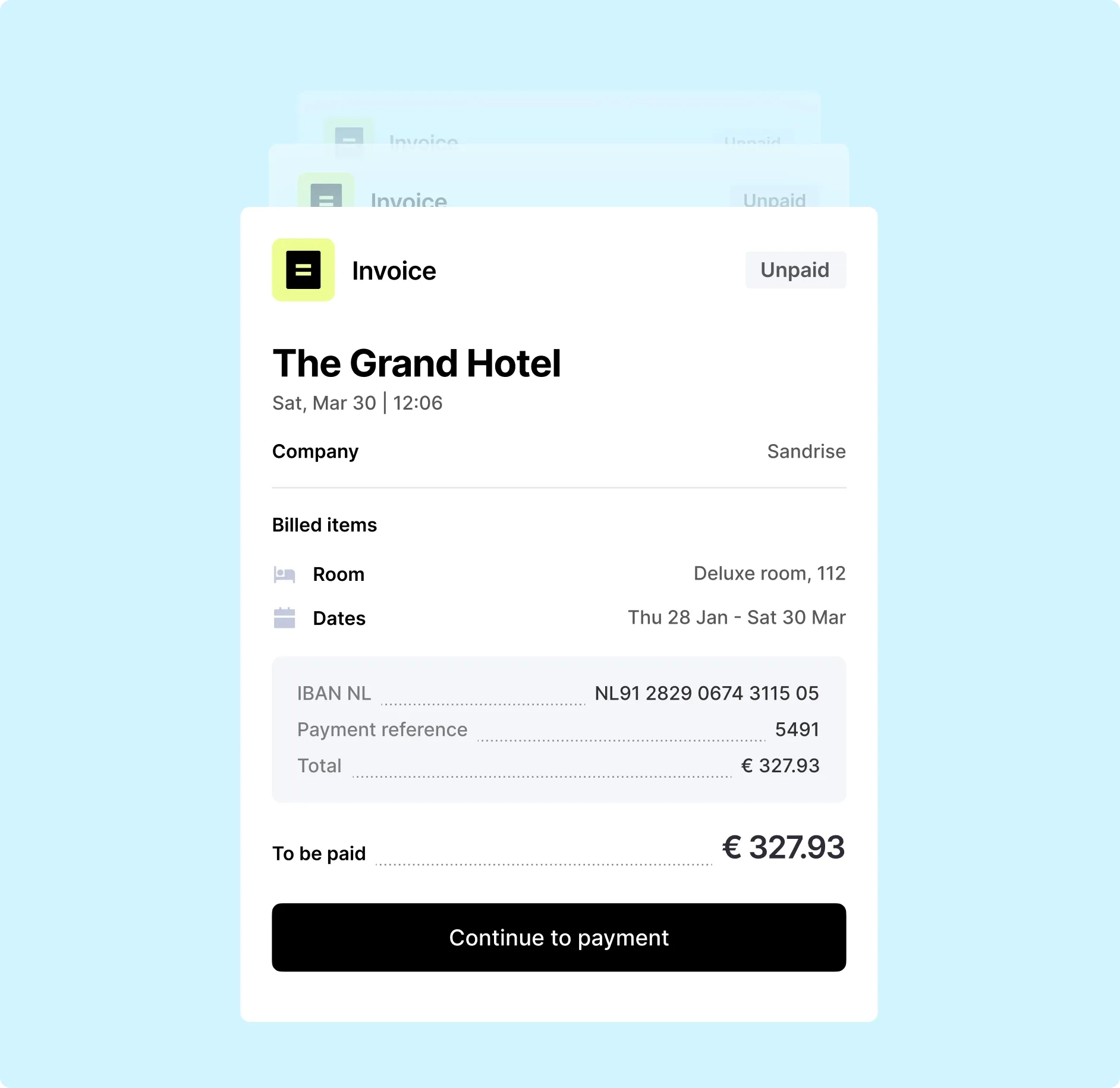
[00:40:02] Yael Barak: So, we have built a product which fully automizes end-to-end,
the process of raising the invoice to reconciling it in your accounts receivable ledger.
And the way it works is as a guest checks out of your hotel or an event is wrapped up,
you're closing a bill, basically. We will automatically raise the invoice for you, and we'll
send it to the payer. When the payer receives the invoice, the payment that they will
make will use either they'll use a credit card, so they use our payment processing, or
they'll use an IBAN that is on that invoice, and that IBAN is mapped to them personally.
So, when I use an IBAN to pay that with a buyer or a bank transfer, when the money
lands in the hotel bank account, Mews will know exactly who the payer is because
there's only one payer that can pay for that IBAN, the IBAN. And when we see that
money land in the account, we will then automatically go to the city ledger of the hotel,
and we will say this invoice has been paid. That's end-to-end, the journey. Now, there
are gonna be other scenarios. What if it was underpaid or overpaid? What if the
company paid a number of, like, they added a bunch of invoices that were owed, and
they paid them aWelle: I So, now a single payment is either reconciling or not
reconciling over and underpayment, or maybe we need to say, attribute this to a
number of invoices. So, we are actually building a reconciliation agent. It's gonna be
driven by an AI bot. It's gonna look at the amount, and it's gonna find these scenarios
for you and make the recommendations. It'll say, you know, this amount fully reconciles
to these 5 invoices. Therefore, you can mark them as reconciled and paid. Or this
amount is underpaid. You know, the invoice is underpaid. We've collected money for
you, but you have money owing, and you need to send a reminder. And our system will
actually automatically send invoice reminders as well. So, the idea is to really absolve
them from having to manage all these exception scenarios and think about, will I get
paid? Will I not get paid? They will see exactly what's getting paid, exactly when, and
they'll have the confidence that their cash flow is sound.
[00:42:10] Matt Welle: And, like, cash is king. If you're a hotelier, you know that we are
in a fickle business, unfortunately. And if you're not reconciling, you don't know which
one to chase at which time. And in hotels, honestly, cash is king. So, while it seems like
a really small thing, this is actually a massive thing because invoices are usually the
largest amount you have to collect there for large events and large group businesses.
So, having accounts receivable completely automated so that even if transactions
come in the weekend, it's instantly reconciled instead of, you know, Monday, midday,
once the accountant gets to opening their bank statements and starting to reconcile
some of these transactions.
[00:42:48] Yael Barak: Exactly. Yes.
[00:42:49] Matt Welle: So, is the reconciliation with some of the AI agents, or how
does that work? How does it know to match it to the right transactions?
[00:42:56] Yael Barak: So, like you said, when we start from assigning a unique payer
ID to every payer, so that is the, let's say, the kickoff point of we know who is paying
this money, right? So, now you know who's paying. And if you know all of, let's say, the
amounts or the invoices that are due by this payer, because it might be more than one,
like we said, you can apply, you know, intelligence to say, well, if the amount matches
or doesn't match, you know, what I'm expecting, well, what is the exception? Over,
under, or maybe there are multiple amounts that are still due, and I can apply, you
know, I can start applying to the each individual amount and see where I end up. Does
it fully reconcile, or is there still an amount owing or overpaying? So, that is what the
reconciliation agent will do. It will basically consider all these scenarios. It will make
recommendations. And then what we're hoping for, obviously, is that in the future, the
accountants will be so confident with this agent that they will just basically let it take
decisions to say, “I'm closing these three invoices, but the fourth one will remain open
because there's an amount that's still due.” But I think there's also a world in which the
agent acts as, like, your assistant to say, “I'm recommending that all of these be closed
and this one remain open. Do you accept?” And then the accountant can confidently
say, “Yes.”
[00:44:13] Matt Welle: And what happens if we get a payment, but we can't attach it to
an account? Like, if we don't know what events it links to, will that be lost in some way?
[00:44:23] Yael Barak: No. I think that is where we will kick off into a manual workflow.
So, this is where you raise the exception to the accountant, and you say, we've been
unable to identify. Maybe someone made a mistake, like, maybe they, you know, we
give them the vIBAN to pay, but maybe they used the wrong one somehow. I don't
know. And so, money landed in the account, and now you really cannot match it. So,
hopefully, we will cover as many of the, you know, the workflows that are automatable.
I guess in any automation workflow, you want the human to only deal with the
problems that humans alone can solve. Maybe you do need to pick up the phone. I
don't know. Maybe something, let's say, is overdue way too long. And at this point, it's
like, it doesn't matter how many reminders you send. It's just not getting paid. You
need to kick off into collection, you know? That's a process where, maybe, that's the
point where the human intervenes. And, hopefully, they only intervene where they
need to because everything else is being taken care of.
[00:45:22] Matt Welle: So, we started as a PMS 13 years ago, 14 years ago. Today, you
know, we have a full payments platform. We launched Mews Business Intelligence. We
have Mews embedded RMS. We're launching accounts receivable, all happening inside
the same platform. From a fintech perspective, what does it mean for hotels to have all
their functionality running from the same system as their operations?
[00:45:45] Yael Barak: Yeah. We've been thinking through that. You know, we've been
given so much attention and advantage to departments in hotels, like front of house
and back of house, and we've not really yet taken care of the accounting or finance
department. In the finance department, of course, they all day long, like you said, cash
is staying, and they're looking at their cash flow, and they need predictability and
accuracy. And because all of the hotels' data, and reservations, and decision making
already flows through the PMS, everything that has a financial impact is already there
for them to leverage. So, the thought process for us is, can we take all of this data,
everything that we know about your operation, cross-reference it with everything that
we know about your finances, because we collect the payments for you, and then
we're now collecting invoices for you. And maybe we can extend this so that you can
actually even do your payables through us. And now that, if we see the incoming funds
and your outgoing funds, and we see all of your liabilities also through deposits and city
ledger, we can help you really understand your financial standing. We can help you
understand your cash flow and forecast. And maybe we can give you services that
other actors in, let's say, financial services, especially, let's talk about lending, where
some banks will be hesitant to lend to hotels because they don't know hotel operations
so much, and it's a risky business, like you said, future delivery of products. So, a lot of
risk elements to it, and maybe the conditions at which hotels will get loans from banks
are not so good. But we are in a position to maybe help connect you to a lender that
does understand hospitality, and we can, with our data that we have, help you secure
loans, or maybe we can actually extend some sort of cash advance to you as well. And
now it's tied to your actual cash flow of the business. So, you know exactly what your
risk level is, how much you need to cover for what period. I think we just know that
we're so well positioned to help hoteliers, especially the smaller ones, especially ones
where it's not a 50-person accounting department. It's not a large brand with many,
you know, many properties. Maybe it's a 2, 3, 4 property, you know, hotel. Maybe it's
even a smaller one where you have, like, 5 people on the staff and one is basically the
finance person that does everything, he does, or she does everything from, like, you
know, accounting to treasury and all of that stuff. Those are the teams that we really
want to enable to be better, to be more competitive even, because yeah.
[00:48:24] Matt Welle: I love the vision for it. Like, it sounds like today we've launched
accounts receivable, but there's so much work going on behind the scenes because we
genuinely want to be the one-stop shop for everyone in the hotel that touches money
or revenue in some way, and we need to make sure that their lives get easier.
[00:48:40] Yael Barak: Yeah. Exactly. I think no one's doing that for hoteliers yet. So,
why not?
[00:48:45] Matt Welle: Yeah. We will be the first, hopefully, to give that full end-to-end
experience. Yael, I thank you very much.
[00:48:52] Yael Barak: Thank you.
[00:48:53] Matt Welle: So, that is the end of the episode. We've covered Mews
automations, guest messaging, Mews BI, Mews RMS, and Mews accounts receivable.
So, there's a lot to take in that we've announced at Unfold last week. But make sure
that if you, you know, if we went too fast, that you go back and you listen to some of
the pieces. But as always, if you wanna see more of this, go to our website mews.com,
request a demo. Our team will be very happy to show you around some of these
amazing features of the Mews ecosystem. I thank you all, and hopefully, I'll see you all
soon.
Resources
Turn data into action with Mews BI
.webp&w=3840&q=85&dpl=dpl_8tTrMhpDCEm6GbF6wy8uBhqXn87q)
Mews RMS
Turn invoices into payments, faster