What to expect?
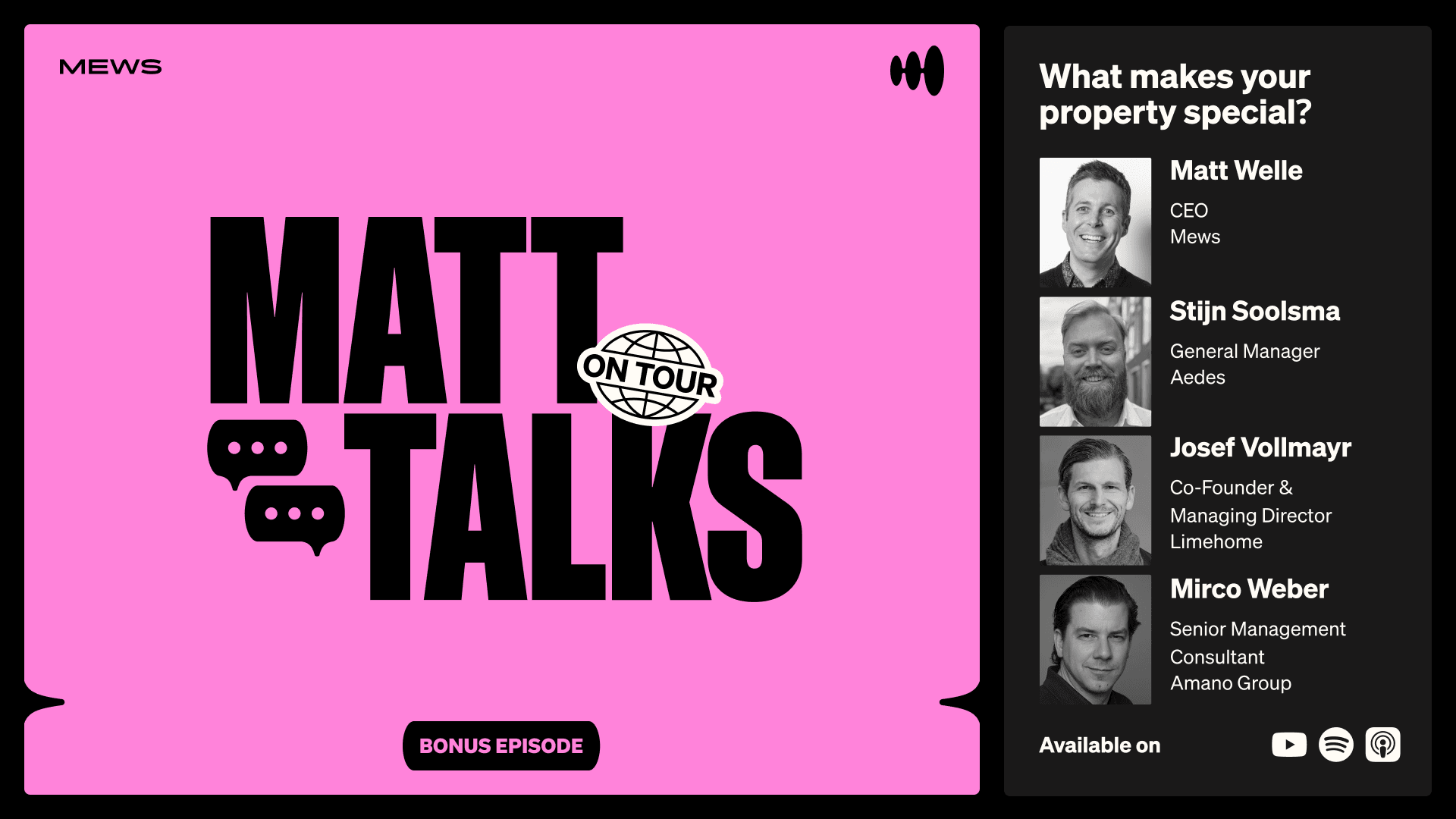
Meet your speakers
Matthijs Welle
CEO, Mews
After years in the trenches of hospitality, Matt joined the Mews journey during its early days in 2013. Since then, he’s been our fearless CEO, leading the company and the industry forward.
Stijn Soolsma
GM, Aedes
Stijn is the General Manager at Aedes Places, overseeing Hotel De Durgerdam and Restaurant De Mark.
Josef Vollmayr
Co-Founder & MD, Limehome
Josef is the Co-Founder and Managing Director of Limehome GmbH, which he founded in 2018 after nearly five years as an Engagement Manager at McKinsey and Company.
Mirco Weber
Strategic Management Consultant, AMANO Group
Mirco is a Strategic Management Consultant who has led a complete tech overhaul and Mews PMS rollout across AMANO Group hotels.
Episode chapters
Transcript
[00:00:12] Matt Welle: Good afternoon, everyone. I love a full house. This is nice. There's still good people coming. There's lots of seats up front if you want.
[00:00:25] Matt Welle: Does anyone actually listen to Matt Talks Hospitality? So I started a podcast about a year and a half ago and it was just really for me a way to just interview people that I find really interesting or explore concepts, but it also forces me to get to know our product and go really deep on it, so it's a forcing function that I love. But it's just nice to see the fan base growing and that people actually want to listen to it.
[00:00:48] Matt Welle: I want to explore kind of what happens if we break the mold of something traditional, because it can be done and it can actually work. So sorry, that QR code, if you have never heard of what Matt Talks is, you can scan it, you can find me, you can subscribe, because the more subscriptions we have, the better guests I can invite, so it does really help me. It's every week. You know, if you sign up, know what you're signing up for. It's a lifetime of Matt Talks at you every single week, but I really enjoy doing it, so I appreciate it if people do follow me.
[00:01:22] Matt Welle: But I wanted to just talk about what makes hotels special, and sometimes things get in the way. I did a Matt Talks, I think three or four weeks ago, about this hotel I stayed in in Philadelphia, and it was a beautiful reception desk with Dell screens on it and people hiding behind it, and then there was a queue outside the door. And that's the kind of hotel that I worked at when I was younger, working at Hilton. And I thought, why are we still doing this today? Why do we still need a desk and these lines in front of the desk where people queue up, and I had a thirty minute wait to get to the front desk, and then because it was a legacy system, they couldn't find my reservation. You can find me talking about this for thirty minutes three weeks ago.
[00:01:59] Matt Welle: But I wanted to talk about really where we started. So we started in Prague, at the Emblem Hotel, if you've ever been. We're a small boutique hotel just off the old town square. This is a drawing from the designer at the time when Richard talked to her and said, I don't want a desk, so we're not going to buy one, and I'm really envisioning hosts that walk around with the tablets and they carry these tablets around their side, so at any point, they can sit down with the guests, they can serve them wherever they are, and it needs to feel like a home. So I don't want the guests to walk in and look around, where do I go and queue up? I want the host to come to them at the door, so that when a friend comes to my house, I am the one coming to the door instead of the other way around. So that was the original vision.
[00:02:46] Matt Welle: And we wrote a — I remember the blog post we wrote was 'Mews will kill your reception desk.' And it was quite an aggressive — we could still say these things out loud when we were young and we didn't really know better, but that negativity doesn't always help, so it didn't really land well with the audience. But the thing that we really took away from it was that it was possible. You could open a hotel, not have a reception desk — you'd run into a few challenges because thirteen years ago Mews was not great, but today, thanks —
[00:03:19] Matt Welle: It wasn't great, right, when Wombats was deployed. No, it wasn't great. So we struggled in the beginning. But we've learned and we keep building. As you can see, there's lots of product releases out there. And now there's a plethora of fantastic examples.
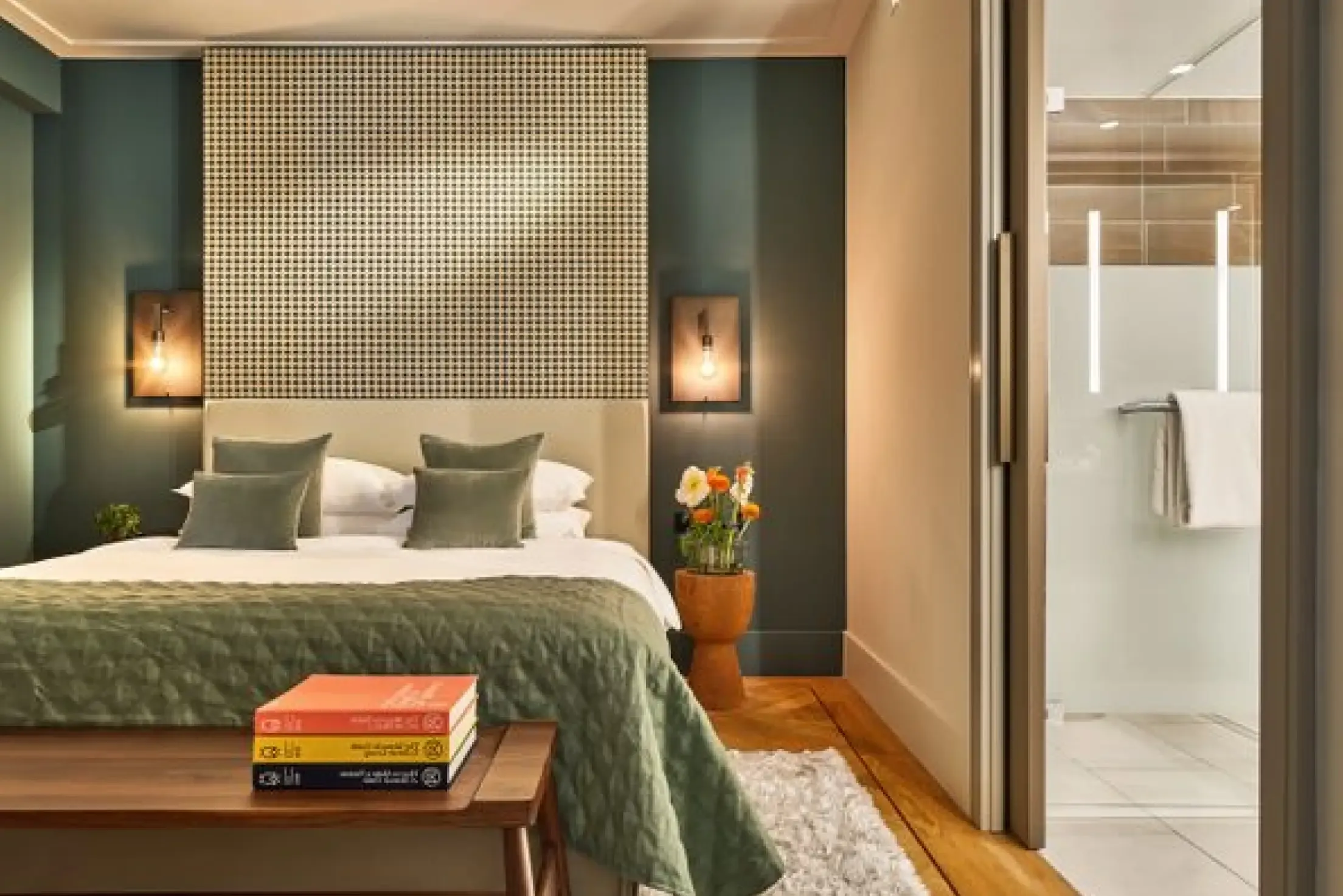
[00:03:33] Matt Welle: One of my favorite hotels in Amsterdam is De Durgerdam, which is a fifteen minute drive, and you instantly are in the middle of nowhere, on the waterside, it's beautiful. On a sunny day like this, that's the place you want to be at. And Aedes Places is also opening a new hotel here on the Amstel. So we've got someone from there who's going to join me on stage because I actually love their hotel, but you walk in and it feels like your home. And I think that's really the vibe that you want to get when you are staying at a boutique hotel.
[00:04:01] Matt Welle: Something completely different is the Zedwell. So there you walk in, and it feels like an Apple store, a very busy Apple store. And you walk in, and it's fifteen Mews kiosks lined up. And you've got the staff walking around with the tablets around their side. So if someone gets stuck, they just whip out their iPad and they support them. And they are, I think, eight hundred units, and Helena will be on stage, on the main stage later as well, talking about this concept of windowless rooms in the absolute best location of London, and it works incredibly well.
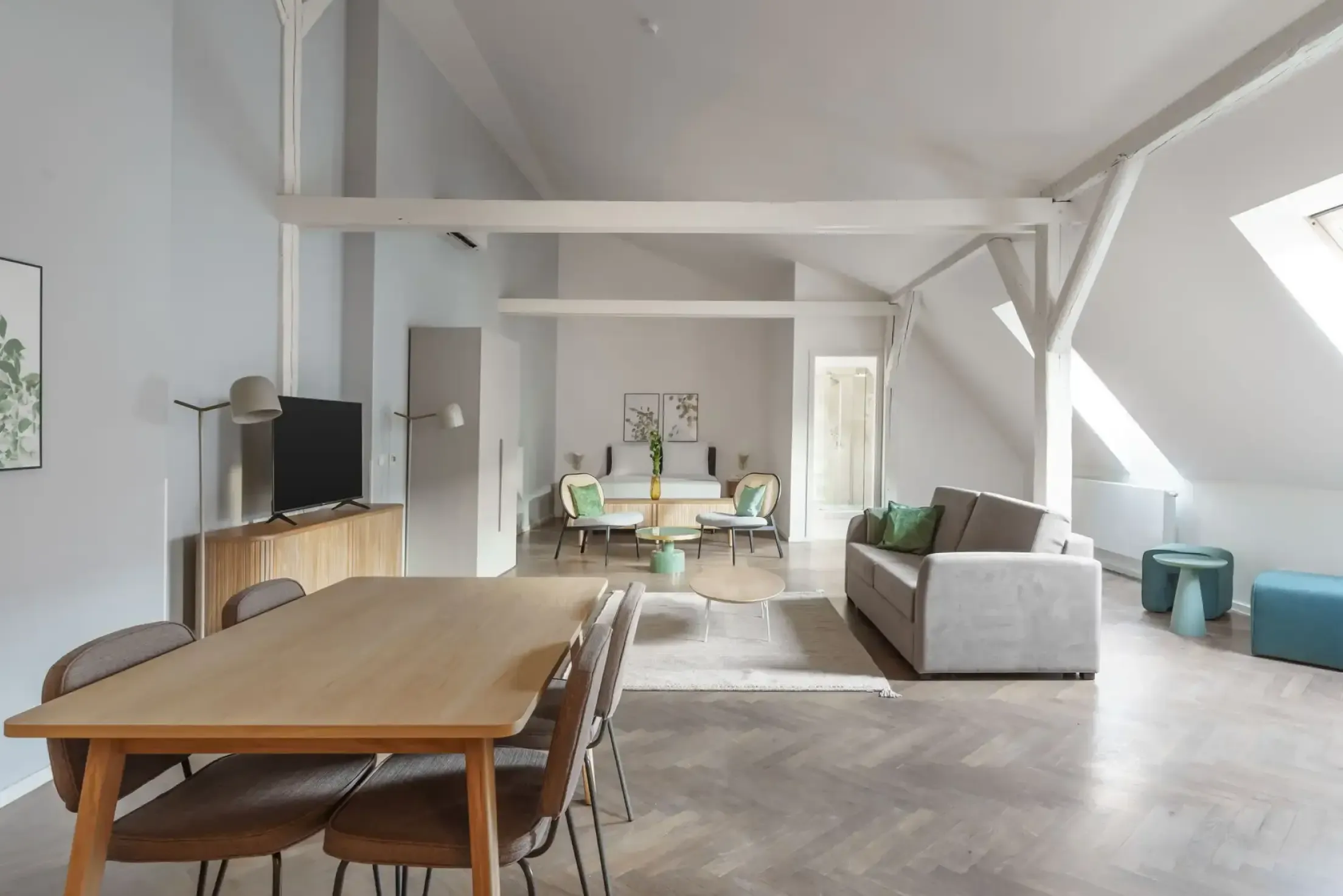
[00:04:33] Matt Welle: Limehome, another guest who will be joining me on stage, they've taken the Aparthe Hotel and they've really digitized it end to end, and I'm really excited to explore more what we can learn from that experience and whether it can still be hospitality when you've digitized most of that journey.
[00:04:48] Matt Welle: The Social Hub, you saw Charlie on stage, and they've pushed Mews to the limits. We often, when we go into new hotel concepts, we say yes to things that we don't yet know if we can actually do it, because it forces innovation. And the Social Hub was one of those customers. They had this blend of students and long stays, and they really broke our system again. Like we've had multiple of those system breakages, but they wanted this kiosk island. So you walk in, and then there's a receptionist on one side of the island, and you've got three kiosks around. So if someone gets stuck, they can just walk around, but it feels much more open than having a desk where you're hiding behind an ugly Dell screen. I have nothing against Dell, by the way. It just feels like that's the brand we all buy, you know, hotel reception desks.
[00:05:30] Matt Welle: Another customer of ours who's going to join on stage is Amano Hotels. I remember pitching to them a very long time ago, and they didn't take us at the time, and then later on we were able to finally convince them, and then when they deployed Mews, they actually rebuilt their reception area. So instead of going from the traditional reception with their Dell screens, they revived that lobby and they had beautifully built in kiosks. But it does feel like a living room, so the kiosks don't become the centre point of the lobby space, because it is your prime real estate that needs to feel like a home, but anyone can find the kiosk really easily.
[00:06:04] Matt Welle: Gravity Haus. This feels like the adventurers we work with, kind of. It's like a club where people like adventure. They have incredible hotels across the US, and they've really embraced the adventurous side of travelers, this experiential travel. And again, they've taken a very different approach to just having an ugly desk in the reception area.
[00:06:26] Matt Welle: Disney is a natural one I have to talk about, because they really think deeply about how do we make sure that there's never a barrier between our artists and our actors and the people that come into their hotels. This is a drawing, but their Disney hotels are really taking a next step as well, so I think it's really interesting to watch what they're doing.
[00:06:50] Matt Welle: Maison Mere, a wonderful boutique hotelier was on stage with me here last year, they still have a reception desk, but they have really dug into how do we segment our guests, so that when a guest arrives, it isn't the passport and credit card and that kind of routine that we do. When I walked in here — because after I had a panel, I went to Paris and I stayed with them — and the first question was, how is Beyonce? Beyonce is my dog, so I don't actually know the main Beyonce, but the second Beyonce is my dog. But it instantly made for a fun conversation, because they had segmented me, they recognised me, they found out some details about me.
[00:07:24] Matt Welle: And then a last example is the Jakarta hotel — some of you are staying there, it's just down the road. And they've got this hybrid. So they've got these pods, they can walk around them, so they've opened up the desk. But at the same time, they've got the kiosk in the front of the desk. So it's basically the moment I find your reservation, I can flip it to the kiosk so the guests can actually check themselves in. That we will be deploying to all hotels. So if you've gone to the product area, there's the new payment terminal, and they become the kiosk and payment terminal in one. So we'll send those to hotels with the kiosk pre installed, so you can instantly switch from me typing in the guest data to allowing the guests to do that, and actually allowing the guests to do a lot of the process there.
[00:08:06] Matt Welle: Oh, I have one more actually, sorry, there's another great one, which is a Dutch new startup called Yaya. They deploy these hollow boxes or these computer boxes, and then they have a centralised reservation team, because sometimes when you're a small hotel, it's very hard to drive optimisation for the business. So they've centralised the reservation team, so if you're a sub thirty room hotel, they're like, right, we'll take over your reception, we'll do that remotely in the local language, but we really optimise how it works. And I was ready to dislike this because I was like, oh, this is awful. I actually liked it. I went to see one of the hotels and I was like, this is not awful, it's actually well done. And I think it can be well done, but it does need to have intent behind it.
[00:08:49] Matt Welle: So let's have the three speakers on stage with me. So we have Stein, who is the GM of De Durgerdam, which is the lovely hotel in the countryside — but it's actually not the countryside, it's like fifty minutes away from here. Joseph is the co-founder and managing director for Limehome, and we've got Mirco Weber, who's the gentleman who finally got us into Amano Hotels, and we've deployed it fully there. Come on up.
[00:09:18] Matt Welle: So, you seem to all have done something different. You've gone against the grain. And I'm just always wondering what was the trigger to make you say, we're going to do something different. And we'll start with you, Amano Hotels.
[00:09:32] Mirco Weber: Yeah. For us, I mean, you started with 'Mews will kill the front desk.' In our case, this is exactly what happened. But as a follow-up, it was a reaction from our CEO, Ariel, when we started to modernise our tech stack, where we decided for Mews, but not only — I mean, we modernised the entire tech stack so that it works seamlessly together. And finally, one day Ariel had a deep look at it and said, okay, if that's the case, then we will not only do a system switch, but also a concept switch. And that was the hour when he said, okay, when we roll out Mews, with this we kill the front office.
[00:10:21] Matt Welle: Because you had a physical desk, right? So you had to get a construction company in to rip it out and —
[00:10:26] Mirco Weber: Yeah, it was not even a construction company. It was basically our internal team, which just came with the flex. Oh, it's Elliot, I love it. We can do anything. And just removed the front office and of course we have architects in house. So they redesigned everything, then came professional construction team and rebuilt the entire room so that it looked cosy. And yes, with this, we killed basically the front desk. And the idea was to combine our F&B concept with the front office.
[00:11:06] Matt Welle: So you turned the lobby into revenue generating space?
[00:11:08] Mirco Weber: Into — yeah, you can say so. Yeah, because so far we had a front office and we had F&B, so there were two teams. And now we combine them to one. So we reduced the administration part of the front office and combined it with the F&B concept.
[00:11:25] Matt Welle: That will work?
[00:11:26] Mirco Weber: Let's say from — yeah. I love it. Yeah. Well, the hardest part, to be honest, is not — it wasn't the system itself. It was the behaviour of the people because so far the front office was like, no, I'm not F&B, and the F&B was like, no, I'm not doing a check-in. And now both teams had to integrate to each other, so that was a little bit of a cultural topic, but it works better day by day. It's not something you change like a system and now it works.
[00:12:05] Matt Welle: With the existing team or did you have to bring different team members in with different skill sets?
[00:12:07] Mirco Weber: Both. We had team members which were convinced about it and they adapted, but we also had team members which said, no, that's not our concept, and so we replaced. Yeah. And so it was a combination of both.
[00:12:21] Matt Welle: So when you hire team members for the new concept, are they a different profile than the people you hired before?
[00:12:27] Mirco Weber: Yeah, that's, to be honest, that's a challenge because there is no such profile which is, let's say, recognised on the market. Like we call it 'ground floor', but if you say we hire for ground floor, no one knows what it is. If you hire someone for a front office or F&B or for a bartender, clear job description. But ground floor is not that common, so that makes the hiring process a bit more challenging. But I would say day by day it works better. And it's a complete revamp of the lobby. Suddenly there's an F&B concept there, different staff.
[00:12:57] Matt Welle: Where do you see the business results? Is it on the cost side? Is it on the revenue side? Do you see business changes?
[00:13:11] Mirco Weber: I would say we see it in the guest experience. That's the most relevant part because we want to really create a guest experience so the guests have less administrative parts and more experienced parts, and we think it's way nicer to have less administration and guide them directly into our bars, on our rooftop bars if the weather is nice. I would say it's more about guest experience itself than about a particular five percent revenue raise.
[00:13:47] Matt Welle: Yes. Thank you. Josef, tell us about Limehome. What is it, the concept?
[00:13:51] Josef Vollmayr: Yes. I can still read 'hotelier.' It still feels wrong for me to — What's the correct word? I don't know yet. But you can't complain about it. No, no, no, I can't. I mean you also asked the question like what makes us different, right? Probably because when I started Limehome, I had worked zero days in hospitality before. Like it was a McKinsey consultant. And for the good or for the bad, I think this naivety helped us to define the concept. And probably the second part of it is we had investors from the beginning, coming from the VC space. So we had to develop a concept basically from scratch, which is built — or is basically made to have a high growth company and one which needs a tech story to justify the high fundings and the high valuations.
[00:14:51] Josef Vollmayr: So we had no experience, like both myself and the investors. And then we basically had three bets, right? And one, there must be very obvious one. There must be value in automation and digitisation. And we thought it really through entirely from planning the property, moving in. We even run warehouses ourselves where we put the furniture from selected suppliers, the whole distribution piece, pricing piece, guest journeys. Everything should be completely automated.
[00:15:20] Josef Vollmayr: Then secondly, there is a huge value in having a flexible real estate approach. So we can basically go into almost every type of asset, every type of location, every size, conversion projects, development projects, takeovers. And thirdly, we saw that Airbnb developed a market in the apartment space but left basically without regulation, without the quality standard. So we wanted to combine these three elements.
[00:15:51] Josef Vollmayr: And maybe just quickly on the apartment thesis. It offers quite some strategic advantages. I think first, it's easier and cheaper to build. It usually has a higher space efficiency. Guests are more forgiving, so they expect less services and less services make it easier to automate. And it's also quite a convincing pitch to landlords. You can get a certain yield compression because there's a downside protection.
[00:16:34] Matt Welle: Because what services do you still offer to guests who stay with you? You don't have a restaurant or —
[00:16:38] Josef Vollmayr: We try to avoid doing it ourselves, but we try to include as many services as possible through external partners.
[00:16:45] Josef Vollmayr: And I think putting these three bets together, I mean the nice thing is they're not only coexisting, they're actually enforcing each other. A leaner product makes automation and digitisation much easier. A very automated, digitised and centralised product gives you much more flexibility on the real estate side. And once you have the real estate flexibility, the scaling gets easier because you can go into every location.
[00:17:18] Matt Welle: What's the scale you're at today?
[00:17:18] Josef Vollmayr: We manage around thirteen thousand rooms in Europe at the moment. And I think the most impressive numbers there are ninety percent of our stays are handled without any manual interaction. So like ninety percent of our guests do not even contact us, and we don't have to do anything manually.
[00:17:41] Matt Welle: What's the experience? I book a room on a platform and what happens from that point forward?
[00:17:46] Josef Vollmayr: As of now, to be fair, it's very impersonal. You get a message, WhatsApp. Ideally, you have the app. You check in there. It gets confirmed. You get automated messaging. You go there with your phone. You can either swipe the door open or you basically type in a code. The code solution is the most resilient stable. If you have outages and so forth, and then you can find all your information about the stay in either the native or the web based app, and then you just leave the room and that's it.
[00:18:18] Josef Vollmayr: So it's not — that's why I'm still struggling with the hotelier to some degree. I think it's not the basic thought of hospitality, and you will probably have a little bit — it's the opposite of kind of where you are.
[00:18:28] Matt Welle: Yes, exactly the opposite. But is there a heart of hospitality in there? Do guests walk away thinking that was great? Or that's not the experience you're aspiring to give people?
[00:18:38] Josef Vollmayr: No, exactly. I mean like how I see it in the end is if you get this all right and working and it's seamless and there are no major flaws in the process, then you can use — I mean we heard it today also — you can use your staff to actually enhance the experience. I think our focus is still in making the journey flawless. So we have eight point six percent on average on Booking.com, which is, I think, definitely better than the average, especially in the locations we're in. Without usually having any person on-site, I think it's quite good.
[00:19:13] Josef Vollmayr: But that's the next step then — develop the product and the experience even further because we have some palaces in Italy, right? It's a bit of a missed opportunity. Have you read this great book, The Power of Moments, which I always love and it's about setting the baseline and then you create these very special moments. How do you do that if there's no hospitality people in the business? Or is it just you who's not the hospitality person and then you just have other people that have that or?
[00:19:39] Josef Vollmayr: Yes. I think we are testing now in seven, eight properties actually to have people on-site just as hosts. So they actually are completely free of the typical reception tasks. So they can just be there to enhance the experience. I believe it's still a bit difficult with just pure tech solutions. There are a few things around personalisation which you can do to excite guests. But I think at any point in time with larger properties, we will need probably one or two people there to provide this. It's much cheaper still than an entire staff.
[00:20:18] Josef Vollmayr: No. I mean that's probably the last number I wanted to share. So we have around three hundred people. And if we deduct the tech team, which is still the biggest and most expensive team and also our expansion team, we need probably one employee for one hundred rooms.
[00:20:36] Matt Welle: Wow. That's impressive. Very impressive. Stein, the opposite of this. Tell us about what your hotel concept is and explain it to us.
[00:20:45] Stein: Yes. So De Durgerdam has been open now just over three years. And Aedes Places I think just really stands for a place where you feel at home, like you said straight in. We have a really strong focus and empathy for the entire experience for the guest side. And I think it's also therefore a focus point for the staff. So we hire more looking for the person than the resume and thereby enabling the staff to feel that same energy and just to focus on the experience that the guest has throughout their stay.
[00:21:20] Stijn Soolsma: And I obviously recognise a lot of challenges that Mirco mentioned, like the classical themes of F&B and rooms and I don't want to do this or I just focus on — and I think traditionally you'll see that people stand for just one type of experience. So I stand for the F&B experience, but then once they leave the restaurant then it's a different part. So I think what we try to do is just make it one and for all the staff to really understand that. So from the moment that someone books to the moment that someone goes back home, that is one experience and there's not a certain part or a gap in there. So the person who welcomes you is the person that checks you in, is the person that serves you breakfast in the morning at lunch. So you just really have that consistency. We'll bring the luggage to the room, we'll grab your bicycle if you ask for it and might give you tips for the city if you are open to it.
[00:22:05] Matt Welle: And the new concept you're building — I would live next to the construction site, or close to the construction side of it. Has it improved because it's going to be one of my favourite hotels in this city I think.
[00:22:14] Stijn Soolsma: Yeah. So I think in De Durgerdam we've really been working with the fourteen rooms that we have and the smaller team compared to what that's going to be like — on figuring out what exactly we want to create and what energy that is and what experiences we want to give so that we can extrapolate that into a larger property because it's going to be ninety eight rooms, it's going to be on the same level. But as probably everybody in this room knows there is a big difference in doing that with ninety eight rooms than doing that with fourteen rooms. So will the concept be different?
[00:22:42] Matt Welle: You gonna put a reception desk with Dell computers in there?
[00:22:45] Stijn Soolsma: We will not. The poor people from Dell, no one from Dell is here, I'm bashing them. No, you will run into people. So there will not be a desk when you come in. We will have a space for people that either don't get along with technology, don't want to check in online or just prefer to have that. So we can guide you there but it will start with a person. Ideally everything can be done online, so we don't need passports, don't need credit cards, you can have your key already and we can just help you with your luggage, we can ask you how your flight was, ask you if you want to have a drink first or if you want to head straight up to the room. Kind of when you come home to a friend and you have a friend stay over.
[00:23:19] Matt Welle: Yeah. You also go straight into that sense. So is there a place for connected technology like messaging apps and stuff in a luxury hotel like that?
[00:23:29] Stein: I think in a way yes. So I think today super interesting things that we've seen and heard so far. I think in luxury, whereas with Joseph you can almost automate everything and take the person out and create a part of hospitality that I think is really interesting — and I think in luxury more and more we'll see that people want that personal, that human attention. But people will still try to — the example that was given earlier in the presentation — ask for a pillow on the way to the hotel. They will communicate. And I think definitely combining all those different channels that people can communicate through, getting that into the same thing. But I think in our case in luxury, in most situations a human will be answering that.
[00:24:13] Matt Welle: I think the thing that I get excited about in the luxury segment is the richness of data that you have on guests because you actually discover what a guest wants and you take the time to have your team write it down in the system and that's where AI can really transform the experience and say actually this customer likes this particular thing, whereas I see when we see hotel companies at scale, they don't have that level of data because it's just transients and people just move through. And I think AI will really benefit the luxury hotels, whereas the automation hub for example will have a much more bigger impact in a hotel that doesn't really focus on those little things like the hot cocoa that he was talking about. I don't know who these people are that like hot cocoa but they exist. So I think it's really important that we have these rich data profiles.
[00:24:56] Stijn Soolsma: Yeah and I think that's exactly where technology can help hospitality as wide as it is nowadays and maybe wider than it's getting. It can support and it can enable staff to have even more time to spend with guests and to interact and to really provide feelings, experiences.
[00:25:12] Matt Welle: So you've all done something distinctly different from what the playbook is that we are taught in hotel school. You haven't been to hotel school, that's what they teach us. Dell, buy Dell computers and put them on a desk. What's the thing that didn't work when you deployed it and you brought automation and guests said no, we don't like this, and how did you correct for it?
[00:25:35] Mirco Weber: Good question. Sorry. Yeah, no, that's fine.
[00:25:41] Matt Welle: What's the thing that didn't work for the guests? I don't know if something jumps to your mind, feel free to step in. Did you ever feel that someone rejected some of the technology that we put in front of them?
[00:25:52] Mirco Weber: The guest you mean?
[00:25:53] Matt Welle: The guest or like even the staff, yeah.
[00:25:55] Mirco Weber: I mean in our case definitely the guest messaging is a topic. Which channel to use, how to reply, how instantly to reply. When we moved in the guest journey via our CRM also to enable WhatsApp, we saw a totally different behaviour. For example, the opening rate in a booking confirmation per mail is about twenty percent, in WhatsApp it's about ninety five percent, so that's a huge increase. And we also see even if both channels were open to reply, the email is seen as a no reply and the WhatsApp is seen as an active channel. So the number of guest messages via WhatsApp increased by far with WhatsApp, so it made it absolutely mandatory also to have the AI in behind for the commodity cases, like do you have a parking place or something like that, which could easily be answered by a proper knowledge base. But then also have this human in the loop. You always need it, there are always edge cases, and for us it's hard also to teach the teams even — or to combine it with their job on the ground floor, let's say, who's probably answering guest messages on time, for example, that WhatsApp is expected to have a way lower response time than the mail.
[00:27:24] Mirco Weber: If I'm waiting for two hours on the mail, I can accept it. If I'm waiting two hours on the WhatsApp, I see that as a no reply. So that's definitely a challenging —
[00:27:35] Matt Welle: And how have you solved that? Because we didn't have a messaging hub until today, so how have you solved that?
[00:27:39] Mirco Weber: Yeah, it's basically all day training and organisation. To push harder, be — yeah, push harder and also to organise this. We are also very much centralised. So we drive a lot of the process from the headquarter. So some messages go to the central reservation, then we have messages for in house, and then we have again messages which are, let's say, for the financial department, which are again HQ. So having there the inboxes, which you can then dedicate — if it's not properly associated, it's still a challenge, which is not yet one hundred percent solved. Thank you.
[00:28:21] Matt Welle: Yes, you're still thinking. I can't ask another question. I've got more questions.
[00:28:26] Josef Vollmayr: I would like to explore the things that don't work because I think we all think about the things that don't work. I mean I have probably one hundred examples because in the end, we started super small and we could somehow afford to fail on some smaller things, maybe picking five, six. What did not work was that we took over the construction works. It needs different people — like we managed the conversion of a building. And then you are stuck in legal claims and whatever. So this definitely didn't work. I think also the learnings on our building standards over the years were huge. Like what we signed in 2018 or what we managed in 2018 doesn't have the same quality standards, and it always falls on your feet. Like if you don't do it right from the beginning, there is a huge problem.
[00:29:17] Josef Vollmayr: There are many learnings on distribution. B2B sales has never worked for us. We run with ninety percent occupancy across the portfolio. So we lose money on B2B sales because I want to discount. You can't protect high rates, event dates. You need staff, sales agents to reach out to whomever. So this has never paid out for us. It was impossible to connect to the GDSs because of data they can transfer with a completely digital model. I think that it never worked to experiment with payment methods which are not protected through 3D Secure and other topics. There are hundreds of millions of learnings and we probably wasted a lot of money, but never so much that it got dangerous for the company. But we could talk about it for hours. Thank you.
[00:30:07] Stijn Soolsma: Yeah. I have like one example that comes to mind, I think that's just for us been quite so often — that we put something on the table that we thought about implementing and then we just decided not to because we thought it's not ready for the level that we want to deliver. I guess it more often has been the case. So I felt very seen earlier on in the day when it was said 'No, because six months ago — ' and maybe it wasn't good enough. Have a look again because it's going really fast. Yeah. So yeah definitely hear that message because I think I've looked at a lot of things that I've been like, this is not it yet. So let's carry on with the day to day. But very often have to keep looking, I guess.
[00:30:43] Stijn Soolsma: You had a brain fart. That's all I'd like to add. I have one more. Like assuming that cleaning personnel speaks English, German or Dutch. If you build an app which doesn't support different languages, it's going to be difficult. Yeah. Languages matter and travel apparently.
[00:31:00] Matt Welle: When you're all independent brands or self built brands, how do we get guests to come back? Like what's the one tip you would give this audience? How you've created this great experience, but how do you now get the guests to book direct and to come back to you instead of someone else in the same destination?
[00:31:17] Stijn Soolsma: I think for me to focus on one of the things that has always inspired me in hospitality is to think that a lot of people don't remember what you do or what you told someone at the table or at the check-in, but they remember the way they felt when they were at your place. I think that's just a big focus that we have — focusing on how you make people feel. And I think that is also like something that you then remember in a few years or the next time you book, like I want to feel like that again. And I honestly — so we're booking our customer advisory boards tomorrow at your hotel. I came for the site inspection and I instantly was like yeah, there's no — I don't have to look at anything else. I just felt this is the place where I want to bring fourteen of our biggest customers or advocates to have a really intimate conversation. I immediately felt that. Thank you.
[00:32:05] Josef Vollmayr: Either you have a product like him in the upper upscale luxury segment, I think then it's — if they really love it, they just come back. I think in our segment, we have two options. One, a very expensive loyalty program, which rewards the guests a lot, but it's very costly. Or B, having a crazy scale and being visible everywhere. Wherever you have to travel, you have to be just around so that people see you as often as possible and having a good value for money offering and a decent experience. But loyalty, you have the scale where you could probably have like one of those traditional points programs. You've thought about it?
[00:32:43] Josef Vollmayr: We had one and we stopped it because in the end, what you have to give to the guests in terms of loyalty rewards is for us a worse use case than reducing the prices for everyone. Right. Thank you.
[00:32:59] Matt Welle: What do you do to bring them back?
[00:33:02] Mirco Weber: No, I think the concept in Amano is very clear. Let's say to have such a guest experience that you stay in the memories. And once you're back, you remember Amano and you want to come back, not because of reductions, prices, but you had a nice time, you had a good experience. I think that's very much the concept of Amano.
[00:33:27] Matt Welle: Wonderful. And loyalty, we're just exploring — super early stage. Thank you all, I really enjoyed it. I love the exploring of different concepts and seeing how you all respond to each other, because I like to learn from people that do something different, and sometimes it's better to just see the perspectives opposite each other. And it's not everything is for everyone, but we all run successful businesses at the same time, and I think that's admirable that we can go from having your traditional, you know, there's a reception and a couple of rooms, and actually diversifying that to something that's unique, and I salute you for doing something very different. I love people that push the boundaries of what hospitality is, and you seem to be pushing the boundaries very much so. So I look forward to the next few years, but thank you for sharing your stories today.
Resources
Introducing Mews OS, hospitality’s first unified operating system
Mews Unfold
Limehome
Aedes