



In 1942, a Gujarati immigrant named Kanjibhai Desai bought a 32-room hotel in San Francisco. He had almost nothing – no capital , no formal training in hospitality, no guarantee that this new city (let alone country) would welcome him. What he did have was something that would prove far more durable than any of those things: the conviction that if he worked hard, this country would let him build something.
That conviction turned out to be right, though not without resistance. Over the decades that followed, thousands of families from Gujarat - many sharing the surname Patel, a name that traces back to farming communities in western India - followed Desai's path. They pooled savings through informal community lending networks. They bought struggling motels along America’s highways. They lived on-site with their families, learned the business by doing it, and reinvested every dollar they could. When competitors went hard against them, when banks refused to lend to them, and insurance companies charged them ten times the going rate, they persevered, triumphed and they organized.
In 1989, they formalized this business community into the Asian American Hotel Owners Association. Today, AAHOA's members own more than 60% of hotels in the United States. Their properties employ more than a million people, support 4.2 million jobs across the broader economy, and contribute nearly two percent of the entire nation's GDP. From one hotel in San Francisco to the single most consequential ownership community in American hospitality – in barely two generations.
This is, by any measure, one of the great American stories.
As the United States approaches its 250th birthday this July, there will be no shortage of reflections on the American experiment. The Declaration of Independence is many things, but at its core it is an argument about possibility – the radical idea that people should be free to build their own futures, unbounded by the circumstances of their birth. The AAHOA story is among its most powerful vindications: a community that arrived with suitcases and ambition and built an industry-defining powerhouse .
It is also a story that is far from over.
Today, I'm proud to announce that Mews has been selected as the Official Property Management System of AAHOA, serving their community of more than 36,000 member-owned properties across the United States.
This is the result of a rigorous RFP process, and we don't take the responsibility lightly. Under the leadership of Chairman Kamalesh (KP) Patel – himself a second-generation hotelier who learned the business from his parents in Santa Cruz, California – and CEO Laura Lee Blake, AAHOA has built an organization that is serious about vetting the partners it puts in front of its members. We are grateful for their trust, and we intend to earn it every day.
AAHOA's members are not a monolith – they range from independent roadside properties to sophisticated multi-brand portfolios. They include first-generation owner-operators and third-generation hospitality professionals who grew up in the business and then earned degrees in it. What unites them is a relentless focus on ownership, building equity, and running their properties better than anyone else. Mews will help them do exactly that.
But I want to be transparent about why this partnership matters to us beyond the obvious commercial significance, because I think it speaks to something larger about where American hospitality is heading.
The hotel industry in the United States is at an inflection point. Guests expect seamless, five-star experiences. The market landscape is shifting under everyone's feet. And the technology that was supposed to make all of this easier has, in many cases, made it harder – rigid, scattered, disconnected – distracting hoteliers and their staff from taking care of the guest. Owners need a live pulse on their business but spend so much time just catching up.
We believe the answer is not more software. It is a better digital infrastructure.
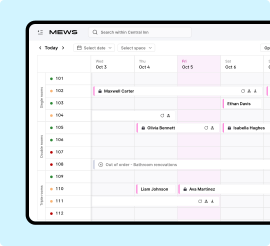
Mews was built from the ground up as a cloud-native platform – not a legacy system with a cloud layer bolted on top, but a genuinely modern architecture designed to connect every part of a hotel's operations in real time. We process more than 1,500 integrations through our marketplace, from revenue management and guest communications to housekeeping and accounting. When a guest books a room, checks in, orders room service, or checks out, every system that needs to know about it knows about it instantly.
This is what we mean when we talk about becoming the technological backbone of American hospitality. Not a replacement for the people who make hotels run – not a way to hollow out the workforce – but a foundation that lets every person in a hotel spend less time wrestling with systems and more time doing what hospitality is actually about: being present for the guest.
That distinction matters enormously to us, and it should matter to the industry. The promise of modern technology is not removing the host from hospitality . It is that we can finally put people where they belong – in front of guests, solving problems, creating moments, building the kind of loyalty that no algorithm can manufacture. The front desk worker who can look up from a screen and actually welcome someone. The housekeeper whose schedule isn't dictated by a clipboard from 1997. The general manager who can see how every part of their property is performing without opening six different applications. That is the transformation we're building toward, and it is fundamentally a human one.
There is a particular resonance to this partnership that I keep coming back to. The AAHOA story is a story about people who understood, intuitively, that hospitality is a business built on showing up, on being present, on caring about the details, on making strangers feel at home. They didn't build their businesses by optimizing from a distance. They built them by living in the properties they owned, by knowing their guests by name, by fixing what was broken with their own hands.
As technology transforms this industry, the question is whether we preserve that ethos or lose it. We believe passionately that the right technology preserves and amplifies it. When an owner can see their entire portfolio in a single dashboard, they don't become more distant from their properties, they become more capable, more connected. When a front desk team isn't buried in manual processes, they don't become redundant, they become free to deliver a five-star experience as a standard.
The families who built AAHOA understood something about American hospitality that is easy to lose sight of in an era of automation and efficiency metrics: this is a business of people taking care of people. Everything we build at Mews starts from that principle.
Two hundred and fifty years ago, a group of people declared that a better future was possible and then set about building it, often imperfectly, but with a momentum that has proven impossible to stop. Eighty years ago, a Gujarati immigrant bought a hotel in San Francisco and bet his future on the same idea. Today, the community that grew from that bet is the most important ownership force in American hospitality.
We are honored to be their technology partner. And we are committed to building a platform that is worthy of what they've built – a platform that strengthens the backbone of American hospitality for the next generation of owners, operators, and the millions of people who work in the hotels that make this industry what it is.
The story of AAHOA is an American story. We're proud to be part of its next chapter.
Written by

Richard Valtr
Richard founded Mews in 2012 and has since become one of hospitality's true innovators and thought leaders.