What to expect?
Meet your speakers

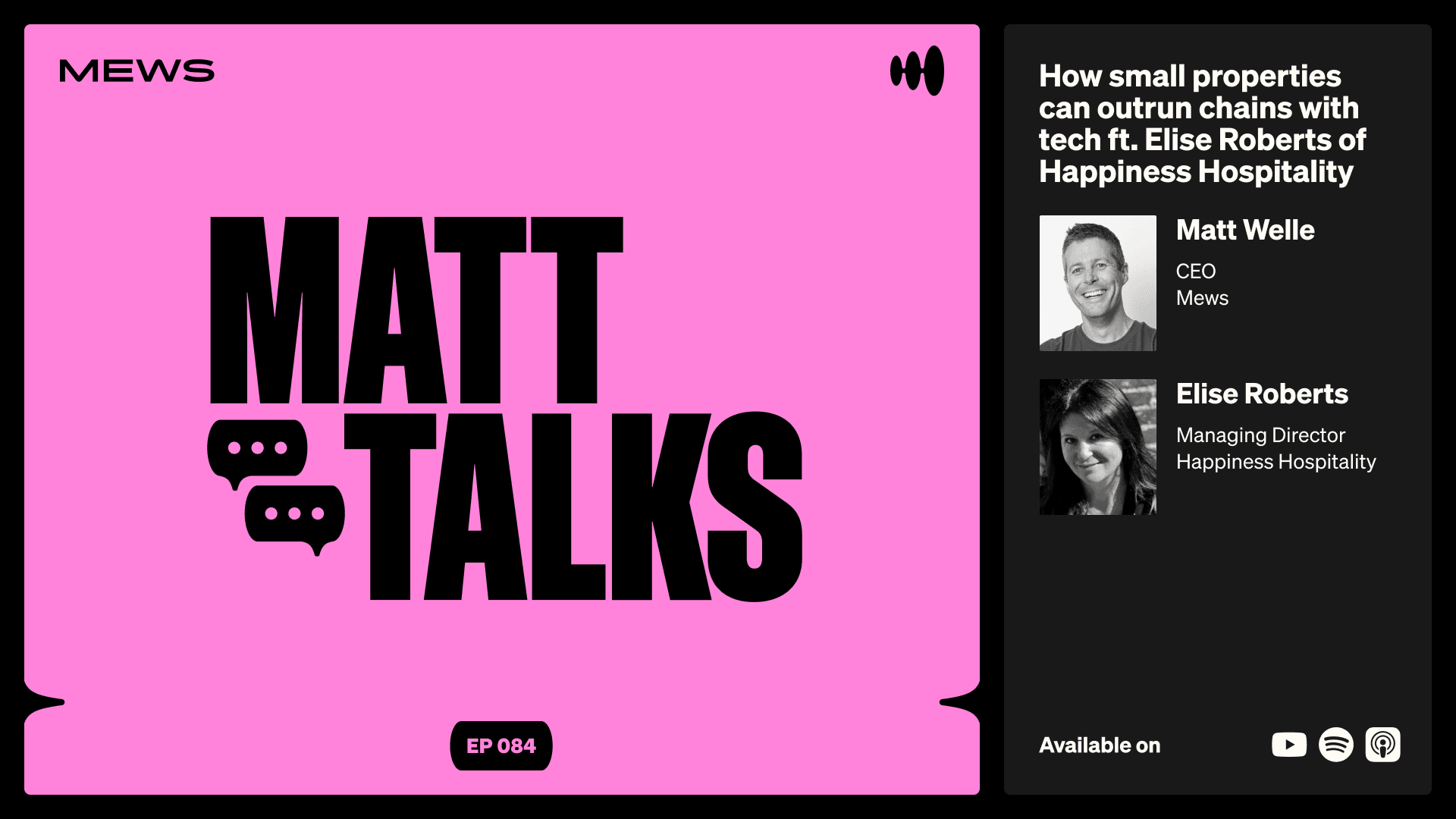
Matthijs Welle
CEO, Mews
After years in the trenches of hospitality, Matt joined the Mews journey during its early days in 2013. Since then, he’s been our fearless CEO, leading the company and the industry forward.

Elise Roberts
Managing Director, Happiness Hospitality
Elise is the Managing Director of Happiness Hospitality, the company behind The Gallivant, a beautiful boutique coastal hotel in East Sussex that holds a MICHELIN key and VisitEngland's Small Hotel of the Year.
Episode chapters
Transcript
[00:00:00] Elise Roberts: The tech is selected to serve what we do. If you have the
right tech, it helps you with efficiency, so the team can focus on doing what they do
really well, human connections.
[00:00:23] Matt Welle: Hi, everyone. Welcome back to Matt Talks Hospitality. Today,
we're talking about technology in the boutique hotel context. How do you build a tech
stack when you have a small team, a seasonal market, and limited data? Where do
economics stack up, and where can AI deliver for an independent property? My guest
today is Elise Roberts. She's the general manager of The Gallivant, a beautiful boutique
hotel on the coast of East Sussex, which holds a Michelin Key and a VisitEngland's
Small Hotel of the year. Before The Gallivant, Elise worked in sales and marketing at
various hotels, including Aviator and Hilton. And she knows what technology looks like
at scale, but then also in the independent environment. And I think that's a really
interesting kind of perspective to get. Thank you for joining us today.
[00:01:03] Elise Roberts: Thank you, Matt. Really pleased to be here.
[00:01:06] Matt Welle: Elise and I know each other really well because 22 years ago,
when I started in hospitality, and I think it was also your first job 22 years ago, at the
Hilton.
[00:01:14] Elise Roberts: Yeah.
[00:01:15] Matt Welle: We were sitting next to each other as very junior people at the
Waldorf, in the Hilton, and we've kept in touch since then. But like, I wanted to make
sure that we put a disclaimer out that I know you very well. So, before we get into
operations, I wanna understand his philosophy around The Gallivant because you've
clearly won a number of prizes. So, you're doing something really well. And I also heard
you have the head of happiness. Is that a thing? Head of happiness staff?
[00:01:38] Elise Roberts: Absolutely. A very important thing. I mean, I think for us, it's all
about experience. So, not hospitality or hotel in the traditional sense. So, everything we
do is built around the idea of happiness. So, happy team, happy customers. And for a
customer, that can be anything from a great night's sleep or a meal with food you
actually want to eat in our restaurant, Harry's, or sharing a bottle of English sparkling
wine in the sand dune with your partner and watching the sunset. And that's why we
have a head of happiness because it really guides our brand, and it's a real rule and a
very deliberate one. So, everything we do centers around that.
[00:02:29] Matt Welle: Because, like, the awards are almost the output of a strategy
that you said probably years before to get to the stage of getting an award or Michelin
Key. But how do you strategize around kind of culture and building that guest
experience? Because it doesn't just happen overnight.
[00:02:45] Elise Roberts: No. It really doesn't. I suppose, I mean, partially that's where
the tech comes in. The tech is selected to serve what we do. So, if you have the right
tech, it helps you with efficiency, so the team can focus on doing what they do really
well, human connections. And, I mean, it's kind of a no-brainer that if you build a happy
team, then they're probably gonna want to make customers happy, or it enables them
to make customers happy.
[00:03:15] Matt Welle: So, you said the word tech, and I immediately wanna go down
there. But actually, before we go there, I actually would love to hear more about The
Gallivant. What's the hotel? What's the experience you're trying to create?
[00:03:23] Elise Roberts: So again, it's not a hotel. It's an experience. So, it's where
people can come to slow down, to reconnect, and fundamentally feel like themselves
again. So, “Happiness is a place” is our brand tagline, if you like. And it's something that,
Harry, the owner, actually came up with during COVID. He was thinking about what are
people gonna want when we come out of this? What are they gonna need? And really
started leaning into that kind of childlike nostalgia of being on the beach, running up
the dunes, paddling in the waves. Like, these kinds of relatively simple things are really
all anyone's looking for, whether it's in food, you know, who doesn't like French fries
and mayo, or the simple connection with the beach, getting outdoors when we were all
cooped up for so long. So, fundamentally, happiness is simple, but actually it takes
quite a lot of work to really create the environment.
[00:04:33] Matt Welle: I think because you know what you want to achieve, but then
you're not around to create all of those experiences. So, you have to have a team that
has the freedom to make some of the decisions and, like, do they feel like they can
sometimes do something that's unexpected?
[00:04:46] Elise Roberts: Yeah. I think so. Absolutely. And they need to if they're gonna
be happy. Otherwise, they feel completely constrained. I mean, so yes, we have
frameworks that people operate within. We have all the boring black and white stuff.
We're not overly heavy on SOPs. Fundamentally, certain things like how to operate the
POS does need some guidelines. But then, once people have learned the basics, they
can be free to add their own personality to it. And, you know, they're much closer to it
than I am day to day. They know what's making guests tick in real time. So, what we
find is really important is constantly getting their input so we could help evolve the
guest experience and what we're focusing on.
[00:05:36] Matt Welle: And being a UK-based hotel, obviously, I think the hotel industry
has struggled in the last few years. At least we see that from the data versus other
destinations. How do you keep your head above water when the economy is struggling
and, you know, people are making hard decisions on travel? Like, how do you
differentiate yourself enough to be able to succeed in this environment?
[00:05:56] Elise Roberts: I mean, it's really hard. Hospitality right now is, you know, it's
actually really upsetting looking around, reading the headlines in this country, how hard
people are finding it, how most hospitality businesses are either closing or cutting
back, cutting corners, streamlining, whatever it is. But for us, we work incredibly hard.
We have to. We look for efficiency all the time. We iterate the product. So, there's no
kind of this is what we do, and it sits stagnant for the next three years. We're
constantly refining and iterating. And sometimes it drives the team nuts because, you
know, as soon as they've learned something, we're changing it again.
[00:06:48] Matt Welle: Here comes Elise with another great idea that I have to now
implement.
[00:06:51] Elise Roberts: Yeah. Or Harry, particularly, the owner. You know, both of us
work very closely together. And I think it's a great balance, the working partnership.
[00:07:02] Matt Welle: What's an experiment that didn't work, and what's an
experiment that did work?
[00:07:06] Elise Roberts: Good question. I mean, something we're looking at right now,
and this is, you know, not a very, I guess, exciting one or experiential one. But we
relaunched the restaurant in February last year. And we were quite tunnel vision
focused on driving and building our local following. And in doing so, we priced our
menus from what we considered to be, I guess, the right position for the local market.
And as a result, we've really quite negatively impacted our average spend. The menu
pricing range is more narrow. So, when people want to splash out, they can't. And that
was clearly a mistake. So, we're addressing that now because what we've learned is the
local market really loves coming to us during the daytime. Whether that's a walk on the
beach with your dog, and then coming and having a great lunch. And that's some more
day-to-day trade. And then when they come and have a meal in the evening, it's more
of a special occasion that aligns very much with the experience our hotel residents
want as well. So, actually, we need those premium dishes and the ability for people to
go a bit wild and treat themselves. Because even though people are perhaps traveling
and eating out less, when they do, they wanna have a great time.
[00:08:40] Matt Welle: I love that. And I love how you, like, how you try things, look at
does this actually profitably make sense? And then you iterate again. I think too many
hoteliers are not iterating. And I think that's the only way you get it right if you just put
yourself out there. You acknowledge that sometimes we do something wrong, but
actually an iteration of that first try is a better one than the original plan that you had.
Right?
[00:09:04] Elise Roberts: Yeah. Absolutely. And, you know, it's tech, isn't it? Don't be
afraid to fail.
[00:09:08] Matt Welle: Yeah. So, let's talk about technology because we're obviously a
technology podcast. That's what we have to talk about. So, I'm imagining that a smaller
hotel doesn't have an advanced IT department that is setting up all the systems for
you. Like, who does this at your hotel?
[00:09:22] Elise Roberts: I do, and the owner does. We work together. You are looking
at the co-head of IT.
[00:09:28] Matt Welle: How do you go about setting a strategy for technology then?
[00:09:32] Elise Roberts: As in a documented on-paper strategy for IT or tech? No. But
fundamentally, tech has to do something, doesn't it? It has to help drive efficiency and,
for us, free up time for the team to do what they're doing well. And we're constantly
looking at the tech we use and improving it.
[00:09:59] Matt Welle: Because we started at Hilton together, and there's this
assumption in the world that the big brands have the best technology because they've
got unlimited budget, they’ve got IT departments up the wazoo, and independent
hotels struggle because they don't have access to great technology because they're
small independents. Do you agree with that statement? Or actually, do you think that
independent hotels can thrive because of their independence?
[00:10:21] Elise Roberts: I think so. And I think modern tech has given much more
opportunities to independent hotels. I mean, fundamentally, technology is for hotels of
every size. I think the big groups, and I'm being very generalized here, but I think they're
strong commercially with their data loyalty and driving repeat behavior to their brands
or their partners. And that's heavily incentivized. But where they probably feel less
evolved for me operationally is that they have tech stacks like everyone else, and
they're layered. But it can often be, and it's changing now, but at the core of their tech
stack are legacy systems. And then they're bolting on newer tools on top. So, while on
the face of things, it may look and feel a bit better. I don't think it's actually making life
easier for their teams. And therefore, I don't think it always translates into a better
guest experience. So, as an independent, we're certainly not more polished. But we can
be more agile. We can be a bit scrappy, and we can try to fit things and move on
quickly if they don't work. And I think that's also supported by neurotech because what
we're seeing more and more is that contracts are shorter. You're not being locked into
the kind of three years. So, when you've got a contract that's a year, if it's not, or less,
some are even on a rolling 30-day basis nowadays. If it's not working, you can just flip
it, and that speed is an advantage.
[00:12:04] Matt Welle: Have you ever done that? Have you ever started with a tech
vendor, and I'm really within a couple of months, that this doesn't work for me, and I've
switched it off and moved to something else?
[00:12:12] Elise Roberts: Rarely within a couple of months. But when we're upgrading,
we will often leave a contract before it runs out. So, we're paying for a few months or
more at the end. And that happens, not that regularly, but we just did it with our
restaurant booking tools. So, I think we paid for three months at the end. You know, we
were doubling up. And it was worth it for improving the guest experience and the
commercial opportunity.
[00:12:44] Matt Welle: What does your tech stack look like today?
[00:12:46] Elise Roberts: Big. So, we've got about 18 systems.
[00:12:53] Matt Welle: Wow. That is big.
[00:12:55] Elise Roberts: Yeah. It's a lot bigger than you would think for a small
boutique hotel. But everything is carefully chosen and has a purpose. And if it doesn't,
or if it's not adding the value that we thought it would or that it once was, then we
would change it.
[00:13:21] Matt Welle: Do you have an economic framework within which you think
about it? Because there's a real cost to software, right? You have to pay a monthly
subscription fee. But how do you calculate whether you should have it or not?
[00:13:31] Elise Roberts: I guess fundamentally, it comes down to two things. So, is it
genuinely adding more value than it costs? So, whether that's revenue, efficiency, or
better decision making, and will the team actually use it?
[00:13:47] Matt Welle: Yeah.
[00:13:48] Elise Roberts: So, ease of use is critical. If it's not intuitive and the team can't
just pick it up and use it, then it's not gonna land, you know, particularly in a small
business. You know, we just can't justify kind of two weeks of classroom training to
learn a new system. I mean, I remember doing that back in the day. It's wild now.
[00:14:12] Matt Welle: I did that.
[00:14:13] Elise Roberts: Yeah.
[00:14:14] Matt Welle: Learning DAWs. “Like, where's the mouse?: I'm like, there's no
mouse. Okay. Great. How do you deal with training, though? Because we do have
turnover in hotels. So, I'm assuming that you do sometimes have new team members.
So, how do they get comfortable with the technology?
[00:14:26] Elise Roberts: I mean, some things you really can just pick up and go.
Obviously, something like Mews. It's a little bit more involved. There's a serious process
in there that people have to follow. And that's a key factor, actually, in decision-making
now as well. Do they have good resources so the team can self-teach? Because we
can't do that, you know, we don't have an HR or a training department. So, there has to
be something that I'm confident the team can learn what they need to learn. And then,
of course, when they start in their first couple of weeks, somebody's assigned to buddy
them and coach them in the process. And we had checklists which are designed for
people to use in their first, you know, 2 to 3 months of a job, while they remember
everything they need to do, which is key because hospitality is way more complex than
anyone appreciates outside of our world.
[00:15:21] Matt Welle: It is. But, like, I always wonder, like, because we used to hire
people that had skills on the legacy systems, because, actually, that gives them a head
start, because then we don't have to put them in the classroom for two weeks. But
then you don't always get the best hospitality, and it sounds like you're leaning into the
experience side more than can they type data into my system very fast. So, I don't
think you necessarily look for the skills to operate the different systems because they
can learn that pretty fast. But you look for different skills nowadays than we did 10
years ago.
[00:15:49] Elise Roberts: They do need the capability to learn it, though. So, we try and
understand what people have used, what they're using in their personal life, because
somebody who is just not kind of comfortable with the digital world is probably going
to struggle a bit.
[00:16:06] Matt Welle: What's your favorite interview question to ask a candidate to
discover this?
[00:16:09] Elise Roberts: I feel like I might have stolen this one from you or someone
else. But at the moment, we're asking, I'm always asking people how they're using AI.
So, how they've used it at work and how they're using it in their personal life, and to
give real examples. Because what I was finding is everyone's saying, “Yeah. Yeah. Yeah.
I use AI.” So, okay…
[00:16:32] Matt Welle: Which means I've asked really dumb questions to AI, but that's
not using AI.
[00:16:37] Elise Roberts: Yeah. Exactly. So, talk to me about that. And that's becoming
more and more important. You know? I spend most of my day using my AI tools now to
help me output more, and it's really helping.
[00:16:50] Matt Welle: How do you use AI? Sorry. I'm gonna flip this interview question
on you now. What's your actionable advice for hoteliers who are not yet using AI? What
should they do?
[00:17:00] Elise Roberts: Use it. I don't know why anyone wouldn't be using it because,
for me, I say I'm a fairly heavy user of ChatGPT and Claude, and I'm constantly flipping
between the two. And I use them for slightly different things. I think they both have
their strengths. But I use my ChatGPT for meetings. I record, transcribe. I have meeting
notes. It enables me to be the manager I want to be in that respect. So, for example,
you know, having a proper regular one-to-one with a team member and following up
with minutes and all of the stuff that sits around, that was impossible before because I
don't have a PA who can take those notes for me. So, that's how I'm using ChatGPT.
Claude, I use for much bigger projects. We recently embarked on a bit of an HR and
payroll restructure, and could turn the task that would have required, you know, an HR
team, a finance team. And I don't know who else to support me with it into something
that I could actually manage and output myself. And that's wild.
[00:18:31] Matt Welle: Like even that experiment that you talked about in the
restaurants where you had the original menu, then you changed the menu, you can
feed in the financial results, and you can ask Claude to analyze and give
recommendations.
[00:18:41] Elise Roberts: And Claude helped me do that.
[00:18:42] Matt Welle: Love that.
[00:18:43] Elise Roberts: And it got me, and your AI is only gonna be as good as you
are. And the information you're feeding it and the context that you're giving it around
the information, if you just dump a load of information, then it's gonna make incorrect
assumptions. That is a certainty. But where I got to, and the time it took me to get
there, is so much quicker, so we can move faster. And my team are also using it very
similarly, so I try to be completely transparent about how I'm using it, and I share it with
the team as examples. And I coach them, setting things up for themselves. And, you
know, I'm still a Claude rookie. Someone recommended it to me, but it's, you know,
really impacting. And the more and more you figure out how to use the tools within it,
the more valuable it becomes. I mean, the only problem is you build so much data, or
you add so much data to it, you become, it's impossible to leave.
[00:19:46] Matt Welle: Well, you actually now have better export tools. I recently
migrated from OpenAI to Claude because we've got an enterprise subscription to it.
So, you can actually export some of the data and migrate it much, much easier than it
was, like, what, two months ago. Like, it's so fast-moving. Yesterday, I had, because we
have way smarter people in our business than I am. So, I was listening to a meeting of
one of our VPs, who talked about how do you teach Claude basically to get better?
And he said initially, when we use it, we ask it a question and give some output, and
then we'll take that file, and then we modify it because it made a few mistakes. And he
said, “No, no. Never modify the output.” You go back to the inputs, and you teach what
the agent got wrong so that he's like, you got this thing wrong. And we have to
constantly keep teaching the input part so that it gets, eventually, you should never
touch the output because the output needs to be 100% correct, but we have to keep
training the upside so that you're not constantly fixing the output because that's a one-
time thing. And then next time you ask a question, you have to fix it again. And it was,
like, such an eye-opening moment because I was like, yeah, I'll just get it 90% done,
and I'll fix the last 10%. But, ultimately, we should just be managers of agents, like in a
tech company more probably than a hotel. But I thought it was a really interesting one.
[00:20:56] Elise Roberts: I mean, I don't think so, actually. I think that's the
misconception, perhaps. I mean, I think certainly, and maybe this goes back to the
conversation. I don't think you have a chance of effectively managing a small boutique
hotel as well as you can unless you embrace all of these tools, and they are integral to
what you do.
[00:21:24] Matt Welle: I totally agree. I think because your team can't be everywhere all
the time, because you know, you have limited staff, so you wanna cover the baselines,
right?
[00:21:33] Elise Roberts: Yeah. Absolutely. And in the kind of back office management
function, if you're not using it, you can't deliver the hospitality you want to.
[00:21:42] Matt Welle: Yeah. How do you think about cybersecurity and protecting the
data of your hotel? Sorry. This is a wild question, but I know you have a story there.
[00:21:51] Elise Roberts: It terrifies me. I mean, it's the scariest thing. And keeping on
top of it with a team who are, you know, they're sharing hardware. And it's way easier
for them to log in to, or to stay logged in, use somebody else's password, and so on.
So, therefore, your two-factor authentication falls off because they can't do that if
they need to text their colleague to get the passcode or whatever it is. So, I mean,
that's something that recently I've been spending time on, like, you know, chatting to
the team individually, helping them set up the pass keys and explaining why it's
important.
[00:22:41] Matt Welle: Because it doesn't feel important in the day-to-day. That's the
problem. Right? It doesn't feel like a priority in the day-to-day.
[00:22:46] Elise Roberts: Well, it's a pain for them. And they just wanna get on and start
doing their job.
[00:22:51] Matt Welle: Yeah. They just wanna log in with, like, a simple password or
even no password. That would be even better for them, I guess. But…
[00:22:58] Elise Roberts: Absolutely. Yeah.
[00:23:00] Matt Welle: We've all been at the reception desk. Well, you know, when they
have post-its on the screen with their passwords on it, like that doesn't feel like the
greatest security.
[00:23:08] Elise Roberts: No. Absolutely not. I mean, I remember years ago, post-its all
over the reservations off of different guests' credit card numbers.
[00:23:18] Matt Welle: That's scary.
[00:23:19] Elise Roberts: At least that doesn't happen now.
[00:23:21] Matt Welle: Yeah. But the challenge is, like, when I talk to our security teams
about how do we build solutions. And it is, you know, we're all sharing the computer at
the reception desk constantly, and you have to, you know, different people jump on
that computer, and then you have to log out, and you have to log in, and two-factor
authentication is an absolute nightmare for usability. But at the same time, the cyber
attacks keep happening in our industry, and we see it consistently across different
platforms. And that's why I keep raising it as a topic. We have to figure out how do we
get people on passkeys. Passkeys are like biometrics, super safe, for single sign-on. But
the smaller, I would never have single sign-on set up.
[00:23:58] Elise Roberts: And then, yeah, I mean, if it's not, people will keep getting
hacked. I mean, I can't remember what I was reading the other day, but it was really just
reinforcing the message: stop using passwords.
[00:24:11] Matt Welle: What in your tech stack could you not live without?
[00:24:14] Elise Roberts: That's an interesting one. Well, Mews, obviously.
[00:24:15] Matt Welle: I was waiting for it. Like, it took you a while to get there.
[00:24:20] Elise Roberts: Yeah. I mean, of course, Mews.
[00:24:24] Matt Welle: But besides Mews, I don't want you to talk about Mews,
because you feel like you're obliged to, but are there parts of your tech stack that
you're like, for an independent hotel, this is a really critical component to success.
[00:24:32] Elise Roberts: No. I mean, I think fundamentally, it's how they all integrate
and work together. And you know, we're now a relatively long-term user of Mews. And
we wouldn't, we genuinely wouldn't be doing that if you didn't keep iterating and
adding value to your product. And what you've been doing, I guess, more recently, is
adding tools like Atomize and Mews POS. And for me, and how I'm looking at our tech
stack, 18 systems is a lot. So, when I can bring more in under the Mews umbrella, that
actually makes Mews even more invaluable to us.
[00:25:29] Matt Welle: If you think about your tech stack, is there something missing
today that you'd love to add in the next year?
[00:25:35] Elise Roberts: No. I think we're more looking at streamlining and replacing
some things that we've been using for a while that perhaps we can do better. So,
coming up in the pipeline over the next, kind of, couple of months is that we've actually
got quite a lot planned. So, we want to move to Mews POS. We're going to replace our
yoga class booking app with something simpler and more cost-effective. We're also
planning a migration from Microsoft to Google Workspace. And, actually, I think where I
can answer that question with what we need to add is some automation and sales
process. So, at the moment, we're really quite manual, I think, because our offer is really
very personalized. So, lots of our event bookings are taking the hotel exclusively for
leadership retreats or brand launches, and therefore, it's difficult to do a one-size-fits-
all proposal and so on. But I think there's definitely an opportunity at the early stages of
the sales cycle to get that appointment locked in, whether it's a kind of show around
on property, or at least just a conversation with our sales team to take it on to the next
step.
[00:27:14] Matt Welle: Is there something that you can't do today, but you wish that
Mews would build as a feature or products that you'd like to see solved in hospitality?
[00:27:23] Elise Roberts: Well, fundamentally, our yoga classes being booked outside
of Mews is one kind of fiddly little extra, which I guess is not frustrating because, you
know, it works. And then alongside that, we have a membership. So, we have a yoga
membership, and membership of The Gallivant for people who want to come in and
spend more time, you know, we have a room where people can work, spend the day
treating it as their home office, and connect with other people.
[00:27:59] Matt Welle: And you're setting that up in Mews as a co-working, or you have
a different solution?
[00:28:02] Elise Roberts: I mean, currently, we take the subscriptions, just simply via
Stripe, which is, you know, it does the job. It's not very sexy. So, we do want to do that
in Mews. So, I think that's something you're working on. Yeah?
[00:28:18] Matt Welle: Yeah. You can actually set up the subscriptions in Mews
nowadays. So, you can create. We've got the hotels that are testing this, where you
can set up a subscription in Mews so you can have members, and then you can set up a
recurring charge, for example. So, if every month you have to charge the credit card of
the person, it should be able to collect it. And we've been building this recurring
charging because it's quite complex, because you have to think about, okay, mid of the
month, this person's starting. So, what do we do with that first month or when they're
terminating? But we've been working through that in the last few years. So, this is
definitely something we can help you with.
[00:28:48] Elise Roberts: I know. Great.
[00:28:49] Matt Welle: A sales call I'm on.
[00:28:50] Elise Roberts: We can talk about some other product challenges if you like.
[00:28:54] Matt Welle: I love it. Actually, I would. If there's something that you would
love to see us build because we're obviously constantly building, and it's hard
sometimes to keep up to date as a hotelier with some of the stuff we're doing. But
what are some of the things, as an independent hotel, you'd love to see solutions for?
[00:29:09] Elise Roberts: Interesting. Well, so what we're, and actually, I think your
product team have really helped us. Agnes, who I think you've met my reservations
manager. She's had some really good calls with your product team about the way we
can better utilize the booking engine because we use Mews distributor. Interestingly,
what we want to do came from Harry, the owner, seeing a new property in France. I
think it's called Susie Blue, and they're using the booking engine much better than we
are, and you know, it's the feature releases that we miss because we're all too busy
doing other things. But it's great. They've talked us through how to do it. And it's just a
little neat solution that they've got to driving direct business rather than people
booking via OTA. So, you go into the booking engine, and it's a pre-populated promo
code that says book direct on the booking engine and get 10% off. Probably more
snappily worded than that, but that's effectively what it is. So, you know, that was a
key thing for us. And we were having quite a clunky workaround with OTAs to get
around the genius discount, and you know, so yeah. They've clearly figured it out, and
the functionality within the booking engine is much better than it was. And I
understand the pressing piece along the calendar range is something that's coming
along soon as well. So, it's all happening.
[00:30:51] Matt Welle: Yeah. Yeah. It's been asked by a lot of customers before. Yeah.
Like, always the hardest thing is how do you prioritize between, you know, we've got
15,000 hotels on the platform and, you know, for a boutique hotel, the needs are very
different from a 1000-bedroom hotel that we have at an airport. But we wanna make
sure that we do constantly keep moving all the products and that we keep iterating,
and that feedback is very valid. As we release things, and it sounds like you're at the
heart of the tech stack together with a colleague. But how do you keep up to date with
some of the stuff we're releasing? Because, like, some of those pop-ups that happen,
you're like, yeah, I'm busy checking someone in. So, it's really hard for us to
communicate. How do we communicate better some of the exciting features? Or are
we doing an okay job so far?
[00:31:37] Elise Roberts: I mean, it's difficult, isn't it? I always look at the little feature
panel of the, what is it, bottom right of the dashboard. And I'm very rarely looking at it,
when I see it, but I always kind of click the link, copy the URL, and put it in my never-
ending to-do list, or share it with the relevant team member who I want to have a look
into it. So, I think that works actually. And, you know, within the team, it's about trying
to build that culture of discovery and improvement. And I'm sure they really tire of me
suggesting, you know, every time they ask a question, my response is, “Well, Mews can
probably do that now. Find out.” But it's difficult to keep up with, and I wish I had more
time.
[00:32:39] Matt Welle: Thank you for sharing all of these things so openly. I've put you
on the spot several times, but it's because I know I can with you, because I know you
so well. Tell me about The Gallivant. What's next for The Gallivant in the coming years?
[00:32:49] Elise Roberts: Site two. So, the builders are about to get started with an
open date for, oh, exactly a year today. Yeah. Really exciting. It's been in the pipeline for
a while, and it's super exciting that we're gonna start moving forward now.
[00:33:14] Matt Welle: Are you doing things differently in the second property that
you've learned in the first property?
[00:33:18] Elise Roberts: I mean, definitely. And that's one of the exciting things to
implement everything that you've learned, whether that's from how your housekeeping
storage is arranged through to, you know, the dream tech stack without anything in
there that's clunky, not working for you. But fundamentally, it's going to be another
Gallivant. So, this Gallivant will be well, and it’s The Gallivant Camber Sands, and that
will be The Gallivant Littlestone Beach. And it's literally just 25 minutes. I'm looking up
the coast from here. You know, that's great for property too, because you can really
benefit from the economies of scale of having both sites close together and
manageable for me and other members of the senior team who'll be working across
both.
[00:34:16] Matt Welle: Exciting. Congratulations. Thank you for joining me today. I
really enjoyed all of your answers, and I can't wait to see you again soon. But thank you
for the insights.
[00:34:26] Elise Roberts: Great. Thank you, Matt.