What to expect?
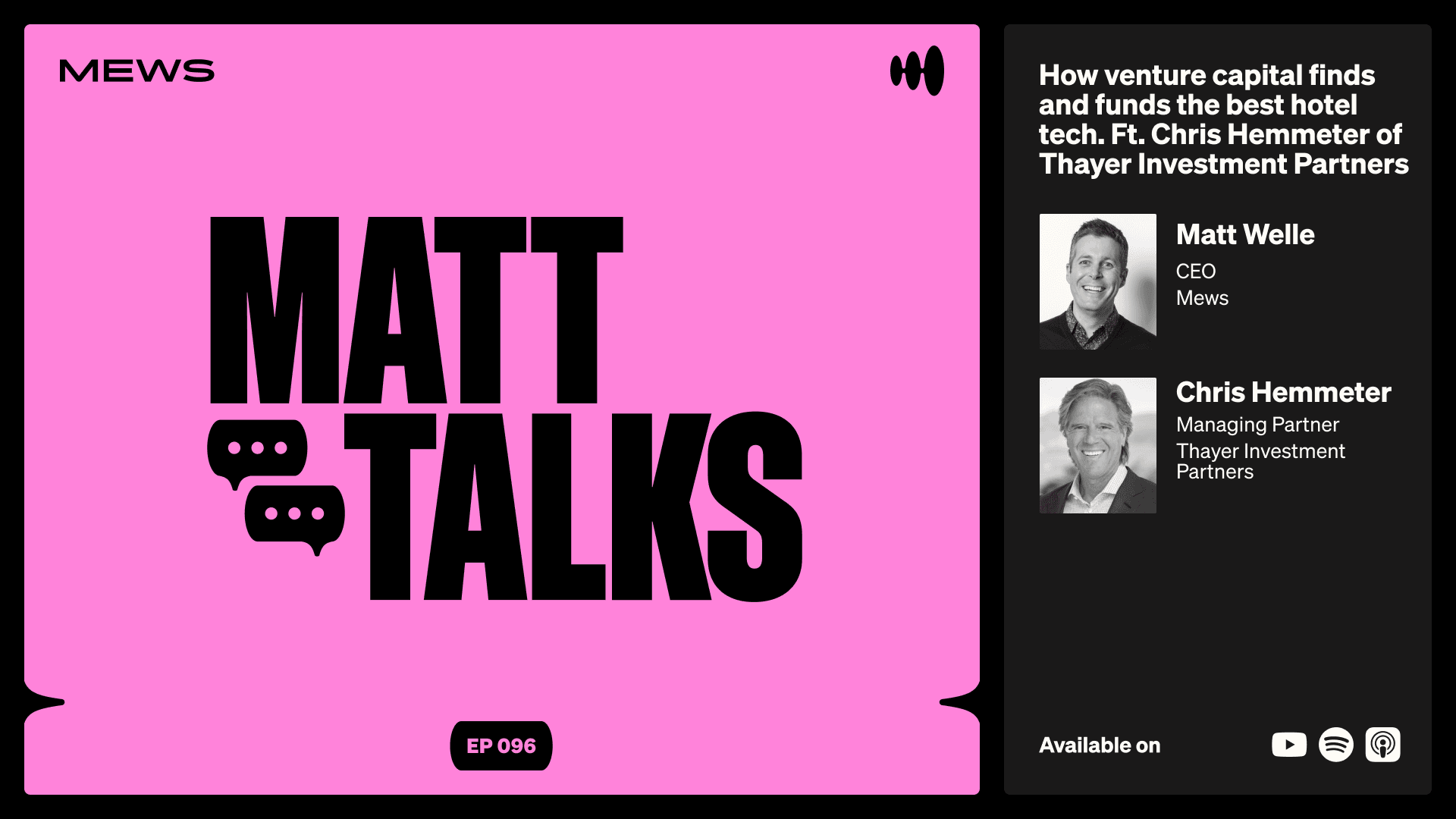
Every hospitality startup pitches a similar story: better tech, faster growth, bigger returns. Someone has to decide which ones are worth the check. On this episode, Matt is joined by Chris Hemmeter, Managing Partner at Thayer Investment Partners. They talk about how venture capital finds and funds the future of hospitality tech: what convinces investors, what makes a business worth the investment risk, and where the smart money thinks this industry goes next.
Meet your speakers

Matthijs Welle
CEO, Mews
After years in the trenches of hospitality, Matt joined the Mews journey during its early days in 2013. Since then, he’s been our fearless CEO, leading the company and the industry forward.

Chris Hemmeter
Managing Partner, Thayer Investment Partners
Chris has spent over 35 years in and around startups and high-growth businesses in travel, hospitality and technology, having founded seven companies. Currently he’s a Managing Partner at Thayer Investment Partners, a venture capital platform investing in technology companies in the travel and mobility space.
Episode chapters
00:00
Intro to venture capital in travel
03:25
The start of Thayer Investment Partners
08:08
Winning the first big brands, and the bet worth making today
Transcript
- [00:00:00] Chris Hemmeter: Hotel owners and operators are no longer interested in just running concrete boxes where people sleep. They want to be more engaged in the traveler's experience and journey. That's part of delivering value, and it's also part of the opportunity to monetize and increase NOI for owners
- [00:00:33] Matt Welle: Hi, everyone. Welcome back to another Matt Talks Hospitality, and I'm really excited about this conversation because I've known Chris Hemmeter for quite a while. He's invested in Mews during our Series A, and Chris has invested in the travel landscape in tens of different companies, and that really shows that he understands the technology space in hospitality. And our audience is a lot of hoteliers who are thinking, "What should we be buying next? What's the thing that we should be holding out for?" So, I'm really excited to go down this winding route with Chris Hemmeter today from Thayer Ventures. Thank you for joining me.
- [00:01:04] Chris Hemmeter: Oh, it's a pleasure to be here, Matt. Thanks for having me.
- [00:01:07] Matt Welle: Can you describe what Thayer does as a firm?
- [00:01:11] Chris Hemmeter: Sure. So, we are a bread-and-butter venture capital firm, which means we raise pools of capital, and we invest in early-stage private companies. We hope to add value to those investments by helping our companies with connections and relationships, and with strategic partnerships. And then eventually, over the course of 5, 7, 8, 10, sometimes longer, years, we then sell those companies, return the capital to our investors, and that's how venture capital works. It's a little bit different than private equity and other types of financial products in that we invest typically in companies with early revenue that are still losing a lot of money. So, we're specifically focused on the travel sector, and travel, from our perspective, travel “T” is a very broad landscape and includes hospitality. It includes the marketing, merchandising, and selling of travel, experiences, air, ground, entertainment - all aspects of travel, business-to-consumer, business-to-business, the whole landscape.
- [00:02:21] Matt Welle: I think you started in 2009-ish.
- [00:02:22] Chris Hemmeter: Correct.
- [00:02:22] Matt Welle: The firm. Has that thesis changed over the years, because we're now a couple of years later? Do you invest in different types of companies?
- [00:02:30] Chris Hemmeter: It's a great question. So, the overall sector strategy has remained the same. Travel is a 11-trillion-dollar global landscape, highly, highly fragmented and inefficient, growing faster than global GDP, expected to for a long time to come, and complex, especially the hospitality landscape, right? The ecosystem is very complicated. But where in the early days we were focused on more pure-play hospitality and travel technologies, we are now seeing more opportunities in what we would consider horizontal categories, so things like security and insurtech and fintech, where these companies may be working in multiple industries, but travel generally is a very big part of their platform, of their sector. We're seeing more and more opportunities like that, and I think that's been a phenomenon of the last probably 7 to 8 years that we're starting to see more crossover as the industry begins to mature and starts to look a lot more like traditional e-commerce and other categories.
- [00:03:34] Matt Welle: Like the travel routes, like your personal routes, I guess, like you've grown up in and around hotels?
- [00:03:41] Chris Hemmeter: Yeah. So, I was born and raised in the business. My dad was a hotel developer in the state of Hawaii. He developed the Hyatt Regency Maui, the Hyatt Regency Waikiki, the, you know, Westin Kauai, Westin Maui. I grew up around wet concrete in the hotel business. After I went to Cornell, I went back to Hawaii and worked in the family business, and very early in my career, I just started tinkering with creating companies. And I've built 7 companies across my career. So, I've spent my entire professional life as an entrepreneur building companies. In 2009, when I started this business, it was based on the insight that, as I mentioned a very large industry, complicated, in the process of transitioning from an antiquated way of doing business to new ways of doing business, and I saw an opportunity to have a firm that was smart with respect to what's going on in travel, but also very connected. Because as an entrepreneur, what I wanna do is I wanna help my portfolio companies with their business development, sales, and strategy. To me, that's being a value-added investor. If I can open doors and make connections. We've raised our money over the last several funds, in addition from financial investors, from institutional investors, from the travel landscape, so the world's largest hotel companies, Marriott, Hilton, Hyatt, Host Hotels and Resorts - are all investors in our funds, as well as other players like Capital One and their travel group, Enterprise Mobility, and others. And again, that sort of helps with our strategy of making connections.
- [00:05:17] Matt Welle: Yeah, exactly. So, like, if they're investing in your fund, then you're investing into the startup ecosystem, like it just kind of self-sustains, like really showing that these big brands are really doubling down on technology or innovation that they're trying to achieve.
- [00:05:30] Chris Hemmeter: Absolutely. I mean, it's been such an interesting journey, Matt. I have to tell you, in 2009, we were still the, you know, little guys knocking on the door, right? Tech was this sort of like, "Oh yeah, tech, that's that fun little software thing, but this is hospitality. So, you don't really know. Go ahead and talk to our CI, our, you know, our CTO if you want, but the C-suite has otherwise no interest in what you're doing." You know, fast-forward, this industry slams into the pandemic, utterly flat-footed, completely lacking agility, brands just layered with bureaucracy, and companies learned a lesson. And they really doubled down on making adjustments to their structure so that they had agility, and they could respond if there were shocks in the future. And they realized that the way to do that was to embrace technology and what it meant for their business. So, suddenly tech went from a nice-to-have sort of tinker around the edges to a, you know, CEO saying, "What are we doing to modernize our tech stack so that we can be more agile?" Whether it's from a pricing perspective, a staffing perspective, whatever it may be, channel dynamics, and selling. So, that was a real accelerator in terms of testing and trial and adoption. And that's what, you know, in the end of the day, what you need in the marketplace is a dynamic where the incumbents, the large players, are willing to experiment and test and trial, because entrepreneurs are incredibly creative.
- [00:07:09] Matt Welle: But do you see that changing? Because we've struggled to get in there.
- [00:07:12] Chris Hemmeter: Fundamentally, the pandemic was an absolute step change in the pace of experimentation. The good news is the good companies then have an opportunity to engage early, get tested, run trials, prove their worth, and then they begin to take off, and then that's when we step in and invest and help them grow. So, it's created a much healthier dynamic landscape. That was shortly followed by AI and all of its implications, which I'm sure we'll talk about. So, it's been this sort of one- two punch that's led to a very dynamic marketplace now, one that we're super excited about as investors.
- [00:07:48] Matt Welle: When you raised your first fund, like, it's hard, right? Because no one knows what you do, what you'll invest in. Who were the first big brands that said, "We'll back you because we do believe that there is a future here"?
- [00:08:01] Chris Hemmeter: Our very first fund was almost more of a private beta. It was so small, and it was just high-net-worth individuals and us. Our second fund was a little bit larger but again didn't have any of the institutional guys. It was just a sort of beta version 2.0. So, it was finally in our third fund that both Hyatt and Marriott were the first ones to come in and say, "Yeah, this makes sense. Let's give it a try." And it was an interesting challenge because, as you can imagine from both companies' perspectives, their interest was not in making money. If we return 5 times their money, it made no difference to their earnings per share and the performance of their stock, right? These are giant companies. What they wanted was information. They wanted a partner out on the digital edge that could help them see the opportunities and the threats that were emerging. This is a time, remember, when Airbnb was coming on strong, when Uber was exploding. There was a lot going on that people hadn't anticipated, so there was a realization that, yes, an internal corporate venture group and strategy group can add real value, but you need to have some eyes and ears and a relationship with somebody who's just a pure commercial animal out there on the digital edge, which was exactly what we did. And we figured out how to then really operationalize that relationship where we brought information back to them; we learned more and more about their core strategic initiatives and interests, which informed us as we were looking at companies. And that flywheel has really gotten very healthy. And now, you know, we've got a very well-designed and developed corporate strategic program for our institutional LPs, from the business.
- [00:09:51] Matt Welle: Nice. So, you've been a hotelier, then you became an entrepreneur, you did 7 businesses, then you started investing. If you take that entrepreneur from back then and you place him in today's time, what would be a company that you'd start today with the technology that's available today?
- [00:10:05] Chris Hemmeter: I'd start Mews. Are you kidding? Of course.
- [00:10:11] Matt Welle: Great answer.
- [00:10:12] Chris Hemmeter: That's easy.
- [00:10:13] Matt Welle: But would you really? Would you touch the PMS space?
- [00:10:15] Chris Hemmeter: So, it's interesting, you know, not right now because you guys are so dominant, I wouldn't dare compete. You know, I absolutely would have started something sort of deep in the B2B stack. I wouldn't have gone out and tried to compete on the consumer side. I think that's changing, but that's not really where I see the opportunity. It was interesting when we first invested in Mews; we had a fundamental thesis about PMS. I mean, we saw the landscape, right? Again, everything I said about antiquated technology, a long history of resistance of adoption of innovation, and then you had this one very large technical incumbent that sort of sat across the whole landscape and wasn't really innovating; in fact, it was a blocker to innovation. I mean, think about it from today's perspective. You're a hotel owner. You want your API open so that you can integrate with a piece of software that you really like, and your core vendor running your basic ERP system in your hotel says, "Sure, that's gonna cost you about fifteen thousand bucks, and we'll get to you in about 9 months. How's that?" I mean…
- [00:11:22] Matt Welle: Like, and I laugh, but this is the reality, unfortunately, still, yeah
- [00:11:25] Chris Hemmeter: It is absolutely insanity. So, that closed, rigid system, you know, we knew was not going to survive. There's no way. Hotel owners and operators are no longer interested in just running concrete boxes where people sleep. They wanna be more engaged in the traveler's experience and journey. That's part of delivering value, and it's also part of the opportunity to monetize and increase NOI for owners. And so you can't do that on top of an opaque black box that won't talk to anybody. It makes no sense. And so we saw that coming. But what we knew was that innovating in that category in North America was a suicide squad run. The chains are just too dominant.
- [00:12:15] Matt Welle: Thank you so much for listening to Matt Talks Hospitality. I've really enjoyed these conversations. I did wanna take a moment to talk about the Mews Revenue Management System. Two years ago, we acquired Atomize, and we then from that moment started rebuilding the whole platform from the ground up at the core. So, the idea was that the Mews Operating System becomes the core platform that everyone in the hotel lives in. But we had to rebuild the whole user experience inside that same platform whilst we optimized the algorithms. That product is now live. Hoteliers and revenue managers love it because once they log into Mews, they get their business intelligence insights. They can manage the rates and the connectivity to the channel managers. And now all the price recommendations are sitting in that same platform, and this makes the life of revenue managers much more interesting because it turns them into revenue strategists. You can see this demo straight away directly inside the system. We can get you live by tomorrow, and we can get recommendations flowing to instantly make your business a better business. I hope you enjoy it.
- [00:13:08] Chris Hemmeter: The independents that are graduates from the chains also have the same legacy relationship with the incumbents. So, how do you get to feature parity as a startup in North America and compete in the PMS space? So, we specifically did not invest in or look at companies that were innovating in PMS in North America. We looked outside of North America, where the world is utterly the opposite, where 80% to 90% of assets are unbranded, where there isn't that kind of dominance. And that's when we found you and Richard innovating, and we're like, that's it. And I think it was a combination of the architecture of your product and your thinking we loved, but it was the discipline also of building a go-to-market service and support, and sustaining that; that was the key. If it had just been a cool invention, it would've been dangerous. But it was a cool invention coupled with one hell of an operator, you, you know, which gave us so much confidence that this was gonna work. So, I would've done what you guys have done. '
- [00:14:18] Matt Welle: Cause when we came to you, we were still Series A, right? We were still a small company. We had some traction, but, like, we needed people that had real product conviction. What gave you conviction that this could be something big?
- [00:14:30] Chris Hemmeter: First of all, again, it was the focus in Europe. It was the structure of the marketplace in Europe. It was the way that you were addressing the tax and regulatory challenges in the different small markets and how, structurally, those were little micro moats that would keep, you know, the big boys from attacking the space. So, you know, it looked like you would have time, assuming you put together a strong sales and marketing effort. And then, of course, you had unit economics that combined both fees for the PMS and revenue and margin off of the payment side of the business. So, there was a way that created a better CAC to LTV forecast, but also enabled you to come into the marketplace and compete on price where you needed to, but still preserve the economics to look like a really great business. So, it was a combination of all those factors that made it look like it was, like it had legs. And then also, of course, with Jos and the Notion guys, you know, in the lead, just so much respect for Jos and how smart he is and his success. And so, I knew that, with guys like that around the table, it seemed like the team was assembled to give this a shot. It was exciting.
- [00:15:54] Matt Welle: And it worked out. Yeah.
- [00:15:55] Chris Hemmeter: It sure did.
- [00:15:56] Matt Welle: Are there investments that you've made that you thought the thesis was really good and everything seemed to look good, but actually it didn't work out?
- [00:16:03] Chris Hemmeter: Oh, many.
- [00:16:05] Matt Welle: Yeah? Where does it go wrong? What's the thing that goes wrong?
- [00:16:09] Chris Hemmeter: Oftentimes there are complexities in markets that sometimes are really hard to tease out until you're actually in those markets jamming away. Sometimes it's been that, and it's either been a competitive response or a sudden burst of noise in a market that just slams the brakes on sales and squishes margins and just makes it really impossible. But more times than not, it comes down to people. I hate to say it, but there's a funky dynamic in startup land where it takes a sort of monomaniacal micromanager type to get something going. But then ultimately, as a company grows, the job of a CEO is to build a world-class executive team. Sometimes founders, they can't cross over because they can't let go, and when they can't let go and they're micromanaging everything, they can't assemble a team. The turnover is too high, and people leave. And young companies are fragile, and it's usually during that phase, that friction phase, that things break down and the company fails. And again, failure is a very sensitive thing.
- [00:17:17] Matt Welle: As an investor, like, you place a number of bets, and you have to write a number of them off logically, right? Because you're hoping that one of them will be the unicorn, but how many do you write off for the one unicorn?
- [00:17:28] Chris Hemmeter: So, at least in our business where we're more sector- focused, our survival rate tends to be a little bit higher. But I think industry-wide it's something like 55% to 65% of investments go bad, that a bunch do okay, and a few do great.
- [00:17:45] Matt Welle: Does it bother you when a business doesn't make it?
- [00:17:47] Chris Hemmeter: Yeah.
- [00:17:48] Matt Welle: Or like they're just part of the game?
- [00:17:49] Chris Hemmeter: No, it's the hardest part of the job, frankly. It's the thing, you know, people think venture capital is pretty glamorous, but the reality is companies that are doing really well don't have any interest in talking to me. Like, "Hey, Matt, what can I do? How can I help?" You're like, "I'm good." But the ones that are dying, and they're scratching for, "Oh, I think I can do it. I just need one more check. Just one more million dollars, and I swear I can turn the corner." I mean, those are the ones that take up all your time, and it's hard. I mean, but I found that, you know, like in anything in life, you just gotta be super honest, clear, transparent, and usually people know when it's over; it's over. As I would say this, for anybody listening to this that aspires to be an entrepreneur, I think it is really important to understand that failure is a part of the game, that the life of an entrepreneur is about taking multiple at-bats. I've started 7 companies. I have taped up more than a few boxes and, you know, filed windup papers with the Secretary of State. It's, they don't always work, and the key is to fail fast because death in the world of entrepreneurship is the zombie company, where you hang on for 15 years, it does barely well enough, you're woefully underpaid, and in the end you return half the money to your investors. You just put a 15-year hole in your resume and didn't accomplish anything. Way better to say, "Hey, investors, here are the objectives. Here are the milestones I have to reach. Here are the things that have to be true for us to be onto something here." And the moment it becomes clear that that's not happening, shut it down.
- [00:19:30] Matt Welle: Pull the plug. Yeah.
- [00:19:31] Chris Hemmeter: Pull the plug and move on.
- [00:19:32] Matt Welle: When you think about hoteliers today that are probably listening to this podcast, a lot of them are like, there's so much noise. Like, everyone's got an AI company and an AI solution and a chatbot here, and an LLM model there. What should they spend money on, like, or at least budget for next year to spend on that's maybe a new category or something that excites you in the space that could solve a real hospitality problem?
- [00:19:55] Chris Hemmeter: Well, I mean, I think one of the biggest issues that independent hotels, individual hotels, whether flagged or otherwise, have to deal with is the quality and the orchestration of their data. As the world has shifted from a keyword search discovery environment dominated by a bunch of big intermediaries, there was some stability there. You could buy traffic on Google, you could have a better vanity website, you could do the, you know, have your own little loyalty program to get people to come back. But the reality was distribution generally, the marketing, merchandising, and selling of your travel products was pretty static, irritating, too expensive, but static. That has fundamentally changed. Now, I'm not saying that bookings are coming through the LLMs, and the fact is, it may be that the LLMs are going to look more like referral sources than distribution channels. We'll see. But the point is, consumers are engaging in contextual search. They're talking about the kind of experience they wanna have, not, "Show me all the hotels in New York City during this date range." They're getting deep, "I want a place that's near a park where my dog can take a shit, and you know, a good Mexican restaurant within two blocks," and blah, blah, blah.
- [00:21:19] Matt Welle: How did you know my last search?
- [00:21:22] Chris Hemmeter: And the reality is, the results being served back to the traveler, recommendations of maybe 3 or 4 places, not pages and pages of links that you can sort by. So, now people don't necessarily book there, but that research the data is showing is becoming increasingly important to the way people are planning their travel. So, if they're down to 4 hotels in the output of that contextual conversation, and then they go to the web and search for those hotels and look at them and verify that's where they wanna stay, as a hotel operator, you gotta be on that page. You're competing to be recommended. And so what does it mean? It means that you have to feed the LLMs all of the information that they require so that they can have a confident response. And if you're sitting on old crappy data, it ain't gonna work. So, in my view, that's sorta job number one.
- [00:22:14] Matt Welle: So, like a CRM product, like a guest review product that pushes out customers to say these things about your hotel?
- [00:22:20] Chris Hemmeter: It's that. It's augmenting your own information, your FAQs. It's understanding the fact that there are two internets now. There's the one that humans come and tap around on, and then there's the one that the robots are working vigorously, and you gotta understand how both work. You have to be running your hotel on top of a system that's ready to deal with this change because the change is an opportunity, right? Orchestrating your data so that your... If you're a beautiful little hotel in the Dolomites, and you've got all the information about where you're at, and people are leaving pretty reviews, and you even have some information in your FAQs about the restaurants nearby and the hikes that you can do, right? You're in a great position to be discovered if somebody says, "I wanna go to the Dolomites and stay at a cool hotel." So, that's step number one. Step number two is then those people are telling you a lot about what they want in their overall experience, and you have an opportunity in ways to sort of personalize an offer back to them, to package other things along with just a basic stay. To somehow incorporate when they're arriving and when they wanna leave and what they wanna do, and get the most out of that traveler's wallet, therefore increasing NOI. In order to play that game, you've gotta be on a modern stack. You've gotta be on a tech platform that's flexible, that can integrate and talk to services that matter to you locally, that give you the competitive, sort of playing field so that you can meet this new world head-on. If you're operating on old crap, you know, I don't care how creative you are, you aren't going to be able to play. And then that, to me, is just sort of no excuse for that.
- [00:24:04] Matt Welle: I just got off a call with an AI integrator, and I said, "So, how do you integrate with the legacy platforms?" And he's like, "We just have a computer in the back office, and it just basically runs the computer on the UI." I was like, "That is insane." But that's the only way to integrate with those platforms, I guess, if you want to deploy AI.
- [00:24:20] Chris Hemmeter: Yeah, it's crazy. And the other thing that I think is, sort of the third layer, what's coming in a truly agentic world, when we think about agentic AI in the operations of a hotel, what are we looking for? What we're looking for is not sort of simply a wiring of old workflows; what's exciting are those companies that are completely rethinking workflows. We haven't changed the way we operate hotels since the 1940s. Is that right? I doubt it. There are probably opportunities where more and more of the talent in our businesses are out touching guests, facing the guests, engaging in the experience of hospitality versus doing a whole bunch of scheduling and management crap in the back of the house. And owners are screaming for that, right? The owners are all about NOI, and they're sitting on top of all this expense while the brands' stock prices are going up, and they're saying, "What the hell is going on? You know, my RevPAR is not outpacing labor. How can I innovate?" And we are seeing in some of the companies we're financing now new ways of thinking about operations and using agentic AI to do that. You can't experiment with and deploy those kinds of opportunities again unless you are on a modern tech stack that enables that experimentation. So, I think that the job, number one and two, are to clean up your data and get on a modern tech stack, and then you'll be set. And the reality is, unless your hotel is a piece of shit, then there's nothing you can do about it, right? You gotta have a nice hotel in a nice place that meets the market, right? So, it's going to come back to the old Statler: location, location, location. You still have to have a good asset, but there's a lot of great assets that are not…
- [00:26:11] Matt Welle: You can make up for a lot of it with great service, right? So, like, the hotel may still be crap, but like, we're a people industry, so some component of service has to be present in order to stand out from the pile of crap, I guess.
- [00:26:24] Chris Hemmeter: Yeah. Yeah. There are many ways to be crap in the hotel business, as you well know, right?
- [00:26:29] Matt Welle: You've invested into so many companies. Is there any company that you've recently invested in that you want to give a shout-out to?
- [00:26:34] Chris Hemmeter: We've made a couple of horizontal investments in security, which I think are really interesting. Jetstream and Cloaked are two companies we've invested in. Again, I think, as this world is flipping over to this AI-driven space, the challenges for security are super, super interesting. We invested in a very early- stage company called Tempo, which is doing agentic AI work in hotel operations. Very excited about what they're doing. Bonafide is another one that's doing data orchestration, working with the big brands right now, and a huge impact’s on the way. The outcomes for AI search with Bonafide. So, a lot, a lot of good stuff happening out there.
- [00:27:18] Matt Welle: That sounds like very AI-heavy kind of investments that you're making then.
- [00:27:22] Chris Hemmeter: Yes. I can't think of any portfolio company that's not basically becoming an AI company in some way. You know, Travel Curious is one of our great investments in doing experiences, working across the industry, very cool company.
- [00:27:37] Matt Welle: You introduced me to that founder, and I had the greatest conversation, and I immediately started introducing him to, like, our technical team. I was like, "There's something here that's really special."
- [00:27:47] Chris Hemmeter: Totally, and so much of their opportunity, the impact of AI on the content that they have and how that can be, and you can imagine a company like that. That's again, if a consumer is giving you contextual information about what they wanna do and the reason they're picking your hotel, they've had all this conversation about the experience they wanna have. You, as a hotel operator, should be in a position to fulfil that interest. You've already shown up as a hotel that they can stay at and then have those experiences. Well, now package those experiences for them. Become a distributor of experiences and monetize.
- [00:28:20] Matt Welle: And my last question, like, what is something that excites you for Thayer for the next year?
- [00:28:25] Chris Hemmeter: You know, I think it's still just the energy out there in all aspects of travel is increasing. The pace of experimentation and testing and the attitude towards innovation and technology is increasing. Even airlines are doing more with, you know, merchandising and distribution and thinking of themselves as travel companies as opposed to just transportation companies. I think the hotel industry is continuing to innovate fast. I mean, lots of really interesting and creative stuff happening. So, as long as, I think, the broader landscape of, you know, it's basically everything - what you might call the experience economy - 'cause it includes all things that we do, not just travel, but entertainment, food service, whatever it may be. As long as that world is in a state of change, and the players within that world are testing and experimenting. You know, I like to say it's like the desert after a long, hard, warm rain. The wildflowers just start popping, and in our world, those wildflowers are startup entrepreneurs. I live in a world where I watch the field, and as things start to pop and grow, those are opportunities where I can find good ones. We have a thesis about this, that, and the other thing, but our biggest category is what we call opportunistic, which means we listen. We listen, and we look, and when, you know, we see things happening, that's where we can sweep in. So, I just wanna continue to see this very dynamic sort of environment of disruption because that creates change, which creates opportunity.
- [00:30:04] Matt Welle: Well, thank you for doing what you do for our industry. Like, I've always aspired to be a hotelier, and I wasn't inspired by technology before Mews, but, like, seeing you take a bet on us when no one else did, like, because it was so hard for Mews, like, building a PMS, everyone was not excited about a B2B company with slow growth. But we needed that first investor to come in and give us money to actually hire salespeople, and you took a bet on us, and I hope it, you're happy with that investment at the time today, but thank you for everything you've done for us and for the growth of the industry.
- [00:30:33] Chris Hemmeter: Oh, man. No, it's been absolutely my pleasure to be on the ride. I mean, you guys do all the hard work. I just get the pleasure of watching you crush it.
- [00:30:43] Matt Welle: I love it. Thank you so much for joining me today.
- [00:30:45] Chris Hemmeter: All right, Matt. Great to see you.
- [00:30:47] Matt Welle: I hope that you're enjoying this episode, because if you do, make sure that you press that subscribe button. It really helps grow the audience and keep you informed whenever a new episode drops. We have some of the best hoteliers on this platform, and I love asking them the hard questions so that hopefully you can improve your hospitality business as well.
Resources

Nine in ten hotels are already using AI. Where does yours stand?
Research
Read More
Platform
pages
Read More


