Key takeaways
- There is no universal best channel manager. Start with your required channels, property type, operating model and existing technology.
- Prioritize connection quality and reliable two-way synchronization over the largest advertised connection count.
- Test room and rate mapping, restrictions, cancellations and error handling before a full rollout.
- Compare the complete cost, including implementation, support, extra channels, modules and contract terms.
- Decide whether you want a standalone tool or channel management that works inside your hotel operating system.
Having the best product out there won’t do you any good if your target audience can’t find it. You know that, so you’ve partnered with online travel agencies (OTAs) to increase your reach. But with that comes the need to keep your rates and inventory up to date on all your channels – and the more channels you’re present on, the more work it is.
The best channel manager for your hotel is the one that keeps the channels you rely on accurate, connects cleanly with your property management system and gives your team enough control without adding unnecessary complexity. That will look different for a 30-room independent hotel than for a multi-property group.
This guide compares leading hotel channel managers and gives you a practical framework for evaluating channel coverage, two-way synchronization, rate and restriction controls, reporting, support and total cost.
What is a hotel channel manager?
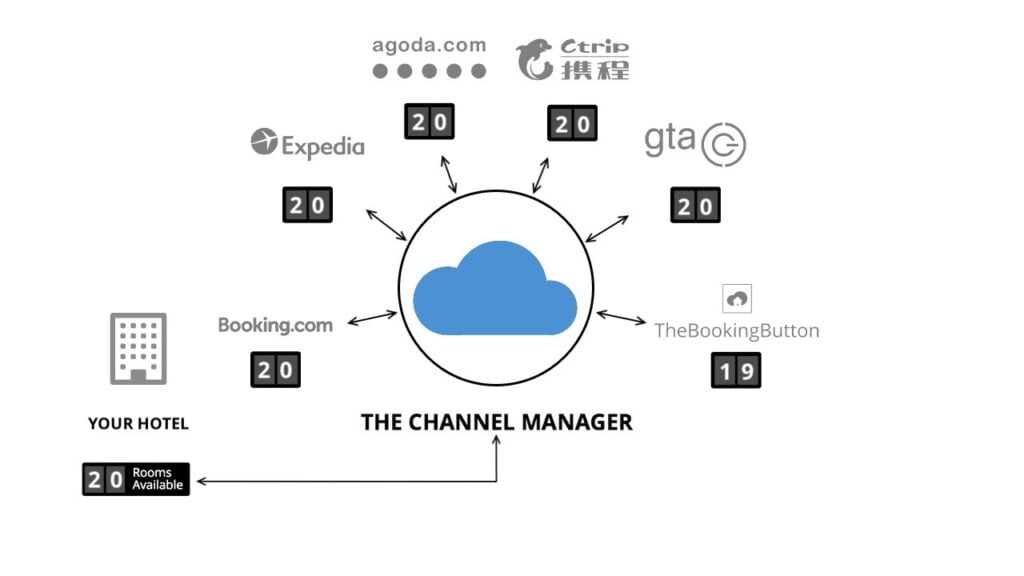
A hotel channel manager is distribution software that connects a property’s room inventory, rates and restrictions with online travel agencies, global distribution systems and other booking channels. When a reservation or rate change occurs, the system updates connected channels so availability and pricing stay aligned.
This reduces manual updates, helps prevent overbookings and gives hotels a central place to manage online distribution. A channel manager usually works with a property management system (PMS), while a booking engine handles reservations made directly on the hotel’s website.
The importance of having an effective hotel channel manager
Enter the channel manager, an application designed to help accommodation providers efficiently manage their online distribution.
What makes them so great? A good hotel channel manager connects your property to hundreds of OTAs, cuts admin work by keeping prices updated everywhere, helps you manage inventory and rate parity and boosts direct bookings.
Sources including Hotel Tech Report (HTR) and Skift have found that, depending on the size of your property and the number of channels you use, you could save 20 or more hours a week and increase occupancy by at least 10%, just by using a channel manager.
How we evaluated the channel managers in this guide
We used the criteria below because they affect both daily reliability and long-term fit. This is an editorial shortlist, not a universal ranking. Product capabilities, integrations and pricing change, so hotels should verify all requirements directly with each provider during a live demonstration.
- Channel fit: support for the global, regional and niche booking channels the property actually uses.
- Synchronization: two-way exchange of rates, availability, restrictions, reservations, modifications and cancellations.
- Hotel PMS and booking engine fit: integration depth, data flow and the number of systems staff must manage.
- Controls and usability: room/rate mapping, bulk changes, stop-sells, length-of-stay rules, permissions, logs and alerts.
- Reporting: visibility into channel production, revenue contribution, booking pace and errors.
- Implementation and support: onboarding, testing, documentation, support coverage and escalation paths.
- Cost and scalability: pricing model, implementation charges, add-ons, contract terms and multi-property requirements.
The best hotel channel managers to consider
The best hotel channel manager depends on your property type, distribution strategy, existing technology and the channels you want to manage. Some platforms prioritize simplicity, while others provide advanced controls for complex portfolios.
The following options represent several established approaches, including Mews Channel Manager and third-party platforms that connect with Mews.
Channel manager
Best suited for
Notable capabilities
Connection with Mews
Mews Channel Manager, powered by SiteMinder
Mews customers seeking an integrated distribution experience
Centralized rate and availability management, channel access that scales with your Mews plan and fewer disconnected workflows
Built into the Mews operating system
STAAH
Independent hotels and groups looking for flexible distribution tools
Real-time inventory updates, bulk changes, performance reporting and broad channel connectivity
Available through the Mews Marketplace
D-EDGE
Independent hotels and hotel groups with more complex distribution needs
Rate and availability automation, centralized distribution controls and international reach
Available through the Mews Marketplace
RateTiger by eRevMax
Hotels and groups managing multiple channels, markets or properties
Two-way distribution, rate and inventory controls, reporting and support for complex channel strategies
Available through the Mews Marketplace
SiteMinder
Properties seeking extensive channel reach and established distribution technology
Real-time inventory updates, pricing controls and connections with major booking channels
Powers Mews Channel Manager
SynXis CRS
Larger hotels, resorts and enterprise groups
Channel distribution within a broader central reservation and hospitality technology ecosystem
Available through the Mews Marketplace
Mews Channel Manager, powered by SiteMinder
Mews Channel Manager brings SiteMinder’s distribution technology into the Mews operating system. It is designed for properties that want to manage rates, availability and channel distribution with fewer disconnected systems and less manual work.
Best for: Mews customers looking for a streamlined, integrated approach to channel management.
Key capabilities:
- Centralized rate and availability management
- Real-time distribution updates
- Access to an extensive network of booking channels
- Closer connection between distribution and property operations
STAAH
STAAH provides channel management tools for independent properties and hotel groups. Its platform supports centralized inventory distribution, bulk updates and performance monitoring across multiple booking channels.
Best for: Properties looking for flexible distribution controls and an accessible interface.
Key capabilities:
- Real-time rate and inventory updates
- Bulk management across connected channels
- Distribution performance reporting
- Support for independent hotels and multi-property groups
D-EDGE
D-EDGE offers hotel distribution technology for independent properties and hotel groups. Its channel manager helps hotels coordinate rates and availability across online travel agencies and other distribution partners.
Best for: Hotels with international or more complex distribution strategies.
Key capabilities:
- Automated rate and availability updates
- Centralized channel management
- Support for multiple markets and languages
- Broader distribution and digital commerce tools
RateTiger by eRevMax
RateTiger helps hotels distribute rates and inventory across multiple booking channels from a centralized platform. It is particularly relevant for properties managing complex rate plans, multiple markets or larger portfolios.
Best for: Medium-sized and larger hotels or groups requiring detailed distribution controls.
Key capabilities:
- Two-way rate and inventory distribution
- Centralized channel updates
- Reservation and performance reporting
- Support for multi-property distribution strategies
SiteMinder
SiteMinder is an established hotel distribution platform connecting properties with a broad network of booking channels. Its technology also powers Mews Channel Manager, making it an important part of how Mews handles distribution.
Best for: Hotels prioritizing channel reach and mature distribution capabilities.
Key capabilities:
- Real-time inventory distribution
- Rate and restriction management
- Connections with major regional and global channels
- Tools supporting direct and third-party distribution
SynXis
SynXis combines channel management with central reservation and enterprise distribution capabilities. It is generally suited to larger hotels, resorts and groups that need distribution to function within a broader hospitality technology environment.
Best for: Enterprise properties and hotel groups with complex reservation and distribution requirements.
Key capabilities:
- Centralized rate and availability management
- Global distribution support
- Advanced pricing and restriction controls
- Integration with a broader reservation technology suite

How to choose the best channel manager for your hotel
1. Start with the channels and markets that matter
A long connection list is only useful if it includes the channels that drive demand for your property. Document your essential OTAs, regional platforms, wholesalers, GDS requirements and direct hotel booking engine. Ask whether each connection is certified and fully two-way, because “supported” can describe very different levels of data exchange.
2. Confirm two-way sync and pooled inventory
The system should update availability after bookings, modifications and cancellations and push rates and restrictions back to connected channels. Ask the provider to demonstrate a live change and show how quickly it appears elsewhere. Confirm whether all channels draw from pooled inventory and how the platform handles delays or conflicting rules.
3. Check the PMS integration or evaluate a unified setup
Long-standing channel managers have one big advantage – something a PMS provider with a direct connection to a few OTAs can’t even begin to compare to.
Your channel manager and PMS need to exchange accurate reservation, inventory and rate data. A standalone channel manager may suit hotels that want to preserve an existing stack, while an integrated option can reduce logins, handoffs and vendor management. Compare the depth of the connection, not just whether an integration logo appears on a marketplace page.
4. Test rate, restriction and mapping controls
Review how the tool maps room types and rate plans and whether teams can manage minimum stays, stop-sells, closed-to-arrival rules, derived rates and channel-specific restrictions. Ask who owns mapping changes and how the system flags incomplete or conflicting configurations.
5. Review reporting and error visibility
A useful channel manager should show more than reservations. Evaluate channel production, booking pace, revenue contribution and cancellation patterns, as well as logs or alerts that reveal failed updates. Your team should be able to identify an issue before it becomes a guest-facing problem.
6. Evaluate onboarding and support
Ask who handles setup, mapping and testing; how support is delivered; and what happens when a connection fails during a high-demand period. Support hours, escalation routes and ownership matter as much as the interface.
7. Compare total cost and contract terms
Normalize pricing across the same contract period. Include base subscription, room or property tiers, setup, additional channels, premium modules, support, training and payment or booking fees where applicable. Confirm renewal terms and how costs change as rooms, properties or users are added.
Questions to ask during a channel manager demo
- Are our essential channels fully two-way, and which data fields synchronize?
- How quickly do rate, inventory and restriction changes normally update?
- Can you demonstrate a booking, modification and cancellation flowing into our PMS?
- How are room types and rate plans mapped, audited and changed?
- What alerts and logs appear when an update fails?
- Can we apply restrictions or pricing rules by channel, property or room type?
- Which reports show channel production, revenue and net performance?
- What does onboarding include, who owns testing and how long should we plan?
- What support is available in our time zone and how are urgent connection failures escalated?
- What is the complete first-year and renewal cost for our current and expected scale?
Which hotel channel manager is right for you?
The best channel manager is not necessarily the product with the longest feature list or the lowest advertised price. It is the one that reliably supports your channel mix, integrates with your core systems, gives your team the controls it needs and can scale without creating avoidable operational work.
Build a shortlist of two or three providers, ask each to demonstrate your real workflows and test the connection before a full rollout. Mews customers can explore Mews Channel Manager, powered by SiteMinder, to see how distribution can work from inside the Mews operating system.
Ready for impact? See Mews in action. Get onboarded the right way and start driving results. Book a demo.
What is the best channel manager for a hotel?
What is the best channel manager for a hotel?
The best channel manager is the one that supports the hotel’s essential booking channels, maintains reliable two-way synchronization, integrates with its PMS and provides the controls, reporting, support and pricing model that fit its operation. There is no single best option for every property.
What features should a hotel channel manager have?
What features should a hotel channel manager have?
Core capabilities should include real-time or near-real-time rate and availability updates, reservation and cancellation synchronization, pooled inventory, room and rate mapping, restriction controls, logs or alerts, reporting and a reliable PMS connection. The required depth depends on the property and channel mix.
What is two-way synchronization?
What is two-way synchronization?
Two-way synchronization means information flows both from the hotel’s system to booking channels and back again. Rates, availability and restrictions can be pushed outward, while reservations, modifications and cancellations return to the hotel’s system.
What is the difference between a channel manager, PMS and booking engine?
What is the difference between a channel manager, PMS and booking engine?
A channel manager distributes rates and inventory across third-party booking channels. A PMS manages on-property operations and reservation data. A booking engine lets guests reserve directly on the hotel’s website. The systems should exchange data accurately, whether they are separate products or part of an integrated system.
How should hotels compare channel manager pricing?
How should hotels compare channel manager pricing?
Compare the full cost over the same period, including subscription or commission charges, setup, extra channels, modules, support, training and renewal terms. Model how the price changes when the hotel adds rooms, properties, users or channels.
How can a hotel test a channel manager before going live?
How can a hotel test a channel manager before going live?
Verify mappings, push a low rate and availability change, and run test bookings, modifications and cancellations. Confirm that each update reaches the PMS and connected channels, then review logs and alerts for any failures before expanding the rollout.