
Key takeaways
- Hotel SEO is essential for increasing online visibility and driving more direct bookings in a competitive hospitality market.
- A successful hotel SEO strategy combines keyword research, technical optimization and high-quality content tailored to search intent.
- Optimizing on-page elements such as titles, headings, internal links and structured data improves search engine rankings and user experience.
- Local SEO is critical for hotels, as most travelers search using destination-based and geo-specific queries.
- Tracking performance through analytics and search data allows hotels to refine their strategy and maximize return on investment.
Getting found online is one of the most powerful ways hotels can attract more direct bookings - but standing out in search results takes more than just a nice website. In a landscape where travelers start their journey with a Google search, owning key moments of that journey can directly impact your visibility, occupancy and revenue.
In this guide, we break down practical, hotel-specific SEO strategies that help you rank higher in search engines, drive more qualified traffic and turn online interest into real bookings without relying solely on OTAs or paid ads.
What is SEO?
SEO (Search Engine Optimization) is a set of techniques used to ensure that a website, such as a hotel's official page, appears among the top results when someone searches on Google or on other search engines.
Why is SEO important for hotels?
SEO is vital for hotels, as most travelers start their search for accommodation online. If your hotel does not appear among the first results, it might as well not exist. Here are four key reasons that will make it clear why SEO is a must for your hotel:
1. Online visibility
No matter how amazing your hotel is, if no one can find it on Google, it's like it doesn't exist. Even appearing on the second page of Google means missing out on opportunities. SEO ensures your website is right in front of people actively searching for accommodation.
2. Find your perfect guest
With the right SEO, people looking for exactly what you offer will find you. It's the best way for your hotel to welcome the perfect guests.
3. More direct bookings
By appearing organically in the search results, you can reduce reliance on online travel agencies (OTAs), which leads to more direct bookings and therefore more revenue for your hotel.
4. Stay ahead of the competition
A good SEO strategy will put your hotel at the top of the list, leaving the competition at the bottom of the queue.

Strategies to optimize your hotel's website for SEO
Success in the digital world starts with a solid SEO strategy. If you want your hotel to stand out from the competition and attract more visitors, it is essential to optimize the SEO of your site (both on-page and off-page). And don't forget about local SEO - many of your potential guests will perform geo-localized searches, looking for hotels near their location.
Below, we explore four key areas of optimization (with their little secret sections included):
1. Building a solid foundation with on-page SEO
On-page SEO refers to optimizations performed directly on your website's content and structure. Here are some basic tips:
A: Keyword research
Before optimizing, you need to perform good keyword research. This means figuring out the words people use when looking for accommodation in your city. Find those popular keywords that can attract visitors with tools such as Google Keyword Planner or Semrush.
The key is to look for words with search intent. That is, to understand what the user wants when they type something into Google. For example, someone searching for "cheap hotels in the centre of Madrid" is likely ready to make a reservation, while someone searching for "best luxury hotels in Madrid" wants to research high-end options. See the difference?
B: Content optimization
Once you have your keywords, use them strategically on your website. Place them in titles (H1), headings (H2, H3, etc.), and throughout the main text. But be careful! Avoid the dreaded keyword stuffing which consists of stuffing keywords unnaturally throughout your content. Google detects this, hates it and can penalize your page if you abuse it. The key is to make sure your content is natural, relevant and useful for your visitors.
C: Meta title and meta description
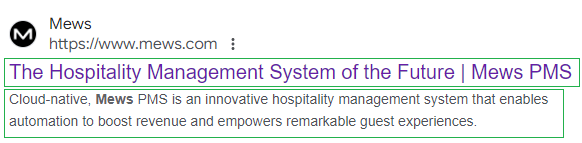
The meta title, also known as a title tag, is the title shown in the search results and is the first thing people see. For example, if you have a pet-friendly hotel, your meta title could be something like: "Best Hotel in the Centre of Madrid | We Accept Pets." The meta title should never exceed 60 characters (including spaces), or it will not be fully displayed in the search results.
The meta description is the small text that appears below the title in Google's results. Although it does not directly affect your ranking, it plays a key role in getting users to click on your page. Make sure it is attractive, short and enticing, for example: "Enjoy an unforgettable stay in the heart of Madrid with your pet. Book today and get a 10% discount." The meta description should have a maximum of 150 characters (including spaces) for desktop.
Below is an example of a meta title and meta description:
D: Improving the user experience
User experience is a key ranking factor for Google, so your website needs to be fast, easy to navigate and visually appealing. Mobile optimization is especially critical, as most users browse and book on their phones.
Your site should function seamlessly across devices. Slow load times or poor usability will drive visitors away and hurt your rankings. Aim for fast performance (ideally under three seconds), with clear navigation, intuitive layouts and easily accessible buttons.
E: Indexing and Crawling
When Google visits your website, its goal is to crawl all the URLs it finds, such as your homepage, booking page or room pages. This process allows Google to decide which pages to display in search results. However, not all pages on your site need to be crawled by Google, especially if they are not relevant to your visitors or do not add value to search results. For example, pages such as login pages, privacy policies or even expired special offers are of no value to users looking for accommodation.
To prevent Google from wasting time checking these pages, you can use the robots.txt file (located at the root of your website, e.g. (https://www.mews.com/robots.txt) to block its access to irrelevant URLs. By doing this, you optimize your crawl budget, i. e., the time and effort Google spends crawling your site, allowing it to focus on the pages you really want it to get indexed, such as your booking page or the rooms section.
If you prefer Google to continue to crawl a page, but don't want it to appear in search results, you can add the "noindex" tag to the HTML code for that page.
F: Work on internal linking
Internal linking is like creating a network of roads and highways between the most important pages on your website, helping Google understand which ones are most relevant. For example, if you write a blog post about "How to Survive the Heat in Madrid," you could add a link that says, "Relax in our rooms equipped with air-conditioning and minibar." This guides your visitors to the rooms page while making Google understand that this page is essential.
This type of internal linking not only helps Google to crawl your site more efficiently, easily finding the important pages, but also improves indexing, because Google discovers and prioritizes these pages in its analysis process. In addition, it improves the user experience, guiding visitors to relevant content and helping those pages rank higher in search results.

2. Building authority and quality links with off-page SEO
Off-page SEO focuses on actions performed outside of your website to improve its visibility and online authority.
Here are some key strategies you can use:
A: Link building
High-quality inbound links or backlinks are a key signal to search engines that your site is relevant and trustworthy. The more links you receive from authority websites, the more visibility you will have in search results. Look for opportunities to generate links, such as from hotel directories, travel blogs or booking portals. You could also collaborate with influencers or generate valuable content that other sites may want to link to.
We recommend creating naturally linkable content on your website, such as PDFs, infographics or downloadable guides. Not only do these resources bring value to your visitors, but they are also likely to be shared by other sites.
For example, you can create an infographic called: "The 5 Best Hidden Spots in Madrid for an Amazing Selfie." Not only will your guests want to see it, but influencers, travel bloggers and travel media will want to link to your website so that their readers can also discover these amazing places.
B: Be active in social media
Social media plays a crucial role in promoting your hotel and generating natural links.
Create social media profiles for your hotel and share relevant and engaging content on a regular basis. Interact with your followers, respond to comments and questions and promote special offers or events. As your social media presence grows, others are more likely to share and link to your content.
C: Generate reviews
Positive guest reviews are a great way to build trust and enhance your online reputation, but that's not all.
Every time your guests mention your hotel adding a link to your site, your ranking in the search results also improves. This is why it's beneficial to encourage your guests to leave reviews on review sites and testimonial platforms.
3. Reach travelers in your area with local SEO
Local SEO is especially important for hotels, as travelers often search for accommodation using geolocation.
Here are some useful tips to improve your local visibility:
A: Google Business Profile
Register and verify your hotel on Google Business Profile. Google Business Profile is an essential tool to improve your local presence. Be sure to fill in all the information, including address, phone number, business hours, etc. And don't forget to upload high-quality photos.
Also, you should ask your guests to leave reviews on your Google Business profile, as this will increase your local visibility and credibility.
B: Local citations
Local citations are mentions of your hotel on local directories and websites. Make sure your hotel's information, such as name, address and phone number, is consistent across all citations to improve your local ranking.
C: Local keyword optimization
Use relevant local keywords in your content, especially in your hotel descriptions and location-related pages.
For example, if your hotel is located in Barcelona, include keywords such as "hotel in Barcelona", "accommodation in Barcelona", etc. This will help you to draw the attention of travelers looking for accommodation in that specific location.
D: Boost content marketing
Content marketing is a key tool in your local SEO strategy and offers multiple benefits for your hotel. Running an up-to-date blog with relevant and useful content not only helps to attract travelers but also improves your website's ranking in local searches.
Publishing useful and entertaining content, such as "The 5 Secret Bars in Barcelona Where Even Locals Get Lost" or "How to Get an Epic Photo in Front of La Sagrada Familia Without an Army of Tourists Behind You," not only attracts curious travelers but also improves your local SEO by using strategic keywords. In addition, blogs are natural backlink magnets: other websites will link to your content if they find it valuable, which improves your off-page SEO.
And don't forget that keeping your blog full of interesting and fresh content boosts your brand image, positioning your hotel as a trusted and active source within the community. It's a win-win strategy to attract more bookings and improve your online presence.

4. Boost your SEO strategies with paid advertising
In addition to the hotel SEO strategies we've seen so far, a great way to complement and boost your online visibility is through a paid advertising strategy.
SEM involves paying for search engine advertising, which allows you to appear prominently in search results and drive traffic to your website.
Some key advantages of SEM include:
- Instant positioning: Unlike SEO, which may require some time before you see results, SEM gives you immediate visibility.
- Accurate targeting: You can target your ads to specific audiences based on location, interests, language, and other demographic criteria, allowing you to reach the travelers most relevant to your hotel.
- Budget control: You can set daily spending limits and adjust your campaigns in real time to get the best return on investment.
- Detailed analytics: SEM platforms offer tracking and analysis tools that allow you to measure the performance of your ads and make adjustments to improve the effectiveness of your strategy.
Turn search visibility into more direct bookings
Strong SEO isn’t just about rankings - it’s about capturing demand at the exact moment travelers are searching for their next stay. By combining on-page, off-page and local SEO strategies, you can improve your hotel’s visibility, attract higher-intent traffic and reduce reliance on third-party channels.
Because SEO is ongoing, success depends on consistently tracking performance, adapting to algorithm updates and aligning your strategy with changing traveler behavior.
With Mews, you’re equipped with the tools to convert that visibility into revenue. From optimized booking journeys and fast-loading pages to integrated payments and performance insights, Mews helps you turn search traffic into seamless, commission-free direct bookings.
Ready to grow your direct revenue? Get a demo.
How long does hotel SEO take to show results?
How long does hotel SEO take to show results?
Hotel SEO is a long-term strategy. Most hotels begin to see measurable improvements in rankings and organic traffic within three to six months, depending on competition and website authority. Competitive city markets may require longer timelines.
Should hotels hire an agency or manage SEO in-house?
Should hotels hire an agency or manage SEO in-house?
This depends on resources and expertise. Smaller hotels may manage basic hotel SEO internally, while larger properties often benefit from specialized agencies that can handle technical audits, link acquisition and advanced analytics.
How does hotel SEO differ from OTA optimization?
How does hotel SEO differ from OTA optimization?
Hotel SEO focuses on improving visibility for your direct website, while OTA optimization improves visibility within third-party platforms. A strong hotel SEO strategy helps reduce dependency on OTAs by increasing direct organic traffic.
What are common hotel SEO mistakes?
What are common hotel SEO mistakes?
Common mistakes include duplicate content across room pages, slow website performance, poor mobile usability and inconsistent local listings. Ignoring structured data and internal linking can also limit organic growth.
How important are images for hotel SEO?
How important are images for hotel SEO?
Images play an important role in hotel SEO when properly optimized. Compressing files, adding descriptive alt text and using relevant file names improves page speed and accessibility while helping search engines understand visual content.
Can blog content really improve hotel SEO rankings?
Can blog content really improve hotel SEO rankings?
Yes. Informational blog content targeting destination queries and travel planning questions helps attract early-stage travelers. This builds authority and increases the likelihood of direct bookings later in the decision process.
Does domain age affect hotel SEO performance?
Does domain age affect hotel SEO performance?
Older domains can have an advantage if they have built authority over time. However, a well-structured site with strong content and backlinks can outperform older competitors regardless of domain age.
Written by

Eva Lacalle
Eva has over a decade of international experience in marketing, communication, events and digital marketing. When she's not at work, she's probably surfing, dancing, or exploring the world.