What to expect?
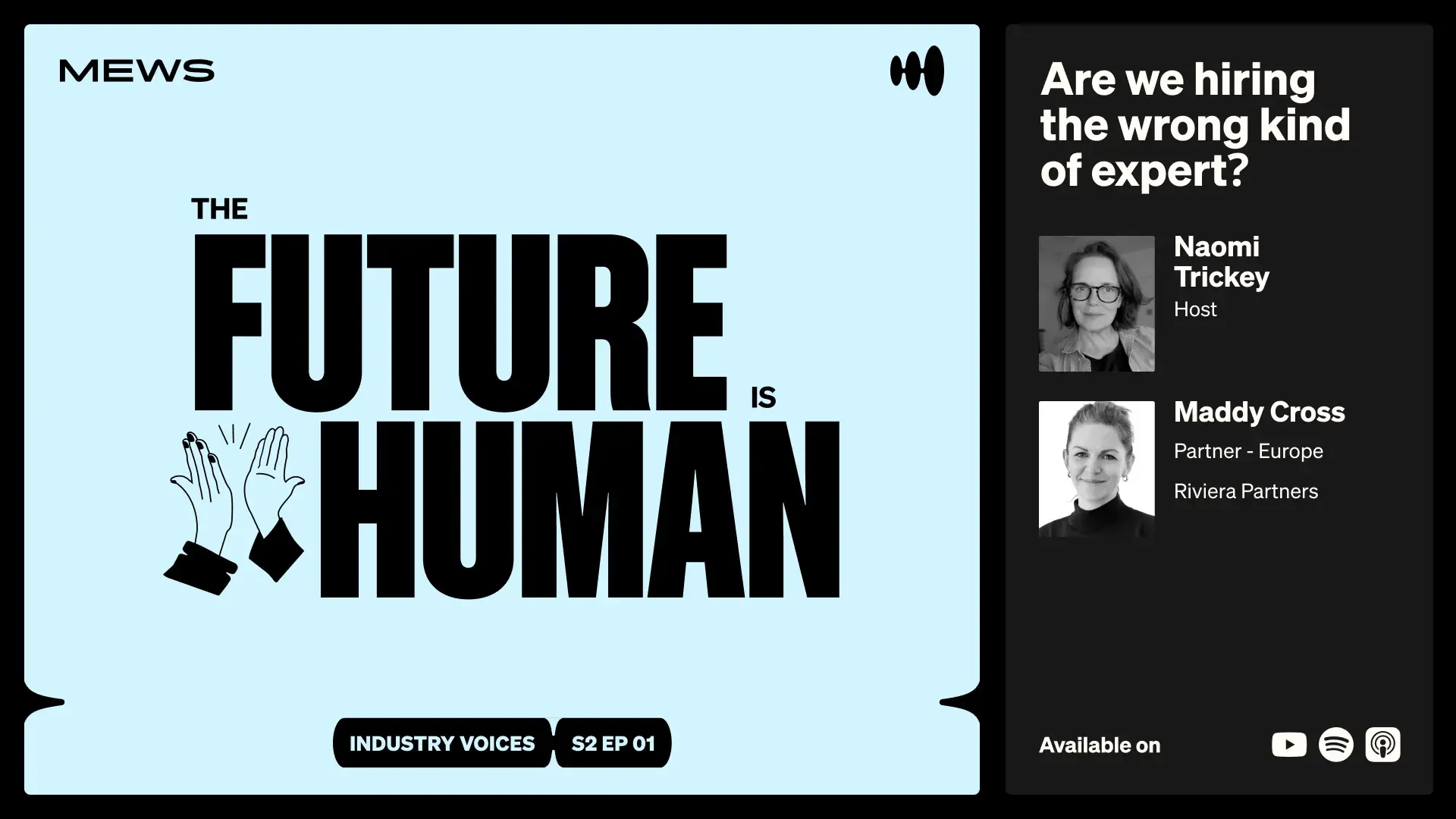
In this episode of The Future Is Human by Mews, host Naomi Trickey is joined by Maddy Cross, Partner for Europe at Riviera Partners, to talk about what great hiring really looks like when the old signals stop being enough. From her own winding career, Maddy has learned to spot the things that do not always fit on a scorecard: intrinsic motivation, range, conviction, emotional maturity and the “light behind the eyes” that tells you someone actually wants the work.
This is a powerful reminder that it’s still the most human moments in a search that decide everything.
Transcript
[00:00:01] Maddy Cross: We want someone out of Anthropic. And I get it, I get it, like, I fully understand why you want someone out of Anthropic, but Anthropic didn't hire people from Anthropic.
[00:00:12] Naomi Trickey: Welcome to the Future Is Human. I'm Naomi Trickey, and in this podcast I talk with leaders from tech and hospitality businesses about how both they and their people are navigating the edge between humans and technology and an increasingly automated environment. We break out of the mould of a standard business conversation to hear more informal perspectives and reflections, to understand what people are really feeling about the future of work.
[00:00:41] Naomi Trickey: Welcome to the Future Is Human. Today I am joined by Maddie Cross, who is a partner for Europe at Riviera Partners, which is one of the world's leading exec search firms. And you specialise in technology engineering, product design, leadership, but you've actually had a really interesting career, which hopefully we'll talk a bit more about. But you spent a lot of time helping founders and boards and investors hire people who shape their futures. But also, you've been a civil engineer, and you became a marketer inside early-stage tech companies. When we first met, actually, you were working in venture, in VC, venture capital and doing a lot of analysis work, so. But I think maybe you feel you've eventually found your calling in talent. I don't know. And so I think we're going to have a great conversation today. Welcome, Maddy. Glad to have you on the show.
[00:01:33] Maddy Cross: Thanks for having me. This is fun.
[00:01:36] Naomi Trickey: Yeah, I hope so. So, I want to start with you really, before we talk about what we're seeing in the market, because I think, like I said, your career is an interesting one. So, civil engineer, marketeer, talent director, analyst, exec search partner. Did you plan your career, or did each move just sort of make sense?
[00:01:58] Maddy Cross: Oh, no, definitely didn't plan. I don't think you could plan for that, though. It's all been quite a strange path, but there have definitely been connections between each thing. So, the engineering into marketing seems a bit crazy, but it actually made sense at the time because I graduated in Civil Engineering in 2005 and took a bit of time just to travel and stuff. So, I started looking at jobs in 2006, and that was about the time that Google AdWords and kind of programmatic marketing, or as it was called then, performance marketing, kind of landed in Europe. And so, there were a number of companies out there for the first time really looking for people that could do marketing that were technical or sort of STEM-based by background, basically. And so I went to see a recruiter and kind of said, “Oh, you know, I graduated in engineering, but I don't think I want to be an engineer.” Like, basically, what have you got? And they said, “Oh, we're speaking to this startup actually that want engineering people that are open to do marketing to help them figure out how Google algorithms work for advertising.” And so I was like, “I'll go and speak to them and see.” I have no idea what that is. And so I kind of stumbled into it, but that was my route in. So, it's very maths, the marketing off the back of engineering. So, not an obvious fit-at-surface value, but it certainly felt like quite an easy transition at the time. And so then I did marketing for about 8 or 9 years and went to do an MBA. I had the full intention of going through an MBA and then continuing to be a marketer after the MBA, but actually what happened was that, towards the end of the MBA, I was thinking about what marketing jobs would be interesting to me, and I just wasn't that excited about any of them. But through that, I was approached by a couple of different venture funds to be a marketing leader for their portfolio companies. And the people that approached me were the venture talent people. And so I was speaking to those people and main takeaway for me was like, I actually don't want to do marketing, but I would love your job. This seems really fun, which was a huge leap of faith. And so, I had met the Notion Capital team during my MBA, and about the same time that I was graduating, they were looking for a talent person, and they asked me, like, “Oh, do you know anyone?” And I kind of said, "Oh, well, actually, as chance would have it, that's a job I would absolutely love.” And of course I kind of said, “Oh, but you've never done recruiting or HR talent of any description.” And I was basically like no, I'm really passionate about it. I feel very strongly that people topics are kind of the make-or-break for high-growth businesses. And so I wrote them kind of a business plan of how I would think about the role and they said yes to that basically. And so that was my leap of faith for me and for them into venture talent. And so I spent four years with Notion doing talent and portfolio companies of venture-backed businesses, which is originally how I met Matt and Richard from Mews and obviously then you as well. And then because so much of the work of talent within a venture fund is headhunting leaders for portfolio companies, I then joined a search firm and then moved to Riviera. So, there's been really one big career change in my life, and that was from marketing into talent and executive search.
[00:04:55] Naomi Trickey: In terms of the way you describe it, there's been a certain amount of hustle, which I love. I'm a big fan of the hustle, and actually I was going to ask whether breadth was ever a disadvantage in that regard, but it sounds to me like the breadth of experience you've had was advantageous in terms of sort of fueling that hustle. Is that fair, how you look at it?
[00:05:16] Maddy Cross: Yeah. Breadth has never been a disadvantage, and I would say, like, now it's an advantage for sure, because when I'm running searches, I've been in other jobs where I was the hiring manager, working with a recruiter. So, I completely understand that the person doing the hiring has got so many other things on. And I think particularly coming from the venture lens, where I've had so many conversations with founders about hiring, but also about other stuff. So, I know exactly how much other stuff they've got on. So, I never come to a new search thinking, “Well, this is the most important thing that the founder is going to do with their next two or three months.” Like, it might be, but it probably isn't. And I have, I think, quite a healthy view of having seen the other side of that and just understanding, like bluntly how much stuff they have to do that's not that. So, that’s definitely going to be helpful. I think where the breadth has been a disadvantage and more that when I've switched things. So, marketing into venture talent and then venture talent into headhunting, which was the second one, was a much more natural progression, but it was still a change; it's less the breadth that's been a disadvantage and more just, like, not actually having the tactical knowledge of how to do the job was very hard. And I think the ways that I got around it at the time were like, bluntly, just working really, really hard. When I joined Notion and then when I joined a search firm, Arvina, at the time, I'd never worked so hard. I worked all the time to get myself to a level that was kind of commensurate with my peers, just on tactical stuff. And that was really difficult. And then I think the other bit was able to do it. And that was kind of what got me over the difficult parts of it. And then the other part of it was just intrinsic motivation. I think I've never made a career switch I didn't really want to do, because I think if you don't really want to do it, you're not going to be able to work hard enough to pull it off, nor are you going to be able to carve out enough time from your life to do, like, background reading and general networking and all the things you need to do to get yourself to the level that means you can kind of compete in that space and value the career move. So, it's basically those two things. Yeah, like intrinsic interest and motivation and then just, yeah, like working really hard for like a year each time.
[00:07:21] Naomi Trickey: But those are also skills, right, that I can imagine the people that you are now helping to hire, you're also looking for. Right? Certainly, intrinsic motivation is something that I look for above and beyond any particular competence. Because I think if someone's got enough intrinsic motivation, they can probably learn it, right, whatever it is that I want to know about, I think.
[00:07:43] Maddy Cross: The inner engineer in me, whenever I'm starting a new search, we'll always have a scorecard. We're quite structured. We have a scorecard of what we're looking for in the questions that we ask candidates, but also the answers we expect from candidates for the candidate to be a good fit for the job. This is something that you can't put on the scorecard, which is just like, what's their light behind the eyes? Like, when I ask them, how do you think about developer tooling and developer productivity, as an example. If the candidate doesn't kind of come to life and explain real-world examples and show an emotional range, I just don't think they're going to be the right person for that job. But you can't put that in a scorecard beyond just telling the client, the hiring manager, the founder, like, by the way, this is a scorecard. I'm also looking for the candidate to really come to life. And if they don't, you know, I think they're probably not the right person for you because without that kind of, what's the point in any of it? Everyone in the industry that we work in, and certainly everyone that we speak to, is smart enough and well-networked enough to go and do any number of different things. So, if they're going to pick this one thing, they have to enjoy it because otherwise what's the point? And so, if I'm speaking to a candidate about what they've done in the past and there's no light behind the eyes, it's not only that I think they won't be a very good fit for the founder that I'm interviewing them on behalf of. But it's also like, I just don't think this is the right job for you. Go and do something that you're going to love because you could do anything.
[00:09:04] Naomi Trickey: I love that. And I think that sort of joy is something that is often not discerned enough in the interview process. So, let's talk a little bit more about the how. When you were at Notion Capital, you published the Unicorn Trajectory, which was a very often cited report on how high-growth startups actually hire and the kinds of people that they hire. Through that research, what did you find out about whether the best companies were hiring specialists or generalists? And has that changed since?
[00:09:38] Maddy Cross: The consistent thing between the people that unicorns hired versus companies that were not so successful, companies that did not become unicorns, who they hired, is that unicorns had a much better diversity of backgrounds, so academic backgrounds. Unicorns hired more people with degrees from top universities; they also hired more people with no degree, and so they had a much wider spread of backgrounds, similar with the years of experience. So, unicorns typically had someone in the leadership team with more than 30 years of experience, but also someone with 4 or 5 years of experience. Companies that didn't do so well didn't have that breadth. And so, when we look at successful hiring patterns around specialisation versus people that are more generalist, you typically need some of each. So, you might need, for example, a generalist ops and finance leader who’s a true Swiss Army knife, and I don't use that phrase like that. I don't love the phrase - I'm a startup Swiss Army knife. I've met very few people in my life who actually are that, but I have met enough to know that it exists. And so you might want one of those people that can just turn their hand to anything. And then if you're a deeply technical business, for example, turning research into products, you're probably going to need a few PhDs in there, like bluntly to do that specific thing that you need to research and then take to market. But having the mix of people is the most important thing. And I think often where businesses get this wrong is around two specific axes, which are academic background. So, like, everyone that we hire has to come from a top university. I don't think that's ever necessary. I think it's great; I don't think it's necessary. And then the years of experience, the thing I mentioned before, so I often encounter businesses that won't say, “Oh, we don't want anyone older on the leadership team”, but they will reference the cultural, quite youthful culture. So, we want someone that's going to fit into that.
[00:11:24] Naomi Trickey: You don't need to read between the lines to understand that, do you?
[00:11:27] Maddy Cross: No one need to read between the lines. Exactly. Some of the businesses that have become really successful, they often have someone in the leadership team that has decades behind them and the most famous example is Eric Schmidt going to Google. Larry Page and Sergey Brin, I think, at the time had like 2 or 3 years of experience between them. And Eric Schmidt had, I think, 25 years behind them. They did an all right job. And then when you look at more recent examples like Monzo had someone in the leadership team from quite early who'd been quite senior at the SCA. And so that person brought with them decades of experience of how to build a bank, essentially. But often when you think about the founders of Monzo, kind of the headline, younger founders are the people that get cited, which I completely understand. But they weren't doing it alone. And I think that shouldn't be overlooked. The diversity of experience, like the most important thing rather than any specific set of experiences, it's having different people with different experiences and different voices in the room that can get the best possible outcome.
[00:12:21] Naomi Trickey: Is there a difference in terms of how you hire these different sorts of people, whether it's a specialist or a generalist?
[00:12:28] Maddy Cross: I think the same rules apply for any job which are that you need to be really clear. With any stakeholder that is going to interact with the person that gets hired frequently, all the stakeholders need to be aligned on what the most important characteristics or experiences are for the person. And sometimes those experiences are quite generalist. We hear a lot about the founders associate job title and chief of staff obviously is becoming something that extends just beyond doing sort of specific projects for a founder, but actually in some cases running whole parts of the business versus like very specific things like VP Infrastructure as an example, which is a very specific skill set. But the most important thing in any hire is really that the people that are going to be interacting with that person the most are clear on what they want that person to do. And sometimes if it's a generalist hire, that thing will be we want them to be really good at figuring out stuff that we don't know what it is. That's okay, but then everyone has to be aligned that's a generalist hire. And so, all the candidates they're going to meet are going to come to the table with a completely different skill set. But then it's about understanding, like how does that person prove they're really good at figuring stuff out.
[00:13:33] Naomi Trickey: That alignment piece is so critical in the hiring process and is where it always goes wrong, isn't it? So, let's kind of go into that a little bit. You've worked with companies from early stage through to IPO, right across the gamut. And what's the most significant shift you've seen in what organisations actually want in a leader? Not what they say they want, but what they're really selecting for. Is it the generalist-specialist shift, or is it something else?
[00:14:04] Maddy Cross: I think it's talking sort of just about engineering products and data here. I think it's about seniority of the person and how that relates to the skill set. So, if you went back 5 or 10 years in a typical enterprise-facing software business, for the sake of argument, the average VP of engineering in, like, a Series B, C business would have needed to have managed 50 to 100 people in, like, a levelled org. And typically, people that have managed that number of people would be two decades into their career or thereabouts. So, you're looking for someone that's got a certain amount of reps behind them, just peaks and troughs of the economy, like different phases of tech, company growth, all that stuff. So, they have a level of maturity that requires them to be able to manage that number of people and be in that job. And that level of maturity also gives them a great tool set to push back on clients, to push back on founders, to push back on the board, to do all these other things that are kind of a core part of that job. What we typically see now is that you can get so much more done with smaller teams. Like a VP of engineering in a Series B, C business could probably get as much done with 10 people that 10 years ago would have taken 100 people. And so that person doesn't need so many reps behind them just to manage the team. To manage 10 people, you can actually do a reasonably junior level. But what that means is then they don't have the emotional maturity always. Sometimes they do, but for the most part they don't have the emotional maturity, the confidence, the reps to be able to successfully and constructively push back on the board, on customers, on founders, etc. And so, we often see now founders coming to us saying, “Oh, we want a VP of engineering who's like at the bleeding edge of AI, who's super in the detail but can also manage the team.” That's great. We know those people. We can find you those people. Just so you know, they can't have enterprise client conversations because they've never done that, and they don't know how to do it. So, we can find you that piece. There's nobody out there that's done both of those things. So, if you're really looking for the bleeding-edge person, we can find you that, but we think you're probably looking for the person that can manage the bleeding-edge person.
[00:16:10] Naomi Trickey: Right. And is AI the thing that is accelerating that, or is that sort of move towards the cutting edge? Regardless of AI?
[00:16:20] Maddy Cross: AI has definitely pushed it forward. I think the other thing that's pushed it forward, which is a slightly longer-term thing, but like, I graduated university in 2005, so just over 20 years ago. Back then, it was like cool to go to Goldman Sachs and McKinsey. Like, startups were like not a thing. Now, obviously, if you're graduating from university, it's pretty cool to go to a startup or a growth-stage business. That's very normal. And I think as a result there are more generalists out there that want to join high-growth tech businesses. People that have maybe graduated from university and gone to an investment bank or gone to a consulting firm for a handful of years and now want to go into a startup. It's cool now, and it's well paid now as well, and it never used to be. So, I think there's those two things in combinations. Career path changes in combination with AI have shifted the way that both talent looks at careers, but also what jobs are available for people that are intrinsically motivated and dedicated.
[00:17:16] Naomi Trickey: Yeah. It's interesting that, isn't it? Yeah. I never thought of myself as cool when, 30 years ago, when I graduated, it was sort of moving into a startup, but now, of course, we have all these expectations of these people. So, I just kind of waltzed in with my English degree and headed off to New York to work on West Broadway. And the experience and all the academic qualifications or the something you'd need to demonstrate to get to land that kind of role is just sort of off the charts, really.
[00:17:45] Maddy Cross: I think there's a certain amount of the bit chicken and egg, isn't it? Because I think if you went back 20 years, the types of people that went to startups, me included, were kind of almost like risk takers by design because it was a risky thing to do. My tolerance for career risk has always been very high, and I found myself in startups in 2006 because my tolerance for risk was very high. I remember joining this startup, the one where they're looking for sort of mathsy people to do marketing and a bunch of my uni friends were just like, “Have you lost your mind? What are you doing?” You know, I had an offer from BP to go and join the BP grad scheme, and I was like, no, I just feel like this would be the more fun thing to do at the time. Just completely unheard of, really. It's not such a risky path, and so I think there's a stronger filter that you need to put on people. What is your actual appetite for risk? Because the compensation numbers are higher, and yes, the job is probably slightly more secure than joining a startup was in 2006. There's still a lot of unknowns out there. You're probably going to get loads of training. It's not guaranteed they were going to be successful. These other things, like: are you sure? Because you could go and do something that's way more secure. So, there's definitely an element of self-selection now that was quite different to how it was 20 years ago.
[00:18:53] Naomi Trickey: Yeah, I agree with that framing and I see that all the time as a chief people officer hiring people. There is a lot of expectation management that you have to do, and if you do have experience of working in other sorts of environments, it’s having to explain that to people that these are different and you will get something; you will get some upsides, but there are also some challenges that you have to accept that come with it. So, let's talk a bit more about the roles that are being hired. In particular, I'm interested in your take on the product builder role. From what you're seeing in searches right now, is the product builder a real thing? Does it reflect the reality of hiring, or is the market actually still hiring specialists and just talking about more generalists? The generalist position. So, the avoidance of doubt, the product builder idea is one where product design and engineering sit under one role, supported and enabled by AI and technology in general. So, is it what people really want, or is it just lip service at this point?
[00:19:58] Maddy Cross: I don't know if it's lip service or if it's what people really want. But like I know obviously you guys have made a shift towards product builder, which I think is really cool in terms of it seems to suit you as an organisation really well. I think that's what we're seeing more and more is like less that, actually, let me wind this back. If you went back 5 to 10 years, there were playbooks and B2B businesses for everything. Like, there was a go-to-market playbook, predictable revenue, Aaron Ross and Jason Monk and the book that everybody had there was Silicon Valley Product Group for product stuff. Like, there were all these ways of, like this is how you build a software business. There are some small variations to how each business does it, but like, this is how you do it. 2026, like, there isn't a way to do it. Like, there just isn't a way that like the businesses that we're seeing that are most successful know what they want to do and get conviction around how they're going to do it. They try it; maybe it works, maybe it doesn't. If it doesn't, they switch really quickly and do it in a different way. And I think the businesses that are doing really well now are brilliant at ignoring what else is happening in the world and just going like this is what we want to do, so we're going to do it. For example, the ElevenLabs org structure. I won't spend too much time going into detail on it because it's not really my place to talk about the ElevenLabs org structure. But it's not conventional, it's not conventional at all in terms of how they have levels of management, who's reporting into who, location of people, responsibility of people. It's not a standard org structure. They've done so well, and from what I understand, they review it every kind of quarter and make sure the org structure is still working for them. If you picked really any high-growth tech organisation that's been founded sort of in the last few years, or that's similar to me, who's had a reorg the last couple of years, every single one of them will be doing things in a different way to the other, and every single one of them would have had to have got high conviction across the leadership team of, like, this does not seem like a sensible thing to do, but for us right now this is the right thing to do. And that's basically what we're seeing is rather than finding engineering product data leaders that have got the playbook and have done things in a certain way, we're seeing more engineering products and data leaders who are saying, like, “This is how I've done stuff in the past, but I don't think that's right for now.” I can cherry-pick my experience and apply it to this setting, but it's not going to be the same.
[00:22:18] Naomi Trickey: I love them. I read a while ago now about this idea that if you want to succeed and do the same thing as everybody else, you're never going to differentiate yourself. It's like a truism, but it's true. And so, actually, that need to, playbooks don't really land so well anymore and if you work in this sort of environment where I love that point that you made, that they review their org structure every quarter, like wow, that's an interesting cadence. Right? You would never have seen that before. So, that sort of agility and flexibility applies there as well, I think. So, things like job descriptions often tend to fall behind reality. I don't know if they even exist really as a thing anymore. To the same extent, I think they're different. They're evolving as well. When you're working with a founder or a board to define a role, how often does the brief they come to you with reflect the person they actually need versus the leader that worked with them 3 years ago? And when you and I talked a few weeks ago, you mentioned that you're basically no longer using CVs, how do you best assess someone in this context when you've got these kinds of various disconnects?
[00:23:38] Maddy Cross: So, we typically only use CVs where we do use LinkedIn. Like that's definitely something that we use, I think in terms of how we assess people. So, I think one of, probably, the biggest misconceptions about recruiting or headhunting in venture-backed business, but really anywhere, is just the amount of time it takes, the number of boots on the ground that you need. So, Riviera is about 250 people globally; we're 40 in Europe, of whom about 35 are actually doing day-to-day search, and that's across Europe. But we do, as the European team, do 100 searches a year. That number has gone up slightly. So, for the sake of argument, let's just say it's about two and a half searches per year per person. It's really not very many, and we work very hard. And so, even if you're a professional recruiter and you have your foot to the floor, you're going to do two and a half a year. And my reason for pointing out, in reference to LinkedIn, is that the reason it's so few is because we get so much information on candidates that we speak to; it is just time-consuming. There isn't really another way to cut it. Of course, we have loads of AI tools that we're reliant on. But equally, you just need to speak to people and understand what's important for them for their next career move. And you speak to them, and you ask them about what their career history is. And because we've got so many hours and hours of conversation on each person, we use their LinkedIn, of course, but we also have loads of notes to sit behind that for each candidate to really understand, like, who they are, what they've done, what they're motivated by, what their personal life situation is. I don't want to make that sound like we wouldn't consider someone for a job based on what their personal life is, but I might say, like, “Oh, I live in Zurich, and my wife's a doctor here, so we could never move because she couldn't retrain. So, relocation is not an option for me.” So, we have all that stuff that sits in the background. We don't use CVs necessarily, but we use LinkedIn. And then all of the hours of dialogue that we've had with each person that go behind that. In terms of when clients or boards or venture investors come to us with a role and we think the role is actually slightly different, I wouldn't say that's changed recently. That's a tale as old as time in recruiting. I would say the immediate needs of the role don't necessarily reflect the candidate pool or what's really needed, but we do a huge amount of work upfront at the beginning of the search. I think often when we work with new founders, they expect to meet candidates in the first few days of instructing us. But that's not what happens, because we need to spend a few days getting to know them, really understanding what the role is, where the company is, and how that will land with candidates before we can actually start calling people about the role. So, for us, it's really important to understand as much as we can about the company, the role, the founders, before we start looking for the right person. Because what we typically find pretty much in every search is that there's something that the founder or the leadership team think they need that they don't really need, or there's something that they think they need that just doesn't exist, or there's something that each of them thinks they really need that the other one doesn't think they need. The alignment piece is huge. I mean, we've talked about it already, but the number one biggest reason that hiring falls apart is because the stakeholders on the hiring side are not aligned. And so, I don't think it's the case that there's really anything that's changed with AI or changed in the last few years about what's needed out of a role versus what candidates want to see. But aside from probably the thing I talked about earlier, which is where VP engineering candidates, as an example, are typically less experienced now than they were, and that can cause some problems with stakeholder management stuff. But the process for us remains the same: we have to have the tough conversations up front in the search where we push back, we understand the business, and where we get all of the hiring panel aligned before we go and look for the candidate. Does that answer your question? That was quite a long-winded answer, but I hope that…
[00:27:12] Naomi Trickey: No. No. It's a great answer in that herding cats technique that I think I identify with the need for very much. The kinds of people that you're bringing in, the kind of roles that you're hiring for, two and a half years. Half must be interesting. You're talking about quite senior leaders. And one of the things about senior leadership is that you're sort of almost generalist by default in some ways because you have to operate across multiple domains. And that's certainly what's expected of the leadership team. At Mews, I don't get to duck out of conversations. I interview CFOs, or I sit in on quarterly business reviews as well as all the people stuff. How do you assess someone's capacity to be that kind of generalist? How do you assess their capacity to operate across domains like that?
[00:28:03] Maddy Cross: I hate myself for this answer. It does completely depend on the job. There are some domains that we work in where there's just really limited flex, like cybersecurity and fintech. Typically, EPD leaders need to have some experience in those domains to stay in that domain, so they're less generalist. There are others that have got way more background, but it completely depends on the role in the company. It all comes back to why we do the process up front. Because, for example, I'm working on a role at the moment that's like they're looking very much for a domain generalist. So, then rather than domain experience, it comes back to soft skills like communication, executive presence, commercial sense and team leadership. Talk to us about when you've taken a team through a transformation and how hard that was. Specifically, what did you do? How do you communicate with team members that are resistant to change? So, it just becomes a different set of questions that's still very structured versus if we're doing something that's not is quite narrow around domain like fintech, for example, it will be like how have you operated in a regulated business before? How have you traded off security versus velocity? Why do you enjoy working in a regulated environment? How do you think about scaling internationally when you've got consideration for cross-border payments, that kind of stuff? So, the short answer is everything still comes back to process and making sure that we have a really robust way of answering all of the unknowns in the role before we start speaking to candidates because then we can assess them properly.
[00:29:27] Naomi Trickey: Yeah. You know the questions to ask. The questions come from that determination, right? And we often talk as a leadership team about our favourite interview questions. You must have just had so many moments and collected so many great questions over the years. What interview questions or moments can you talk about that sort of genuinely reveal someone's range, someone's potential versus the ones that just reward preparation and polish? And this is obviously another sort of implicitly an AI question, isn't it? Because obviously we're all having to be very careful that we don't just hire someone who's very good at talking to Claude. Yeah. Familiar much?
[00:30:07] Maddy Cross: There's a lot of people out there now that are very good at talking to Claude, as they should be. They should all be very good at talking to Claude, but also at talking to humans. So, I think I have a few, like the team that I work with here probably laugh because they've heard me ask these questions a thousand times. The candidate always feels like I've just come up with that question.
[00:30:22] Naomi Trickey: Of course.
[00:30:23] Maddy Cross: “Oh! Here she goes again.” The one that I ask that's my favourite is because it gives the candidate time and space to really tell me what's important to them, but also genuinely can uncover some really interesting things about them that they haven't necessarily been able to answer in a specific question, which is just: if I'm going to put the perfect job description in front of you, what's on it? And if they mention stuff that is explicitly not on the job description for the role that we're talking to them about, I will then tackle that head-on. And it might be that they say, “Oh, that's the perfect job. But I love all these other things about this job, and so I really don't mind giving up on that one thing.” Or it might be that they say, “Oh, actually, yeah, that thing is actually really important to me.” Obviously, there's a lot of grey area in there around, like, we're also not looking for people that will join a business and on day one, come in with big opinions and big ideas without really considering where the business is. But we're looking for people that will say, like, “I'm going to join. I'm going to spend 3 months talking to people, observing, understanding what's happening, and then I'm going to weigh in and explain what I think needs to be done, and I'm going to make sure it happens.” The question around, like, who's going to be telling me what I'm doing or in any format of that for me would be like, I think this person's not at the level that we need them to be at for this role.
[00:31:35] Naomi Trickey: Wow. Just the luxury of someone telling you what to do is not a thing, is it? Especially if you go back to your point about intrinsic motivation. Right? It's that you can't be held back when you get to a certain stage in your career because if your experience tells you anything, it's what needs to happen here. And that's literally what you're hired for.
[00:31:56] Maddy Cross: Totally. And look, I've met some brilliant people who've asked that kind of question in these situations. So, I don't want it to sound like if people ask me that kind of question, I just think they're rubbish. I think you're probably not ready for leadership because that's not, in our view, what leadership is. But you may be a brilliant team manager, individual contributor, and further down the line in your career, you'd be an amazing leader as well. But you're not quite there yet.
[00:32:17] Naomi Trickey: Yeah. Super interesting definition of leadership, actually. Have you ever hired someone who looked unconventional, or even looked conventional on paper, but turned out to be transformative, that there wasn't what you expected them to be, basically, and what was it that you saw in them kind of triggered you to hire them?
[00:32:34] Maddy Cross: Yeah. So, I think I maybe don't want to talk about any specific examples of people because I don't want to embarrass any people. But I did do a CTO hire for a fintech business, and the slate of candidates was all really scaled fintech, really impressive people in payments, fintech, cross-border transactions, etc. And the person that I hired into that job did not come from that background but did come from really high-volume transactions. So, gambling, original background and then some other consumer stuff interspersed with B2B. So, the person knew how to run a B2B engineering organisation. They also understood volume, and so they didn't have payments experience; they had big parts of the skill set needed for the payments fintech domain without actually being a specialist in that. And because that organisation already had a bunch of people with like very deep domain expertise, that person really complemented them well. I'm trying to think of any other examples where the answer was just not obvious. Yeah. So, I did a hire quite recently where the person was commuting from San Francisco to Berlin every month for a week because he thought that would be a really fun and exciting thing to do. And I think sometimes we will speak to candidates and we'll say, “Oh, you know, like the role is in Berlin, would you be up for a move?” And they'll look at us like, “No, of course not. I'm not going to move to Berlin.” And like, we're asking because sometimes people say, “Yeah. Great. I would love to be in Berlin one week a month.” I personally would never be that person. I don't want to live on the other side of the world a week a month. But having an open mind to what the solution is, I think, in this job is critical in asking the question anyway. Even though, like, 9 times out of 10 the answer will be like, no, it's not for me. But the one time out of 10 that that is the answer is super powerful. And so I think it's worth keeping an open mind. Sorry, Naomi, this is a terrible answer to your question. I can't think of anything where I can actually talk about the person.
[00:34:30] Naomi Trickey: That's totally fine. I totally get it. I think your point about being open to the possibility, because what it's about is deep empathy. What is required of you is deep empathy to understand the other person's perspective and not presume the other person's perspective and the other person's decision about their lives.
[00:34:51] Maddy Cross: And also understanding that you don't know the person that well either. Even when you know candidates really well, you don't. And actually I'm not just saying this because it's you, but Mews is one of the businesses that have done by far the best of putting people into leadership that on a profile or on a CV would never have been on the long list for that job.
[00:35:07] Naomi Trickey: Yeah. It wouldn't be a podcast in 2026 if I didn't ask you a question about AI specifically. There's lots of debate about whether AI is going to transform exact search in general, as well as exact search with data and predictive hiring and better matching and so on. Does it help, or does it optimise for the wrong thing? And what do you use it for?
[00:35:28] Maddy Cross: So, we use it for kind of every part of the stack, basically. So, we use it to uncover new candidates. For the most part, we know the candidate landscape very well, but every so often, obviously there'll be candidates that pop up that we haven't met before. So, we use it for that. We use it as a note-taker to write up interview notes. We use it to draw insights across multiple conversations. So, with clients, with candidates, we can obviously use AI to understand how patterns have changed, how sentiments change, all that kind of stuff. So, we use it for every element of the hiring process and it's extremely useful, but it kind of lends itself, I guess, to different challenges. So, rather than making this job easy, which it is definitely not, it's created, now, questions and challenges that basically weren't there before, which are expectations around candidate volume. So, I think, again, if you went back 4 or 5 years in pure headhunting, so executive leadership search, the average founder would expect to meet 4 people, maybe, in a search process. Now, the expectation is many more because there's the “Oh, but you've got tools that can do this really quickly.” So, presumably you'll be able to meet sort of 12 to 15, which gives us the issue of, yes, you might think that, but there just aren't 12 to 15 that have done a job like this. There literally are only 6.
[00:36:44] Naomi Trickey: Yeah. AI hasn't created the people.
[00:36:46] Maddy Cross: Exactly. AI hasn't created the people. So, we can find them and annotate our notes on them more quickly. We can't make more of them. And so, that's definitely a thing that we have to be conscious of. I think going into research, and we understand it completely. Like, if you're a founder coming to this, of course you want to meet more people. It's a huge decision. You want to make as many as you can. I completely get it. I just aren't certain in Europe for the average job. That many people out there. I think ultimately, like what we do is still very much a person-to-person business. And I think where search firms, not just Riviera, but any search firm really adds value and almost more value than ever really is around the kind of the emotional side of it. So, whenever I've made any leadership hire, and I'm talking about leadership hires with candidates that are extremely experienced, they've done this multiple times before, they often are no longer working for money because they might have had a few exes. So, finances don't matter to them, give or take. There will still, in every single process towards the end, be a point where a candidate or a client wobbles right at the 11th hour as the offer goes out; the candidate says, "Oh, this just got real. I need to talk to my partner and figure out if I'm really going to do this.” You can't really replace that with AI. I'm sure we'll be able to in the future. But right now, the part where I am personally on high alert is that specific bit because Claude will not fix that for you. It has to be me, and it has to be one of my colleagues, it has to be one of us on WhatsApp, on the phone, over email, explaining different parts of the offer, the considerations that they should make when going into this. Like, the pros and cons of the role versus other roles, and the same thing on the client side. Should we really hire this person? Like, what kind of person do you want to work with? Do you like this person? Are you excited about them joining the business? Or there are all these other questions that just Claude could answer them, but I think the founder or the candidate would never think to ask Claude for the answers.
[00:38:48] Naomi Trickey: Yeah. And even if they did, the kind voice at the other end of a phone, as you're making a decision about how you spend in terms of these roles, it's often like 75% of your week. And so, as a human, Claude is helpful, but it's not supportive to the same extent in my experience anyway.
[00:39:11] Maddy Cross: And it often comes down to really like things that seem inconsequential, but for whatever reason they're quite emotive to the person. So, I'll give you an example. I placed someone last year, a really experienced guy, but he'd only worked remotely in the previous 10 years, like fully remote for 10 years. And he got the offer for the role. He was super excited about it, and the company hiring him was also super excited. But he said, like, “I didn't even think about how I'm going to get to the office. I actually need a car allowance, like, to drive to the station. It hadn't occurred to me, like, is that something I can ask for?” And I was like, “Look, I'm very happy to ask; is it a deal breaker?” And he was like, “You know, I think it actually is a deal breaker. Like, my day-to-day is going to completely change.” He could have afforded a car out of his base salary; that wouldn't have been an issue. But there was just something tied to that around the lifestyle change that he really felt like the company hiring kind of owed it to him to help him make that transition. And they offered it, he accepted it, and it was all fine. But it was one of those things where, like, intellectually that makes no sense at all. Financially, it makes no sense, but it just was important to him. And so, we had the conversation; I asked the question, and it all got sorted out. But if you went into a search trying to use Claude to ask it, what things typically come up? Like a car allowance wouldn't be one of those things. But it was in that case. And having a human on the other side of the phone to try and make that happen, I think, was very important in that specific case.
[00:40:35] Naomi Trickey: Yes. I mean, it's that how do you show the candidate that you care and it's for the candidate to share with you what that caring element, isn't it? And sometimes they don't know until right at the end, when the reality of the job offer hits. And maybe, it's about business class travel, or maybe it's about, I don't know, working from home more frequently than the company stipulates or something else, but…
[00:41:03] Maddy Cross: We're taking pets to the office sometimes, like, can I? But I really need to bring my dog to the office. That's the thing that comes up, too. And I'm like, fair enough. Like, this is a huge part of your life. I get it. I will ask the question.
[00:41:13] Naomi Trickey: I was once offered a job, or it was early stage in an interview process quite a few years ago now. And it was working for a pet food, a dog food company. And it was in Richmond, which is in the southwest of London, and I live in Brighton, which is on the south coast. And they were like, you could bring your dog to the office. I said, “Well, I do have a dog, but I don't think my dog wants to go to Richmond three days a week.” The clincher for me was actually being able to work remotely. Not that I could bring my dog to the office, even though I have a dog, and it shows sometimes you get it wrong, right? The recruiters get it wrong because they misread. Yes, I do have a dog. My dog doesn't want to commute. What are you talking about?
[00:41:56] Maddy Cross: I was down the train with a dog, just going, I just wanted to walk.
[00:42:00] Naomi Trickey: Yes. Exactly. Walk or sleep. I'm going to wrap up. This has been a super interesting conversation so far, but I want to end with a couple of quicker questions. What advice would you give someone just starting out today, someone who's been told to pick a lane, go deep, be a thing, rather than be more open to the possibilities that their career may bring them?
[00:42:24] Maddy Cross: Oh, I think just go on gut feel and intuition and I think money is kind of a dirty word often to people, particularly in England, around sort of career aspiration. And I don't think it should be. And I'm not talking about doing a job at any cost to make loads of money. I'm more talking about, like, if you want to have a certain quality of living, you do need to factor that in. Like, don't be afraid to factor that in and think about it and talk about it with your partner, your friends. I'm not saying, yeah, like, go and work all hours at an investment bank to max out your bank account. I'm more just like, it can be a deciding factor in whether you're happy in your career or not. So, at least factor it in. That's one. Or don't be afraid to factor it in. And then I think the other one is like, almost like the advice we're just talking about giving to founders around how they structure teams in their business. Like, if you have conviction about something, even if it seems to the onlooker to be a completely unusual way of doing things. If you have conviction about a career decision that you want to make or a career path you want to go down, take it, just do it, work hard at it, stay intrinsically motivated, like, then I have super high conviction on your behalf that you will end up in a place that you enjoy, even if it's a bit of a winding path.
[00:43:32] Naomi Trickey: Thank you for that. And your point about money is so well made. I often talk about the same thing. Don't be afraid to talk about money, especially for women. Actually, I think it's incredibly, incredibly important. So, great advice. Finally, what do you hope organisations will stop hiring for as well as start hiring for in the next, I don't know, few years?
[00:43:52] Maddy Cross: Recognition. We see many asks for, like, we want someone out of Anthropic, and I get it. I get it, like, I fully understand why you'd want someone out of Anthropic. But, a, people are not leaving Anthropic, and b, Anthropic didn't hire people from Anthropic.
[00:44:08] Naomi Trickey: They're hiring qualiticians, right?
[00:44:10] Maddy Cross: They're hiring from loads of different places. And OpenAI didn't hire people from OpenAI because they didn't have the choice. So, they hired for aptitude, skill set, motivation, all these other things rather than brand names on CVs, so keep an open mind for that. And you know, of course there are some brand names that carry a lot of weight and that carry an implicit experience as well, so it shouldn't be ignored. But don't look at brand names exclusively in favour of potential capacity, academic ability, all that stuff.
[00:44:37] Naomi Trickey: Fantastic. Brilliant advice. Thank you so much for your time. It's been a pleasure as always, and you will continue to be a friend of the Mews family, so we really appreciate your time.
[00:44:52] Outro: The Future is Human is brought to you by Mews, the cloud-based hospitality platform. If you want to learn more about what we do, visit mews.com and if you'd like to listen to more conversations like this one, find us on Apple Podcasts, Spotify, YouTube or wherever you listen. Subscribe so you don't miss future episodes. Thanks for listening.