What to expect?
We’re ending season one of The Future Is Human with the question that has been sitting under every conversation so far: what does it mean to stay human in work that is changing this fast?
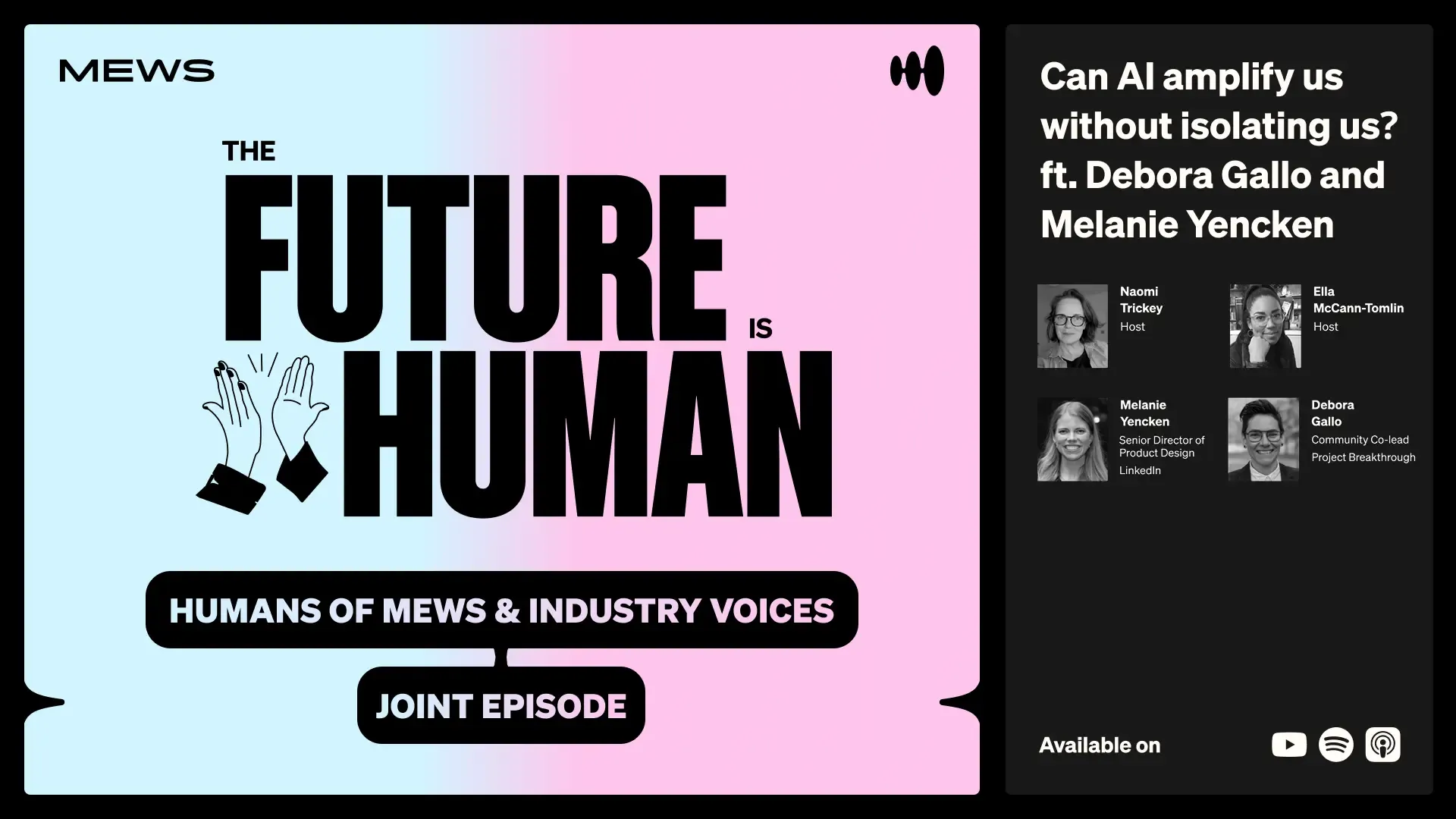
In the season finale, hosts Naomi Trickey and Ella McCann-Tomlin bring together two previous conversations with Debora Gallo and Melanie Yencken. Debora speaks from the deeply personal side of AI, where expertise, identity and connection are all being reshaped. Melanie speaks from the design and product side, where AI makes it easier than ever to build, but much harder to know what is actually worth building.
Together, their conversations ask what needs protecting as work becomes faster, more automated and more individual. The answer is, unsurprisingly but importantly, human: judgment, taste, empathy, agency, community and the courage to keep asking better questions.
Transcript
[00:00:01] Debora: One of the things that I struggle with most, and I don't think I've quite accepted it yet, is that whole notion of putting agents on your org chart and they're your colleagues. They're just algorithms that are running and, like I said, guessing the next words. Like, they're not my colleagues. So, I struggle with that. I struggle with this humanisation, this giving them these human characteristics and traits because I do think that that should stay with us, humans.
[00:00:26] Melanie: Now literally anyone can build anything, and so the only differentiator in product is gonna be, like, the level of quality, how much it actually solves the problem, the craft, the experience. But you were already seeing so many products that are just AI slop. Like, they all look the same.
[00:00:41] Naomi: We're ending season one the way we started it with a question we still don't have a complete answer to.
[00:00:47] Ella: What does it mean to stay human in work that's changing this fast?
[00:00:50] Naomi: We recorded two conversations this year that answered that question from completely opposite ends.
[00:00:55] Ella: Melanie named what needs protecting. Deb was having to lead people through the change while reckoning with it herself.
[00:01:02] Naomi: Different guests, different worlds, but they were actually pulling at the same thread.
[00:01:06] Ella: So, we thought, what if we let them talk to each other?
[00:01:09] Naomi: This is The Future is Human.
[00:01:13] Ella: I know for you personally, you have built your career around something that is changing really quickly. When did you first start to feel that uncertainty?
[00:01:22] Debora: I remember it clearly. It was this one moment. I was in Argentina for Christmas with my family, and my brother was there, and my niece was there, and my sister-in-law said something around the lines of, oh, my niece, she actually prefers to chat with her AI friend for a range of reasons and stuff. And I was like, what? Until that moment, I just hadn't paid any attention to it. I was like, oh, I don't have time. I'm too busy. I'm doing what I'm doing. That moment stayed with me. And then I came home, and I'm like, maybe I should try this out. So, I opened ChatGPT, which I hadn't used that much, and I just said, “Hey, ChatGPT. I've got a headache. What do I do?” And it replied, "Oh, maybe, you know, maybe you should go outside for a walk, and have you drunk enough water, and, you know, you've been working really hard and blah.” And I was like, oh my God. I wasn't shocked at what it said. I was shocked at the feelings that it conjured for me. Like, what came up was that I felt heard. I felt listened to. I felt like, oh, it's a friend. And that shocked me that I could feel those things from a machine. I was like, oh, holy moly. Like, I can't control that. That just happened. And this is dangerous. This is exciting, but this is scary. And, like, I just didn't know what to think. I think that was the moment for me, like, okay. I need to look into this. This is something different to what I've come across before.
[00:02:43] Naomi: I think what's really interesting, and what's formed as a component of our conversations in the past and now, really, is that you are a very strong advocate for design to have a seat at the top table. So, it's not just design because branding matters or anything like that. It's actually at the top table. And I'm really interested in how you think about that. What does it look like for design to influence not just interfaces, but business roadmaps, ethical decision-making, and so on? And in what ways is this new sort of AI-led world affecting the need for design, like a need for design to be sat at that table?
[00:03:22] Melanie: So, I think the way that this is done effectively is where design is set up to be a true partner with product management and engineering, and the roles between those three functions actually get quite blurred. And that's what we're seeing with AI. And design, instead of just being responsible for the mocks, the design of the UI is acting as a facilitator for product and engineering to, like, more deeply understand the problem, to partner with research, and, like, really get close to what is it that customers are actually doing, what do they care about, what are the problems that they're experiencing, and being the voice for that in those discussions. And then creating this sense of design thinking, which is essentially that customer obsession, and then using creative problem solving to explore what the potential options are, using the other functions as an extension of that, like actually bringing product engineering along with the process. We used to do that pre-AI. We had design sprints. We would, like, bring everyone together. We would go through this whole process. It's like, AI is definitely changing how we work even more, but getting a seat at the table is earned - earned by showing that you actually understand the business, and you're able to translate customer obsession into business impact. And this is where I've definitely seen some designers fall short is that they don't speak the language of the business and turn what their idea is into, like, "Hey. This is how solving this problem can actually help us achieve whatever goal it is that we've set out overall.” And that's where more partnership with product management can be extremely effective because they're much more likely to already be speaking the language of the business, understanding, like, how we were able to improve a certain metric or whatever it might be. And so, I've seen design get a seat at the table by proving that they should be there and then having other people say that they have to, inviting you there and actually saying that it's essential to have that, to actually create a great product that will help us deliver impact.
[00:05:23] Naomi: Has it changed how you think about creativity, having to demonstrate that business value and reshaping that narrative?
[00:05:32] Melanie: It's like, what is creativity? You know, you can make a creative, beautiful thing that doesn't solve anything, and then what's the point? So, like, I'm obsessed with creativity that actually helps a human achieve something, and sometimes the most creative solution is something that's almost invisible because it's just receding away and helping the user actually achieve the thing that they wanna do. And, actually, those designs are the hardest to make is to strip it back to what is truly just the most essential thing to get out of the way and help the person just do the thing they're trying to do, which is why I think, you know, we've seen a lot of move towards the chat-based interfaces, which we're just stripping down to having a conversation. Like, anyone can have a conversation, and now that's all you need to do to actually build product.
[00:06:22] Ella: What was the sort of next thing that you did? Because I suppose there's a, oh, okay, this is interesting. I'm gonna lean straight into this. Or there's a potential response, which is to pull back and go, this is scary. I don't like this. This feels anthropomorphised in a way that I don't like.
[00:06:37] Debora: No. It was at that point. It was like a sliding door. Like, you know, they go that way and go, oh, this is ridiculous, crazy. Oh, I don't wanna have a bar of it. Or, actually, let me just test this out a little bit more. And that's when I started going, okay, let me just try basic stuff, like rewriting emails and things like that. I'm like, okay, this is interesting. And then it just opened up the doors of what if I can create a training module? What if I could do this? And it just kept allowing me. It just kept enabling me to do all these things, and I'm like, oh, wow. Okay. Now I get the kind of, like, the hype. Now I get, and for me, it was, I can see the depth of my expertise, how I can amplify it. I'm like, I can do so much right now. All these things that I thought, like, were impossible, like, 20 years ago when I started my career, I was suddenly, you know, just doing it in an afternoon, and I was like, okay, everything's changing. If I can do this, then others are doing it, then my profession and the stuff that I do at work is, I wouldn't say, in danger, but it's available to everyone. So, then that took me down the path of, okay, what is my role if I'm doing this? Everyone's doing this. And then I started learning on my own, and then I'm like, well, if I'm teaching myself and my job is to teach others, but I'm teaching myself, and I'm not relying on anyone teaching me, I'm like, wow, that's interesting. I don't need people like me anymore. So, yes, it's been kinda like a roller coaster of realisations, of ups and downs. In terms I think the piece that is consistent across the bottom, and what my previous experiences have, I guess, given me is that resilience to keep trying and to keep kind of, like, moving forward. And that's what I've noticed is that when I engage with AI, it can be very easy to just go, oh, this is rubbish, and just, like, I don't have time. But there is a tenacity. There's a willingness that I keep trying. I keep trying. And I do think that comes from, like, all the past experiences. There's another element of wanting to be the driver, wanting to be in control of this, and I think those experiences also, you know, that comes to the surface in what way can I control this situation? In what way can I have some agency here? Like, how can I be the one who's driving this instead of this driving me? So, I think, from that perspective, it's what comes through for me. It's like, okay, so, how can I use this for my benefit? How can I drive this? How can I be the one who's leading instead of it leading me? Which is, I think, the thing that we struggle with because a lot of times, you can just kind of, like, let yourself go with it and just go with the flow or not really challenge it much, if that makes sense. I do think about that a lot. Like, I question myself, like, how much of this is me, and how much of this is my thinking, and how much of this is the machine just regurgitating the stuff that it has learned? And I think for me, I try to put a little bit of space in between, like, this is what I tell myself is, okay, stop, stop a little while. Just think, okay, how would you do this without AI? Okay. Like, what do you really wanna get out of this? Or what is it that I know? Like, okay, bring that in instead of just going in blind. So, I think there's that piece of I know what I know, and I'm very confident that I know what I know, and I wanna keep using that. And I'm confident that what I know is, you know, it's really valuable. So, reminding myself of that and bringing it to the forefront. But then at the same time, there's this other element that I do question, like, what is my craft changing? And then I'm like, yeah, it is, actually. I'm developing other skills, and my craft is changing. The profession is changing, and that's also scary and exciting at the same time. So, I'm like, okay, great. The way that I think of that is, okay, let me shape this. Let me shape the type of, you know, L&D, Tundra person that I'm becoming. Like, let me, again, be in control. I think there's something about being in control, but let me jump in and direct this, and I'm the one who is actually shaping and creating the new version of what a talent development leader looks like or what it means to use. I am what it looks like. The constant struggle for me is being in control. I think it's becoming key now.
[00:10:46] Naomi: So, I guess that does beg the question: why it was important to you that this work was, maybe, you don't define it as design-led, but I hear it as a design-led initiative. And we've got product builders, for example, at Mews, and they're often engineers predominantly. Why do you think, if we think about the broader context of human skills that can't be replicated by machines, why is the design skill set a really critical one for you, do you think, still?
[00:11:17] Melanie: Yes. Yeah. If we just focus then, like, what are the critical skill sets? So, if we look at the whole product building process, the things that I think AI is gonna be the hardest to replicate. Maybe eventually with superintelligence, it will. But right now, it's still very much human required is, like, the ability to create vision, the ability to have deep empathy and understand a problem, creativity, and then, I think most importantly, judgment and taste. I think AI has come a lot further in the last year in terms of taste, but still, it's like the things that it comes up with, we go from zero to a million, and then what you're doing with AI is, like, how do you chisel it down to something that is actually the right thing to execute on? But I think, really, it's about, like, the soft skills, like communication. So, if you think about what you're actually doing at work to make things happen, the actual building or designing is, like, one part of it, but what actually makes things happen is the ability to navigate internally, to convince people, to get alignment, to resolve conflicts. It's like these important soft skills around influence, emotional intelligence, conflict resolution, just negotiation skills. Even if we have AI that we're able to delegate a lot of our work to, we're still gonna work in a team. We're still gonna work with other humans. And so the ability to navigate with each other, I think, is still essentially this human experience, and that's still gonna be the most fundamental thing that we need to be effective, even if we have 10 different AI agents that we're working with at every moment.
[00:12:49] Ella: And then there's a school of thought that is like, ignore it. It's a bubble. It's not gonna be a thing. Or maybe it will be a thing, but it won't have all of this power that we're sort of imbuing in it. And we have the power to say, no, I'm not interested in that. That seems to be the sort of binary discourse. I think some of those conversations are being treated as visionary, but I'm interested in what your view is on them.
[00:13:15] Debora: I do struggle with that. And one of the things that I struggle most with, and I don't think I've quite accepted it yet, is that whole notion of putting agents on your org chart, and they're your colleagues, and my colleagues are all these agents and stuff. And I'm like, no, they're just algorithms that are running and, like I said, guessing the next words. Like, they're not my colleagues. So, I struggle with that. I struggle with this humanisation, giving them these human characteristics and traits and things like that, because I do think that that should stay with us, humans. That should stay on our side. It was funny because while I was in Dallas a couple of weeks ago, we were having dinner, and this little dog robot went past. And we were like, what is that? Like, and it had little eyes, and it had little eyelashes that were, like, blinking, and it got to part of the road where it couldn't keep going because there was roadwork happening, and it was just standing there. I was like, oh my God. The little robot dog can't keep going. Like, and we were all like, oh my God. The little, like, what's he gonna do? So, in a way, we were humanising it, and then it made me think. I'm like, we inherently want to humanise these things and have empathy, and I wanted to cross the road and help the poor little robot. Like, no. And then it just, like, turned around and went back where it came from. I was like, where's it going? And who owns that little robot?
[00:14:38] Naomi: It's kind of shifting how we think about all of our jobs, obviously. But from design, it's quite a deep shift, isn't it, really? And you mentioned earlier that you've been bringing on AI natives. And I imagine one of the advantages of bringing on an AI native is that you don't need to teach them that AI isn't just an add-on. It's a core component of design work. How do you go about shifting teams who aren't AI natives in that thought process? So, moving from thinking of AI as an add-on to treating it as a core component of design in terms of the material, the tools, the working practices, and so on. How do you affect that shift?
[00:15:20] Melanie: Exactly. So, I talked about a year ago. I think we had that AI on-site day where it started by, like, sharing my own personal experience of realising, like, I can't have my head in the sand anymore. Like, I need to be using all these tools. I need to almost be eye seeing myself as a leader to really be in deep empathy and understanding, like, what is the design process gonna change? How is it gonna look? And it's the most hands-on I've been, I'd say, for the last 10 years because I've heard a few other design and he designed VPs every single he feels like an intern. We're having to go back to the beginning, and if we don't get into detail, then how are we actually able to act as a leader and a manager for the team? And so that day, we did a lot of exercises where we had new tools that we had access to. So, we had done some pre-work to then, like, okay, let's try to replicate a design process that we've done recently, but let's do it instead using the AI tools, and everyone was sharing what they were working on. And we started that AI peer groups where we put people together, and they were meeting each week, basically saying, "Oh, well, this is what I tried.” This didn't work in this safe, small space of, like, three or four people from a design group. And then we set the expectation that they should be spending at least 10% of their time just constantly learning and trying AI tools. I think because I've been so passionate about it, my team's been on the forefront of being in all these pilots. So, basically saying to them, like, that they have permission to then participate in these things and spend time not just doing the work, but then helping us figure out the new way of working. So, quite a lot of my designers were in the code program, whether shipping front-end experiences, or they're in the PM program, and so basically making it safe for them to be in this trial and error. I think I've spoken to some colleagues at other big tech companies, and they've felt this increasing pressure to just be more productive constantly and that there hasn't been enough space for them to really learn and test and trial with these things in a safe way. So, I've been very intentional about creating that space where we share our learnings of, like, not just what's working, but what didn't work and, like, where the gaps still are, so that we can keep feeding that into our team who's working on this whole transformation internally for the product org. I think, just like now, we can use these tools to almost like be an IC again. And in a way, we need to so that we can help our teams to move through this transition and change and that we can't just lean on everything that we've learned in our careers because everything is changing. So, then we have to have that hands-on nature to be a part of leading the innovation of this way of working. And so, yeah, I've seen leaders, or in the code, we're shipping bug fixes, we're actually in the detail of the work. I don't think the extensible model is that I would be eye seeing a large percentage of my time, but I think the change is really that leadership's getting much closer to the work, and the role of the middle manager, I think, is dying. And instead, we're in the move towards these, like, flatter organisations where leadership are much closer to the work itself. So, I'm hiring a new manager right now in my team, and they're gonna be a hybrid player-coach. So, I just wrote the job description yesterday. It literally says, I need you to be both a principal designer and a manager. You'll have a small team, so you need to still be successful at setting up that team and managing and leading them through this, but at the same time, creating strategy and vision yourself and being really hands-on. And with these tools, like, that can be relatively easy. It can be about having a point of view and spinning up a prototype, you know, even if it's low-fidelity, that helps people understand what that is versus our old, you know, just months creating these visions and these, like, really long-term exercises. So, now we can all be in the detail, actually, creating work ourselves. Not that it'll be the final artefact, but it's the thing to, like, tell the story.
[00:19:27] Ella: I think part of what is interesting about the dancing robot example is it's ludicrous for a robot to dance because a robot can't feel joy, and that, for me, is what dancing is. It's like babies dance before they know how to talk, you know? It's an innately human kind of instinct to dance. So, that's also part of my discomfort. This is only one part. But part of my discomfort with some of the memos that you see flying around from the tech CEOs is that I think there's something being flattened about what it means to be a human at work and what value humans bring at work. And for instance, management is beyond, in the Jack Dorsey memo, it was very middle management is about passing messages, and we're not gonna need to do that anymore.
[00:20:11] Debora: I think that's always been there, though. It's just been masked as different things, and we've always done that to some degree and in some way. I think now it's just more visible. But if I think about the ways that we dehumanise people at work and all that kind of stuff, like, we've always, unfortunately, done that. Now, it's just we've gone another avenue to that's happening quicker, that can justify, maybe; that's how I think about these. And also, thinking about the type of organisations that they lead and how they treat people, they don't have great track records. And I think that is what’s to think forward, that is what's gonna continue to differentiate, you know, the employers, the founders, the people who really do value humanity, and that we'll hopefully win in the end. As much AI and tech that you can have, those are the organisations that are gonna win. So, hopefully, I mean, that's again my optimism. It's funny because since I said that, I'm now - I don't know - it seems to just move me so quickly, but there's now a part of me that's thinking, actually, there's a strength in fighting back. And there is something, you know, there's something really powerful in pushing back, and that's the struggle. Like, there's the shame of I'm not on board. I'm behind. I need to be, you know, showing and doing and learning and constantly pushing myself. So, that's one part of it. And then there's the other part of, actually, no, I don't have to. I wanna be me. I want the human part of me to be, you know, what I'm going to value, and I'm not gonna get on board and stuff. And I think it's kind of like a pendulum that's swinging, and I think, and I don't know how fast, but there is a bit of a swing back to the pushback. I'm like going in between a bit, like, okay. And it all goes back to it. I think back to the control. Like, where is my agency? How do I have more agency if I jump on board and get ahead of it and try to control it, or if I push back and rebel? And I'm part of the other side that I also have to be realistic that I work in organisations, and I have worked in organisations where the resistance doesn't win. And that's the reality of organisations. So, that's also something that you need to come to terms with. You work in an organisation. The organisation has a view, a strategy, a direction. If you don't like it, well, then there's the door.
[00:22:33] Ella: Yes. That's the sort of reality of corporate life in many ways. And at the same time, I think, I agree with you that there's an option to do both in a way. There is this sort of middle. The middle never sounds sexy, but I guess what I mean is that there's a sort of ‘and both’ that can happen. That is, we can challenge it because, actually, if you are going to do something, you want challenging voices in the room. Even if everyone ultimately agrees that you're gonna do the thing, you want the challenging voices to help guide: how are we gonna do this? What are the consequences? Like, what are the trade-offs? If everybody is, rah, rah, this can only be a good thing, that doesn't actually necessarily lead to the best decision-making. And at the same time, you're having to upskill and learn and get yourself in a place where you know what you're talking about about it.
[00:23:19] Debora: And I think now that you say that, what suddenly, you know, becomes clear to me is I think the power is in that middle. For me, that's where I feel most powerful because that's where I have the option to say, “Well, do I choose this or this in this situation?” Like, how am I leading? Like, what's my approach? And I think that's probably the place where I do feel most in control.
[00:23:39] Naomi: I know this is another topic that's very close to your heart. What practices have helped your team stay connected and human whilst building in this new world?
[00:23:52] Melanie: I'm definitely seeing that, I think. And we see it in general on LinkedIn. Like, the amount of anxiety has never been higher, and it's very reliant on AI anxiety and then the layoff anxiety that's coming with that because of a climate that's been created. And so then there's pressure that people are putting on themselves because when you have to reinvent yourself, when you have to be, like, constantly learning, especially if you maybe already had the experience that you were relying on, it's a high-stress environment. And so, in this environment, it's never been more important to prioritise well-being and setting boundaries. And I did a talk last week at our Design Week to the whole LinkedIn design organisation, telling them about my journey with burning out at Google. I speak about it very publicly and how that experience, whilst it seriously negatively impacted my physical and mental health, reaching that rock bottom helped me realise that I have to have boundaries. I have to create space to, like, completely step away from technology and have a life outside of work where I can be creative and fill up my bucket with activities that are about connecting with other people or connecting with nature. Literally, sometimes I say to someone at work, like, I feel like you need to go and touch some grass right now because you're so wrapped up in this problem that, actually, in a month from now, no one's gonna care about. And so we need to go and get some context and step outside of this so that we can come back tomorrow and have more resilience and be able to manage the stress. And so, I champion that for my team. I try to talk about it very vulnerably and visibly so it makes space for them. I take a lot of time off, and I do that very visibly. And so then that gives other people permission to do that. LinkedIn is great at that, and then we have lots of we shut the whole company down for multiple weeks throughout the year, and then we have unlimited leave, and people actually do take a lot of that unlimited leave. So, yeah, finding that balance so that you can come to work and then be your happiest, healthiest self, who's then the best possible version of you to creatively problem solve, to connect dots, like, all of those things you need to be happy and healthy and well rested and all of those things to do that. But then also, what I'm seeing with AI is the way that it's implemented right now is this really individual exercise. It's quite hard to collaborate in those spaces, whereas our other tools that we've used for design, especially with Figma, it's so easy to have multiple people there. It's this tool that really helps you come together and explore options together. Hopeful that new versions of AI, like Cowork for Claude is like, how do we start to actually have more people coming together around this? Because when you start to collapse roles into a single thing, it's like, well, that can be really isolating when you have one person. So, I still believe that we'll need teams, and we'll have generalists and specialists to work together. And, ultimately, the way that you, like, amplify creativity and problem-solving within the team is that they have to have psychological safety. They have to have a baseline of trust. They have to understand who they are as people, and then have good relationships in place so that they're able to work effectively together. So, it's like, even though everything's changing about how we work, the fundamentals of building a psychologically safe team that prioritises their own well-being - those things that haven't changed. They're existing paradigms that I've been preaching for the last 15 years of my career, and in fact, they're even more important now as, you know, we're getting even more stressed with all these changes.
[00:27:19] Ella: I don't know if this is something that shifted for you in the recent weeks. I don't know if your worldview has changed in the past few days. But you said, “I'm gaining a lot, but I'm also losing a lot.” And I'm interested in, at this stage, your journey with this: what you feel you've gained and also what you feel you've had to lose or grieve?
[00:27:42] Debora: I still feel that, and I feel that every day. I think as I sharpen my skills, as I get more into it, I realise, gosh, I can do so much. Like, this is really amplifying, you know, what I can do, and that's an amazing feeling. But at the same time, I'm like, okay, if I'm able to do all this and I'm becoming, in a way, like, self-reliant and more kinda like siloing myself because I can do everything, then I'm like, okay, wait. But wait. What am I losing? It's that connection with others. It's that collaboration, that stuff that that for I needed more of. Now I'm like, well, I don't need that as much anymore. So, that for me is one thing. And I'm very conscious of that. Okay. This has a potential for me to just, you know, really isolate myself and just do everything. What brought me joy before was community and others. So, I'm balancing that with, I guess, reconnecting with community outside of work, at work, like, doing other things, bringing people together. And I think that's helping me balance the, okay, I'm feeling a loss of some sort of connection, but I'm trying to build this connection somewhere else because I think it's key. I think it's what's going to sustain all of us sort of, like, moving through this. So, that's one thing. And then there's the whole skills thing. Like, the other day, I created a skill in Claude. It's an instructional design skill, you know, super simple. It looks at what you create and tells you how to create, you know, an amazing training program. Whereas years ago, that was really difficult. You had to get an expert to help you with design, and that was why we were so proud of being, you know, L&D experts because we brought that expertise. And, like, I just offloaded that and offered it to everyone, and I was like, oh, okay. So, I've just kind of, like, shaved a bit of my expertise off and just put it out there. And that's the piece that I'm like, okay, so, that's gone. I can't say that, you know, I own that or that's the thing that I bring because now it's not. So, now I need to go, okay, what is it that I bring, and how do I balance that? It's constant, like, there is that feeling of more and more things eroding, more and more things falling off because you go, oh, everyone's doing this and that, which before required an expert in L&D. Now, it doesn't. And, like, oh, okay, like, what do I do now?
[00:29:54] Naomi: How do you come up with new ideas?
[00:29:56] Melanie: First is having a foundation of deep understanding. So, we're in the middle of an exercise right now to solve a particular audience that we haven't traditionally solved for. So, we spend a number of weeks upfront just looking at the data, looking at our research, and talking to those actual people. And then, purposely, people kept trying to talk about ideas. I was like, no, not doing that yet. It's like, first, we're getting a full, steep empathy and understanding, and we're gonna do it for two weeks. So, we're gonna get to ideas soon, but literally gonna spend these two weeks right now in deep understanding. And then that just improves the quality of the ideas after that. And so, then I use all that understanding as a stimulus. Basically, break it out. I did work with AI. They're like, extract these 20 or 30 individual findings, and then each of those is a brainstorming point of, like, okay, well, I understand the nuance of this individual insight, so therefore, his ideas that branch off that versus brainstorming in a vacuum where it's not based on the reality of some insight of an actual user.
[00:30:58] Naomi: Brilliant. That's such a great idea. And I really like that it's a common thread throughout a lot of your answers, actually, about ring-fencing time. And in a world that is moving so fast, it's such an obvious maybe, but such a critical step. It's about ring-fencing time for thinking and thought.
[00:31:15] Melanie: Yes. And then making sure that you have the right context. So, the quality of your output that you get from working with AI is based on what you give it, like, the quality of your prompts and, like, how good you are at prompt engineering, but also what context you give it, what information, what artefacts. And it's the same with an individual brain when you brainstorm yourself: what stimulus you have to react to. And, actually, that activity is then useful for you to do your own brainstorming, but then also to feed to AI. And we actually ended up making a GitHub repository of all of our insights and understanding that Claude has access to. And so, when we're working with Claude to brainstorm, it's using a repository of all the data analysis and all the UXR and the customer interviews that we did as its basis.
[00:31:58] Ella: Is there any advice that you would give to a leader right now about how we stay human through this moment? Because I think you're modelling that really well.
[00:32:09] Debora: Yeah. Thank you for that. I appreciate. For me, what's really important as a leader, you know, always, you're leading like, you're someone that others are looking to, and you're providing something more than just direction on tasks. And reminding yourself of the responsibility of that and what that means, I think, is really key. And especially now, like I said, where people can become isolated, can go into this, or can be very anxious, or can be very excited. Like, there's a lot of emotions, and that's hard to manage as a leader, and sometimes I'm like, oh, it's too much, you know, too many emotions. This is hard to manage. But I think now more than ever, as leaders, we do need to be more attuned to what's happening to our teams and to our people as people and asking and not being afraid to open that conversation. Also, I share what's happening with you. I'm very open with my team that, you know, I wrote this thing about L&D being dead and feeling all these things, and I think that's part of just what we're all going through and sharing that is important as well. So, that's, I guess, remembering the humans and what you're going through and sharing that has, you know, goes a long way to just bringing people together and helping them through it as well.
[00:33:24] Outro: The Future is Human is brought to you by Mews, the cloud-based hospitality platform. If you want to learn more about what we do, visit mews.com. And if you'd like to listen to more conversations like this one, find us on Apple Podcasts, Podcasts, Spotify, YouTube, or wherever you listen. Subscribe so you don't miss future episodes. Thanks for listening.