What to expect?
Through this conversation, one thing becomes clear: The dialogue can no longer be about software. It has to be one of identity, discernment, community, speed, bias and the human interaction we should refuse to automate, even if we could.
Transcript
[00:00:02] Jack Lawrence: All it's done is actually make you more busy because you can do more now. The task that used to take you half a day now takes an hour. Great. Well, you can do another four tasks, so you've actually just taken on more often.
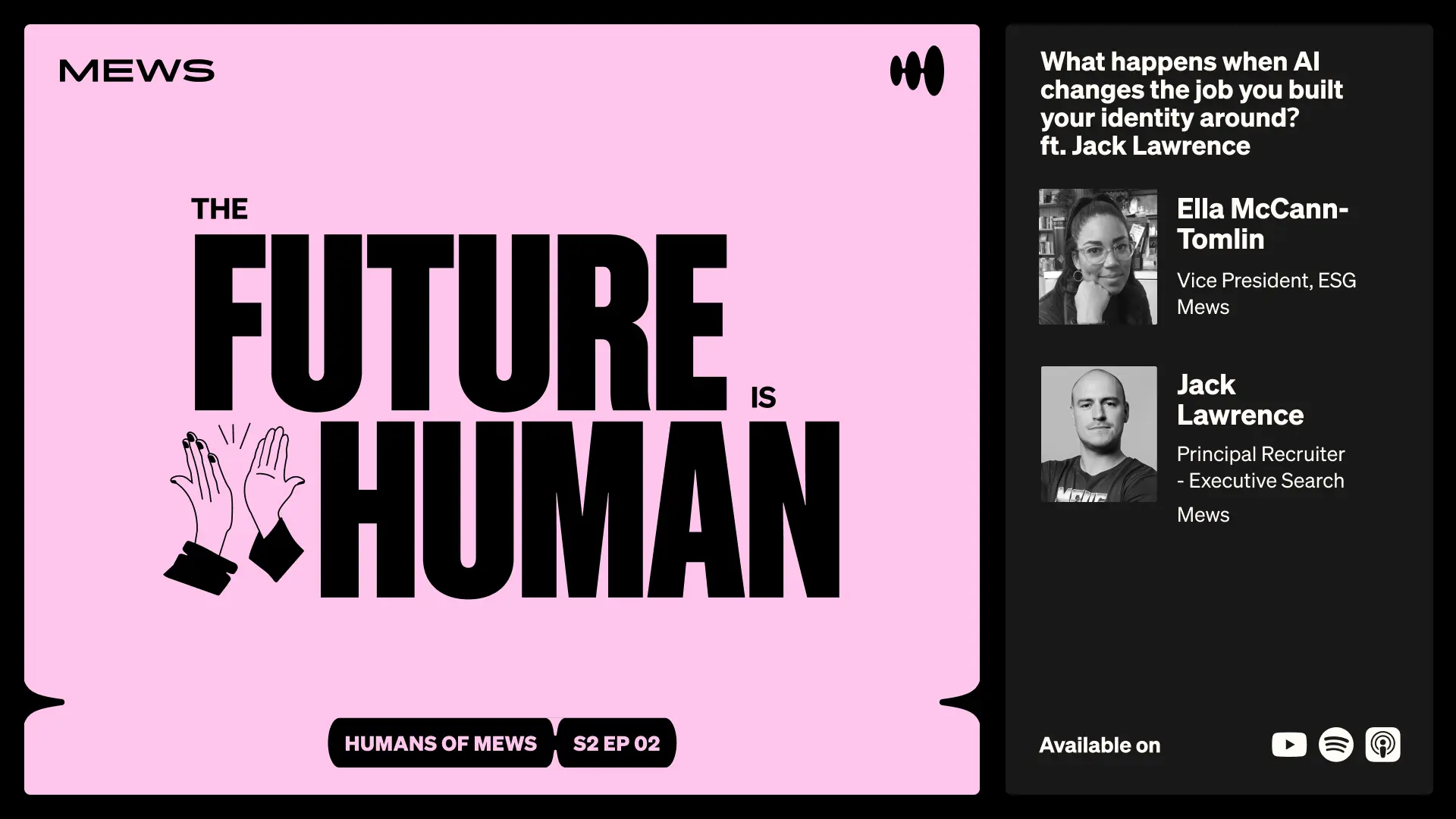
[00:00:16] Ella McCann-Tomlin: Welcome to Humans of Mews, part of The Future is Human podcast. I'm Ella McCann-Tomlin, and this is where we surface the human stories that often go untold at work. The turning points, the unconventional past, the things that shape who we are beyond our job titles. These are the intimate conversations with people across Mews about their journeys told on their own terms.
[00:00:41] Ella McCann-Tomlin: Welcome to the Future is Human and to season 2. So, today I'm joined by Jack Lawrence, who is Mews's Principal Recruiter for Executive Search. And Jack has spent over a decade in tech recruitment, 5 of those years at Mews, and has watched his function change more in the last 2 years than in the decade before that. He's also someone who is actively building the AI tools reshaping his own job while asking honest questions about what that means. And he's building something completely different outside of work, which we're going to get into because I think that tells its own story. Welcome, Jack. I'm really glad you're here.
[00:01:17] Jack Lawrence: So lovely to be here. What an introduction that was. By the way, Ella, I worked out this morning, as I was getting ready, that exactly 12 years ago today, I started my career in recruitment. That's the genuine truth. Honestly, 12 years ago today. So, the recruitment gods are up there somewhere going, "Oh, pin all the dots together.”
[00:01:35] Ella McCann-Tomlin: They're like, this is the moment to reflect on your career so far. Today is the day.
[00:01:41] Jack Lawrence: Something about me feels really old. Because when I started recruitment, I was 6 ft 5, had lots of hair. Now look at me, I'm shrinking,
[00:01:49] Ella McCann-Tomlin: Just shrinking and going bald over time.
[00:01:52] Jack Lawrence: All the best ones always do.
[00:01:54] Ella McCann-Tomlin: I think it's this kind of thing, isn't it, where it's like, September time, it's back to school. This is the kind of time when you start your first graduate job.
[00:02:01] Jack Lawrence: Seriously, it's great to be here. I've even dug out one of the retro Mews R&D shirts to show off to all of our viewers today. So, yeah, I hope you're happy with that.
[00:02:09] Ella McCann-Tomlin: Limited edition. I've never seen that shirt before. So, that is a vintage polo.
[00:02:14] Jack Lawrence: There were only two ever made, so, yeah, I got one of them.
[00:02:18] Ella McCann-Tomlin: Well, before we start getting into your career proper over the last 12 years, I'm interested in going back even further than that and finding out a bit more about your origin story. So, when you were even younger, when you were a kid, what was it that you wanted to be when you grew up? Did you know what you wanted to be? Did you have a clear sense of it? Or were you one of those people like me who has never really known?
[00:02:43] Jack Lawrence: Ella, I remember sitting there in Year 10 thinking, when I grow up, I definitely want to be a tech recruiter. And luckily for me, I made that happen.
[00:02:50] Ella McCann-Tomlin: The dream came true.
[00:02:51] Jack Lawrence: So, I think like 95% of most recruiters out there, if you ask them, honestly, will say, and this is exactly my situation, “I sort of fell into recruitment somewhat.” Right? So, when I was younger, growing up in the UK, obviously, I wanted to be a footballer; after that, I wanted to be a wrestler. Obviously, those two things didn't happen, but I was really into sport, and so I went to university and studied sports science, graduated with a degree in that, and then sort of spent some time sort of flirting with the idea of getting into that industry. Never quite penetrated. I sort of did a bit of coaching with personal training. I spent some time working with young adults with autism, sort of working on their nutrition plans and exercise plans and so on. But, yeah, then one day I got a phone call from what would be my first ever recruitment boss, a guy with Chris Jackson, and he said, "Would you come and interview for a tech recruiter role?” And I said I would. And the rest is sort of history. And here I am.
[00:03:44] Ella McCann-Tomlin: And you loved it from day one. What was the experience like?
[00:03:47] Jack Lawrence: Yeah, obviously, it was completely new. I didn't even know that recruitment back then was a job. Like, I've heard of the term. I sort of knew the word. I didn't know they could follow that as a career. I guess what resonated with me really quickly was the fact that it was very sort of human-based, right? Like I love talking to people; I like getting to know people. And I was spending, particularly back then, sort of hours and hours every day on the phone speaking to candidates, sort of selling them roles, finding out about their lives, their careers and then selling them into clients that we work with in that agency. And I think that combination of just me being quite extroverted and being able to talk to people and sort of have a laugh and also at the same time, to be honest, make quite decent money out of doing that in agency was definitely quite attractive back then for sure.
[00:04:29] Ella McCann-Tomlin: And I know we're going to get into roles now and how they're changing and how that's hitting people's identities and things like that. But I'm interested in, at that point in time when you shifted from being into sports science and that potential career path versus getting into recruitment, was there an identity shift that had to happen there? Was there anything that you felt like you had to shed? Or was it not, did not work out that way and it wasn't really a moment in time. It was just something that evolved, you know, over the years.
[00:05:00] Jack Lawrence: So, definitely the latter. I didn't really think about it too much. Right? I was just a graduate. I needed the money; I needed the job. This opportunity came along, fell in my lap, I went after it, and it turned out to be a great role. I think I didn't change fundamentally who I am. Not changed. I've always been the same person. I've definitely had to hone certain aspects of my personality. I think when I first started, I was very much in your face, and you might say I still am that way. I don't know.
[00:05:22] Ella McCann-Tomlin: This is the smoothed out, refined vision that we're…
[00:05:26] Jack Lawrence: If this is the smooth version, then goodness me. You learn on the job, right? And you learn to be a bit more conservative when you need to be and a bit more measured and stuff when you need to be. So, actually, I would do the recruitment bit for a little while and then go off and do something else. And obviously, that hasn't happened. I'm still here 12 years later. But I think the reason I'm still here 12 years later is because I do enjoy the fundamental aspect of the role; as I mentioned, it’s quite exciting, sort of aligns with my strengths, as I mentioned, my personality. So, I don't know that I had to change too much. I think I just evolved somewhat, and I think I evolved as a recruiter, but also as Jack Lawrence as well at the same time.
[00:06:01] Ella McCann-Tomlin: Yes. And do you think that over time, being a recruiter has become a part of your identity versus it being what you do? I know that some people are quite good at being quite separate, right? A job is a job, even if I've been doing this job, even this career, for a long time. But it doesn't necessarily define who I am. And who I am is just a world of things outside of work. And I'm sure that's true to some degree for all of us. But I know that other people, and I would say myself included, identify quite a lot with our jobs, and they become quite a big part of our identities, and they mean quite a lot to us. And that has its own challenges, right, with boundaries and how much you're kind of fused to your work. Where do you sit in that continuum?
[00:06:49] Jack Lawrence: So, I think if you look at your role, for instance, as a sort of comparison, I feel like a lot of what you do is quite vocational; you care deeply, obviously, about your craft. And that's not to say that I don't, and I'm not trying to sell or undersell recruitment at all. But for me, to be fair, for the longest time I was Jack Lawrence who did recruitment, and then more and more I become Jack Lawrence, the recruiter. Because I think sometimes after years and years of some go, “Oh, what do you do for work?” I say I'm a recruiter. It ends up becoming your identity somewhat. But I've never struggled at the same time with being able to separate the two. I can sort of leave work at work and, you know, I have other obvious pursuits and hobbies and stuff that I'm sure we'll talk about in a bit. So, I don't know. That's almost like a blended answer. I feel like they are separate. But at the same time, I would definitely consider myself a recruiter. Right? If somebody said to me, "What do you do?” I'm a recruiter. I've said that for many years. And I identified, particularly in this environment, as a specialist recruiter. Right? If you'd ask me, “How would I like to be known in front of my colleagues?” I'd definitely like to be known as Jack Lawrence, the recruiter, the specialist recruiter, the headhunter. So, maybe it changes based on who you're talking to.
[00:07:52] Ella McCann-Tomlin: Yeah, that's interesting. And in the environments where you do want to be known as Jack Lawrence, the specialist recruiter, what is it that kind of means to you, the meaning that you associate with that part of your identity?
[00:08:07] Jack Lawrence: First of all, I feel like everybody likes to be special and to be a specialist taps into that feeling. I guess it's just recognising some time well spent, you know, somebody who's been working at their craft for such a long time that they've honed their skills to a point where they're now considered like an expert specialist in that particular field, in that particular area. And so, for me, it's sort of vindication. But I've spent so much of my life doing this job. If I got to where I am today and I wasn't considered a specialist, I've probably done something wrong. So, I think it's just that recognising the effort that's gone into it, the learning that's had to happen, the adaptation that would have had to happen, the resilience as well. Recruitment's not the easiest role when it comes to, you know, if you're not resilient, you probably won't last. For me, completely, there are lots of ups and downs. It's a bit of a roller coaster. So, it's all of that combined through that, recognising that I'm somebody who has gone the distance, is put in a hard graph to get where they are today.
[00:09:00] Ella McCann-Tomlin: Really interesting. And if I reflect on that for myself, I was just thinking about the fact that you cling to and tie yourself to things which obviously are part of your value system as well. Right? So, like, my role is very closely tied to my value system. And in my early career, when I wasn't in this kind of role, but I was in tech, I would almost lead more with the tech thing. I would lead more with the kind of industry that I was in and the fact that I was proud of being in that industry. Tech has gone on a journey, and big tech has associations now. And so, it's interesting which pieces you start to dial up and down in how you think of yourself and what parts of your job you associate your identity to more. And for me, I think it shifted from industry first in some sense to role first, perhaps.
[00:09:50] Jack Lawrence: 100%. I get that. I was in a conversation the other week. I was at a 1-year-old's birthday party, obviously, various people there, lots of parents and stuff and friends of friends, and I was stuck in a group of two other lads, one of which was a doctor, been a doctor for sort of 7 years. The other lad was a sort of big movie editor. And I definitely recognised in myself that when they asked me, you know, when you got to my turn, “What do you do, Jack?” You know, what do you do for a cause? Jack the headhunter, you know, the exec search headhunter, rather than Jack the recruiter. And I don't know if I did that because I want to feel like my role is more impressive or I want them to get the impression that I'm doing something that's as good as what they're doing. I don't know. But I do think sometimes temper what you say and how you describe where you work or what you do, depending on the time you're in or the people that you're talking to, for sure.
[00:10:37] Ella McCann-Tomlin: Yeah. Absolutely. You want to be seen as a kind of peer with the people that you're talking to in whatever kind of context that is. And you're building something completely different alongside everything else. Right? You've got Yondera, which you can tell us what that is. But my understanding of it is it’s a lifestyle brand. There's a community focus. It’s about wellness. It's about conscious living, in some ways aligned to Mews to some degree, but quite a different thing. What made you do that, and what does having that other thing give to you that having your day job doesn't?
[00:11:14] Jack Lawrence: Initially, it was maybe a bit of escapism, just something that was very different in a lot of ways to what I was doing day-to-day. The reason that I even came up with the concept was that, at that time, running the entire length of the River Thames, because I'm a little bit mental and I like running. And when you're out doing 15 miles on a Saturday or Sunday, many weekends, you have a lot of time to think and be in perspective and so on. And I was just sort of thinking about life and, you know, everything that had come before and all the things that were coming up and things I wanted from life and so on. And I guess I started looking at me and those around me and recognising that more and more we're spending a lot of time sort of online in front of a phone, in front of a laptop, connected, but not really connecting with one another. And so I wanted to build something that was, I guess, the antithesis of that movement or, like, as you mentioned, the lifestyle brand that was about bringing people together through shared experience. Right? Whether that's music or food or just being outdoors or, you know, whatever the case may be. Because I do feel like we're sort of losing some of that community, for sure. I think people are more and more hanging out online than they are in person, which I think is all a shame as a sort of 90s kid. And when I talk about escaping, I found that it's really nice to sort of bury yourself in that sort of work, which is, yes, there are a lot of similarities, particularly around, like, the human aspect. Right? Mews is trying to centre experience around the human, and that's what I'm doing. But the sort of day-to-day work obviously is quite different. Right? Like, I'm not interviewing high-flying execs or software engineers as much.
[00:12:40] Ella McCann-Tomlin: There's an interesting thing that I think is generally happening with people, not just people in tech, but there are like some prominent examples, right, of people who leave Anthropic and go to write poetry or go to live in the woods or whatever, like there's a kind of extreme between I've worked in tech for a long time, and I need to go and literally hug a tree, and there's a little bit of tree hugging. I'm quite pro at that. I'm quite into it. But also I think generally, right, there's a broader conversation in society around what tech is doing for our human connection. And you can see that in little pockets, can't you, with, like, clubbing, for instance. There are now increasingly club nights and things where you're not allowed phones. You've got to put them in lockers and whatever because there's an understanding that we've lost something carefree and connected and human in the way that we interact. Not only because we're just on our phones the whole time, but also because everyone's being recorded the whole time. That's also a kind of interesting component in that particular context. So, I almost see that your day-to-day being in a kind of very tech-focused context and your side hustle being something that is… They feel weirdly connected to me in a way.
[00:13:50] Jack Lawrence: I'm obviously not a technophobe, right? Like, I use technology all day, every day, and I wouldn't go as far as to say that there's this sort of counterculture necessarily that's forming at the moment around anti-tech. But I do think that there's, as you mentioned, like, there's this cadre of people, there's this sort of population of people that just want to be outside more or just want to be around one another more. I think things are cyclical. Dating apps, for instance, I always find that's really fascinating. Our parents grew up; they met people at work or at the bar or at the club or at the library or whatever. And that was quite normal. Then, for a long time, and still, to be fair, like, lots of people meeting through dating apps. But now I'm hearing more and more of these dating apps that are, basically, you can't talk to each other before you meet; you have to go to a physical location. That's when you get to meet the person. And I think Thursday is also that. And I think that's interesting because I feel like people are crying out again for that human interaction, that human connection that I think personally is way better experienced, obviously, in front of somebody, one-to-one.
[00:14:52] Ella McCann-Tomlin: It's like these tools open up so much, and then you get to a stage where there's so much saturation that you don't realise quite what you've lost. And then there's a little bit of a kind of, how do we get that back? We're not going to take the tech away. Or even to your point about the dating app, that's a dating app, but it's like the concept starts to shift to try and redress a little bit of balance, I guess.
[00:15:15] Jack Lawrence: I heard the other day that there's been an explosion of running clubs in London, and maybe that's just because all of a sudden people have just desperately wanted to get into running, maybe. Or it's because it's a quite sort of low entry barrier to meeting people that's pretty easy. It doesn't cost a lot of money. You can run off. If you don't like it, you don't have to go back again. But yeah, I think that's an expression of people wanting to be around others and meet people in person, as I said.
[00:15:40] Ella McCann-Tomlin: And community. And I also think that you can, my partner and I have been talking a lot about whether or not we stay in London or we move somewhere else. It's a boring conversation, but this is a debate that's raging. And one of the things we've been talking about is community, and how there's this sense in London that you feel super connected, a little bit like the tech example, that you feel super connected, but you're not, like, it's hard to book in time with friends. I was texting a friend before this recording, and I was like, October, November, do you want to go to the seaside? And she was like, “I've got the last two weeks of November.”
[00:16:12] Jack Lawrence: Wild. It's wild. I think that all the time.
[00:16:15] Ella McCann-Tomlin: I was like, it's September.
[00:16:17] Jack Lawrence: Is that also just life happening? We’re getting a bit older. I think naturally you get busier. Your priorities shift as well, somewhat.
[00:16:23] Ella McCann-Tomlin: It is life happening, but I think there's a tie for me a little bit with you living in a big city; everyone's super busy, everyone's super social, everyone's busy doing lots and lots of things. And also something gets a bit lost, whereas when I spent a month by the sea in summer, a much smaller place, much, much less people, I felt a little bit more connected, weirdly, because you're seeing the same people; you're chatting with the people that you're getting coffee from. You kind of start to get a sense of the community around you in a physical way. In London, obviously, I see my friends all the time, but everybody's kind of got to book stuff in, and they live over an hour away in the northwest, and I'm southeast, and whatever else.
[00:17:05] Jack Lawrence: I don't want to go down too much of a rabbit hole. There's about 5 different threads I'd love to follow there. So, maybe I'll just choose to mess it, but I'm one of those people that’s always busy, and my family and friends are always saying, like, you have too many plans; you try to fit too much in. Do you ever have time to relax? Me, personally, I don't sort of feel that. I feel like it's manageable, and I enjoy it. If I didn't enjoy it, I wouldn't do it. Maybe there's something in that, in what they're saying. But I think, sort of, Christmas, this is a good time of year. Like, this build-up now to what I call a party season, which is sort of, you know, end of October, November, December, it's so easy to just jam-pack your diary of plans just to be busy, just be doing things. And sometimes I take a step back: did I even want to do that thing? Why did I do that? And I actually think sometimes it just feels good to be busy because other people are busy, and it's like this self-fulfilling prophecy that everyone makes each other more busy, more plans. So, I think that's definitely interesting, the thing around sort of being by the seaside and so on. Like, I think, naturally, cities, although they're super busy and feel very lively and vibrant, they can often be very lonely because everybody's just on a mission. They're going about their day, they're going to that appointment, they're going to that thing, they're going to the millionth plan of what about months. And so it's very hard to just have a conversation, London or Manchester, a place like this. When you're by the seaside or in the countryside, everything is relaxed, and you know, the pace is softened, and you sort of feel like you have less chaos around you, more space and more time to actually have a conversation. I think that's definitely important. Listen, people want the village, but they don't want to be a villager as well. And that's another point that maybe we can get into another time.
[00:18:34] Ella McCann-Tomlin: That is true. That is a rabbit hole I could go down all day long, but we're not, or we'll get too far off track. We'll get too far off track. If we go back a little bit to your Mews career specifically and the fact that you've been at Mews for 5 years, which we all know in a hyper-growth tech company, 5 years means you're an old timer at this point, Jack. And the function in that time has changed significantly - the tools, the pace - what's the biggest shift that you felt in your time here?
[00:19:07] Jack Lawrence: I mean, it'd be so easy to just talk about, like, the scale and how sort of Mews is vastly more complex today than it was, you know, when I joined. And just in terms of, like, our operating system and the various products that live inside that sort of ecosystem now. And just seeing that evolve and change, and so what that's done to the types of people we have to hire and so on. But I think the one thing that sort of stands out to me is our expectations around quality in the bar have shifted so, so much. A pound for every time I said this, you'd never have to work again. But I say to my team all the time, which is like yesterday's zenith is today's baseline at Mews. Things move that quickly in our expectation. It moves so quickly. And so, I think, yeah, the standard of what we're looking for today, you know, particularly when it comes to things like AI fluency, for instance, which I'm sure we'll talk about in a minute, has really changed and evolved and developed in a way that I couldn't even imagine. You know, when I first joined, there were like 50 people in the R&D team, and I was on the 250th person at the company, and the processes that we were following were crazy. It was a bit like the Wild West just after COVID. If you look at that versus where we are today, a lot has happened, but as I said, if I interviewed today, I'd like to think I'd get a job, but I can't guarantee it. Like, I wouldn't be able to guarantee that.
[00:20:21] Ella McCann-Tomlin: Interesting. And you talked about, I'm not sure whether I could or not, and I've only been here for two and a half years, but you're absolutely right. The pace and the expectations have really continued to shift. And it was high. You know, I'm sure it was high when you joined. It was certainly high when I joined. Obviously, a big shift that we felt this year has been around AI and AI fluency and the sort of expectations around that. You're in an interesting vantage point there because your specialism in recruitment is not only exact search but R&D, and you're hiring senior execs in the tech world. Can you talk a little bit about your vantage point? Because we're adopting AI in the people team, and we'll get a little bit into that and what that means and structurally how that's landing for you. But there's also the vantage point of the roles that you're hiring for from within Mews. What's that shift look like?
[00:21:17] Jack Lawrence: So, I think I spent so much of my time here at Mews, like hiring large volume. It was always some years, 100, 120, 145 was the biggest year that we had here when we were really scaling, and a large majority of that was like software engineers, right? And for the longest time, you'd hear that if you have children, tell them to get into coding, go to university, do software engineering; that's something that's going to stick around forever. That's a role for life. And literally within the space of January to where are we now? September, October time. I've completely seen that viewpoint change here at Mews because even just when we talk about, like, introducing product builders, which is a brand new concept role here, right, which is essentially a product builder is somebody who has an appreciation across all of the traditional free sort of R&D verticals, right? So, software engineering, product management, product design. And back in the day you'd hire in those trios, right? So, you'd have an engineering manager and loads of software engineers, you'd have a couple of product managers, and then, as I said, have a couple of product designers. With AI and the way that it's changing the environment, it’s changing how we hire; it's changed how people work and interact, and it's amplifying everything that we do. A product builder can basically, with the help of AI, now do all of those things on their own, right? So, traditionally that was impossible. You'd have to have scores and scores of people to sort of move that work forward, to deploy that work, to make those iterations. That same work can now be done in a week by one person. And so, by its very nature, it is always going to completely change and sort of tear up the rulebook. So, our hiring plans have completely pivoted. How we build the orgs out has completely changed. Our expectations around how quickly things can be done have again completely changed. Mews has always been the company that sort of deploys very quickly, even when I first joined. But now that's ramped up. You saw 10x that at least. But obviously, when you do that, the expectation the clients will also naturally change as well. So, we’re sort of getting to this interesting point now where we led into this product builder model for the first two product builders we hired about 12 months ago, 18 months ago; now, we've gone all in. And that makes up the bulk of our workforce in R&D. I'm really interested to see now what does the expectation set in our clients because they're having things developed so quickly. Can we keep up with that pace? The way that AI is moving and changing and rethinking how we deploy and how we build, is it possible for us to sustain that pace indefinitely? I don't know. I think that's a pretty interesting problem to try and solve.
[00:23:44] Ella McCann-Tomlin: A really interesting problem to solve, and maybe how we think about that altogether starts to shift. We're not having an R&D conversation, this conversation, but you don't know downstream two years what that is going to do to even how you think about a product roadmap and how you add things to it. What you're talking about here, in some form or another, is moving from one deep specialism to a broader generalism crudely. But obviously, each person who comes to interview for that role, for example, will have a background in either product management, product design, or engineering. Can you speak about what happens to that specialism? Are we looking more for a certain type of specialism? Does it get absorbed just into a kind of more generalist approach? And how are people grappling with that shift? Because I'd imagine software engineers, as much as anyone, that's part of their identity.
[00:24:38] Jack Lawrence: Oh, 100%. By the way, it's worth sort of mentioning that I think that Mews is in the sort of top 5% of businesses, particularly in Europe, that are heavily leaning into AI and these sorts of innovative ways of thinking when it comes to workforce and stuff. So, there will be lots of people out there, heaps of companies out there that are still very much following the Trio model and all of those things I just described. Mews, obviously, loves to be on the leading edge of things, and so we think about things differently. So, to answer your question, which I can't remember now.
[00:25:06] Ella McCann-Tomlin: Based on what you just said, given that, do you think that… So, you're headhunting. When you speak to people who are presumably not in a product builder role, right, they're in one of those roles at the moment. How do they respond? Are they intrigued? Do they think that we're bonkers? Is there an expectation that this is what the role looks like now? What's the response tend to be like when you're speaking to candidates who presumably aren't in this role right now?
[00:25:32] Jack Lawrence: There's more than one way to skin a cat, and there's more than one profile that fits the product builder typically. If I had 5 product builders today, there's every chance that they could all have completely different backgrounds. I think one thing that is often sort of like the foundation here at Mews is that they should have an engineering or an understanding of engineering and coding and so on. They don't have to be absolute experts, but they should have a foundational understanding. When you're reaching out to software engineers or product managers who are maybe more technical than others, or the graduate who's been out of university for 2 years but has done forward-deployed AI engineering, who's never been a software engineer but is an absolute expert at using AI and has been coding or vibe coding with AI, they're all going to react differently because they've all got completely different backgrounds, right, to one another. You have to sort of play on their skills, the transferable skills, why it's going to be interesting for them, why we think this is the way forward, what we see in their profile that aligns nicely with sort of the expectations of the position, but definitely, yeah, you know, there's sometimes pushback. People that have been, maybe, software engineers for 15, 20 years - all of a sudden you're telling them, “No. We think the sort of market's changing. We think this product builder concept is the way forward.” I think naturally, as a human being, you don't always like change. And I think maybe you’re sort of haunted up your fences, go up a little bit. But I think it's always about selling the challenge. Like, why will this person be interested in this opportunity? Like, what are we doing differently here at Mews that this person is going to be enthusiastic about? And again, that's the same for saying any role across any piece of recruitment, not just within R&D. It's about getting them to understand what is about their profile that is really interesting to us. And obviously, everybody likes to be told they're interesting, right? So, it's not always too difficult. I think once people hear the challenges that we're solving here at Mews, some of the really cool stuff we're doing in the market and how we're trying to evolve within hospitality, that does a lot of the work, to be honest, for us.
[00:27:21] Ella McCann-Tomlin: And in an R&D world, obviously, AI is shaping in this really dramatic way what these roles look like, because building software is the role and AI is software. And it's kind of completely upending what that looks like. We have a different challenge, and a different, I think it's shaping things in our world. And by our world, I kind of mean people work broadly in a different way because software isn't the work. We exist in the context of a software company, but that's not what our work has been. And our work has historically been very human. From your work to my work. Even though our roles are very different, we're in very human roles. Do you see this trend or this journey that certain roles are on looking the same across the board, or how do you see it shifting for different worlds than the more kind of tech-focused roles?
[00:28:15] Jack Lawrence: So, if you'd asked me that a month ago, I'd have a different answer to the one I'm about to give you. But no, because I think, you know, we were recently at the People off-site; we spoke a lot about this, and it’ll come to pass, I'm sure, in a bit. Originally, I thought that it might be somewhat difficult to take what I believe to be quite an R&D-focused methodology and then try and layer that on top of another department. Right? Say that the people team, or any team, actually I understood why it made sense in R&D - that centralisation that has been more generalist, that sort of role seeping into one another and so on. I didn't quite understand how that works, from a people team perspective, because I'm someone, as I said, who spent 12 years in recruitment. I'm always sitting there thinking, “Well, what do I know about employability law in Germany? Or how am I supposed to help with a really difficult question on reward, or in countless other examples that I could think of live with inside people work, not just inside TA.” However, having been to the off-site and having sat down and learned a little bit more about how we're thinking about products and our version of specialists versus generalists, I can see that there definitely is work that could be shared across different individuals who have very different backgrounds, with some enablement, with some upskilling, and we spoke about the difference between, like, specialist skill versus specialism. And I thought that's super interesting. So, I guess my answer is, I think it can work in the people team. I think it can work across other departments. That lens that I spoke about. But I don't know if it will always work exactly the same way. I think there will always be a bit of nuance. I think there should always be a bit of nuance because this is serious stuff that we're talking about, right? These are people's jobs, their lives that we're dealing with. So, we have to have the right people on the right tasks. But definitely I believe that, particularly with AI and automation, whether we're looking at workflows and stuff, we can become a bit more centralised and share that load, and that actually becomes more about how we serve in the business and the people within the business. If we think about outcomes and so on, how can we, as a team, be a team that is malleable to the business need and make sure that we're always delivering on that and thinking that is the only thing that's important, rather than having our little silo teams doing our own tasks and never talking to one another and so on and so forth. Like, when you think like that, that's what's first; that's the most important thing.
[00:30:36] Ella McCann-Tomlin: To your point that you just made about first principles, that is a. That's a lot of a term that gets bandied around, isn't it? Especially by a lot of tech bros. But I do think that what this moment has been able to open up for us is that, okay, yes, I could have an existential crisis, and maybe I've had a few mini ones. And at the same time, this opens up loads of quite existential questions. What is my work? What is it for? What's the purpose of it? Is the way that I currently do it the only way to do it? Is the way that we currently kind of pool resources the right way to pool resources for the outcomes that we're trying to drive? Are we attached to things because I've got this thing I've been doing for 10 years, or I've got this team that I'm really attached to, I've got this manager I really love working with? And so it forces you to unscrew everything and look at all the component parts and go, “Is this building the right thing?” But it is a really challenging question, and I think especially for teams like ours, where it's more of a nuanced shift that's happening. And one of the things that I particularly like about how we're talking about AI fluency - and I don't think this came from us; I think this is from Anthropic, actually - but one of the aspects of AI fluency that I think is really important is the discernment piece, which kind of captures not only how much you’re building, how much AI you're using for AI's sake, but what are you not doing? How are you using your human discernment to say, no, I need to manually check that thing, or I'm accountable for that thing, or I need to write that thing because it's really important that it comes from me, or whatever it is, I need to reach out to that person and call them. So, that kind of layering of what percentage, and it might change from day to day, of our work needs to be protected as much as anything is also, I think, part of the question, but…
[00:32:32] Jack Lawrence: In my view, anyway, there'll always be a need for a human being as part of any process, any workflow, any decision-making, and I think of a pilot that, for the longest time, has had, like, autopilot as a functionality on a plane, right? Ultimately, the human will always take off and always land because that's the most important part of that journey, that process. And I think for us in our roles and in our world and our work, for me, you always need a human being overseeing, zooming in on certain things, checking it, making sure it's correct. AI is great; it can't replace the human that's using it, in my view.
[00:33:08] Ella McCann-Tomlin: And something that we haven't touched on yet, but I think is really interesting about this moment for talent and for AI and for tech, is if we say, okay, this is an opportunity for us to think about roles in a more broad way and perhaps we can throw out, even more so than we've been trying to throw out some of the credential-heavy hiring that maybe we've done in the past. And by credential-heavy, what university did you go to, and what qualifications, quite hard qualifications, do you have? I'm not saying that those things aren't valuable, but maybe this is a moment where you can start to really question some of those things in certain roles and with certain profiles, which in theory can open up things like a more diverse talent pool, right? That's always been one of the challenges when we want to focus on diversity is enablement of hiring managers in thinking about what their needs really are and what kind of person they're really looking for and what kind of background they really need to have. And not to lower standards in any way; in fact, to make standards higher, because actually you might be missing out on a gold mine of talent because you're thinking about things in a very specific way. So, this moment feels like a particularly exciting moment for that kind of thing. But I know that actually we can use AI, and you and I spoke beforehand about how you can use AI to really heavily filter. So, I guess my question to you is, could we end up squandering this moment where, in theory, everything is getting potentially opened up by ending up with a certain pile of CVs at the end of the process that AI has sifted through for us, and we've not really realised that it's doing some quite biased filtering.
[00:34:58] Jack Lawrence: You do need to be careful. Definitely. And by the way, AI can be just as biased as any human recruiter or any human reviewer. And actually, if we fall into the trap of just over-obsessing about how efficient we can be - yeah, I saved myself 10 minutes, you know, filtering through those 300 candidates - but at the same time I've lost access to the golden goose that would have been absolutely wonderful, who maybe didn't fit the mould, then that's, obviously, you shooting yourself in the foot. I can think of so many examples here at Mews, in particular, where somebody who, on paper, wasn't a good fit for the role and is now excelling for promotions later; somebody who worked at the hotel reception, who's now a Director of Product and Engineering, has gone through the journey of solutions architect into a completely different department. So, again, based on your question, sorry, if you only ever use AI to become more efficient, to save you time to filter out candidates that aren't 100% right on paper, you'd have missed that opportunity. That's a real shame. So, you do have to be careful. We should be using AI to help us, definitely, but we have to always be measured in how we're using it and the information we're feeding it - our prompts to make sure that it's reflecting the sort of workforce that we want here at Mews, which is a diverse workforce with varied skills from varied backgrounds.
[00:36:17] Ella McCann-Tomlin: And is that a case of just being really deliberate about how we, prompt probably isn't exactly the right term, but I could see a world in which we accidentally, and this is what often happens with questions like diversity, right? I have encountered them, but very rarely encountered people who are really actively against having a diverse workforce, let's say, or having people from different backgrounds or having people from different walks of life in their workforce. What's often happening is that, accidentally, they're biasing through their processes, for the most part, through the way that they hire, the interview questions they ask, the criteria that they're using, the working environment that they create, which some people want to stay in and other people don't want to stay in. All of those things, on aggregate, create an environment where certain people thrive, and certain people don't, and it's usually accidental. So, is this a case of, especially with AI, being really intentional and deliberate because the ICP that we're creating might be doing almost like a 10x version of that?
[00:37:23] Jack Lawrence: For sure. Just to roll back a little bit there for me. I think, to your point, that nobody that I've ever met has been actively trying to not hire diverse candidates. And in my experience, often we index for speed and recruitment, right? That's not just in Mews; that's every recruitment I've ever had. You're up against time; you need to fill the position quickly, you know, you've got targets to hit, that person is going to impact this OKR or whatever the case may be, this piece of work. And so you just have to move fast. And so when you move that fast, there's inevitably going to be room for mistakes. And one of the mistakes that you could make is, yeah, we have to move really quickly, let's use Claude or Chat or whatever, whichever you're using, to expedite and speed up that laborious process of filtering through applications or finding candidates. Right? And again, as I said a minute ago, that's where you could end up making a mistake. So, you have to be very intentional about how you think about that. I think the human being, as I mentioned earlier, always has to dip in and oversee, and then you need to, probably, build a vehicle mechanism for being able to check the standard of the candidates that are coming through into the recruiter stages or the later stages. And there are ways of doing that, of course. And you know, we should be using the technology; we should be using AI to remind us to do that, as well as sort of using it to actually do the filtering in the first place. But that would only change, I guess, when people feel like they have the time and the bandwidth and the support to be more considered and do that in the first instance, in my opinion.
[00:38:54] Ella McCann-Tomlin: And unfortunately, one of the things I haven't seen personally so far is the promised land of AI freeing up everybody's time and everyone being a lot less busy.
[00:39:03] Jack Lawrence: No, because all it's done is actually makes more busy because you can do more now, right? Like the task that used to take you half a day now takes an hour. Great. Well, you can do another four tasks in half that day because you've got the time to do it. So, you've actually just taken on more often.
[00:39:18] Ella McCann-Tomlin: Yeah. And the expectation is you can bang out a Confluence page or a document now; you know, it won't take you half a day to craft it, and so, yeah, the goalpost continues to move, doesn't it? I know that we've got to go. And I know that we could yap on all day. If I had to ask you a final question, my final question would really be: we've talked a lot about optimisation and how that shifts expectations, all that kind of thing, and what should remain human. Is there anything that you would refuse to optimise even if you could, or refuse to automate even if you could?
[00:39:53] Jack Lawrence: Human interaction. 100%. And when I say that, it can mean lots of different things. For me, that's the human interaction with the candidate opposite me or, you know, the candidate that's applied for that role. I think we spoke about this before. We could easily fall into that trap of my AI talks to your AI and that no human beings have ever been involved, right? And yeah, we said before that use AI to do the dishes, not write the book that you've always wanted to write. Like, free up your time to do the thing that's fun. Because actually doing that thing is often the reason you do it in the first place. I talk about cooking all the time. Yes, you have to cook to eat, but the process of cooking is fun. Just like the process of talking to a human being, to selling them the role, you know, to understanding what their motivations are, why they want to join the company, what they've done in their career, what they want to do in their career. Like, that is the fun part of the job. So, if you were to ever automate that, then I would be tapping out because, you know, you've lost that human element, that human aspect that I really enjoy, and I think it's really important as well.
[00:40:52] Ella McCann-Tomlin: And not only is it fun, exactly to your point with the cooking example, it also has meaning. You know, I always think about it; I'm a person who likes cooking, so I use that as an example as well. But it's not just that I enjoy cooking; it's meaningful to cook for someone else. If I said, “Jack, come to my house, I'll make you dinner.”
[00:41:08] Jack Lawrence: And you never have said that, by the way.
[00:41:10] Ella McCann-Tomlin: Ordered dinner. I've never said that. Soon to come. The invite after this call, and I got loads of food from a local restaurant and put it on my plates; you'd be disappointed. Not because of anything to do with the quality of the output. It probably would be better than my cooking. But there's meaning in the fact that I've taken the effort to think about what you like and gone to the shops and looked up a recipe. And that's the part that has meaning. And so I couldn't agree more. It's partly about what we enjoyed to do as humans, but it's also about how we kind of exchange meaning with one another, I think.
[00:41:46] Jack Lawrence: Not to hammer on the cooking reference too much, but cooking can mean so many different things for so many people. It's an expression. Sometimes, it’s a way of just relaxing after a busy day. Sometimes, it's experimental. Sometimes, it's a loving gesture. Sometimes, it's preparation to feel better because of the food that you're eating. And so, it could be a tree. It's so different things. But again, like we had a sort of tenuous link to it. For me, in recruitment, all the different people I've spoken to over the years, those different conversations, thousands of conversations I've had, have all somehow shaped the way that I work, the way that I think, the person that I am, and to think that one day the Jack Lawrence of the future might not have that opportunity is a really sad thought, because human interaction is key. It's so important.
[00:42:31] Ella McCann-Tomlin: Perfect place to end, Jack. Thank you so much for talking to me for an hour. Always a pleasure. I really appreciate it. Thanks so much for coming on the show.
[00:42:41] Jack Lawrence: Thank you for having me.
[00:42:47] Ella McCann-Tomlin: The Future is Human is brought to you by Mews. If you want to learn more about what we do, visit mews.com. And if this conversation resonated, you can find us on Apple Podcasts, Spotify, YouTube, or wherever you listen. Hit subscribe so you don't miss future episodes. Thanks for listening.