What to expect?
Meet your speakers
Matthijs Welle
CEO, Mews
After years in the trenches of hospitality, Matt joined the Mews journey during its early days in 2013. Since then, he’s been our fearless CEO, leading the company and the industry forward.
Episode chapters
Transcript
[00:00:01] Matt Welle: The greatest hoteliers, they come up with the concept; they decide what the target audience would be, what they need to have the best experience, and they start designing the real estate around what their guests are. And then the technology question should come later.
[00:00:26] Matt Welle: Hi, everyone. Welcome back to another Matt Talk, and this is a very special episode. It's the 100th episode, so that means I'm about 2 years into this journey with you, exploring hospitality. Like, I'm speaking to hoteliers, technologists, just a whole variety of people, even investors who are investing in technology or hotels, to just make sure that we get as rounded a perspective as possible.
[00:00:48] Matt Welle: Two years ago, when I started, I wasn't in a great mental space. I realized that, you know, the job was draining me. You know, the amount of hours that I worked was really hard. The business results weren't fantastic, so it was a really tough time, and I realized if I wanted to sustain what I do, I need to lean into the thing that I enjoy the most, which is hospitality and innovating. And I decided to start a podcast so that I get to talk to hoteliers. I get to, you know, learn new things from some of the people in the industry that are really defying what's happening in hospitality. And today we're, what, 99 guests in our 100th episode, and I was reflecting on some of the things that I learned from some of these amazing conversations with these innovators. And I have plenty, but I wanted to just really take a step back and look at hospitality first.
[00:01:34] Matt Welle: So, one of the things I've noticed in my 20 years in hospitality is that the big brands no longer manage their hotels, so the whole industry has shifted significantly in the last 20 years, and that means that the franchise model, the asset-light model, is quite rampant. But I find that hospitality, you know, across those big brands isn't as exciting as it used to be, and the service levels aren't as good as they used to be. And I want to explore, well, what it's like if you run your hotel without one. What could you do with that freedom that you get when you've got full freedom of systems?
[00:02:06] Matt Welle: And I found many guests that have talked about this, and I found real optimism in those hoteliers, and those are the stories that I enjoy telling. So, today I want to reflect on some of the lessons that I have learned, or you've learned with me because you've obviously been here for 99 episodes with me so far, hopefully. And I wanted to reflect on some of the optimists of the industry, the people that have defied gravity and really did something different, but who are succeeding at it. And I think that's a really critical component to how hospitality can develop in the future. And so, that's what I'll focus on today.
[00:02:39] Matt Welle: I'll highlight 5 hoteliers. I'll tell you a little bit more about our journey, where we started, and why we started Mews at the time. And hopefully that gives you some insights and gives you energy to keep listening for the next 100 episodes, because I have decided that I'll keep going because I actually really enjoy it. I enjoy spending time preparing to interview someone and asking them really deep questions about their business, and hopefully I walk away with lessons every time, and I actually do. Every single time I speak to a hotelier, I walk away a little bit richer.
[00:03:08] Matt Welle: For this first section, I want to really talk about standardization that's happened across the hospitality industry. If you were to walk into 5 hotels in your neighborhood today, you'll probably experience the same thing. You drive up to the hotel, you walk in, your eyes start to scan for the reception desk. You queue up to check in. There's probably a screen where you've got receptionists hiding. They look up, and then they start to ask you about your passport and your credit cards and registration details, etc., and then they hand you a plastic key. You head to the elevator, you go up to the room, and there you experience pretty much a whole lot of sameness. You find that there's a bed and a bathroom with some toiletries in it, a minibar that's nowadays empty. We used to have those stacked with really fun things. And if you wake up in the morning in that room, you can't tell from the room where you are. And, you know, we've lost this local touch because of the standardization that we're experiencing and throughout that experience, you know, things like breakfast. Breakfast from 6:30 till 10:30. Nothing special. It's just a buffet. And you've got an egg station, and most of those experiences are the same.
[00:04:08] Matt Welle: But when you think about what happens when we travel, we travel because we want experiences. We're looking for that human connection, but also the local influence into the brand. So, with the brands growing very aggressively, and specifically the hard brands, right? When you've got a soft brand, then that allows the hotelier to still have some creativity. But when it's a hard brand, you really don't know where you're waking up in the morning because it could literally be in any city around the world. And I think that's a real challenge that hoteliers are facing. If you are the owner of a hotel today and you're looking for investments to renovate a hotel, most of the time the bank will require you to slap a brand on the roof because it's a guarantee of revenue, but it's also a guarantee of costs, right? So, when you have a major brand, you have to pay them large franchise fees for every reservation that they bring, and that cost is significant.
[00:04:57] Matt Welle: So, whilst there's a predictor of success on the revenue side, there's also a really steady cost. So, the ability to outperform is less, whereas if you seek independence and you make your own decisions about what you want the brand to be and the experience to be for guests, you actually have the opportunity to exponentially out-achieve, kind of, the results that you'd have if you had a more standardized property.
[00:05:22] Matt Welle: And those are the kind of stories that I've been exploring here with Mews and Matt Talks Hospitality to figure out whether this is a trend or whether this is just hypothetical situations. And what I've found time and again is that there's a significant amount of hoteliers who have defied gravity and have just said, "No. We're going to do the thing that I think is the right thing." And they're highly successful, and they're scaling as well. It is not just a once-off hotel brand, but these are scaling hotel companies, and I think that's really exciting. And I'm hoping to share some of those lessons with you today.
[00:05:55] Matt Welle: Today, we're living in 2026, but I wanted to take you back to 2012, 2013 which was when The Emblem Hotel in Prague was being built, a 59-bedroom hotel, lifestyle, very forward-thinking in its design. And Richard, the founder of Mews, was helping his family design and develop this hotel. The thing he wanted as a concept was something significantly different. He wanted this to feel much more like a home and very high-end design with a private members club and, you know, really nice living spaces and smaller rooms, but highly luxury rooms. So, as they started developing that concept, at some point he got to the, "Well, how do we check people into this hotel? I want the guests to have iPads in the rooms with a concierge app where they can self-navigate their entire stay in the city." And really everything broke once you started looking at the technology vendors on the market at that time.
[00:06:51] Matt Welle: So, we had conversations with some of the largest technology companies in hospitality and realized that they required a standardized format. They required a reception desk because most of those systems were still on-premise systems and needed to be plugged into a wall, same as the door lock systems and the payment systems. Everything needed wires to be plugged into each other. However, the designs for the lobby were actually of hosts walking around, really well-dressed, with, like, an iPad on their side because the idea of real hospitality should be when a guest walks in the door, you approach them, and you say, "Welcome to our hotel," like you would with a friend. And the idea was we'd sit them down, you'd get them a drink like you would with a friend, and do a really personal check-in. But when you started to explore that 12, 13 years ago, it wasn't possible. There weren't open ecosystems where you could build those experiences on top of it. So, we really got stuck, and we had a couple, really, like, it was about a year before the opening when Richard realized, "I probably need to do something." He then approached me and said, "What are you doing at Hilton?" And I said, "You don't have a clue. We're running on DOS, like these blue screens still." And you know, whilst the whole world was already running on iPhones, the hotel I was working in was on these blue screens.
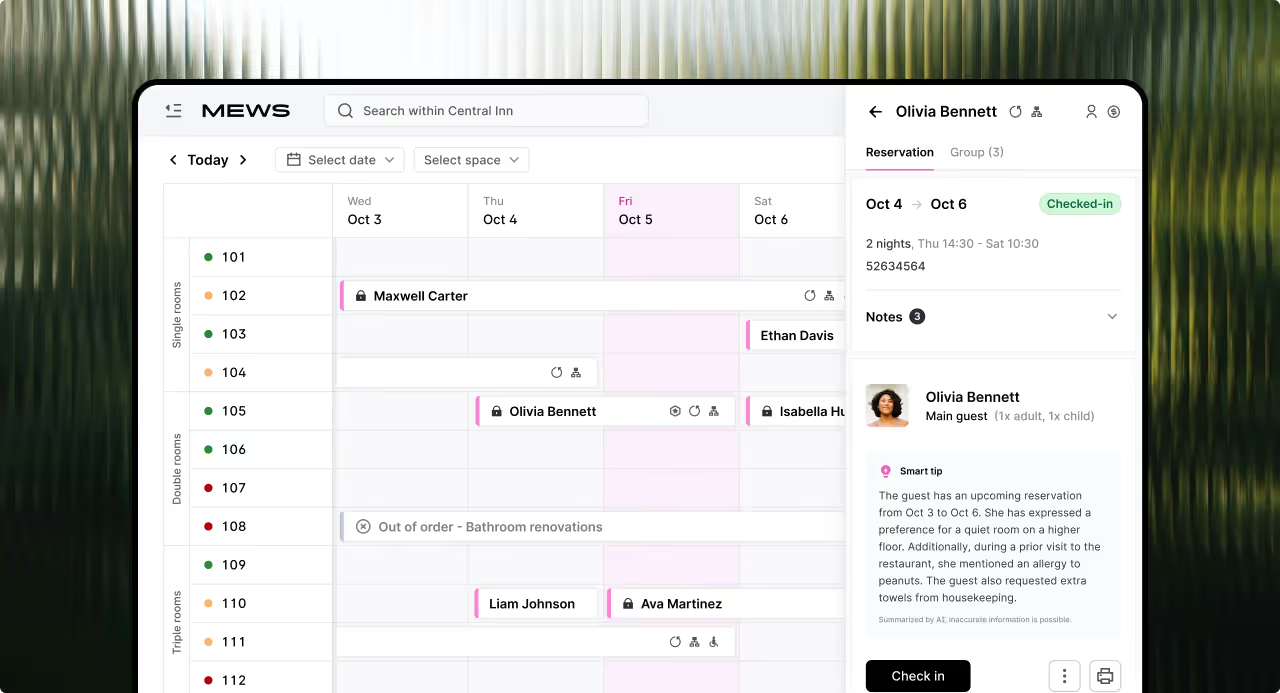
[00:08:04] Matt Welle: And we'd recently upgraded to Windows, and I realized it wasn't a better experience. The DOS was a better version than what the new innovation was in Windows. So, this is when he convinced me to quit my job and to join him on this journey to build that technology of the future, and that's how we started Mews. We just hired two really smart students from the technical university, and we said, "We've got this problem. We'd like you to solve it with us." And that turned into what Mews is today: this open, flexible platform that allows hoteliers to create these experiences where a host is walking around with a tablet and creates these really personal experiences. But we went much further than that because we've now created this huge space for hoteliers to flexibly design their entire workflow. So, whilst there are still lots of hotels that have a reception desk with a computer on it, you don't have to. You've got complete flexibility to transform that into any type of experience, and that's a really critical component to the future of hospitality today.
[00:08:59] Matt Welle: So, that leads us to today, 13 years after we started Mews and The Emblem Hotel opened. What's actually shifted? And the 5 hoteliers I wanted to highlight today are those hoteliers that have said, "No, I want control, and I want to create these special experiences.” The first hotelier is Inge Decuypere, who was the operator of C-Hotels and still is today. And they joined us very early on in our journey. They are running a Belgian hotel group, and these were large hotels. You know, they were larger than the average hotel that Mews was running on. But what I loved about meeting them is that they're open to listening to what we were doing, and they really took Mews to the next level. They created their own brand, and they own and operate their own buildings, and that freedom allowed them to create a very efficient operation that works really, really well. Recently, they bought a new hotel, and they've been expanding steadily throughout our relationship together. Recently, they bought a new hotel that was a formerly branded hotel, so a big global brand, a top 10 brand, was on the roof, and they said, "We'll buy it, and we'll make this hotel more successful. We'll take the brand off the roof. We'll run it under our portfolio of hotels, and we will make this a much more profit-driving business." And because they have extreme control over their businesses, they turn it around. And I love these stories of hoteliers who take something - a building that has always had a big brand on the roof - but through their control, they genuinely transform a hotel operation. And with Inge and their hotels, I think they've been with us for about 10 years now, and they have grown consistently with Mews because they always see the features we're releasing, and they're adopting those, and it's allowed them to scale their business and be very successful in the Belgian market. And I think it's just that defying, trying to just make sure that you own and control the journey, but also have ideas about what you want the journey to be, that's the thing that drives success for Inge.
[00:10:57] Matt Welle: Another great example was a conversation I had recently with an operator at the Cactus Cove Inn. It's a hotel in North America, and it was very interesting because this is an independent hotel and not part of a brand, and it was, you know, unconventional. At some point in the call, he said, "Sorry about the noise in the background. There's kids running around, but I love it. It makes me happy. Because that's the target group. We've realized that if we embrace children, you know, they are the ones that drive the next stay. You know, they're the ones telling their parents, 'I want to go back to the Cactus Cove Inn.' So, he's like, "We will never tell children to quiet down in this hotel. We will embrace it, and we'll have them have more fun."
[00:11:39] Midroll: I hope that you're enjoying this episode because if you do, make sure that you press that subscribe button. It really helps grow the audience and keep you informed whenever a new episode drops. We have some of the best hoteliers on this platform, and I love asking them the hard questions so that hopefully you can improve your hospitality business as well.
[00:11:56] Matt Welle: At some point, he said, I saw, like, I think it was Disneyland or something, that they had a dinosaur, and the impact that that had on kids who love dinosaurs was incredible. So, I said, 'We just buy a dinosaur suit, and every morning during breakfast, you know, we'll have the dinosaur appear and serve breakfast and create these really special experiences.” So, you know, it's unconventional, but they realize who their target group are, which is families with kids, and they lean into it heavily to create those very, very special experiences, and you can only do that once you've got the extreme freedom to create your own very special brand.
[00:12:31] Matt Welle: Another operator I always like to highlight is Charlie MacGregor from The Social Hub. If you've been to The Social Hub, and I stayed in The Social Hub two weeks ago, you know, I experienced some of that special sauce that they've created. They started really from the local community, and they said, "We've got these great local communities and cities. We've got these students that come in, and we'd love to blend the local community with students with short stays." So, initially, whilst they started as student dorms, they very quickly realized there was a buzz about these buildings because these students had energy, and they were working from the lobby. And he started bringing in the local community, and he started selling rooms. Whenever there were vacant times between semesters, he opened them up for sale on the short-term rental market. And today, you know, he's blending those seamlessly with each other. So, when you walk into The Social Hub, you feel that there's a culture. Like, the staff feel young and excited about working in a brand like this. They've got fantastic gyms, so they really lean into this new generation that cares about wellness. The breakfast is fantastic. Rooms are really designed for kind of this, like, lifestyle kind of level experience. But because it's a blending of guests, you feel that there's an energy that you don't get at a traditional hotel, and they are scaling. They have very large hubs here in Europe, and the flexibility of their model allows them to go much more towards the students during their high season, but then shift very quickly in holiday seasons to travelers, and that's made this business incredibly profitable.
[00:14:05] Matt Welle: Another one is Bob W. You know, I spoke to Niko, who's the CEO of Bob W. They run these aparthotels. So, they take a building, and they turn the rooms into apartments. But what he's done is he's pushed technology to the limits. So, he says, "I want to automate as much of the experience as possible while still creating great guest experiences." And when you hear him talk, he's like, "The guest reviews..." He could name you the guest review scores of all of his different businesses because there's a deep passion for guest experience. But somehow, when you get to a Bob W, you walk into your room without a reception desk, without a check-in. You get, you know, a fully automated experience. But because of the way that they've deployed the technology, guests actually walk away incredibly happy, feeling like they've connected with the local community because instead of that breakfast room with the breakfast from, you know, 7:00 till 10:00, they say, "No. No. We're gonna partner with local restaurants because we want guests who stay with us to have these very local experiences instead of a soulless gym in the basement of the hotel.” He said, "I'm gonna partner with a local gym, so you get to meet locals there as well." And I think it's that really where he's, on the one side, made sure that the room is very efficient; the experience of getting into the room is fantastic, but you always have service on the fly. You can message the reception, and they are super responsive. And then they've embedded the local community into the concept in some way, and that works wonders.
[00:15:30] Matt Welle: The fifth hotelier that I wanted to just highlight that I love talking to was Halima from the Zedwell Hotels. They have some real estate that is challenging. So, they have, for example, a large real estate piece under Piccadilly Circus which has no windows. And they said, "This is great real estate, and it used to be these, like, arcade halls.” You know, how do you turn that into a successful hotel? They realized that their benefit was location, and people are willing to pay for location and are willing to compromise sometimes on things like daylight. So, what they've done is they've created this hotel that has no daylight, but the rooms are extremely comfortable, and they focused on the sleeping concept. So, they've embraced, for example, Mews Technology, and when you walk in there, it feels like you're walking into a really cool Apple Store. The Mews kiosk is beautifully designed into the wall. But they've really focused on automation, but there's always a host around. And when you get to the room, it is quiet as a mouse. Like, when you turn off the lights and, you know, there are no light sources there, you can have the deepest sleep that you've ever had at this hotel whilst you're in the absolute bustling heart of the city. And people care about that, and this hotel is extremely successful, and this concept has now been expanding throughout the UK. And you know, it's empowering to see hoteliers like Halima really challenge what people expect from a hotel and build a very, very successful business from a real estate point of view.
[00:17:00] Matt Welle: So, those are some of the inspiring characters that I've met in the last year, and I wanted to just reflect on kind of what those stories have in common. So, when you think about these 5 hoteliers, they were extremely different experiences, right? You've got the hotel that embraced children and went wild with dinosaurs. You've got the student living. You've got, like, beachside resorts in Belgium, and you've got an apartment concept. What was the thing, the line between, like, across there is really that the hoteliers said no. They said, "We wanna be different. We wanna embrace that we can be different, and we can also be successful." And they had a really strong conviction about who their guests are. Like, if you listen to anything, it was about, you know, knowing who their target audience was, and it's not for everyone. They specifically said, "We are for children," or, "We are people who choose a specific location," or "We are for a very inclusive culture at this particular brand." And they know their target audience extremely well, and they build a concept around it. Also, what I didn't focus on in that was the technology because that comes after. Like, the greatest hoteliers, they come up with the concept. They decide what the target audience would be, what they need to have the best experience, and they start designing the real estate around what their guests are and build it around that. And then the technology question should come later, whereas historically, you would have to lead with the technology question because it was very limiting, and you had to build around what technology could do.
[00:18:33] Matt Welle: Today, that incredible freedom you have allows you to build the concept in the way that you're supposed to, and all you need is an entrepreneur who's willing to take a risk, who's willing to say, "No, we're not doing that. We're not doing the standard thing. I have a strong opinion, and I'm writing it down into a business plan, and I'm gonna get funding for that, and I'm going to take that risk, and it's going to pay off more than what a traditional hotel would do.” And time and again, I'm seeing those hoteliers that are saying no and have great ideas, you know, have that MacGyver kind of talent of, you know, with a bit of duct tape, create something very special, and then that turns into a special concept that they get to expand on. And I think that's what great hospitality should be about. So, if I, again, step back and think about where we were 13 years ago, we were building a PMS that allowed you to check people in and out with an open API. We've morphed that platform over the last 13 years into something much bigger. Initially, we added in payments because we realized that payments were a large friction point that happens at the reception desk. "Can I have your credit card?" And then the minutes that ensue to try to charge that card or take pre-authorization, explain how a pre-authorization works. We've automated most of those payment flows today because we've realized it was a real pain.
[00:19:46] Matt Welle: But then slowly, we also realized we need to add in other things. So, for example, an online check-in or an online check-out. If you think about that Emblem Hotel where you had a host walking around, you know, you still needed to give them a plastic key, and you needed to take the payment. So, payments we solved, but the plastic key we hadn't solved, so we built an online check-in. So, that allows a guest to check in before they get to the hotel, fill in a registration card, maybe even take an upsell from the hotel, and we can issue a digital key to that guest. So, it becomes an end-to-end tool to let those guests who wanna create that really smooth experience to their room, like, fully end-to-end.
[00:20:22] Matt Welle: But we started building on top of it, and we added more and more functionalities. So, today we have a fully fledged revenue management system which is embedded into the platform. It is not some outside platform. It is natively inside the platform. We added a channel manager that sits natively inside the platform. All of the workflows between the RMS, between the channel manager, between rate management and the PMS are all in the same system with the same interblended workflows. We added housekeeping. You know, Flexkeeping was acquired 2 years ago, and that team has built an incredible solution. So, to ensure that housekeepers on the floor get the latest amount of data to target and to improve the guest experiences that they have, we've this month launched Mews Messaging. So, it's a messaging hub where SMS, WhatsApp, Booking, and Expedia messages come in. We've added automations. So, as you can hear, we added more and more technology, but it's all from the same core. So, we call that the Mews Operating System, where the PMS is at the heart. So, once we've got the reservation and guest data, we can really think about what the end-to-end experience of a guest would be. And this gives the hoteliers extreme flexibility to build the concept that they want. So, no matter whether you're building a student dorm that's blended with guests or a family-friendly hotel, you've got the complete flexibility and all the tools within that one ecosystem.
[00:21:48] Matt Welle: And the thing we've now added on top of all of it is this AI layer, because if there's anything that we have done well in hotels, it's collecting large, large amounts of data. And if you wanna do anything special, you need data in a time of AI. So, we started making sure that we capture as much of the guest journey as possible into our database. Then we added the large language model on top of that and a semantic layer - like, how does your hotel operate? All the rules of operation, and AI can now help support your business. So, it can say, "Did you know that Mr. Jones has been with you 15 times, and he always prefers Room 101? And he doesn't appreciate that VIP setup; he actually prefers a cookie in the room," for example. And you can build an entire automatic workflow that ensures that he's always pre-assigned to Room 101, that room service is advised to bring that cookie to his room right when he checks in so that the cookie is still warm, and you can only do that once you own the entire workflow from the moment that the guest books on the booking engine until the moment that the guest has checked out and hopefully books their next stay with you again, and we ask them for their review.
[00:22:56] Matt Welle: So, we've just announced the Mews Operating System. We've introduced a number of features like Messaging and Automations and the Mews channel manager. And on top of all of that, the AI layer is the thing that's going to be the absolute special sauce. And we're starting to see more and more hotels embrace this ecosystem because they see the benefits of it going forward. So, I'm really excited that we finally got it out into the world as 1 cohesive system instead of, you know, 10 different standalone solutions. We worked for years to embed these inside each other and make sure that the workflows that we have are extremely seamless.
[00:23:32] Matt Welle: So, that's our first 100 episodes wrapped up, and I'm excited for the next 100. What I've realized is that the more I keep going, the larger this community becomes, the more access I get to great other people in the industry that I get to talk to and get to unpick what makes them so successful. Underneath all of it, it's optimism and entrepreneurialism. Someone who says, "Yes. We can do this, and we're gonna go a little bit further than anyone else," and they just take a bet. It's one of the hardest things to take a risk, but it's those hoteliers that take a risk that find that they're running some of the most successful hotels today. I think the thing you could do if you do anything after listening to this, and if you are potentially in a more standardized hotel or you don't have as much freedom, is to start small. Make small changes because the systems allow you to make those changes. We had a hotel concept that had a very traditional reception desk, AMANO Hotels in Germany, and you know, it worked well for them. But once they deployed Mews, they said, "We're gonna go and change our lobbies." So, they basically removed the reception desk, designed their lobbies as a living room, and put kiosks in a corner, so it's not the first thing you see because it's not, you know, the most attractive look, but now their lobbies became living rooms, and it becomes much more of a hub where people actually hang out. And I love when a more traditional hotel retrofits our solutions in and realizes what the benefits are and starts to chip away at it, slowly improves the brand, and makes it the most exciting modern potential brand out there. But underneath all of it, it's hire optimists and surround yourself with these people that are like, "Yes, we can do that, and we can do a little bit more." And I think that's the story that I want to tell today about those hoteliers that have inspired me, and I'm excited to meet more of you.
[00:25:19] Matt Welle: So, if you're listening to this and you're like, "I have a great story for Matt," reach out to me. I'm very active on LinkedIn. You can find me there, and I'm looking forward to speaking to you. But thank you for sticking with me for 100 episodes so far, and here's to another 100.