What to expect?
Meet your speakers

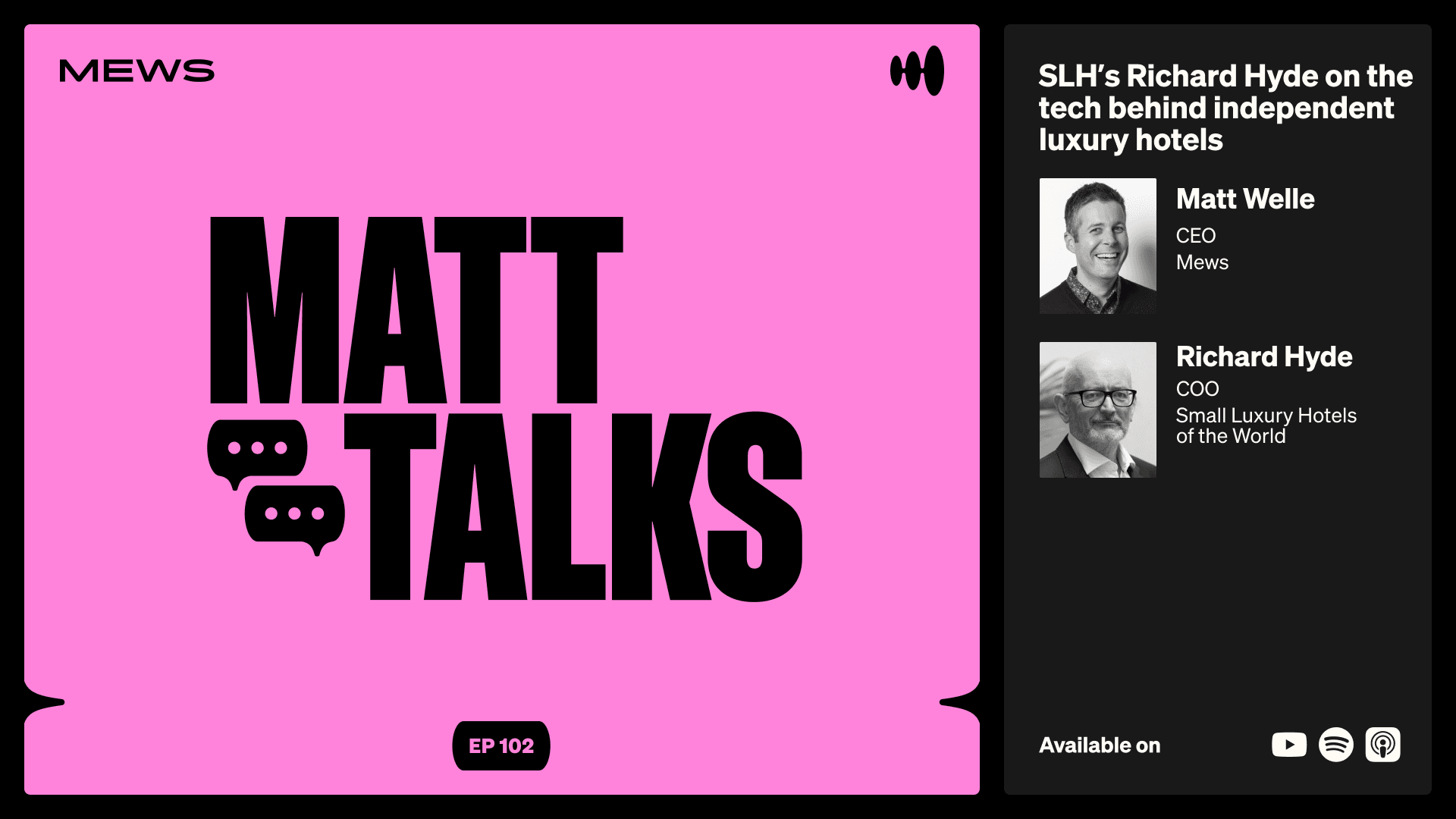
Matthijs Welle
CEO, Mews
After years in the trenches of hospitality, Matt joined the Mews journey during its early days in 2013. Since then, he’s been our fearless CEO, leading the company and the industry forward.

Richard Hyde
COO
Richard has spent more than 35 years in luxury travel and hotels. His career included senior leadership positions at InterContinental Hotels & Resorts, Conrad Hilton, and The Maybourne Group.
Episode chapters
Transcript
[00:00:00] Richard Hyde: People are. They're just tired. And they're tired of being on the whole time. So, we focus a lot now on being off. Come into our hotels and relax. Our definition of luxury is along the lines of: how does a hotel stay make you feel?
[00:00:25] Matt Welle: Hi, everyone. Welcome back to another Matt Talks Hospitality. Around 2,000 hotels apply every single year to small luxury hotels, but only 50 to 75 actually get in. And I love those numbers because it means there's a really high bar for quality. And today, we have Richard Hyde; he's the Chief Operating Officer at SLH, and we're going to dig into that. Like, what is SLH? What is luxury travel? What's their strategy around technology? We have a wide-ranging set of questions, and we'll see where it takes the conversation. Richard, thank you for joining me today.
[00:00:57] Richard Hyde: Yeah. No problem. Nice to be with you.
[00:00:59] Matt Welle: So you've got what, 700 hotels odd in about 90 countries today?
[00:01:04] Richard Hyde: Yeah, I mean, live today, which is normally what we measure it by, is 737 in 97 countries.
[00:01:11] Matt Welle: 737.
[00:01:12] Richard Hyde: Yeah.
[00:01:13] Matt Welle: Is everything a hotel, or are there also unconventional hotels in there?
[00:01:17] Richard Hyde: Yeah, I mean, that's a good question. I mean, 5 years ago, yeah, they were all hotels, but now we're starting to add luxury tented camps, which we have in Tanzania. And also, we have a couple of boats, cruise lines. We've got one on the Nile, one in Vietnam and one in the Galapagos. I mean, they're all kind of eco-cruise lines. I mean, they're not cruise liners in the traditional sense. They're either sailboats or they run off electric power or green diesel, whatever you call it. There's a kind of an emerging trend to add luxury accommodations which aren't necessarily hotels, and we're also talking to a couple of the train operators.
[00:01:59] Matt Welle: Is that like a remnant of COVID, when everyone realized when we were trapped in our homes, we wanted to invest in experiences or had that started earlier already?
[00:02:07] Richard Hyde: Well, a lot of it is supply-driven. So, if you get an entrepreneur, say, that makes their money in packaging, you know, having a hotel is a nice thing to have, a nice kind of hobby. And, you know, they put their passion and their own thoughts into it because most people travel a lot and they've got their own ideas of running a small hotel. And if they're interested in cruise lines or luxury tents or trains, then it just adds to the diversity of supply. So, it's a good thing in a way. It just gives people the choice, right?
[00:02:41] Matt Welle: Because the brand, like the name, is small luxury hotels. So, have you ever considered changing the word hotels to something different just to facilitate to a wider range?
[00:02:48] Richard Hyde: Yeah. Well, actually, Matt, it's Small Luxury Hotels of the World. That's our brand name. Small Luxury Hotels would be impossible to trademark, but we trademark Small Luxury Hotels in the World. We're one of the few companies that kind of do what we say. So, our hotels are small. The average size is just over 40. New hotels are joining in. It’s getting smaller and smaller. So, that's interesting. Obviously they're luxury, and they're of the world. So, we've got hotels as far afield as Los Angeles in the west, to Japan in the East.
[00:03:20] Matt Welle: And have you stayed in the majority of them by now? Like, you've been there for almost 20 years, I think, right?
[00:03:24] Richard Hyde: I wish I had. But you know, I do try to spend a few days on vacation in one of our hotels that, you know, is mainly on business, and you know, we have regional meetings where we get together as a community of hoteliers, which is equally important because then, you know, our independent hotel owners like to socialize with their fellow people.
[00:03:46] Matt Welle: Lovely. There are worse places to stay, I guess.
[00:03:49] Richard Hyde: There are worse places, absolutely. Yeah. It's a tough one.
[00:03:52] Matt Welle: How is, like, the word, luxury, I think it's quite a loaded word. You know, it could mean so many things. How do you define luxury in your portfolio?
[00:04:01] Richard Hyde: 20 years ago, 10 years ago, you’d probably say it's about experiences, and you know, being able to offer experiences as well as kind of the traditional trappings of the hotel stay. But you know, recently we've sort of gone back and this is validated through research is focusing on relaxation. So, you know, with people constantly online, with notifications left, right and center from text, email, WeChat and WhatsApp. People are just tired, and they're tired of being on the whole time. So, we focus a lot now on being off. You know, come into our hotels and relax. You know, maybe not in the way that it was in the 70s or 80s, but you know, with wellness and kind of yoga retreats and all that kind of stuff, the offering is kind of more extensive, but the theme is to relax. So, our definition of luxury is along the lines of how the hotel stay makes you feel. I call it the ‘F’ word. It says how you feel, and that can mean lots of things. But it's mainly around, nowadays, does it make you feel relaxed? Does it de-stress you? Does it make you feel happy? And that, in a way, is what we think is luxury now. I mean, everybody has a different definition. You know, if you go to some of the Uber luxury hotels, like, I don't know, Rosewood or Aman, it's probably more on the architecture and the product and service. But you know, with us, it's very much on how you feel. So, that's kind of our definition of luxury, if you will.
[00:05:38] Matt Welle: Like, there's the real estate elements, of course, like, to make things look beautiful, but then there's also the how do you make people feel. How do you drive that as a network? How do you drive that, like, level of service in hotels?
[00:05:49] Richard Hyde: Just traditional, really. It's just attention to detail. So, you know, staying in a luxury hotel, I mean it goes, you know, from your business is from the booking part. Was it easy to make a booking? Did you receive the correct confirmation? Did it make you feel confident that you've booked the right hotel? And then, you know, you fly to a destination, we drive to a destination, and so that's hassle, and you get there, and you know, especially if you're with your family, you want to kind of validate that you've made the right decision. So, you know, it's the check-in experience. If it's in the middle of nowhere, was it easy to find, or not? Did it wind you up? So, you've got to make it easy. You've got to make it easy to book, and the check-in experience needs to be as seamless and hassle-free as possible. And then, you know, did you get the room that you booked, or you thought? Did the pictures match your expectations? Is there an element of AI-generated images nowadays, and you're a bit annoyed that it didn't match your expectations. So, it's the whole customer journey really is just to make you feel good, and you know, with the attention to detail from booking to, you know, and also, you know, the checkout and the goodbye is as important as arriving at the hotel. So, it needs to follow all the way through. And then, obviously, if you go back to the hotel you've been before is recognition and all those kinds of good things, so.
[00:07:18] Matt Welle: I grew up in Hilton, and I saw that in your background you've also worked at different brands. There used to be these brand standards that would say, like, oh, you used the guest's name three times during the check-in and name three facilities, etc. Do you feel that those standards today get in the way of creating those experiences and that we should have less standards to describe the human interaction?
[00:07:37] Richard Hyde: Yeah. We use a word or two words, emotional intelligence, which is, you know, everybody's different. I mean, I'm slightly privileged, but when I go to a hotel, I do not want to be shown around the room. I know how the TV works, I know how the window works, I know where the bathroom is. So, for me, the check-in experience they have that kind of simpatico with what I need. So, it's really just to try and be open enough as a hotel person to understand what the guest really wants. And they are all different. So, you know, you can talk about customers that like contemporary hotels or traditional hotels, or they want loud music, but to be honest, everybody's different at different times. You know, we have young people, you know, under 25, that like going to Nobu Hotel, which has loud music. But we know that the same people will go to a wellness retreat where there is no noise because what they want to have, their state is different. So, lots of people are different, but also lots of people are different at different times.
[00:08:40] Matt Welle: Yeah. The segment is not attached to the human, but it's attached to the trip almost. Like, on this trip, I'm feeling like this kind of person.
[00:08:46] Richard Hyde: Yeah. I mean, sometimes, you go on your own or with your mates or with your wife or with family or girlfriend or you know, whatever, boyfriend. Yeah. I mean, you’ve just got to try and anticipate what people and technology can help in that respect. So, yeah, I mean it's very difficult. We've put people in pigeonholes. You can't. People are so different now. Isn't it? They're so demanding that, you know, you can't second-guess. I think people are far more sophisticated than they perhaps were.
[00:09:16] Matt Welle: Fair. So, in my intro, I talked about 2000 applications that you get every single year from different hotels that want to join. Are those numbers correct? And it sounds like you turn most of them down. So, what does a hotel need to have to fit in the portfolio perfectly?
[00:09:30] Richard Hyde: Yeah. I mean, we do get a lot of applications, which is great and very gratifying. So, we have an online, a joint SLH website, and to be honest, you know, and we're grateful for the applications, but you know, the majority of the hotels applying just aren't suitable. You know, that may be wishful thinking, or they just haven't really thought about it. But so, you know, we can look at the applicant's website, and you can generally turn them down pretty quickly. No offense. But so, you'll get to maybe 150, 200 hotels that are suitable. So, then we go and visit. We have a team, a development team. We go out and visit the hotels. So, they vet the application, and they experience the hotel and talk to the owner and see what their plans are and what they want out of the venture. We take it from there. But you know, by the time the process is completed, you end up with 60, 70 hotels out of, I know, 1400, 2000. So, it's like 5%. And then there are some hotels or locations where we don't have a hotel that will actively try to recruit a hotel. So, we know from our own website where people are searching and what we call an unfulfilled search. So, we don't have a hotel there, but we know our customers want us to be there. And then we'll try to find out if there are any independent hotels and see if they wish to join us.
[00:10:55] Matt Welle: Because I wake up every week in different hotels. When you stay at one of the big brands, you often don't know where you wake up because the room could be anywhere. But I'm assuming your portfolio is much more custom and much more unique. How do I know that I'm staying in a SLH hotel? What makes it a unique experience?
[00:11:11] Richard Hyde: That's the crux of our brand, to be honest. So, you know, good, good question. So, we kind of say, you know, we want guests to feel that they are somewhere rather than just anywhere. You know, how does it make you feel somewhere? So, obviously, it needs to be independent, it needs to be small, it needs to be characterful, it needs to have great staff. Most importantly for us, it needs to be independently minded. And it needs to be rooted in the location. So, you know, there's no point in going to a hotel on the Côte d'Azur that is decorated like a hotel in New York. And you know, the pictures are kind of standard pictures from IKEA or something. The passion of the owner needs to shine through. So, I'd say the majority of our hotels are still run by the owner. So, they have a personal, vested interest in the success of the hotel and how it's run, and that really kind of shines through. And a lot of general managers or owners will greet the guests as they come in or greet them over dinner or around a pool or, you know, hopefully, discreetly. But that's that sense of being independently minded, having an engaged owner that's passionate about the hotel, and that independence is rooted in the location. I think those kinds of 2 or 3 things are really important.
[00:12:29] Matt Welle: Hi! It's Matt from Mews, and I hope you're enjoying this episode. Before running Mews, I ran hotels, and I remember what it was like on the weekends when you're trying to create the best experiences for your guests. Also worrying about setting the right rates and dealing with all of the demand changes that are happening. This is a thing we've solved with the Mews RMS that lives inside the core of the Mews Operating System. You now have access to all those tools on the same screen. You can even switch on autopilot. So, all of the recommendations, we will just adopt those and communicate those to the online channels for you. We've seen hotels that have deployed the Mews RMS see an uplift of about 13% in revenue per available square meter versus hotels that have no RMS at all. If you want to find out more, head to mews.com.
[00:13:12] Matt Welle: Yeah, because the thing that came back as I was doing research was family-owned seemed to be mentioned a number of times. So, it feels like that very personal, like, I built this hotel because I have a deep passion for the building and the experience, and then that returns to the experiences.
[00:13:26] Richard Hyde: Yeah, I said the major, I mean, some of our hotels are owned by companies, but most of them are either individuals or families. And so they, you know, put their heart and soul into it. They may be in the second or third generation. They understand hospitality. They have this simpatico. They, you know, understand; they have this emotional intelligence. You know, if you're a third-generation hotelier, you don't want to cock it up for your parents or your grandparents. So, you know, you're pretty passionate about it as well. And then we have quite a few number of hotels that are the first hotels, completely for an owner. So, you know, we have somebody in Bali who is a software engineer with Microsoft, and they bought this hotel, and they were so passionate about hospitality and also technology that they know precisely when the swimming pool is leaking. So, they kind of combine that experience of being a software engineer with running a hotel. And it's a beautiful hotel and beautifully run. But, you know, there are quite a few examples of that, of hoteliers, hotel owners making the money elsewhere. And then, you know, having a small boutique hotel, it's just a nice thing to do, really. So, the other thing to remember is the SLH itself is owned by family. It's owned by the Shamoon family. They own 100% of SLH. So, that family ethos - it's a brother and sister - that family ethos runs throughout our DNA as well. So, it's not just the hotels, but it's also the brand.
[00:14:54] Matt Welle: And I read that you have a partnership with Hilton. What does that look like as a partnership, and how do you then retain the authenticity still?
[00:15:00] Richard Hyde: Yeah. So, our partnership with Hilton, we started this in 2024. So, basically, all our hotels that wish to participate - we don't force it on hotels; they can opt in. And we have 575 hotels that have. So, it's about 80% of our portfolio. They're featured on hilton.com, on Hilton, and on all of Hilton's digital channels, the app, allowing Hilton Honors members to book SLH hotels for ordinary pay for stays to earn points or to use their points, Hilton Honors points, to stay in the hotels to redeem their points. It works both ways. And you know there are 230,000 Hilton Honors members, so that's a huge audience for our hotels to plug into. So, it's been a huge success, and I think the majority of our hotels are really happy that we've added that value because it would cost them a lot of money to have that reach with, I don't know, Google or some other paid marketing to reach that level that Hilton does. And they simply pay a commission on the booking. So, you know, there's no pay entry fee.
[00:16:08] Matt Welle: So, at the start of the conversation, we talked about how luxury is changing, and people are leaning more towards experiences and spa experiences. Does that change then what you expect from the real estate of the hotel, or how does that change what you sign up today, knowing that this is what the future will look like?
[00:16:25] Richard Hyde: Yeah, I mean it's obviously hugely difficult to add a wellbeing retreat to a city centre hotel, so. And also underlying a lot of things nowadays is sustainability. So, you know, that equally applies, but you know, a city centre hotel can still be sustainable. But to answer your question, yeah, we are sort of evangelizing that well-being, and it doesn't necessarily have to be an expensive kind of wellness retreat, you know, with all the spa treatments, swim calls and activities; you just make it, you just kind of make an effort, so maybe some rooms that you can convert into a well-being space or some lands with some in the garden that you could convert. But we're very kind of hands-off, so we're very much a soft brand. So, we don't dictate to hotels, but we do kind of share the latest trends, and it's up to the hotels to follow or not. But to be honest, a lot of hotels are leaders anyway, so, you know, more often than not we follow them. So, you know, you've got a lot of, kind of going back to your original question about owners, you've got a lot of very clever, dynamic, young entrepreneurial hoteliers. You know, you go to Südtirol in Italy. You know, some of the architecture and some of the hotels are simply amazing. And a lot of that is based on well-being. You know, Germany, Austria, Italy, Switzerland - well, in Europe, they all have got some amazing facilities. And then, you know, you go to the regional kind of areas in the world for well-being, such as Goa and Kerala, India and then in Vietnam, Thailand, China, even.
[00:18:08] Matt Welle: Because you talked about this team that hunts for hotel locations. Like, what are some of the things that people are searching for where you don't currently have supply that you would like to fill? Like, the new luxury traveler is seeking out because we've all been to London, Paris, Rome, like, where should we be going?
[00:18:24] Richard Hyde: Well, it's not as exciting. The answer is not as exciting as you'd think, I'm afraid. The number one location where we don't have a hotel is Hawaii. So, if there are any small luxury hotels in Hawaii, please ring me. But our hands, probably, up in the top 5 is Las Vegas. So, again, if you can find a small boutique hotel in Las Vegas.
[00:18:42] Matt Welle: Are there even boutique hotels in Vegas, or does it have to be a minimum of 1000 rooms?
[00:18:45] Richard Hyde: Yeah. Exactly. It's all comparative, isn't it? Yeah. That's why we don't have hotels in Hawaii, Las Vegas and, in some respect, Dubai and some of the other places as well. It's hard to find a small enough product that matches the brand. And then you've got a big increase in demand for coolcations, which I'm not a fan of that word, but you know, Iceland, Scandinavia, Norway is booming, Sweden, Finland.
[00:19:12] Matt Welle: Coolcations? Is that what… I've never heard this word before.
[00:19:14] Richard Hyde: Yeah. Coolcations is to get away from the summer heat. So, if you go to Greece, you know, Greece is amazing, but maybe not in August. Same with, you know, some other parts of Europe, Spain, you know, the temperatures over the last 5 years or so are sort of getting uncomfortable. So, there's a big trend for coolcations. Not staycations, not vacations, but coolcations.
[00:19:41] Matt Welle: I agree it's not the most sexy word, but it does describe what it actually is.
[00:19:44] Richard Hyde: Actually hard to say. Coolcations. Coolcations.
[00:19:47] Matt Welle: Mews and SLH have been partners for a couple of years. I think we signed our partnership in 2023. What does that partnership look like for a hotelier?
[00:19:55] Richard Hyde: Yeah. As I said before, we're very kind of hands-off. So, we don't dictate to a hotel what PMS they use. We have 737 hotels, and I'm afraid to say we have about 150 different PMS systems, which creates its own issues. But our preferred partner Mews will help us to get that number down because it's important for consistency and two-way interfaces and all the old stuff, rate and availability, parity, doing all the terms and conditions. If you've got one platform, it helps. So, we're keen to push the partnership, and for a hotel, they can plug into our knowledge of Mews and the preferred rates that you've provided. But more importantly, we can just, with confidence, hand them over to you because, you know, we're not PMS experts. So, you know, we're experts on the CRS and how all the marketing loyalty works. But you know, we like working with people that know what they're doing because it makes our life easy. So, to answer your question, it gives them a handshake, if you will. So, we just literally pass them over to you, you know, with the confidence that they'll be looked after. We are hands-off. We don't dictate what PMS a hotel has to use.
[00:21:08] Matt Welle: Which I think is a great thing. I think hoteliers want that freedom to do the thing they want to do to run their hotel, right? They want to create the experience. And one of the things, when we started Mews, we started with a small luxury hotel in Prague, and we didn't want a reception desk. Like, we just didn't want to build it into this lobby, this beautiful lobby and then just slam, like, this marble desk in the middle of it. And we just got stuck, technology-wise, because we wanted to create our own custom guest experience. And that's where the heart of Mews started. You know, we've taken that to the next level now, where you just have complete freedom to create what you want the arrival, the departure, and the in-stay experience to be. And that's landed really well with those types of hoteliers. Where does technology get in the way of luxury travel?
[00:21:49] Richard Hyde: It has to work. I think the big thing in the moment is probably security, you know, about being hacked and credentials being stolen. Because it’s so easy to, you know, you got, you got hundreds of hotels, and you've got all these young people, you know, or admin people; they're so busy, and you know, their credentials can very easily be stolen. So, you know, that's an issue from a hotel point of view is to make sure is to try and secure your data and do all the stuff. And that will affect both CRS and PMS.
[00:22:23] Matt Welle: I'm actually so thankful that you actually said it out loud because I think a lot of people don't want to bring up cybersecurity as a topic, but I think we've seen so many breaches in our industry in the last couple of years. It's been elevated, and you know, we've built all the security tools, but hoteliers have to actually set them up and spend some time configuring them. And when they do, they don't see the challenges. But often it happens after the attack; they get angry, or they try and figure out what happened, but then at this point it's already damaging the reputation of that hotel, and we want to be ahead of that. And so, I'm so glad that you, you said it, because you have to do that up front instead of after the attack.
[00:22:59] Richard Hyde: Absolutely. And it's very difficult to trace. So, you know, you've got such a long string nowadays. You know, they've got the hotel to the PMS to the interface, the CRS to all the channel manager that goes through somewhere else, and it goes to booking.com or whoever. So, it's very hard to trace the leak. But you know, you’ve just got to follow best practices: two-factor authentication. And then obviously, with AI, it's very hard to determine what's genuine and what isn't. You know, you click on an email. I mean, people impersonate me. I'm sure they impersonate you.
[00:23:33] Matt Welle: Like, several employees receive a WhatsApp from me asking for a quick call. I'm like, “I would never WhatsApp an employee because we have internal communication channels.” But, like, they don't know.
[00:23:43] Richard Hyde: Yeah. It's a big problem. So, that would be where it… Quite an example.
[00:23:47] Matt Welle: That gets in the way. Yeah.
[00:23:48] Richard Hyde: And probably you need technology to solve it. And then you've got AI, which is a bit of a distraction, to be honest, for hotels. It's still a new area. I mean, you can use it for rate management, you can use it for forecasting, you can use it for manipulating your pictures, you can use it to create content, you know, where does it stop? And you know…
[00:24:11] Matt Welle: Are you nervous about the disintermediation of SLH as a website, as an aggregator where people do their search, and AI will just give a recommendation and they go straight into the local website to book direct.
[00:24:23] Richard Hyde: I mean, we have done throughout history. I mean, everybody thought that the Internet would destroy the travel agent and the GDS systems. But for us, the majority of our business comes from traditional travel agents using the GDS, which was borrowed from Sabre, I don't know, 30, 40 years ago. So, I'm not overly worried, but I understand where you're coming from. I was in China recently, and it's amazing what tools can be used to create micro APIs into your RES platform and from your own browser. You don't even need to have a proper app. You can build a mini app using software. I mean, you know more about it than I do, but OpenJaw or something like that. But it is a worry. Just when you think you're out of COVID and business is good, and you can relax, something else comes along. So, who knows? I don't know. Maybe this is a whole, it's probably a Mews conference on its own.
[00:25:21] Matt Welle: I agree with you. I think especially in the luxury segment, people will still want to use a travel agent who has personally experienced things and makes these personal recommendations. And I think in your segment it's probably not as prevalent as it would be in, like, a budget segment where you're just looking for convenience and then AI makes it easier. And actually I think the travel agent business is booming at the moment. I think they're doing better than ever before.
[00:25:42] Richard Hyde: But also it kind of suits our hotels. You know, if you've got a small boutique hotel in the middle of the Netherlands, or if you've got an island in the Maldives that's still very hard to book online because you need to book the boat and the seaplane, and yeah, that has to match the plane landing at the main airport, and your grandparents are coming on a different. It's hard, you know, so you know, travel agents have an enormous contribution still to the booking path.
[00:26:14] Matt Welle: Love that. The last question I always ask every guest is: what's something in hotels that irks you today? That something that you wish that technology would fix? Because I could actually fix it to some degree. But what's something that you would love for Mews to fix for you?
[00:26:27] Richard Hyde: That's easy to answer because I just experienced a hotel in China. It’s the in-room switches, the light switches that you have now. In the old days, you put the key card in the little socket by the door, and it would turn it on and off. That was fairly good. Nowadays, you have buttons everywhere. Sometimes, there's a master switch. When we click the master switch, there are still sort of neon lights everywhere. I mean, normally you have to press about eight buttons to turn everything off or everything on. And that just drives me crazy. And surely with sensors, it could sense you're in the room. It just needs a complete look at, and, you know, air conditioning, which other people either love or hate, or they have to have it. What's wrong with an on-off?
[00:27:15] Matt Welle: Not everything needs an app. Yeah.
[00:27:16] Richard Hyde: Or analog. Right? So, because, at the end of the day, I mean, the stay’s short. So, our stay is like two-room nights per reservation. So, you don't have time to work out all this crap. You know, just do it quickly. If you're there for a week, okay, you'll figure it out. But if you arrive late and you know you've got to depart early, then you just need some solution that will. It's the same with the TVs, I mean, the TVs are sometimes so hard to manipulate. It's just basic things. Right? So, yeah, that would be my thing is to have another, yet another go at in-room technology
[00:27:51] Matt Welle: Like that I can't fix because it's hardware. But we do partner with a lot of them. So, I'm sure I'll have one of them on a podcast very soon, and I'll make sure that I pass that question on to them. I think the lights in the room are a very recognizable challenge that people experience.
[00:28:04] Richard Hyde: People think, “Oh, you know, I've got all these buttons, and you got this master switch. What are you talking about?” But just check yourself into the room and just feel. It goes back to my very original point about how does it make you feel? If it's annoying, then, you know, I mean, so that is the ‘F’ word. The whole stay experience is ruined because you can't turn the lights off.
[00:28:25] Matt Welle: I'll get on that. I really appreciate you spending time with me today, Richard. Thank you for sharing all your insights. I went through the list of hotels, and I've stayed at so many of your properties because I just love the brand so much, and it's exactly what I need when I have a busy workweek and need to get away to a nice hotel. I'm obsessed with the brand. So, keep doing what you're doing. Thank you for joining me, and hopefully we'll speak to you again soon.
[00:28:46] Richard Hyde: All right, Matt, thank you. Enjoyed that. Thank you.
[00:28:48] Matt Welle: Thank you.
[00:28:49] Matt Welle: You've made it to the end of the episode. And thank you for listening along. I know what it's like to run a hotel and to, you know, get wake-up calls at 2 am when the fire alarm goes off. And that's the exact reason why this show exists, so that I can help share the stories of other people that have lived the same pains but have found solutions. And hopefully, you're learning from these solutions. Like and subscribe, and make sure that you follow along so that we can keep you informed about the next episode dropping.