What to expect?
Meet your speakers

Matthijs Welle
CEO, Mews
After years in the trenches of hospitality, Matt joined the Mews journey during its early days in 2013. Since then, he’s been our fearless CEO, leading the company and the industry forward.
Leah Rankin
CPO, SiteMinder
Leah spent 25 years in product and tech across telco, travel and software before joining SiteMinder, where she led the customer teams before finding her way back into product.
Episode chapters
Transcript
[00:00:00] Leah Rankin: It's actually not about the number of channels. It's not even about the type of channels necessarily. I think it's about where your right guest is searching. It's making sure that we're putting the eyes in the right place to get the best guest for the hotel.
[00:00:27] Matt Welle: Hi, everyone. Welcome back to another Matt Talks Hospitality. And we keep on talking about SiteMinder, and I thought it was time to bring them in because at Mews Unfold, we announced something that we want to do for a very long time together. And SiteMinder's distribution engine, which is the largest in the world, is now being built natively inside Mews. So, availability rates, inventory, and other content will not be handled from one single place, closing a gap that hotels have been trying to bridge for a very long time. And my guest today is Leah Rankin, who's the chief product officer at SiteMinder. She has spent about 25 years in tech, so I'm dating you a little bit here. Sorry for that. She joined SiteMinder first in a customer-facing role, and then she moved into a product role, which I always find very interesting. So, that's probably where I'll start. But, Leah, thank you for joining me today.
[00:01:12] Leah Rankin: No problem. Thanks for having me.
[00:01:13] Matt Welle: You started on the customer side. Like, I saw your history. You actually came from the product side, and then you entered SiteMinder on the customer side. And then after a few years, you moved into the product side. So, like, that's very illogical, I think, as a career path.
[00:01:27] Leah Rankin: Yeah. It definitely isn't a kind of a standard career path. I'll give you that. But my passion's always been about customers, about building great products. And interestingly, when I finished a role, I connected with someone who was working - who's currently the chief customer officer at SiteMinder who I've worked with in a previous life. And he suggested to me that I came in, in a customer role, actually looking after the onboarding team at that initial stage. And I must admit, like you, Matt, I was like, well, why would someone, you know, with a product and sort of tech background move into that type of role? And you know, he really convinced me that it was actually a really fantastic opportunity, a logical step even, because when you think about building great products, often how they're serviced and how you talk to your customers, that's as much part of the product experience as the product itself. And also building great, high-performing, and high-functioning teams was something I was super passionate about even in the product and tech space. So, actually, there was a lot of sort of synergies, I suppose, and he was right.
[00:02:28] Matt Welle: You have a deep empathy probably for the customer who has to suffer through some of the workflows that you now get to fix on the product side.
[00:02:34] Leah Rankin: Correct. Although I'm sure I'm still not fixing as many as the customer teams would like me to, but no, for sure, it really gave me such a great insight into, really, what was the pain customers felt, you know, not even just the customer, but our teams, to really understand how we could make a difference. So, getting back into product, which I must admit, as much as I love my time in customer and I love the team at SiteMinder, I really felt I was coming home. It's definitely where I'm meant to be, but it was such a great step to kind of come back in and really have that knowledge, have that, you know, real feeling because you've been at the front line, I guess, of really understanding what customers are feeling and what they're loving, what they're not loving.
[00:03:14] Matt Welle: What was the first thing when that’s like, I'm gonna finally fix this thing because it's been bugging me?
[00:03:19] Leah Rankin: I have to say it's the onboarding experience, and I wouldn't say we've yet nailed it, Matt. But I am pleased to say that's one of the things we're tackling first with our partnership. So, I feel like I'm making sure I'm playing that forward for sure.
[00:03:31] Matt Welle: Right. So, how many hotels today worldwide run on SiteMinder?
[00:03:35] Leah Rankin: So, we've got over 53,000 hotels that currently use the SiteMinder platform.
[00:03:38] Matt Welle: That's a mind-bogglingly large number if you think about how many hotels it actually is. How do you make 53,000 hotels happy? How do you prioritize what you build first?
[00:03:47] Leah Rankin: Great question. Prioritization is, I think, one of the hardest things in any company. I'm sure you would agree. But really for me, it's gotta be based on data first and foremost, and we try and do that as much as we can, whether that's quantitative or qualitative, obviously. But it's a really hard balance between making sure we're doing enough of the big bets, enough of the big, you know, really impactful features and improvements to the product to make sure our hoteliers are realizing more and more value, but also that they see that we're constantly innovating and staying ahead of what's happening in the market and balancing that against the small things. I'm actually quite passionate about small things. I often talk about, you know, making those constant small iterative improvements, you know, as being sort of the polish to make things really shine, and obviously making sure you can do a little bit of both of those, I think, is really important.
[00:04:40] Matt Welle: And what's something small that you guys have released in the last year that you're like, that's actually really lovely. I wanted some appreciation.
[00:04:46] Leah Rankin: Yeah. For sure. Well, I think there's been a lot of work that's done just even in our channel manager around improving the way we even display error handling. It might sound like something super simple, but just little tweaks and improvements to how we bring those errors in front of the customer so that they can address them. You know, we can already see the benefits and the improvements that we had when it comes to driving even support calls down. So, it's things like that that I think are just really important that you can continue to drive, as well as obviously all the other exciting features that I no doubt we'll get to talk more about.
[00:05:17] Matt Welle: I think, you know, we'll never get appreciation for a slightly faster system or a slightly better-written error message, but that is when, like, the friction really happens. When you don't do these things right, they have to now reach out to support, log a ticket, and get up-and-down communication. So, it's a small thing that we do that I love, and I love that that's the thing you talked about, but it actually has a tremendous impact on how people experience their products.
[00:05:40] Leah Rankin: Yeah. Definitely. It definitely does. You know, I think sometimes spending time, again, I suppose going back to my days in customer, but really understanding why customers are calling, and it's often not what you might think. And so, some of those small things.
[00:05:53] Matt Welle: They're calling for a friendly chat, right?
[00:05:55] Leah Rankin: No, they're definitely not. Exactly. If only that were the case, but no. But, yeah, they're always, you know, looking for answers. And if it is something that they just don't know how to, you know, if they're confused, they've got, you know, no way of understanding how to navigate a particular task, you know, that's problematic. And so if that's driving a call and there's a small thing we can do to improve that, then that's what we should do.
[00:06:17] Matt Welle: Sometimes customers do call with good news. I had a customer last week. And normally, when you reach the CEO, it's probably the last escalation point. So, I deal with a lot of escalations and, like, I enjoy speaking to customers, but most of the time I'm like, oh, shit! Let me figure out what's going on. And actually, he called because he's had such a delightful experience with the team, and he's like, I just think it's important that you know it. And it just made my day because, you know…
[00:06:39] Leah Rankin: Amazing.
[00:06:40] Matt Welle: It's so rare to hear some of those things when someone actually reaches out and calls you to say something really positive.
[00:06:45] Leah Rankin: Definitely. Everyone's very quick to pick up the phone if there's a problem. But yeah, that must have meant that you'd nailed it. That's really great to hear.
[00:06:53] Matt Welle: Distribution, and you've been in distribution for 20 years with SiteMinder, but it is sometimes quite hidden, right? So, it's a lot of the very hard pipelines between the channels and the PMS, etc. So, how do you innovate in a space like that?
[00:07:07] Leah Rankin: Look, I think we have to continue to innovate, right? The distribution and the depth of distribution that we have is absolutely something that I'm certainly hugely proud of. It is at the heart of who we are, and we have that real depth of connectivity with over 2,000 ecosystem partners now, which is amazing, and we have obviously over 130 million reservations that flow through the platform every year, and that number obviously continues to grow. So, for us, it's about looking at that depth of connectivity and distribution and thinking about the data and the intelligence and thinking about how all of that can come together to really make sure that we can level things up to hoteliers, help them join the dots, understand what is a great distribution strategy, how do they get more of the right guests through the right channel at the right price. So, it's really thinking about how all of that comes together and continuing to innovate in that space. I think with AI, the other really interesting thing that's happening is that kind of more unified experience, the data flow, how that actually all starts to join up is becoming so much more important because, of course, that then unlocks a lot of the agentic workflows that we can now play out to continue to add value, and you know, give time back to hoteliers. So, from my perspective, it's, you know, constantly thinking about how we can continue to change that and improve things for hoteliers.
[00:08:33] Matt Welle: I'm really intrigued by it because, you know, back in the day, you'd go on Google and you, like, look for a hotel by the beach, and then you enter Booking or Expedia. And then with filters, you find the hotel, and then you either book there or you go to the website to actually end up making the booking. I think a lot of people today start in a large language model where they start to query it. Where does distribution sit in that? Like, how do we enable hotels to be visible on a large language model, and an end-to-end booking process?
[00:08:59] Leah Rankin: Yeah. It's all about the content. If you think about, as you just said, if you think about times of past where you've actually had to go into a UI, user interface platform, and then you use your filters to drill down, I want a four-star hotel. I wanna make sure it's in this location, maybe a certain distance from a particular location. But you're actually using all of those fields, you know, within the user interface. You're entering them as filters, ultimately, as you just said. But fast forward to today, you're saying, “I'd like a weekend away, you know, dog-friendly, near a vineyard, you know, somewhere warm.” All of a sudden, those parameters need to be able to be made sense of, and we need to be able to make sure that hotels are capturing all of that data in a way and structuring it in a way and presenting it in a way that these large language models can find it and can make sure that they bring the right hotel back in the result.
[00:09:53] Matt Welle: And then, if once it's given you a hotel result that you like, what do you think will happen then? Do you think that my personal agent can actually make the ad spend booking, including payments? Or do you think it will still route into a booking engine or into a website?
[00:10:07] Leah Rankin: Oh, good question. I know there's a lot happening in this space at the moment. The race is on, I suppose, to try and sort of figure out whether we can do the full end-to-end booking. The truth is, booking is hard, as you know as well as I do. You know, there's a lot that needs to happen when it comes to payments: making sure that payment's done securely, you know, making sure that there's no, you know, fraud is very serious, obviously, in that space. But also there's a lot to be done when it comes to post-booking, you know, whether there's changes, whether there's amendments, whether there's other modifications that need to be made. So, in times of past, when even in the meta space or when, you know, some of the big names have tried to do sort of booking all the way through, they actually found it to be difficult, right, which is where booking has managed to land back with us. I don't know. I think the times have changed with the agentic. There's so much happening. The technology is moving so quickly. I think we will end up in a space where booking can happen all the way through. We're certainly looking at making sure that we can facilitate that, should that be the case. But early days, I think, on whether that's really gonna land. Let's see. Let's see.
[00:11:17] Matt Welle: Yeah. It's definitely interesting. Yeah. And you also talked about connecting hoteliers to the world of channels. I talked to a hotelier last week, and I said, “Oh, you know, we have this great partnership with SiteMinder, so we can connect you to hundreds of partners.” And he said, “Yeah. We’d like to keep it exclusive, so I'll just stick with booking Expedia.” And I said, “But that's not exclusive.” Like, that doesn't seem like the right strategy, but how do you feel about, you know, connecting to hundreds of channels? Is that losing exclusivity as a hotel brand?
[00:11:45] Leah Rankin: It's something that comes up all the time. And I actually think that it's actually not about the number of channels. It's not even about the type of channels necessarily. I think it's about where your right guest is searching. So, actually, I think it goes beyond just thinking about, right, booking on Expedia, or I'm only interested in direct. It's making sure that we're putting the eyes in the right place to get the best and the right guest through the right channel for the hotel. That's what I strongly believe. So, for us, it's then looking at this holistically to say, right, okay, maybe it's a combination of channels. Yes. Of course, the big channels are hugely important. There might be a smaller, more niche channel that actually is tapping into a perfect guest for that particular property for your hotel. And then when it comes to Meta, you know, that's also an important channel to start to bring traffic into your direct booking solution. And of course, you've already touched on agentic. That's a whole other channel that's booming now as well.
[00:12:47] Matt Welle: But if a hotel has, like, a choice of, like, 500 channels to go for, how do they know which is the right channel for them without having switched it on?
[00:12:54] Leah Rankin: Yeah. Great question. I think one of the things we're looking at doing, and we're already doing, is trying to give more data to hoteliers so that we can help them make that decision. And so if we are seeing that we're getting activity from a particular market, source market, in a particular channel that they're not connected to, let's surface that. That's part of the, I suppose, the innovation you asked me about that we're definitely making sure we do to keep that distribution strong.
[00:13:21] Matt Welle: Yeah. So, let's talk about the Mews and SiteMinder partnership. You are, for years, you've been the number one integration in our marketplace. I think we've got about 3,000 customers in common that are using Mews and SiteMinder together. So, what's the next iteration of this partnership? What's the thing that you're excited on the product sites that we're developing?
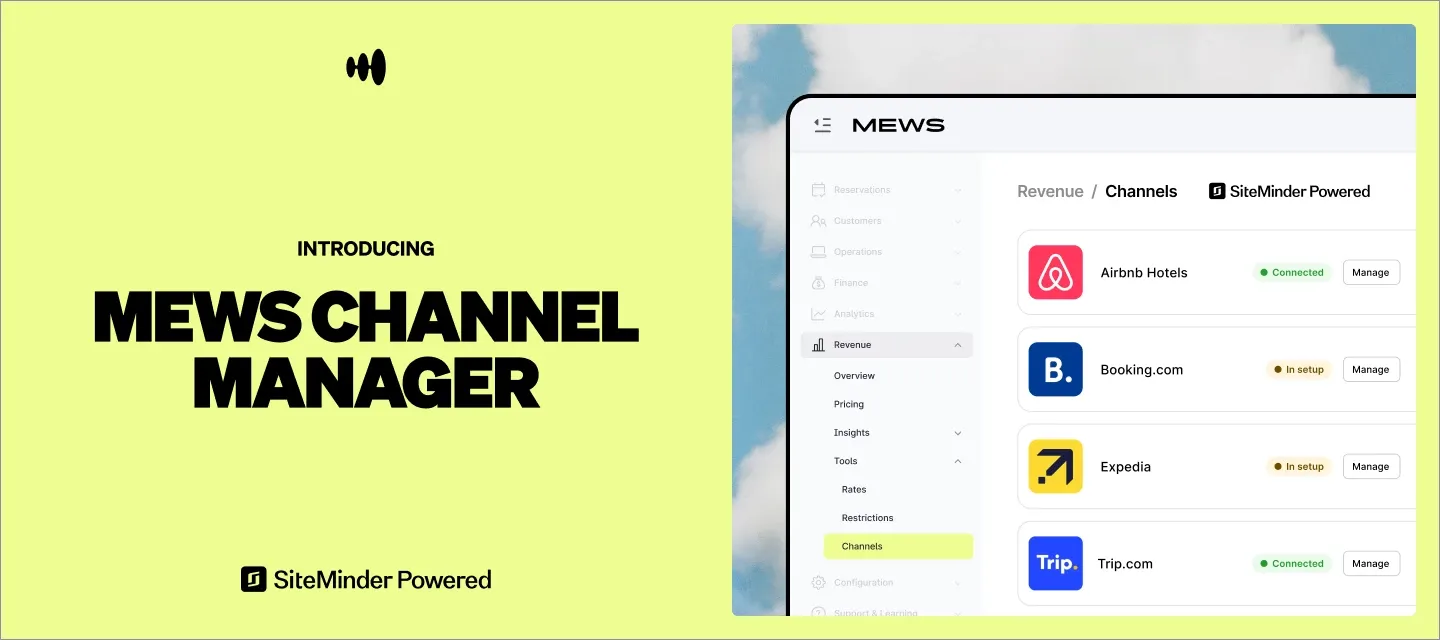
[00:13:39] Leah Rankin: Oh, gosh. Where do we start? Look, I think, first, the conversation started was in the logical place, right, at the beginning of the journey, taking the friction out of getting set up, getting connected to channels, mapping your channels makes sense. Right? And that's where I think we absolutely started our conversation. So, the first version of the Mews channel manager powered by SiteMinder is absolutely gonna take all of that pain out, which is unbelievable. And that in itself, I think, adds huge value, Matt, and I'm really excited about it. I think beyond that, we're talking a lot about how we can start to bring even more of that optimization forward. So, some of the sort of functionality that we've just touched on, you know, how do we make sure that we can help our hotels on Mews know which channels they should be connected to? How can we help make sure they are optimized for the best result? So, some of that is what I'm probably most excited about when it comes to kind of how this journey can continue.
[00:14:40] Matt Welle: I just went into Claude this morning, and I just - so we use Claude to get data pulled from across our different platforms, so our support desk is plugged into Claude, so I can ask you questions. And I asked, “You know, with SiteMinder and Mews, how many support tickets do we get, and how do you rank them? Like, what are the categorizations?” And about 45% of the tickets that we see in the last year are about configuration. And, you know, people don't wanna reach out to the help desk to configure a rate, but it's often where things get stuck. So, that's really why we prioritize, like, how do we make that as smooth as possible? Because when you create a rate on an OTA today, you have to log in to SiteMinder. You also have to log in to Mews to make sure that these three things are connected. And we just try to tie the dots: you just go into Mews to connect it to the OTA. And, actually, we're just making it really easy. And, hopefully, it makes support significantly easier. Like the goal is that someone should never have to reach out to us because they have a challenge somewhere, right?
[00:15:39] Leah Rankin: Yeah. Definitely. And again, that's about the small, simple things. I mean, you would assume in today's tech landscape that would have been nailed, but the fact that we are still talking about that as a friction point, the fact that you still have to go into three different platforms or indeed multiple depending on how many channels that you're connected to, you know, does seem quite crazy. Yeah. So, I'm really excited that we're doing that together as well. I think it's about time.
[00:16:04] Matt Welle: And is this partnership, does it work for every hotel or is it a specific segment of hotels that we're tackling together?
[00:16:09] Leah Rankin: Look, from our side, we are very strong on making sure that our distribution capability is for all hotels. You know, we have small independent hotels; we've got large independents and groups and chains on our platform directly today. So, certainly from our side, no limitations, but that's probably more a question for you, Matt, if there's a sweet spot there for Mews. But certainly, we're keen to make sure that we're delivering this capability to every hotel. That's key.
[00:16:37] Matt Welle: Great. Yeah. And like for us, we've gone now across the spectrum. So, we came up from the independent hotel, like, 13 years ago. But actually, we now serve, you know, big brands like Best Western and Choice. So, we really like the spectrum of going to as many large customers as possible. And it's, like, everyone has distribution. Like, 96% of our customers use distribution to connect to the world, which makes complete sense. So, like, the problem is really big that we can solve for, which excites the hack out of me.
[00:17:03] Leah Rankin: Yeah. Me too. Me too. Well, we're just excited to be doing this. Yeah.
[00:17:07] Matt Welle: One, we've talked a lot about the hoteliers and the pain that they feel, but does it solve anything for the guest itself as well?
[00:17:13] Leah Rankin: Definitely. If you even take the first use case that we will be able to deliver on, which is simplified onboarding, already the guest is going to get access to the hotel faster. So, that hotel is going to be set up, connected, and distributing rooms and rates to a particular channel much, much faster than ever before - less mapping errors, less problems. So, just that in itself, more reservations, more guests, so that's all positive. You know, how I can see this play out are some of the work we can do together as a partnership on making sure we get an even better result as I say, getting hoteliers access to more channels which previously just as a channel, a list of channels doesn't add value, but if we can say which are the most valuable channels and be able to really help hoteliers connect that way, then, of course, that's gonna also equal goodness for the guest. I'm quite passionate about that matching, you know, the matching of the right guest to the right hotel. Like, we've all been in situations where we're in a hotel that's not the right fit, you know, whether it be there for work, I need to focus on doing a podcast, and I need quiet and there's kids playing in the pool or whether it be when I'm, you know, out for a good time with some girlfriends and it's a bit too stuffy and corporate. So, finding that kind of sweet spot and connecting the two, I think, is actually a really important part of the story.
[00:18:36] Matt Welle: And direct connections, like we talk a lot to hotels about getting the booking direct instead of through expensive online channels. How could this, like, help drive more direct bookings?
[00:18:47] Leah Rankin: Yeah. Look, I think direct's definitely an important player. I mean, particularly as we see a lot more of the agentic search play out, we've always known Meta's been a big part to play as well. But as I said earlier, for me, I think it's the combination. It's making sure you've got access or understanding that full distribution story, and that's where I think we, as a platform, really have a sort of superpower because we can look at all of that together to really understand what is the right approach, what is the right strategy, how do you get the best result. And, yes, absolutely, direct booking is part of that, but it's a part of the story, I suppose.
[00:19:25] Matt Welle: If I'm a brand new hotelier and I'm new to the space, what are the must-have channels that I should connect to? Like, how many channels should I have? Should I be on 300, or should I be on as little as possible and slowly grow it?
[00:19:36] Leah Rankin: Yeah. Honestly, I don't think there's one answer. It's a different answer for every property, which is why this is so complicated. It isn't that you can just sort of say to a hotel, right, here you go: day one you set up, all you need to do is connect to these channels, put these rooms and rates together, happy days, you'll be able to be successful. Like, the market changes; where guests are searching changes, you know, and even some of these channels pop up. Small channels can be quite impactful in a particular market. Meta is obviously changing constantly. Even the algorithms that are used by Google and Tripadvisor, etc, that's constantly evolving. As we've said, you know, agentic - who knows where that's going to go? So, yeah, it's no one-size-fits-all, unfortunately. But that's where we've gotta lean into data. We're gonna lean into some of the technology we can now use to be able to figure out, for that particular hotel profile, this is your sweet spot. And if we can do that, then that's where the goodness comes in, I think.
[00:20:35] Matt Welle: So, you talked about Meta there. And I remember coming into the space, like, 13 years ago. Like, I was just a hotelier. I didn't know anything about PMS building, etc. And we just started building Mews. And then I kept hearing Meta, Meta. And I was like, what is Meta? To hoteliers listening who don't actually know what it is. Can you explain it?
[00:20:52] Leah Rankin: Yeah. Of course. So, essentially, Metasearch, which is looking at using platforms like Google. I'll use Google because it is the largest. So, if you're searching directly on Google, not necessarily using a chat instance, which a lot of customers, a lot of hoteliers, a lot of guests are now doing. But if you're searching on Google and you search, say, “Looking for a hotel in Sydney, Australia,” then the Meta search will actually go and find all the Metadata for that particular hotel that's been loaded up and will allow that to be populated, and you'll see it listed on Google so that hotels can actually then be accessed directly. A guest then clicks on the link; it'll go directly to the actual, direct website or direct booking engine for that hotel. So, it's really a marketing tool, really. It's a way of making sure you put, essentially, we, on behalf of hotels, put bids in to really help elevate where you're listed and how high you come up in that listing. So, it's quite a complicated algorithm that happens behind the scenes, but ultimately, marketing engine to help get you more eyeballs when it comes to search, and then that comes through to your direct booking so that you can secure the booking.
[00:22:08] Matt Welle: I do search, and then it says, okay, Booking.com has this rate, Expedia has this rate, Agoda has this rate, and your hotel website has this rate. And you wanna make sure that your hotel website shows the same rate as the others, and preferably in the first position so that the likelihood of clicking on it is high. How do I, I’m like, great. I'd love that. Like, do you have a product for this?
[00:22:27] Leah Rankin: We do. We have a product called Demand Plus that we actually use for our customers. We do all of that hard work for them, all of the bidding. We've even got smart algorithms behind the scenes, sort of doing sort of the machine learning to understand what is the appropriate bidding, and what is the right strategy for particular hotels to get the best result. It is actually a hugely successful product for us, so it's something we're really proud of, and I do believe we are going to be working together to bring that solution to the Mews booking engine as part of our partnership as well, Matt. So, really looking forward to that.
[00:22:58] Matt Welle: No. Like, the thing I get very excited about because, like, it allows your hotel to just get surfaced where people are searching. We're not specialists in, you know, search engine marketing. Like, how do I bid on these things? And I love that you guys are specialists in this field, and we can now make this successful for thousands of hotels instantly. And you do the really difficult work, which is making sure that the booking link is visible on all of the different platforms because it is very hard to do this yourself as a hotel.
[00:23:26] Leah Rankin: Correct. Absolutely. And that's where I think we've got this real opportunity to lean into our strengths, right? I'm quite passionate about this and I think this is why I'm so excited about our partnership and how we, you know, can really help lead and show the way for the industry because I do think the fast paced nature of what's happening both within the market for hoteliers to be successful, but also with technology, how quickly things are advancing, the success will equal, to me, my personal view, is success is when you can lean into your strengths and then partner with those that complement you. Because as you say, I mean, a hotelier doesn't need to be an expert in distribution. We can be the expert in distribution. You don't need to be an expert in a lot of hotel operations. You can be the expert in a lot of how hotels need to do to operate. So, yeah, I think that's how we, as, you know, working with the hotelier, can really help them get the best result, but do more of what they do best, which is run a hotel, be hospitable, you know, entertain the guests. So, yeah, that's what's exciting.
[00:24:30] Matt Welle: So, we're solving channel management together.
[00:24:35] Leah Rankin: Yes.
[00:24:36] Matt Welle: Then Meta feels like that's a big solution that we're bringing to market and making it accessible for everyone. What other solutions that hotels can benefit from are we bringing to market together?
[00:24:44] Leah Rankin: So, we're still talking a lot about some of the optimization that we believe we can surface so that we can make sure we have the best results for hotels when it comes to their distribution strategy. We also have another product called Channels Plus that we're quite excited to work together on, and that really is about taking even more of the friction out of channel connectivity. If you think of the world today, perhaps one of the reasons why hotels don't connect to 400 channels because they still need to have a direct relationship with every one of those channels; they still need to manage the commissions, you know, manage the invoicing, make payments, you know, do that reconciliation. So, that's all a lot of work, time, energy that goes into kind of managing that, which is often why they'll choose 2, 3, maybe 5 channels that are key. Our Channels Plus solution takes all that friction out. So, one to many solution that allows a hotelier to connect to Channels Plus, and we do all the legwork to do the connectivity to channels behind the scenes. There may still, of course, be a reason and a need for a direct relationship with a channel, but this is where some of that power of understanding, where there might be some smaller hotels or maybe access to particular opportunities that would not be previously known that we can actually surface through automation and through our Channels Plus solution. So, that's another opportunity.
[00:26:17] Matt Welle: Every partner that you have, you have to go and negotiate a contract with specific commissions. You have to upload your photos and availability, connect it, make sure that the payments are coming through. It is such a pain to have, you know, more than a couple of channels, because then suddenly you have to employ a full-time person, and that channel might drive a couple of bookings. But they're high value booking. So, I think what you're solving with this is a genuine pain to make your hotel, your independent hotel, visible across the Internet in all of the right channels and start to make more money, hopefully, and attract customers that you wouldn't have naturally found.
[00:26:47] Leah Rankin: Correct. And be able to do more of that automation. Because if you're thinking about the way we've actually been able to do that, where you have one central place for managing content, as an example, which, of course, will come through from our Mews integration, then that can be surfaced out to all of those channels. So, it makes it much more seamless, much more of an open opportunity for automation, and so yes, it is a lot we can do on that front. I'm really excited.
[00:27:12] Matt Welle: So, my last question is always asking you about your personal travel experiences. You travel a lot. Like, you've just returned home, I think, after 4 weeks of travel. What's something in hotels that you wish that technology would fix that still irks you today?
[00:27:25] Leah Rankin: Okay. You'll love this, Matt. And this was not pre-arranged, I can assure you. But, no, the thing that bugs me the most is you turn up to a hotel that you've stayed in multiple times before, and they'll be like, “Oh, Harley, nice to see you. Have you been here before?” And honestly, you are literally like, “Yes, I have been here before.” I've been to the same hotel multiple times before, and of course, you know, they're clearly not using the right operating system. So, I think that ability, when you first arrive, to be able to say, “Hi, Matt. Lovely to have you back. You know, we were so pleased to have you here last time. We've actually kept the same room for you, made sure you've got the soft pillows, all the hard pillows, and you know, why don't we have you down for a welcome drink? I think I remember that you enjoyed Martinis.” You know, having that upfront, I think is that would be such a great way to start your holiday, whether it be a business holiday or a personal holiday. And you know, I think I'm a strong believer in starting as you intend to go on. So, if you get a great experience at the beginning, then surely that's gonna flow through. So, that would be my thoughts.
[00:28:30] Matt Welle: It's a really difficult challenge to solve, and we're getting closer to resolving it. The challenge with, like, online channels is that you get a profile through, and it's just the first name, last name, and an anonymous email address because they obfuscate the email addresses. So, we've got all these profiles. We're like, I don't know if this is John Smith. Is this John Smith? And how do I connect kind of the profiles? But we're getting really good at it. And you know, we now have so much data that we can very quickly recognize, and we're really trying to automate as much of this as possible. And through the online checking, for example, we say, "Hey. Your email address doesn't look like the right one. Can you give us your real email address?” And that instantly allows us to merge it. The credit card - if you give us your credit card for incidentals, suddenly I'm like, ah, this is that John Smith. They have been here four times. But it's a real, real pain to solve when we did that for the last few years. But I do agree that we're getting very close to the holy grail because you should never be asked if you've been at a hotel. We should know this.
[00:29:23] Leah Rankin: I agree. I agree. And I certainly appreciate it's not an easy problem to solve, but I'm sure that if anyone will, Matt, the Mews team will.
[00:29:28] Matt Welle: We will.
[00:29:29] Leah Rankin: Yeah. Exactly.
[00:29:32] Matt Welle: Leah, thank you so much. I know it's late at night for you in Sydney. I'm over here in Europe, but I've really, really enjoyed catching up with you and learning more about the partnership. We hope to get this to market very soon so that all of our hoteliers can enjoy the connection as well. But thank you for sharing all of this today.
[00:29:47] Leah Rankin: Oh, thanks for having me, Matt. I really appreciate it. And yeah, looking forward to how this continues to go on.
[00:29:53] Matt Welle: I hope that you're enjoying this episode. Because if you do, make sure that you press that subscribe button. It really helps grow the audience and keep you informed whenever a new episode drops. We have some of the best hoteliers on this platform, and I love asking them the hard questions so that, hopefully, you can improve your hospitality business as well.
Resources
Mews and SiteMinder pioneer native best-in-class distribution inside the hotel operating system