What to expect?
Meet your speakers
Matthijs Welle
CEO, Mews
After years in the trenches of hospitality, Matt joined the Mews journey during its early days in 2013. Since then, he’s been our fearless CEO, leading the company and the industry forward.

Jim Deters
Founder & CEO, Gravity Haus
Jim is the founder and CEO of Gravity Haus, an adventure lifestyle hotel and membership club with 13 properties across the Rocky Mountain West in the USA. A platform investor and creator, Jim has spent the last two decades building companies around one simple idea: people thrive when they find places where they belong.
Episode chapters
Transcript
[00:00:00] Jim Deters: Membership sits above lodging in terms of its profitability, right? It's very high margin, and that extra third leg of a revenue stool is a very positive economic driver. It also acts as a paid loyalty program, which basically builds our direct distribution model.
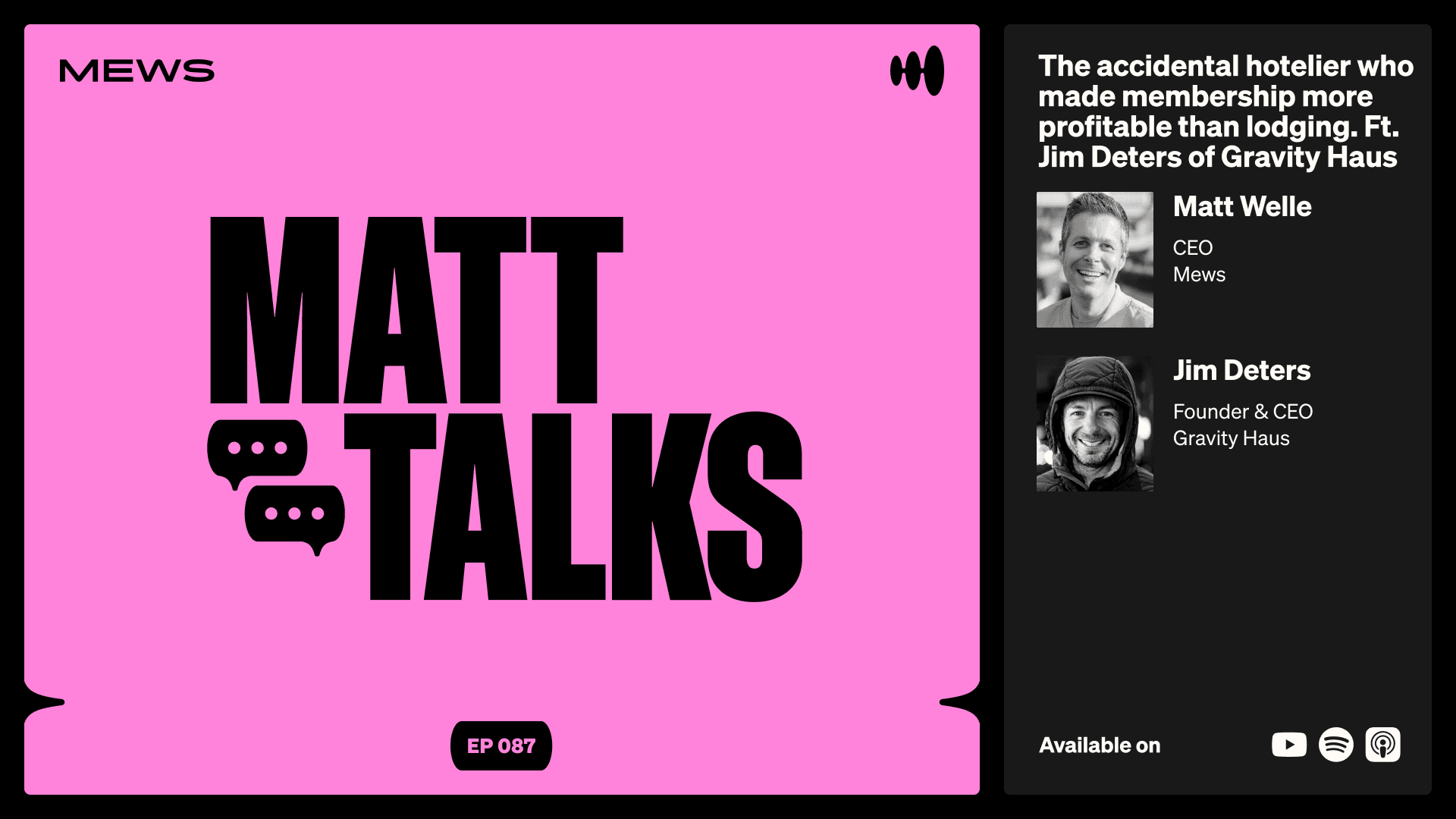
[00:00:28] Matt Welle: Hi, everyone. Welcome back to another Matt Talks Hospitality, and I am actually really excited about this conversation with Jim. I met Jim Deters a couple of months ago on a call, and we had such good energy. I said, "You need to be on this thing, and I wanna just, like, hear you out for, like, an hour, and we wanna talk about the business that you're building.' You're the founder and CEO of Gravity Haus, which is a very exciting brand, and it's definitely gone far beyond just a bed factory, like a hotel where you just have people to sleep and then they leave. You've really leaned into the membership and the adventurous travel, and I'm very excited to explore whether that works as a business model and whether, you know, what your motivation was behind it. Jim, thank you for joining me today.
[00:01:07] Jim Deters: Thanks for having me, Matt.
[00:01:08] Matt Welle: So, you are not a hotelier. You're an accidental hotelier, are you? Like, or did you study hotel management and you're, like, always dreaming about having a hotel?
[00:01:15] Jim Deters: No. Never really thought about owning a hotel at all. So, as you said, as an accidental up hotelier, I think it came from sort of two happy accidents, if you will, one, my life partner turns out to be my cofounder in this business. She has a hospitality background, grew up in restaurants and hotels and developing them. I myself built software companies, built tech companies, so the confluence of marrying into, and my cofounder in life being in the industry, and my deep passion really has always been about community and bringing people together. Previous to Gravity Haus, I built a community in a company called Galvanize, which is about coalescing entrepreneurs to help them change the world into campuses and things. And so, I'm a community entrepreneurial glue. I just happened to marry into, and my cofounder in life and my cofounder in Gravity Haus, we had a deep passion for raising our kids outdoors, teaching them about fitness and wellness and being great stewards of the environment. Always wanted, you know, in 2018, saw an opportunity to make the move and work to take this idea that we had and buy a hotel and see if we can bring this idea of building a community-led hotel company to life.
[00:02:38] Matt Welle: The world is filled with hotels. Like, what's the deep problem that you're looking to solve by building yet another hotel on top of, like, the thousands of hotels we already have?
[00:02:46] Jim Deters: Yeah. I love how we always talk about this. The commoditized box, with the box, with the bed, that's not unique. And like you and probably many of your listeners, we spend a lot of time traveling. We have lots of things that drive us nuts about hotels. The dynamic for Gravity Haus is pretty unique because of twofold. So, I'm sitting in our hotel here in Vail, Colorado, and there is a very large urban area, the Denver Metro Area. So, myself and my family, we lived in Denver, Colorado, and we had a mountain home in Breckenridge. And that's what you do. You, you know, come to ski every weekend. You come to get away from the heat. It was 90-plus degrees for, you know, very high 36 degrees centigrade. It was very hot in Denver yesterday. It's about 56 degrees outside right now, looking at the stunning Vail Mountain. We're literally at the base of Vail Mountain, and we wanted to provide that escape for the Denver people. And solving the problem of accessibility is a really big deal. Luckily, I was at a point in time where it was a little bit more affordable to buy a second home in the mountains. That's out of reach for a lot of folks now. These resort areas, these high barrier resort areas, are very expensive to own a second home, and second home ownership is out of reach. So, we want to build that place where people could go repeatedly from a large drive to market, where we could be the easy button. And it wouldn't just be about a box with a box with a box, but it would be about how we live today. And how we live today, the hotels never built themselves around. This continuous movement between working, playing, managing a kid, or kid experience, and if you come to one of our hotels that looks like a campus, I'm sitting in a conference room right now, but behind me is 18,000 square feet of a super amenitized hotel. So, this is a big co-working lounge, there's private meeting booths, there's fitness facilities downstairs; you can walk out and go for a hike and go for a trail. So, this flow of, you know, working and playing and making that a sort of home base for where you can be and not necessarily have to own it and pay its mortgage or HOA dues or fees was something we really wanted to sell for. And, of course, the other last pillar of that is that it's a pillar in the asset itself, this hotel, is where the locals come. So, the locals are members here. And when I travel anywhere in the world, I want the most authentic experience possible, so I wanna hang out. But I'm in Amsterdam. I wanna hang out where Matt's hanging out. I wanna know where you're going. What's the cool restaurants? Where do you work? What are you interfacing with? Well, here, what trails might you go to? So, this was, you know, a community-led idea. And on this particular property, there are almost 700 local members that use this facility. It's their office. It's their coffee shop. It's where they meet. And, of course, you'll see a rack of bikes down this hall right now where people will jump on their bikes in between meetings and go right up the old mountain. And no one really looked at building a hotel, I think, from the perspective of the empathy of how people live and how to live this outdoor modern adventure lifestyle.
[00:06:21] Matt Welle: I'm very jealous that, like, you have that, but, like, I'm very sad that you're not close to where I live because it sounds exactly like a thing I would love. So, I hope soon you come to Amsterdam. No mountains here to build in. Like, we have to go find the lake or something.
[00:06:33] Jim Deters: But there are bikes everywhere. If I was gonna put, I have my mountain bike around the corner, I was gonna put it behind us as a bike prop because that is on my agenda after my series of morning meetings here, morning my time here in Colorado. I plan to go right up the mountain in a little bit in between calls at my lunchtime, and then back to work.
[00:06:54] Matt Welle: You live the life. So, when COVID happened, we thought, right, oh, remote is impossible. It doesn't really work. Then, suddenly, people were like, oh, actually, remote companies do work. And we saw these companies and people having freedom to basically sometimes move into a hotel, work from there, do all of the fun activities, and then still get a full day's work done in a hotel. And then slowly, we're seeing people creeping back to the office. But have you seen a positive impact in this post-pandemic era of people realizing that actually they care about the adventures in their life more than their, like, day job in the city?
[00:07:28] Jim Deters: You know, it's been an interesting dynamic as the post-pandemic period is sort of seen a little bit of a reshuffle back to normal, honestly. And the remote idea, as it still persists and has momentum, people got sucked a little bit back into their more normal lives. And the ability to just because a lot of things were put on pause, if you will, various kids' sporting programs and things like that. I think it was a pretty phenomenal moment in time where people were able to completely change their lives, move to a new destination, here in America, at least, I think we've seen a drawback to a little bit more normal lifestyle, more normal work and kid raising patterns. At the same time, this sort of idea of experiential travel and experiential traveling to go have experiences and integrate my lifestyle into that, those tailwinds are not gone, right? Although I think there's been a pushback to a little bit more normalcy in terms of, if you will, the patterns. But the consumer who wants to go to something unique, independent, but also be at the absolute front door, the doorstep of a trail, of an adventure, of an experience, and have the ability to engage with not just a box, but a group of people who can give you advice, can take you on a hike, can take you on a ride, can take you skiing, can tell you where to go see the best wildflowers in a age appropriate hike for you and your 10-year-old and your 8-year-old, that's very, very unique. I don't think that trend is going away anytime soon.
[00:09:12] Matt Welle: Yeah. I agree. I think people realize that when you take their freedom away, the thing they care about most is their freedom to experience the world and to make memories. And I think when you travel the way that you travel, those are core memories that people are creating, and they're like, I don't ever want to not do that again.
[00:09:28] Jim Deters: Those memories and those moments really set the foundation for building this company. And when you raise kids, and I encourage anyone who's fortunate enough to have children and raise them, the things they remember are the experiences, are going somewhere different, the traveling, you know? I took two of my kids to Japan and skied right ahead of the pandemic, and it's still one of the most amazing trips of their lives that they still speak about. And then from a regular perspective, I talk about trying to bottle the essence of Gravity Haus. The time I spend skiing with my kids and my wife, and we're all out on the mountain together enjoying this beautiful experience, and it's one of the few sports you can do together if you're of relative abilities, and you might be waiting for someone on the slopes of any of the skiers out there or listeners. Those moments of doing something physical, usually outside with, whether it's your family or with perfect strangers, you create this new bond and relationship. And that moment of time of that combination of things, I would love to bottle that up so everyone can experience that, right? Because those moments and that experience is really, in my opinion, one of the great spices of life.
[00:10:44] Matt Welle: I love that. So, as a businessman looking at the business model, so you could have just built the box in a box in a box with a bed inside the box, and that could have been very profitable. And you've gone for the very complex thing where you have multiple models. You've got a membership model. You've got a hotel. You're doing fitness. You've got all kinds of gear that you're renting out. Does it make sense from a business point of view? Have you been able to scale the business?
[00:11:05] Jim Deters: Yeah. So, let's shift from the passion of, you know, the 'why' of the business of enabling this adventure and lifestyle, to let's get to the nuts and bolts of some of the economics of…
[00:11:16] Matt Welle: The CFOs that are listening to this thing.
[00:11:19] Jim Deters: Yeah. The 'how' the hospitality speaks of, well, does this thing really work? The driver of the brand standard of having a community that is localized and on an asset on a regular basis, they're driving monthly recurring revenue to a subscription. So, think about I'm in this hotel right here. We have hotel keys. We have a very substantial restaurant here. We have a coffee shop, and we have 18,000 square feet of what I would call a super amenitized wellness stack, yoga, fitness. We're running yoga classes. We're running fitness classes. We have steam rooms and sauna rooms, and cold plunges, and this lounge area. Members are buying memberships to this specific asset, right? So, if you have 700 local members paying into this asset, that takes some seasonality out of this asset. This is, you know, a lot of high barrier resorts have their various peak seasons and low seasons. That's a recurring revenue stream. That's a very high margin. In fact, in your stack of margins on a typical hotel, of course, it starts with your lodging margin, and then your course removing downstream to your F&B margin is your lowest margin. Membership sits above lodging in terms of its profitability, right? It's very high margin. And that extra third leg of a revenue stool is a very positive economic driver. You can also see the other side of it is that it also acts as a paid loyalty program. So, we do have members that live in Denver, that live in Texas, and Florida, and Illinois, and New York. They, too, of course, love the adventure lifestyle. They have an affinity towards a brand, and they buy into the paid loyalty version of this program, which basically builds our direct distribution model. So, we think a lot about the lifetime value of a customer, and we wanted to turn, you know, really help membership drive an identity, not just be part of a points program. So, again, you have local members choosing a specific asset that drives specific membership revenue to the hotel, and then we have a very unique distribution model of paid loyal members that are booking and getting access and discounts and what we call rope drop in the winter. Like, when it's, you've ever been on a ski mountain, and the patrol drops the rope on a fresh run to get the fresh powder, we call them rope drops. These are sort of the deal alerts that we deliver on our mobile app. Think of our own adventure hotel tonight to our members, alerting them to the best opportunities, the best deal that lines up with the best weather, and you can immediately book, grab, and go. So, you got two economic models that are driving a distribution strategy, and then a local revenue strategy that, of course, we believe allows us to outperform a normal hotel in our concept.
[00:14:14] Matt Welle: Because, you know, you run Mews at the core to run the hotel, but you're also a tech entrepreneur. So, I'm assuming, and it sounded like you've started building your own apps. Like, what technology do you build yourself? What do you buy off the shelf? Like, what's your tech strategy?
[00:14:26] Jim Deters: I think we have a little bit of an unfair advantage, right? So, we're a young company. Right? Like, we opened our first hotel in 2019. We now have 13 properties across the United States and Canada, from Colorado, Wyoming, Utah, Montana, British Columbia, Canada, and now the state of Washington. And we've been able to build a very modern tech stack with Mews at our foundation. If you don't get the PMS right and you don't get that core operating system as a partner with Mews, a lot of things are gonna go wrong. So, I think we had an unfair advantage. We grew up in an era where we, I think, were able to select a really, really modern tech stack, but at the end of the day, we were ultimately focused on the member journey and the guest journey and experience to make sure how do we optimize that layer. So, there's a lot of complexity, I think, as most of your viewers or listeners know, in terms of all the various components of rev management and automation of rev management and the algorithms and the guest service feedback loops and the automations that we're trying to do. We try to focus on building the layer above to make that seem simple and seamless because our consumers don't care about how cool our tech stack is or how wonderful we might talk about Mews as an operating system for our business. The customer doesn't care. They want to click, get, experience, be recognized, have an amazing experience, and have people, as I talk about, not just personalize the experience, but anticipate their needs, particularly if they're part of a program and a community that they pay into, that they're paying for a membership. They wanna feel like they're special, right, that we know them and we know their needs. We know their dog's name. We know their kid's name. We know that they brought their bike with them and that they're gonna head out for a ride, and what they might need for lunch or be prepared to go on their next trip.
[00:16:29] Matt Welle: Where do you store all that information? Do you store it centrally somehow?
[00:16:32] Jim Deters: We live between two major profiles. So, we built our own homegrown membership component because there was nothing we thought that could provide the flexibility of that membership program, so we did invest heavily in sort of the custom software we built, is on top of HubSpot, in this case, which is our main membership profile, and then, of course, Mews is the heartbeat and soul of what's happening on the property. And, ultimately, those two things need to come together to make sure we can manage their guest profile and their experience and know exactly who they are when one of our what we call Haus Experience Specialists, AKA front desk, is there to greet you and know who you are and make sure your experience is amazing.
[00:17:18] Matt Welle: Haus experience specialist. So, you've rebranded something traditionally called a receptionist. Like, what was the thinking behind that? Like, how has that job changed?
[00:17:25] Jim Deters: The job has changed so much because it shouldn't be about clicking some buttons and swiping credit cards and checking your identification, right, that's the lowest common denominator, that's a transaction, that's not delivering hospitality, right? So, even just trying to, as we build the employee journey, our teammates, as we call them, we have a lot of team analogies. How do we make sure that our teammates are ingrained and onboarded in a way that their job isn't just to check you in, their job is to make you feel seen, to make you feel welcome, to understand your why. Why are you here? Why did you just show up in our building? Did you come to celebrate an anniversary? Did you come to celebrate with old college friends? Are you on a girls' trip that flew in from all over the world and wanna know where to go have the best time and integrate some heights? Like, getting to people's why. We really wanted to make sure it wasn't just about the act of checking things in because technology's gonna be, you know, working with a great platform. That should be, like, frictionless. Now, we get to focus on delivering real hospitality, and I think that's what is so incredibly exciting about what's happening in the industry today. A lot of the technology, it's not just about trying to eke out more margin, and certainly we do drive automation, but it takes away the time and energy from some of the tasks that we can now focus on delivering what hospitality is about, so to me, it's not about replacing the people and the humans, it's about giving the humans the time, or people the time to deliver on the real brand standard and experience of why you showed up in our hotel today.
[00:19:10] Matt Welle: Because, like, when you had one hotel, I'm imagining you were probably always there, and you could make sure that everyone understood that vision. You can retrain them. How do you do that at scale when you've got 13 properties where you can't be everywhere all the time? How do you make sure that culture still is sticky?
[00:19:24] Jim Deters: Making sure you can scale cool, Matt. How do you scale culture? How do you scale that? Because answering that last question, the brand standard is the culture, and part of our brand standard is that each property is really unique. And it's not just unique in its architecture and design, as most of what we've done is repositioned and remodeled very unique bespoke hotels that were in irreplaceable destinations. The real trick is to keep that local authenticity true. So, it starts with the placemaking and identity of the community. And, of course, we're now going to be recruiting our teammates that will run that property from the community. And it starts with thinking about people as a product. And our people team, what we call our people and culture team, the entire journey and experience, and this is what I think a lot of us in the hotel industry often can kind of lose sight of. People are the product, and we don't try to dictate or complete. Our brand standard is being authentic, and you can't just script that out. You have to train and recruit the right people, and onboard them, and provide them with the tools and autonomy to create the experience and navigate and do unique things. And if you can scale the culture and people appropriately, I think that's how you win the game. And, of course, that's way easier said than done. And I'm sure you've experienced that too, as Mews, any company skills. It becomes extraordinarily hard. How do you protect what I call the core? How do you keep that core energy? And you protect the values. The values of the business live in the values of the people. And you reward them, you ingrain them, you reinforce them, and hopefully, you protect that. And as it scales, that energy can continue to radiate out as you get more mass and more properties. And, of course, we're still relatively small. You know, 13 properties is not 30 or 300, but it's still relatively, you know, we're learning a lot, of course.
[00:21:35] Matt Welle: Yeah. Because what's the ambition? Is massive scale the ambition? Or actually, are you like, "This needs to stay curated and small."
[00:21:41] Jim Deters: The ambition is to, you know, galvanize this community of entrepreneurs. And, of course, we started with ski and ski communities, and we started with really hitting some extraordinarily marquee bull's eye locations. Because I think when you start a brand, and you wanna build a brand that has a sort of premier dominant, you know, space, we started in Vail, Big Sky, Jackson Hole, you know, Steamboat, Colorado. So, we wanted to own a niche and market of ski and ski mountain culture, but that certainly resonates to what I'll call gateway cities, you know, cities that are close to outdoor recreation and building sort of a potential similar super amenitized hotel stack in a near metro area. Think San Francisco to, you know, to Tahoe, Denver, of course, to the Colorado resort, Seattle to its various hubs, maybe even Scottsdale to Sedona and markets like that. But we'll absolutely, the brand also resonates with surf and beach culture. And I think a lot of the same people that wanna ski also wanna play on the ocean and surf and things like that. In terms of, like, the number and quantity, look, we wanna do what's right, and we wanna do it with excellence, and we're very disciplined in saying no. We look at dozens of opportunities before you get to say yes to one in terms of, do we think it works for our community? Is it grounded in the financial gravity of reality? Can we make it profitable? Can we make it profitable for our owners? Does it fit the amenity set that we wanna try to do on that property in terms of our brand standard of this wellness and fitness stack? Like, if I showed you a picture of the gym that's over here to my right, you'd be like, that's not a normal hotel gym, right? It's 12,000 square feet, functional…
[00:23:39] Matt Welle: I'm looking for rusty barbells. Like, that's my experience of a hotel gym.
[00:23:43] Jim Deters: Yeah. Rusty barbells hidden in a basement corner, you know, that you're winding your way down, and you hopefully find the random door that led to, you know, an elliptical machine and some rusty barbells. These are world-class functional fitness with turf and squat racks and cold plunges, and there was a class going on the morning 7 AM morning class was going on as I came in because we do run our own functional HIIT classes. We have trainers here. We run our own yoga classes. That's not a normal hotel. Not a hotel I've ever been able to really experience.
[00:24:23] Matt Welle: I love that. So, when you have a primary location where you start an off firm, and then you start to open secondary locations, do you find that because your hotel is the experience where you're drawing people and you're creating the experience, rather than the destination being the pool, and then you just stay in the box in the box in the bed, that they are right. Gravity Haus got me on this primary location. I'm now going to experience other Gravity Hauses as well. Are you really able to see that cross-pollination?
[00:24:48] Jim Deters: 100%. As we've opened new locations, having this loyal, committed member who identifies with what we're doing, that adventure innately wants to explore novelty and use new things. And one of the things that's sort of synonymous with us, if you look at an industry analog, is the ski pass industry. So, we do a lot of work, and I was interviewed on the local affiliate this morning, talking about Colorado tourism. And Colorado, this past year, had, historically, the worst snow season ever. And if you have your ski pass, in this case, if you own an ICON pass, we were talking about Revelstoke. We just opened up a property in Revelstoke. Our community members here in Colorado, who are very disenchanted by the low snowfall season, are mobile. They have a ski pass that's extraordinarily mobile. They can fly up to Canada. They can leverage their ski pass. They know Gravity Haus is there. They know the amenity set's gonna be there. They're gonna be great people to plug into, and Canada had great snow this past year. So, that mobility of an adventure that has built their identity around outdoor adventure, we wanna be their place, like their brand. Oh, well, Gravity Haus is going to Costa Rica? We wanna go check out what Gravity Haus would look like in Costa Rica in their surf club and surf business, maybe that's some foreshadowing. You know, that modern adventure, I think, resonates with our brand and our brand identity. We just opened up some properties in the state of Washington, including a surf destination on the Washington Coast. I think that's super intriguing for our, you know, Colorado community. Oh my goodness. The Washington Coast is so rugged and beautiful, and then we have wetsuits there. There's surfboards there. You can get everything you need. You walk out onto the beach, and you can surf. And I think that focus on and the empathy of what you're gonna actually do, the people that are wired for novelty that get out and do things, it's the same type of folks that are doing high rocks or doing these endurance running, is taking off and run clubs. We run run clubs, we host backcountry adventure trips, and we'll talk a little bit, I think, maybe about sort of the add-ons and driving revenue. Ours are so high because we're selling experiences. We're not just selling an early check-in or a late checkout. You can bundle a guided trip inside your checkout experience. And that, again, gets to that why did I come to this amazing destination? I don't think our community comes to these wonderful places to sit in their room and watch a Netflix show. I certainly hope not. After they're all exhausted and worn out and rinse the dust off of them, you know, then they can lay in bed and watch Netflix. But I don't think people are visiting our locations to sit in their rooms all day and watch TV.
[00:27:55] Matt Welle: Yeah. Like, upselling feels often, like such an afterthought, and it feels so forced because we're like, well, we were told we should do the upsell. And then they have some, you know, they have your boring products, like, I don't know, a bottle of champagne on arrival and, like, the stuff that isn't really inspiring. If a hotelier is listening to this and is like, "Well, my hotel brand is not built for the level of adventure that you've built in." What would you recommend they do with upsells to get some of that adventure built into the more traditional hotels?
[00:28:22] Jim Deters: I encourage everyone to be creative and authentic to who they are and where they are. I mean, for us, for instance, some things that are pretty unique is you can actually add on Normatec boots. And I don't know if you or your audience know what Normatec is, but they're compression therapy sleeves. So, after you have a long day of hiking or biking and cycling, you can slip on these big compression sleeves that run these cycles. You can add those onto your room, and check them out, and take them to your room. And maybe depending on where your other hotels that are great Mews customers live, what's unique to their community? Maybe it's a dining experience or a dining partner. Maybe it's something they don't own inside of their box, if you will. But what's unique in the community and how they can partner with, you know, the yoga studio next door, that they can work with or somebody who does acupuncture or does birdwatching, you know, depending on where, you know, birding is a pretty big thing these days for some people, and in some places where it's a thing.
[00:29:29] Matt Welle: Yeah. That's the thing. If you find, I think with LLMs, people search so specifically in an LLM for a hotel close to a birdwatching sanctuary, for example. And if you can lean into the narrative of the uniqueness and find the niches, they will be willing to pay for experiencing some of those things.
[00:29:47] Jim Deters: You're hitting on something that sort of LLM and that agentic search that we're seeing this transition to does provide a huge challenge and a unique opportunity for those that are moving in that direction because more and more people are looking for what to do, not necessarily the destination first. They wanna lead with where is the best place? We'll stick with our birdwatching thing, or maybe we'll switch to a Gravity Hausing. Where is the best place to mountain bike this time of year in the Western United States for an intermediate rider? And what's gonna come up? Is it gonna show a Gravity Haus Moab, which Moab, Utah is a very big mountain bike destination. It's not really a beginner one, by the way. I don't really encourage beginners to go to Moab. It's a little more challenging than people think to write out there. It's wonderful and amazing. But those new ways of how people are starting their journey, they're starting with not necessarily the location, but what experience do I want to have? And tell me, "Where are the spots I can go? Where are the properties I can go?" And, of course, then they're gonna find, well, who are the tour operators? Who might be the guides? Where's the closest place that does live next to the Pacific Crest Trail or the Appalachian Trail entrance for a section? And that's how I've traveled my whole life. It's way easier to, you know, the LLMs and agentic searching capability have really changed the game quite a bit.
[00:31:17] Matt Welle: Yeah. And I think it's specific. Like, we've always talked about the websites because that's where people go, and hotel websites are probably the worst. You know, you never find the photos of the things that you wanna do, or whether they have, you know, a nice gym and what does it look like. I always get the towel photo with a dumbbell next to it, like that doesn't tell me if it's a nice gym. But what you now see is that the more guests talk about your hotel and guest reviews, and they talk about specifics, they talk about the bird and the mountain bike trails, and that feeds the LLMs. And it's like suddenly people need to really switch towards driving to get their guests to talk about the stuff that they love because that drives into the niches, kind of that you're feeding into.
[00:31:55] Jim Deters: Yeah. Getting the customer to validate your brand and your experience is one of the most critical levers to win in this new LLM game. One of the things we love here and we particularly reward and reinforce, one of our Haus experience specialists upstairs here, is Ryan Tarun. He's one of our Haus experience specialists. He gets mentioned all the time in reviews. All the time. Ryan gave us the best advice on where to go. Ryan really, really made us feel welcome as soon as we walked in. Ryan helped us solve this problem. I love it when our teammates get recognized directly in these LLM reviews. And again, that's part of scaling that culture. You can't really, it's harder to train that than to hire for somebody who more innately has that hospitality attitude and perspective, the one to see people or what, you know, maybe this dates me, Danny Meyer's original book, Setting the Table from 1998, about hiring the 51 percenter that they instituted into their Shake Shack. And you hire for attitude, and you can train the skills. I can teach Ryan how to use Mews. That's not hard. Can I teach him to be warm and smile? I guess so. Authentically, it's a little harder, right? We can teach people how to pull espresso shots and make cool cocktails. It's really hard to teach that genuine caring and interest and, of course, his local knowledge of the community and the trails and everything that surrounds us in this amazing environment. That's much harder to train, right? And we really recruit and hire for that. I'm hoping we actually launch at some point this year. I wanna launch what I call Ski Bum academy, which is, you know, in the culture here, a lot of people start their careers by taking a gap year or becoming a ski bum to take some time off. But there's really an amazing culture and opportunity to build a career around this, too. And if any of your listeners are looking for a great company to join, if I can do a selfless plug, right, if you wanna be a ski bum and build a great career, we're at the, you know, and be an amazing professional in this exciting hospitality industry. You can do both, right? You can be an amazing outdoor lifestyle person and have a rewarding, fulfilling career and growth opportunity. And we're looking obviously for folks that would start at the Haus experience specialist and work their way up into various managerial capabilities. And seeing someone mentioned over and over in a review is a high-performing teammate. Yeah.
[00:34:37] Matt Welle: It's so nice. I wish I was younger so I could take you up on that job, but, like, I feel like I'm too old to ski bum at this point.
[00:34:43] Jim Deters: I think you got a pretty cool job, and then you make all sorts of cool friends like me that have hotels in amazing places. The invitation is open to you and, of course, any of your listeners who wanna come come visit. And if I happen to be at the spot and I'm deeply passionate about biking and cycling, which is one of my favorite things about going to Holland, we get the bikes everywhere. I often say it's hard to be an unhappy person when you are spending time outdoors pedaling on a bike. It makes you feel alive. It makes you feel free. Right?
[00:35:16] Matt Welle: I was just, like, so I moved to Amsterdam about three years ago. So, I grew up with bikes. And then you moved to Amsterdam. And then it's next-level biking. My husband never grew up on bikes. So, I remember when we started biking, and he was, like, freaked out because, like, here, there's no real rules. Like, he just bikes, and you just kind of know when you go and when you don't go. And I was, like, shouting. I was like, just follow me. It's fine. But, like, it is such a skill. Like, once you get on that bike and you get into this biking community, it is so addictive.
[00:35:45] Jim Deters: It is. And the culture there, and you know, having just, was that Unfold with you all in Amsterdam just a few weeks ago, right? The culture, what we call bringing people along, you know, you wanna make these types of experiences and even these sports and outdoor, out-lifestyle thing, they can feel very intimidating. We want to build a culture that makes it feel approachable, welcoming, to bring people along, and I saw folks who were very intimidated getting on bikes in Amsterdam. I would say the majority of the people were very accommodating. They were giving advice, and I saw someone going down the wrong way, and they didn't, like, scream explicatives at them. They politely said, "You might wanna consider going the other way 'cause this is dangerous what you're doing?" You know? But look, that sort of culture of letting the lore of the region, the people that are grounded here, that are the local legends, pass on that knowledge and not be the, well, I was here first. You don't get to; this isn't for you. I want to build a culture and a community that welcomes people in, that want to explore these same trails, that would like to try these very unique sports that are very fulfilling and rewarding to spend that time outside in nature doing something physical. Like I said, it's very hard to be an unhappy human when you combine those two activities. And again, that's like, that's the experience of the brand is those moments that you're having, ironically, not even inside of our actual box. We're just the enabler of that experience. And then, of course, you come back to this welcoming box with awesome coffee and warm people that are greeting you, giving you Normatec sleeves to get your legs ready for your next ride, you know, giving you an amazingly awesome meal that's curated from local farms and made, and is nourishing. That, to me, is how I want to travel and experience the world and experience humanity, honestly. That is how I kind of looked at the world of building hospitality from the experience and empathy for that consumer, and giving them that approachability. Because most of our folks, I mean, there are the people that win the Leadville 100 here, which is a 100-mile mountain bike race, that are training. They're locals. They're extreme. But how do you find that person like that who's incredibly driven in local legend, but has the humility and respect and care to, like, welcome new people into their sport, into their community, bump into them here in the co-working space, and randomly ask them a question about, clearly, you look like a bike rider, you have any tips for me or where you're going, or you can use our app and sign up for the bike ride that's gonna be going out later this afternoon, right? And programming those experiences from a business perspective, by the way, just to shift, that's hard, by the way. It's not easy to run the base of the hierarchy of the hotel. You have to do the basics. You have to check people in. You have to run restaurants. But how do you now build that layer of experience on top of it and curate experiences in the community that create the serendipitous connections? That's the secret sauce, right? That's not easy to do.
[00:39:07] Matt Welle: It takes time to build up that community, and the excitement and like, patience is one of the skills that not a lot of people have, but once…
[00:39:16] Jim Deters: Do you have that, Matt?
[00:39:17] Jim Deters: I have none.
[00:39:18] Jim Deters: I was gonna say there's two qualities I know about most CEOs. We're not very patient, and we're pretty demanding.
[00:39:25] Matt Welle: Again, but it's also a good skill when I'm like, I've done this thing before. I'm not interested in doing it again. And then I automate it the second time around because, you know, when I was doing trainings for our first hotels, I think, sorry. I've just done this same pitch at the hotel next door, and talking them through all the screens. So, I just started recording myself, and I would just send them a deck of videos. And that has now turned into Mews University, for example. But it was just me being frustrated that I had to do it again. So, I wouldn't recommend you hiring me as a guest service agent because you need to find the person that has the passion to do it over and over and re-engage with people. Like they're just different people for different jobs, and I'm definitely not that person.
[00:40:03] Jim Deters: Yeah. We're not very patient folks.
[00:40:05] Matt Welle: Last question. I've really enjoyed the conversation. If you look forward, what's one thing that you get excited about around Gravity Haus?
[00:40:13] Jim Deters: Oh, man. There's so many things I look forward to and am excited about. I'm so proud of the team and culture. Honestly, we came out of a really tough ski season where we have a lot of properties, and in terms of, you know, owning a modern tech stack that allows you to drive the tools to flex in our industry, the tools are one thing, the culture and the people that can still deliver an amazing experience and improvise and move with the changing market conditions that we do is amazing. So, I just spent the last, you know, several days here touring properties, getting to meet members, getting to connect with our teammates on our various properties, right? The idea of continuing to scale and experience myself in these unique communities, right, is something that is really rewarding as a business builder to come into a community and feel the impact and feel people resonate with the strategy and the team win. Like, when we opened up in Big Sky Town Center, this time, almost about a year ago last summer, the town was so welcoming, and it's so fun, and experiencing their culture, I'm sort of like this hotelier cultural anthropologist, right? I love to, like, drop into a new community, explore their amazing terrain and adventure, but also explore their culture, their norms. That, to me, is just wildly fun and rewarding. I think that's probably the big thing that a lot of us are drawn to in terms of why we travel is to meet new people, experience new things, and that crave for novelty, I'm wired for it. Obviously, I love watching it have an impact on the local people, and the impact also resonates through our own team's growth and our team's ability to learn, and learn new skills, and that's probably one of my most cherished values, learning and growth. I love cultures and communities, and building a culture that is constantly looking to grow and take on the next challenge. And the same thing for me personally. Right? Learning how to be the accidental hotelier. You know? My first hotel was seven years ago. Right? Learning more from the best people in this industry, working with the best partners, you know, the diversity of experience of getting to run a business in the space, from physical experience to technology, to operations, to brand, all that has to come together to be an excellent hotelier, right, to build an excellent customer experience. And that diversity of skills and operating spheres is such that I think that's why this industry is incredibly exciting. And it's a very, very interesting time to be in it from a technology perspective, especially.
[00:43:19] Matt Welle: Jim, thank you so much for sharing all your insights. I wish I'd learned about you when I was much younger, and I'd come work for you because it sounds like you have a very special culture.
[00:43:27] Jim Deters: Thank you very much, Matt. It's awesome to be here, and my invitation is open to go for a bike ride or a hike, whichever you prefer.
[00:43:33] Matt Welle: Love it. Thank you.