



Key takeaways
- Hotel staff at every level benefit from knowing terms such as ADR, RevPAR, OTA and PMS to communicate more clearly and work more efficiently.
- Key metrics like occupancy rate, ADR and RevPAR help hotels track performance, set competitive prices and make smarter staffing and revenue decisions.
- Technology tools like a property management system and channel manager work together to streamline bookings and simplify daily hotel operations.
A new front desk agent once quoted a guest the wrong rate because she'd mixed up the rack rate with the negotiated corporate price. The guest was confused, the manager had to intervene and what should have been a smooth check-in became an awkward back-and-forth. It's a small mistake with a real cost and anyone working in hospitality knows how quickly the wrong word at the wrong moment can unravel a guest experience.
Hotel terms are the common language that holds operations together across every department and every shift. This dictionary covers the hotel terminology every hospitality professional and hotel staff member should know, from front-of-house basics to back-office essentials.
Terminology dictionary of the hotel industry
Hospitality is full of terms and hotel slang that every staff member should know. Learning them makes daily tasks easier and helps you feel confident on the job.
ADR (average daily rate)
The average revenue earned per occupied room over a given period, calculated by dividing total room revenue by the number of occupied rooms.
Advance rates
Discounted rates that hotels use to get guests to book in advance.
AGOP (adjusted gross operating profit)
The total gross operating profit minus management fees and additional expenses.
Availability
The number of unoccupied rooms for a specific room type across a given date range, used by front desk and revenue teams to manage inventory, set pricing and respond to booking demand in real time.
ALOS (average length of stay)
The average number of nights guests stay, calculated by dividing total nights stayed by total bookings.
BEO (banquet event order)
A document detailing an event’s schedule, food, setup and other requirements to guide staff in managing the event.
BAR (best available rate)
The best rates available at the time of booking, especially for last-minute bookings.
Booking engine
Software embedded on a hotel’s website to manage direct online bookings, often integrated with the property management system.
C&B (conference and banqueting)
Refers to services for conferences and banquets.
C&E (conference and events)
Refers to services for conferences and other events.
Channel manager
Software used to manage distribution efforts across online channels, ensuring that rates and availability are consistent across channels.
Check-in
The process of registering guests, providing stay information and issuing room keys, often with a standard or early-check-in option.
Check-in kiosk
A terminal that allows guests to self-check-in and issue their own key cards, often integrated with hotel management software.
Check-out
The process when a guest completes their stay, settles their bill, returns keycards and departs from the hotel.
Commission
A fee or percentage of the booking value that hotels pay to third-party sellers such as OTAs and travel agents in exchange for generating reservations.
Comp set (competitor set)
A list of hotels with similar attributes used to compare rates and services, essentially identifying direct competitors.
CRM (customer relationship management)
A system that allows hotels to manage their engagement with guests.
CRS (central reservation system)
Software that manages room bookings and distribution across multiple channels, including travel agencies and online travel agencies.

DND (do not disturb)
A sign guests place on their door to indicate they don't want housekeeping or turndown service.
Demand-based pricing
Adjusting room rates higher during peak demand and lower when demand is low.
Dynamic pricing
Adjusting room rates based on factors like season, demand, booking patterns or special events to optimize revenue.
Early bird
A discount that guests receive when they book far in advance.
ETA (estimated time of arrival)
The expected arrival time of a guest or vendor for check-in, events or deliveries.
Extended stay
A booking spanning several nights, weeks or longer, typically associated with corporate travelers or relocations, often offered at a discounted rate.
F&B (food and beverage)
The hotel department responsible for preparing food, managing the bar and restaurant and purchasing supplies.
Fam trip (familiarization trip)
A complimentary stay to help travel agents, corporations or tour agencies familiarize themselves with your hotel for future accommodations and conferences.
FOH (front of house)
Guest-facing staff, including receptionists, concierges and bellhops.
Full board
A rate that includes breakfast, lunch and dinner.
GDS (global distribution system)
An electronic system used by travel agents worldwide to book hotel rooms, including Amadeus, Sabre and Travelport.
Gross margins
The percentage difference between the revenue generated and the cost of services sold by the hotel.
GOPPAR (gross operating profit per available room)
A revenue metric that helps hotels calculate the gross operating profit generated by each available room in a set time.
House count
The total number of guests currently checked-in and on property, used across departments to coordinate staffing, housekeeping, and food and beverage preparation.
Hotel rate parity
Also called price or rate parity, it ensures a hotel offers consistent rates across all distribution channels.
Invoice
A hotel bill listing all charges for a guest’s stay, including room, meals, services and incidentals, provided at check-out.
KPI (key performance indicators)
Metrics that measure hotel performance against goals or competitors, such as ADR, ALOS, RevPAR and occupancy rate.
Lead time
The number of days between when a booking is made and the guest's check-in date, used by revenue managers to guide pricing strategy.
LOS (length of stay)
The total duration of a guest’s stay at the hotel.
Loyalty program
A rewards program for frequent guests, offering perks like free stays, meals, vouchers and more.
Market parity
Setting your hotel’s rates based on competitors to maintain a competitive edge.
Market segments
Distinct groups of guests within the wider market, divided by shared characteristics such as travel purpose, booking behavior or budget.
Market share
The percentage of total bookings, room nights or revenue your hotel captures within its competitive market.
Metasearch engines
Third-party platforms like Kayak, Google Hotels and TripAdvisor that let guests compare rates and book hotels.
MICE
A hospitality segment focused on Meetings, Incentives, Conferences, and Exhibitions, often involving corporate events and group management.
MAR (minimum acceptable rate)
The lowest rate a hotel accepts from a group to be profitable.
Net rate
The price a hotel charges third parties, excluding commission fees.
No-show
A reservation where the guest does not arrive and does not notify the hotel in advance.
Occupancy
The number of rooms occupied at a given time or over a given period.
Occupancy forecast
A hotel’s prediction of future occupancy, expressed as the number of rooms or percentage of total rooms, to guide business planning.
Occupancy rate
The percentage of available rooms occupied over a given period, calculated by dividing occupied rooms by total available rooms.
OTA (online travel agent)
Online platforms that sell hotel rooms, helping generate additional bookings and revenue.
OTB (on the books)
Reservations that are confirmed and officially recorded.
Overbooking
A situation where a hotel accepts more reservations than it has rooms available, usually to account for expected cancellations or no-shows.
Overstock
A situation where a hotel has more supplies, amenities or inventory on hand than it needs for a given period.
PAX
Short for “passengers,” used in hospitality to indicate the number of people in a booking or event.
Peak season
The period of strongest demand, when hotel occupancy and rates are typically at their highest.
POS (point of sale)
Hardware and software used to process payments, either in person or online.
ProPAR (profit per available room)
A metric that measures profit generated per available room over a given period.
PMS (property management system)
Software that manages hotel operations, including front desk, housekeeping and more, in one platform.

Rack rate
The price of a hotel room without promotions or discounts applied.
Repeat business
Revenue generated by returning guests who are typically cheaper to retain than new ones and more likely to engage with loyalty programs.
Revenue management
The practice of predicting demand and adjusting room rates to maximize revenue.
RevPAR (revenue per available room)
A metric measuring hotel performance, calculated by dividing total room revenue by total available rooms.
RevPOR (revenue per occupied room)
A metric that measures revenue generated per occupied room, excluding vacant rooms
Room block
A group of rooms reserved for a specific set of guests, event or booking.
Room class
A category of rooms grouped by similar features, size and value.
Rooms yield
A measure of how effectively a hotel generates room revenue, typically calculated by dividing total room revenue by the number of available rooms over a given period.
Shoulder season
The period between high and low season, with moderate occupancy and demand.
SOP (standard operating procedure)
A documented set of instructions that explains how staff should complete a task or process consistently, safely and according to hotel standards.
Transient business
A segment of business made up of individual bookings that are walk-in guests, guests that book last-minute or guests requiring a short stay.
TrevPAR (total revenue per available room)
A key performance metric used by hotels to calculate the total revenue per available room based on all sources (rooms, F&B, etc.).
Upselling
The practice where hotels offer guests additional services or upgrades to increase incremental revenue.
Value-added pricing
Charging higher room rates while including extra services or amenities.
Walk-in
A guest who arrives without a prior reservation and is accommodated based on current availability, typically at the rack rate or best available rate.
Yield management
Also known as revenue management, it involves analyzing and responding to demand to maximize hotel revenue.
YTD (year to date)
A financial term showing results from the start of the year up to the current date.
Which key hospitality terms should every team know?
Every hotel team member, regardless of department, should know core hospitality terms to communicate clearly and support smooth daily operations.
A few key terms stand out as essential for every role:
ADR and RevPAR
These metrics help teams understand how well the property generates revenue per room, guiding pricing and forecasting discussions.
Channel manager
This tool distributes room inventory across multiple online platforms, and knowing how it works helps staff understand where bookings originate and how rates stay consistent.
Occupancy rate
Knowing how full the hotel is at any given time helps housekeeping, front desk and F&B teams plan ahead.
PMS
This system connects operations from check-in to housekeeping, making it the most used platform across the property.
Download our guide "The Metrics that Matter" to get a complete breakdown of the metrics that drive hotel revenue and operations.
How can you learn hotel terminology faster?
Learning hotel terminology takes time, but the right habits can help you pick up new terms and retain them faster.
Here are some practical methods to build your hospitality vocabulary:
- Create flashcards for daily review, writing the term on one side and its definition on the other, and go through them during breaks or downtime.
- Use new terms in conversation with colleagues as soon as you learn them, since applying vocabulary in real situations reinforces memory far more effectively than passive reading.
- Shadow staff in different departments to see how terms like RevPAR, OTA and channel manager are applied in real-time daily operations.
- Keep a printed reference sheet of common hotel terms at your workstation so you can look up unfamiliar words without interrupting your workflow.
- Ask questions when unfamiliar terms come up in meetings or briefings, since clarifying on the spot is one of the fastest ways to learn.
Hotel terminology empowers better operations at Mews
Understanding hotel terminology is only half the equation. The real difference comes when your team has the right system to act on that knowledge.
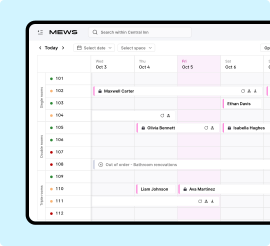
Mews PMS, the core of the Mews hospitality operating system, is a modern cloud-native platform that connects front desk, housekeeping, payments and revenue management in one place.
Here's what your team can do with it:
- Manage reservations, check-ins and check-outs from one unified dashboard
- Monitor occupancy and ADR in real-time to support smarter pricing decisions
- Integrate with your channel manager to keep rates consistent across all booking platforms
- Automate guest communications to reduce repetitive tasks and free up staff
Book a demo to see how Mews helps your entire property run more efficiently every day.
ADR vs. RevPAR: what's the difference?
ADR vs. RevPAR: what's the difference?
ADR measures the average revenue earned per occupied room, focusing only on the rate charged for rooms. RevPAR combines both occupancy and room rate, showing the revenue generated per total available room, whether occupied or not.
How is the occupancy rate calculated?
How is the occupancy rate calculated?
Occupancy rate is calculated by dividing the number of occupied rooms by the total number of available rooms, then multiplying by 100 to get a percentage. It shows how full a hotel is during a specific period.
Why do hotels use dynamic pricing?
Why do hotels use dynamic pricing?
Hotels use dynamic pricing to adjust room rates based on factors such as demand, season, events and booking patterns. This helps maximize revenue by charging higher rates when demand is strong and lowering rates to attract guests during slower periods.
What does OTA mean in hospitality?
What does OTA mean in hospitality?
In hospitality, OTA stands for online travel agent, which is a website or platform that sells hotel rooms to guests. OTAs help hotels generate additional bookings and revenue by reaching a wide audience online.
How can staff members memorize new hotel terms quickly?
How can staff members memorize new hotel terms quickly?
Staff can memorize new hotel terms quickly by using flashcards, creating real-life examples for each term and practicing them during daily tasks. Regular quizzes, group discussions and integrating terms into their workflow also help reinforce learning.
Written by

Jessica Freedman
Jessica is a trained journalist with over a decade of international experience in content and digital marketing in the tourism sector. Outside of work she enjoys pursuing her passions: food, travel, nature and yoga.