Key takeaways
- Kitchen order tickets connect hotel food and beverage (F&B) teams by creating a clear record of guest orders, special requests and preparation details.
- Digital and printed ticket formats each have benefits, but digital workflows improve speed, accuracy and coordination across busy hotel kitchens.
- A reliable kitchen order ticket system reduces errors, streamlines service and helps hotels improve guest satisfaction and revenue.
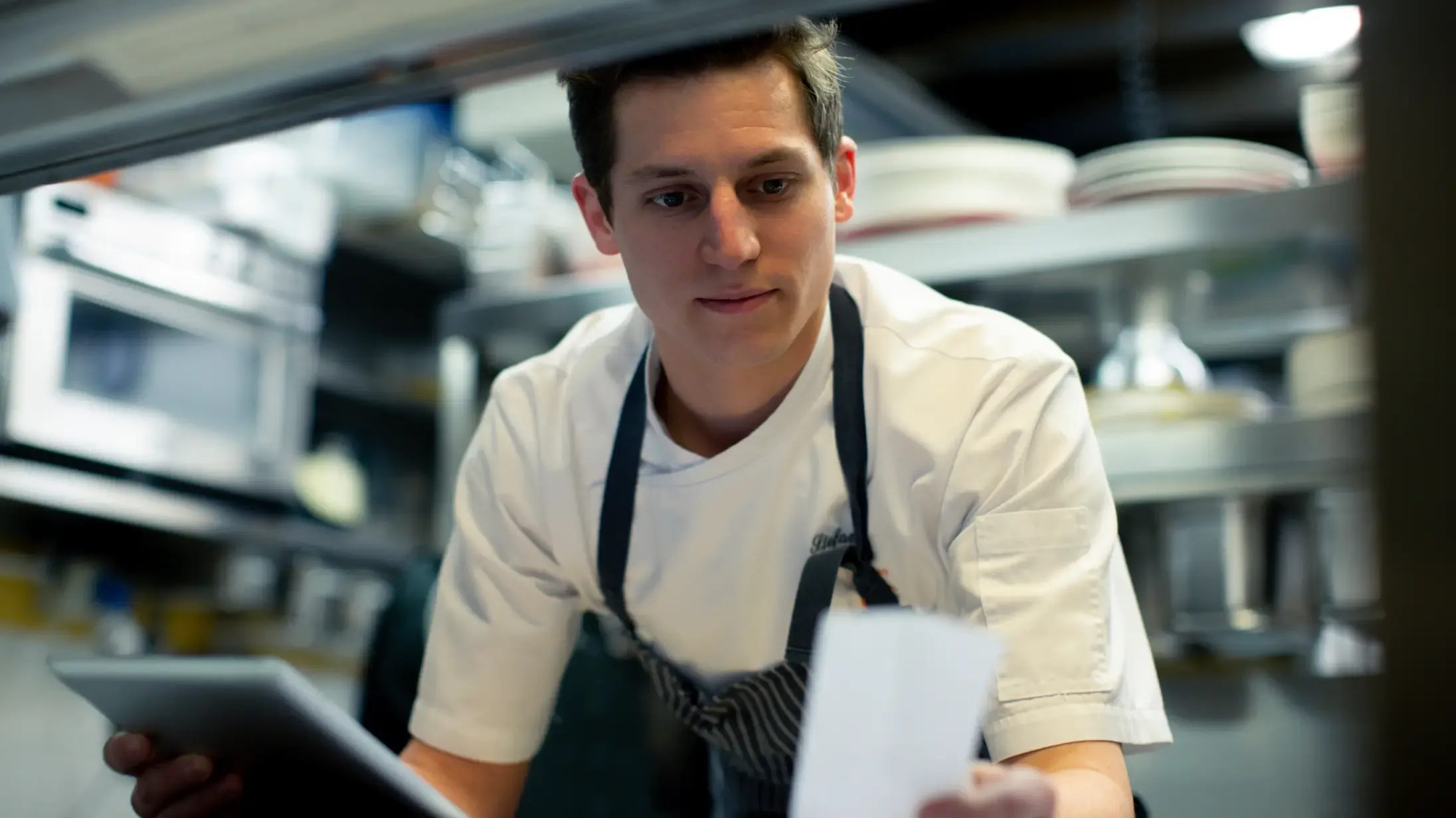
The dinner rush hits and tickets are stacking up. Somewhere in the middle of it, someone shouts from the pass: "Wait, which one's the gluten-free?" And now half the line is standing still, trying to remember.
A kitchen order ticket keeps that from happening. It gives your front-of-house and kitchen teams one clear source of truth, so orders move faster and mistakes stay off the menu.
In this article, we'll cover what a kitchen order ticket is, why hotel F&B outlets rely on it, how it moves from point of sale (POS) to kitchen and when digital workflows make more sense than paper tickets.
What is a kitchen order ticket?
A kitchen order ticket is the bridge between the front-of-house team and the kitchen. It records a guest's order and tells the kitchen exactly what to prepare, including quantities, special requests and table or room details.
Whether printed or digital, a kitchen order ticket system creates a single source of truth for every order. That means fewer misunderstandings, smoother coordination and faster service.
For hotels with multiple dining outlets, room service and special requests, a well-managed kitchen order ticket ensures every order reaches the right kitchen at the right time.

Why do hotel F&B outlets rely on kitchen order tickets?
Hotel kitchens handle a volume and variety of orders that verbal communication simply cannot keep up with. Kitchen order tickets bring structure to that pressure, giving both kitchen teams and guests something they can count on.
Operational gains for kitchen teams
When orders arrive on paper or digital tickets rather than via spoken relays, kitchen staff spend less time clarifying and more time cooking. Each ticket carries the table number, item-level modifiers and timing instructions, so cooks at every station work from the same source of truth.
This reduces the back-and-forth that slows service during peak hours and cuts down on costly errors.
According to CBRE, labor expenses accounted for 59.4% of total hotel F&B department costs, which means every saved minute on the line is a direct gain for the bottom line.
Experience improvements for guests
Guests rarely see a kitchen order ticket, but they feel its absence when orders arrive wrong or out of sequence. When kitchen teams have a clear, written record of every order, the right dish reaches the right table without unnecessary delays.
That consistency, especially across multi-course meals or large group bookings, is what turns a one-time diner into a repeat guest.
Kitchen order ticket types every hotel F&B team should know
Hotel kitchens deal with orders that change, grow and occasionally go wrong over the course of a single service. Knowing which kitchen order ticket to use at each stage helps staff stay accurate, reduce errors and improve sales performance by preventing costly remakes and lost revenue.
Type
When it's used
What it does
Primary kitchen order ticket
When a guest places their initial order
Sends the full order to the relevant kitchen station for the first time
Supplement kitchen order ticket
When a guest adds items to an existing order mid-service
Updates the kitchen on additional items without disrupting tickets already in progress
Return or void kitchen order ticket
When an item is canceled, sent back or incorrectly prepared
Removes the item from the kitchen queue and flags it for the supervisor
How does a kitchen order ticket travel from POS to kitchen?
Every kitchen order ticket follows a defined path from the moment a guest places an order to the moment food leaves the pass. That path moves through three stages, and each one plays a specific role in keeping the kitchen running accurately during service.
1. Order capture at POS or tablet
- A server enters the guest's order at the POS terminal or a tableside tablet.
- A cloud-based POS system generates a kitchen order ticket for each new order.
- The ticket is tagged with the table number, item modifiers and any special instructions before it reaches the kitchen.
2. Ticket routing and display in kitchen
- The kitchen ticket system routes each ticket to the correct preparation station.
- Tickets are displayed on a kitchen screen or printed directly at the relevant station.
- Time-sensitive items are flagged so cooks can sequence their work accurately.
3. Status updates and pickup
- Cooks update each item's status on the display as they work through the ticket.
- Once all items are ready, the server receives a pickup notification.
- The kitchen order ticket is closed, keeping the order queue up to date for incoming requests.
Printed vs digital tickets: which format works best
Printed and digital tickets each serve the hotel kitchen differently, and the right choice depends on how your operation runs. Both have clear trade-offs across cost, reliability and day-to-day kitchen performance.
Factor
Printed tickets
Digital tickets
Setup cost
Requires only a ticket printer with low upfront investment
Requires kitchen display screens at each station, which carries a higher initial cost
Speed
Printers can back up during high-volume service
Tickets reach the correct station instantly with no print delay
Error risk
Tickets can be misread, lost or damaged by heat and moisture
Orders display clearly and reduce the chance of mistakes
Reliability
Functions during network outages or power fluctuations
Depends on a stable power supply and network connection
Sustainability
Generates paper waste across daily service
Reduces paper use significantly over time
Best suited for
Smaller kitchens or lower-volume properties
High-volume kitchens handling complex or multi-course orders
Boost hotel F&B efficiency with Mews kitchen order ticket workflows
A reliable kitchen ticket system starts with tools that keep front-of-house and kitchen operations properly connected. Mews POS, part of the Mews hospitality operating system, routes orders from a server's device directly to the kitchen, removing manual steps from the process.
Here's what it does:
- Lets guests order directly via QR code from their phones
- Tracks live inventory so the kitchen always knows what's in stock
- Reconciles F&B charges automatically within the property management system (PMS)
- Delivers real-time reporting by outlet, meal period and product
For hotels running complex multi-outlet F&B operations, these capabilities make a measurable difference. Arctic SnowHotel & Glass Igloos, a property managing three restaurants and two bars in Finnish Lapland, switched to Mews POS. Using the Mews Terminal S2, staff could take orders and process payments from a single handheld device across all outlets.
As Suvi Ristiluoma, Head of Restaurant Operations and HR Manager at the hotel, put it: "Mews Terminal S2 saves us so much time. Human errors have dropped significantly because everything goes directly into the system, making reporting easier. No more time wasted fixing mistakes."
Book a demo to see how Mews helps your hotel kitchen run faster, reduce order errors and serve more guests with the same team.
What is a kitchen order ticket in hotel F&B?
What is a kitchen order ticket in hotel F&B?
A kitchen order ticket is a document or digital record that sends a guest's F&B order from the service staff to the kitchen for preparation. It includes details such as the ordered items, quantities, table or room number and special requests to help ensure accurate and timely service.
How does a kitchen order ticket system reduce kitchen errors?
How does a kitchen order ticket system reduce kitchen errors?
A kitchen order ticket system reduces kitchen errors by sending clear, accurate order details directly to the kitchen, including menu items, quantities and special requests. It minimizes miscommunication, prevents missed or incorrect orders and helps staff prepare and deliver the right dishes on time.
What information should every kitchen order ticket include?
What information should every kitchen order ticket include?
Every kitchen order ticket should include the order number, table or room number, ordered items, quantities, special requests or dietary requirements and the time the order was placed. It should also identify the staff member who took the order to help ensure accurate preparation and timely service.
Which kitchen order ticket format suits hotel F&B better: printed or digital?
Which kitchen order ticket format suits hotel F&B better: printed or digital?
For hotel F&B operations, digital kitchen order tickets are often the better choice because they improve accuracy, speed up communication and connect service teams with the kitchen in real time. Printed tickets can still work for smaller operations, but digital systems are more suitable for hotels managing multiple outlets, room service and high order volumes.
How can a kitchen order ticket improve the guest dining experience?
How can a kitchen order ticket improve the guest dining experience?
A kitchen order ticket improves the guest dining experience by ensuring orders are prepared accurately, communicated clearly and delivered on time. It helps reduce mistakes, delays and missed requests, allowing staff to provide faster and more reliable service.