
Key takeaways
- Cloud-based POS offers greater flexibility. Unlike legacy systems, cloud-based POS allows hotel teams to access data, manage outlets and oversee operations from anywhere.
- Real-time data reduces manual work. Transactions update instantly across the system, helping eliminate manual reconciliation and improve accuracy.
- Cloud POS scales with your hotel. Adding new outlets, devices or locations is easier and faster without complex infrastructure changes.
A cloud POS system is a point-of-sale device that’s connected to the internet and can be used to process payments across all business types, including the hospitality industry. Cloud POS combines the use of hardware and software to do so. It can sometimes be referred to as ePOS due to the fact that the system can be deployed by accessing the internet electronically from a web browser.
There are many benefits to cloud POS, which we’ll look at in more detail in this article, along with how to choose the best cloud-based POS system for your business. So, let’s get started.
What is a cloud-based POS system?
A cloud POS system is a way of managing payments and transactions for any kind of business where information is stored on external servers located in the cloud. It consists of front-end hardware that guests and employees at your hotel will interact with directly from a tablet, smartphone or internet-enabled device. The backend contains software that allows you to manage data, customer profiles, insights and more from any web browser.
Since data and information are stored on the internet, this means that it can be accessed from anywhere as long as you have a connection to the internet. It requires little training or setup because you essentially just download the app once your business is set up with the point of sale provider and using SaaS (software as a service) technology.
How does a cloud-based POS work?
A cloud POS processes transactions through an internet-connected system that stores data securely in the cloud rather than on on-site servers. When a guest makes a purchase – whether at the front desk, restaurant, bar or spa – the transaction is recorded instantly and synced across the system in real time.
Because everything is cloud-based, updates happen automatically, and data is accessible from any authorized device. This means hotel teams can view sales, manage outlets and track performance without being tied to a single terminal or location.
Advantages and disadvantages of cloud POS systems
Cloud POS systems come with a range of advantages, as well as some limitations. Let's take a look.
Integrates with other systems
One of the biggest advantages of a system that relies on the cloud for its point-of-sale functionalities is the ability to integrate easily with your hotel property management system in order to help optimize your operations. Integration also means that everything is updated in real-time and payments are streamlined across your systems. The more integrated your systems, the easier it is to streamline all aspects of your business, from reporting to day-to-day tasks.
Accessibility and mobility
With a hotel restaurant POS, that’s accessible virtually, you can charge guests anywhere at the hotel, whether that be at the front desk, at the pool bar, from their hotel room, or at the hotel’s restaurant, which helps to improve the guest experience. You can also sync all the data in one place so that it is easily accessible no matter where you are, and from what device you are accessing it. This ensures a more streamlined data collection and optimization process.
Connectivity does have its disadvantages though because in the case the server or internet goes down you risk being left without a payment system, which can negatively affect your business's sales. That being said, even if your Wi-Fi does go down, you should be able to switch to your network provider to process sales.
Training requirements
One of the advantages of a cloud-based POS is that it’s very intuitive; you can sign up with a provider, download the app, and then you’re ready to go. This means you and your staff don’t have to dedicate time to training. On the other hand, seeing as this sort of system is so easy to use, this means support can be limited to online support.
Pricing
Pricing for cloud-based systems tends to be based on a three-tiered subscription model, which makes it particularly advantageous for those just starting out because it has a low barrier to entry. However, the more properties you have, and the more features required, means that your monthly subscription will rise.
Backup considerations
Cloud systems have one great advantage over traditional systems: all information is stored on the internet, so there’s no need to back up customer data and insights, and there is no risk of losing data. However, as we mentioned when there is a power outage or the server goes down this can be detrimental to your hotel’s sales.
Hardware costs
Because SaaS products use internet connectivity to run, there’s no need to invest in expensive hardware. Even a smartphone or tablet with access to the internet can be used to process transactions. There is also no risk of having to replace parts because there is no physical machine required. Software updates are automatically launched, meaning that you don’t have to invest money in technicians to manually update your device.

How to choose the best cloud POS system
Since choosing the best cloud pos system is never easy, it's essential to keep in mind different factors. Let’s take a look at each of them.
Ease of use
Being able to accept and process payments is fundamental for your hotel, so you want to be sure that the POS you choose is easy to use and requires little installation time because time is money, and you want your staff to be able to stay as productive as possible.
The features
The features that you need will depend on your hotel, so before purchasing a system, you want to do a thorough analysis of where you are lacking or what areas of your business could use optimization. Because there are so many features available, from inventory management, integrations, reporting, scheduling, and more, it's important to understand your pitfalls so you can see how you can overcome them with the right tool.
Your hotel’s needs
You may consider doing a SWOT analysis to identify the strengths, weaknesses, opportunities, and threats when it comes to processing payments at your hotel. This will help you better identify exactly which features and functionalities you need and how much budget you are willing to attribute to the purchase.
Top cloud-based POS solutions for your hotel
A handful of providers cover most of the market. The right fit comes down to how tightly the cloud POS connects to the rest of your operations.
Mews
Mews builds POS directly into the hospitality operating system, so point-of-sale shares live data with the rest of operations. A bar tab, a dining bill and a room folio sit on one guest profile and one revenue view – no manual reconciliation, no stitching systems together. Charges can be taken anywhere on property, sync in real time and update automatically. For hotels that want POS to run with operations rather than alongside them, it's the only fit where POS lives natively inside the same system as reservations and payments
Lightspeed
Lightspeed is a strong standalone cloud POS with deep food and beverage features – detailed menu management, inventory and table-side ordering. It's well suited to hotels with high-volume restaurant operations, though it relies on integrations to connect with the wider PMS rather than living inside it.
Toast
Toast is a restaurant-first cloud POS known for its hardware and F&B tooling. It works well for properties whose dining outlet operates almost as a separate business, but the hospitality fit depends on how cleanly it integrates with your property management system.
The pattern across all three: standalone POS can handle the restaurant well, but only a POS native to your operating system removes the reconciliation work between outlets.
Invest in cloud POS for your hotel
A cloud POS is essential for hotels looking to reduce manual work, improve efficiency and deliver better guest experiences – but only when it’s built specifically for hospitality. With Mews, POS is fully integrated with hotel operations, enabling real-time data, connected workflows and simpler processes across departments.
Ready to move beyond disconnected systems? Get a demo to see how Mews helps hotels operate smarter and serve guests better.
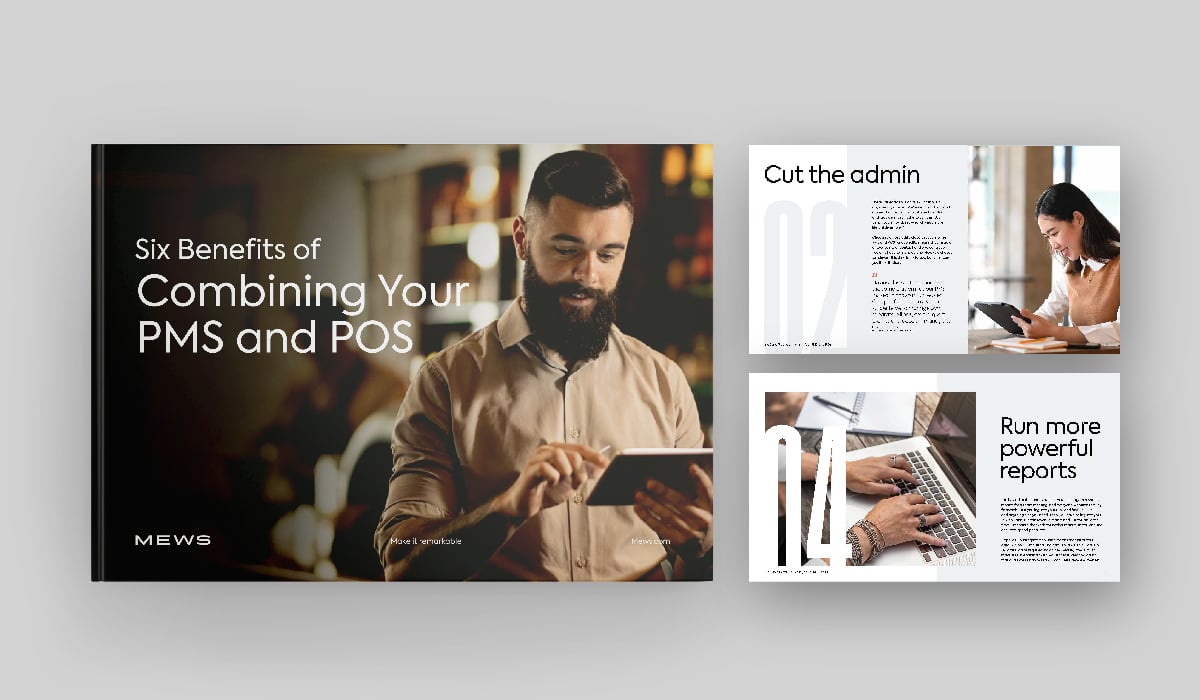
Six Benefits of Combining Your PMS and POS
Discover why choosing a hospitality cloud with a built-in POS creates a more seamless guest experience and streamlines processes for your teams.
What is a cloud POS system?
What is a cloud POS system?
A cloud POS system is a point-of-sale solution that runs online and stores data securely in the cloud rather than on local hardware. This enables transactions, reporting and operational data to be accessed in real-time from multiple devices and locations.
What are the main advantages of a cloud-based POS?
What are the main advantages of a cloud-based POS?
Real-time data across every outlet, access from any device or location, automatic software updates and no investment in expensive on-site hardware. Because transactions sync instantly, there's no manual reconciliation at the end of the day. The bigger advantage comes when the POS lives inside your hospitality operating system – then a bar tab, dining bill and room folio all sit on one guest profile and one revenue view.
How is a cloud-based POS different from a legacy system?
How is a cloud-based POS different from a legacy system?
Legacy POS runs on on-site servers and fixed terminals, so it needs manual updates, physical hardware and ongoing maintenance. A cloud-based POS runs online, updates automatically and lets staff take payment anywhere on property – front desk, pool bar, restaurant or in-room.
Written by

Eva Lacalle
Eva has over a decade of international experience in marketing, communication, events and digital marketing. When she's not at work, she's probably surfing, dancing, or exploring the world.