



What to expect?
Episode chapters
Transcript
[00:00:00] Halima Aziz: We're a windowless by design concept. We often call ourselves an adaptive reuse brand. So, we created these cocoons because they cocoon you from the world that you've come to visit. Guests are almost ignorant of the fact that there's no window inside. It's very few guests who come down to reception and go, “I think you forgot a window.”
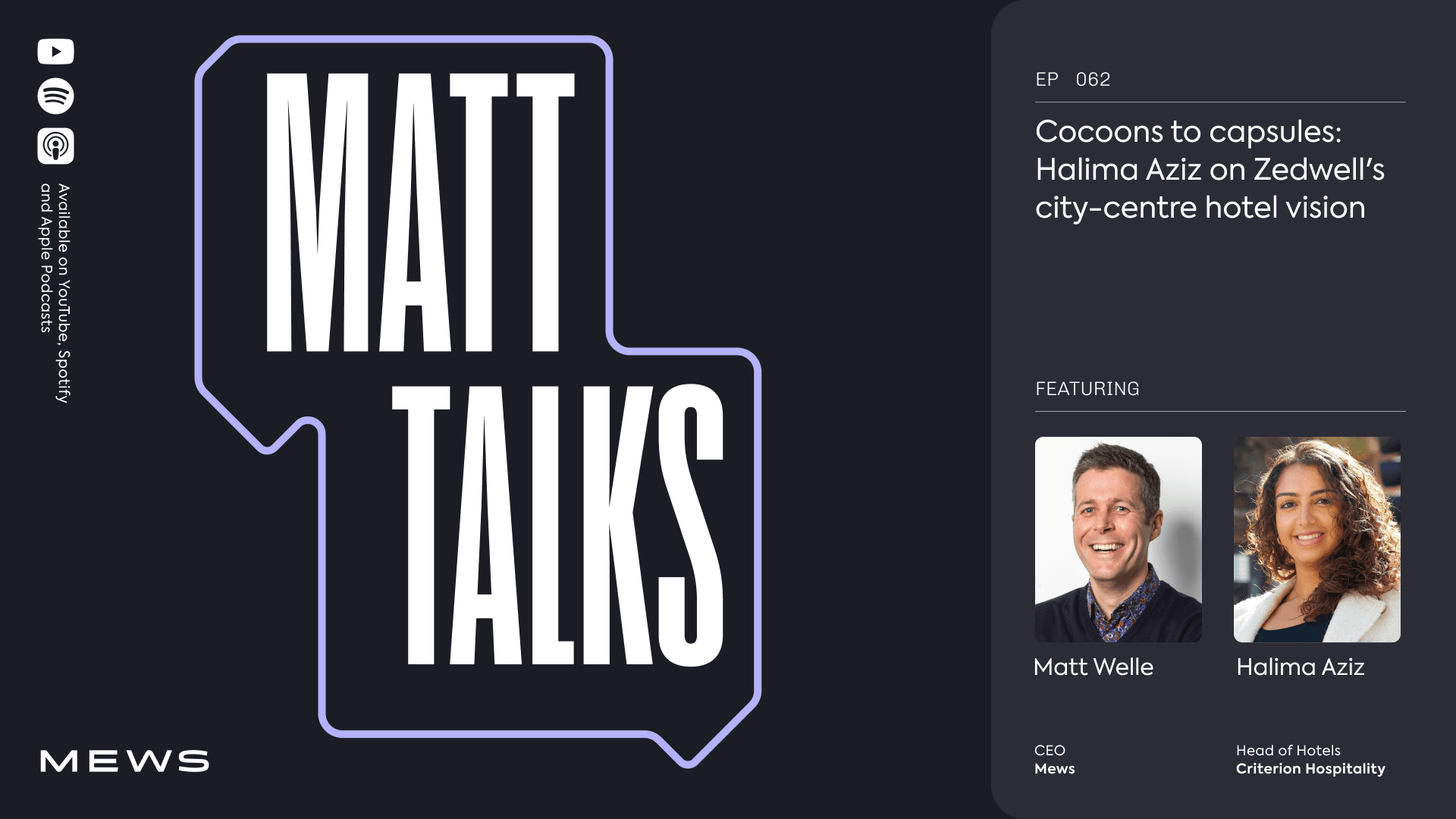
[00:00:28] Matt Welle: Hi, everyone. Welcome back to another Matt Talks Hospitality. And a couple of months ago, I walked through London, and I walked past a hotel that didn't make sense to me. So, as I walked in, I started to see the lobby, and I realized this was a 700-room hotel right in Piccadilly Circus in the heart of London's West End. And inside of an old indoor theme park that had no windows, they built a hotel. And the idea was really simple: good sleep and a layout that uses every part of the building really, really well. And it makes me think about all of the unused real estate that is around the world that we could be turning into really effective hotel space. This particular concept was created by Criterion Hospitality, who owns and operates the Zedwell. Halima Aziz is the Head of Hotels at Criterion, and her background spans across real estate operations and large-scale developments. And she has been the backbone of turning this underutilized real estate into something really, really exciting. So, I'm so happy to welcome her to Matt Talks today.
[00:01:28] Halima Aziz: Thank you. What a welcome, Matt. I'd love to say I am the full backbone, but I will give kudos to the team that came before me, as well that had these visions, but it's a pleasure to be on here.
[00:01:39] Matt Welle: Can you explain the concept to me? Because I described it briefly, but I think it's better if you describe this futuristic type of hotel.
[00:01:47] Halima Aziz: Zedwell was a real disruptor when we first started and continues to be so as we iterate our products. We're a windowless by design concept. We often call ourselves an adaptive reuse brand, and it was a brand that was born out of necessity. We had, as landlords, a number of underutilized buildings that we had to reposition as they came to end of life with their existing tenants. So, we decided to create a brand that could fit into any building. It could fit into a car park. It could fit into 70,000 square feet of internal space in an arcade, or it could fit into a department store and really make use of the assets that the property world had more or less forgotten about. And as we created this brand, we really wanted to emphasize what the brand could do for guests inside the heart of the city while still delivering the affordability needed for the guests coming to London. So, we created these cocoons, and we call all of our rooms cocoons because they cocoon you from the world that you've come to visit. We started with our flagship hotel in London, Trocadero, the 721-key flagship that we opened in 2020 just before the pandemic. And we worked very closely with architects and designers on developing a concept that would deliver the basics really well, but exclude anything that guests had thought of as traditional sort of hotel features, things like TVs, kettles, windows, of course. But even going down to how we operated our front of house, we wanted our guests to have a seamless check-in experience and not spend hours queuing for a reception desk to type in information they could have typed in themselves. So, we really built the brand from the ground up to deliver a hospitality concept in the building that we had. It was really born out of necessity, as it were. How we've continued to develop it is understanding that hotels that deliver the basics well satisfy the needs of a budget-conscious traveller without needing to go down the routes they used to. And once Zedwell Piccadilly had made that proof a reality, we looked at the rest of our portfolio and continued to develop it accordingly. We opened London's first underground hotel in a car park underneath a YMCA in Tottenham Court Road. So, it's sort of sitting at minus five right by the tubes as they pass you by. And this, again, was something that we were constantly challenged by by planners, by hoteliers, by investors, saying, “This isn't gonna work. What are guests going to think coming into a room that has no windows?”
[00:04:19] Matt Welle: But do you get complaints? Do guests complain?
[00:04:21] Halima Aziz: The only type of complaints we get are when they haven't read our communications well enough. But, typically, no. So, many of our employees also find that. When they read about us online, a windowless hotel concept, they come in expecting something a bit grungy, as if it's sort of one of those really small, not very well-maintained, cramped, claustrophobic spaces.
[00:04:43] Matt Welle: Yeah. That's exactly what I'm imagining. Yeah.
[00:04:45] Halima Aziz: Then they walk into the space, and particularly our lobbies, we design them to really transport you from the chaos of the city you're in into sort of this dark funnel of a corridor and then this ‘wow’ moment where you see sort of these lights, this warm wood effect. And it really makes you feel a sense of warmth that you wouldn't otherwise be feeling in these city centers. It's a very similar journey to your room. So, you go through these dark corridors, a bit of a maze, and you open your door to your room, to your cocoon, and you're confronted by this oak cocoon. We call them cocoons because we really identify with that idea of cocooning someone in a space. And they're essentially a bed base that has been built up out of pure oak to create a square effect with a great, great, great mattress inside. Guests are so thrown off by the concept and the aesthetic of what they've entered into that they're almost ignorant of the fact that there's no window inside. It’s very few guests who come down to reception and go, “I think you forgot a window.”
[00:05:45] Matt Welle: Yeah.
[00:05:46] Halima Aziz: Well, the majority are like, this is actually something really interesting, something very different. And at this price point, is nowhere; there's no other options on the market that are anything like it. At the price point we sit at, which is very much the affordable end of the budget market, you have the likes of much smaller independent operators who are sitting more or less similar, but they're giving you very bog-standard tiny rooms. Everything cramped inside. And because they're trying to deliver what they have been told to deliver, a TV, coffee and tea facilities, a mini bar, or a mini little fridge, spacious sort of bathrooms that you don't really use, storage solutions or desks that, again, you may not really use. It's not even a like-for-like comparison. When you look at our product online, it's so visually attractive and interesting, I guess, is the word.
[00:06:35] Matt Welle: Like, the thing I think that struck me the most when you showed me around, and you do this thing when you take me into one of the rooms, and you're like, right, stand there. And you switched off the lights, and then you basically, it's soundproof. Like, the soundproofing of the rooms is insane, and you're in the absolute heart of London. There's no more central place in London, but also, it's pitch dark. So, if you need deep, deep sleep, like, this is the best place to go and sleep.
[00:07:02] Halima Aziz: Well, it's exactly that. So, our locations, our buildings, are iconic. They're some of the most prime real estate London has to offer. But very similar to being in Times Square in New York, you may wanna be there as a tourist or as a business traveler who needs to be in the area, but you don't wanna bring the city into your hotel room with you.
[00:07:19] Matt Welle: Yeah.
[00:07:20] Halima Aziz: We recognize that so many hotels in this area, at a much higher price point than us, kept getting this basic wrong. They were letting light and noise bleed into the room and disrupting the basics of what we provide, right? Ultimately, at heart, what does hospitality provide? You can argue, yes, there's an experience there, of course. But, ultimately, it's rest. It's a place to rest, recover, and recuperate so you can go on about your day. We view ourselves as an enabler in the guest journey that you use us for your need, and then you get out there and go to do what you came to London to do. So, it was really important to us that we continue going back to the principle of ‘deliver the basics well’.
[00:07:59] Matt Welle: But did you get nervous about stripping back the room to the absolute bare bones, like, no television, no coffee and tea facilities, no mini bars? Like, at which point did you think, like, we're taking this too far?
[00:08:10] Halima Aziz: I don't think we're there yet. I think we looked at it as what are the friction points as travelers that we have? I hate a TV in a room, which is not smart. If it's got a sort of free-view channels flicking through, it's useless to me. Plus, what a lot of people don't realize is that the TV actually emits a white noise throughout the night. It's like a small buzzing that you don't think about it, but it's disrupting to your sleep. We recognize the doors typically had that little sliver underneath that would let light always bleed in. So, we invested in doors that are akin to a music studio soundproof door, something that's sort of crazily over-specced. But to be able to do this, we had to strip back something else. So, to make our business model commercially feasible and scalable, we had to be really clear on what the necessities were in the room and what weren't. Now, in our price point and in our bracket, we operate three-star hotels in the heart of the city. Our competitors who are offering coffee and tea don't really offer that Nespresso machine, sort of full star.
[00:09:08] Matt Welle: No. No. You get the instant coffee that I would never drink.
[00:09:11] Halima Aziz: You get an instant coffee and a kettle that looks like it's got a bit of limescale inside it and a few bits that you don't, it adds, in our opinion, clutter to the room. And I think we always approach this idea of visual clutter and physical clutter. So, it's everything from the light switches to what's actually on your desk if you have one. I see so many hotels I walk into that have lots of sorts of printed collateral, and sort of vases and all these amazing things inside the room. But as they've been faced by the same real estate problems we're facing and had to shrink their rooms, the rooms become more and more cluttered.
[00:09:47] Matt Welle: Yeah.
[00:09:48] Halima Aziz: And it becomes harder as a guest to use the space as functionally as you can. So, we really want to, what can we remove from this process that makes it really easy to clean, really easy to use as a guest, really easy to build, and really easy to sell? I think we didn't ever think of it as in, actually, are we going too far? In fact, and I think we'll get onto that later, we've gone smaller, right, and more compact. And we've actually looked at needs even more granular to say that cocoon, that hotel room protects you from the world. What other needs are not being answered in the hospitality space today?
[00:10:23] Matt Welle: Can you talk about housekeeping? So, in a typical, you know, four- five star hotel, I'm imagining a housekeeper takes 20 to 30 minutes to clean a room. So, on an average day, they can maybe do 14 rooms. I'm imagining that you're way more efficient. So, on the one side, you're saving on housekeeping, so better prices to compete in the market. But on the other side, profitability is probably better per square meter than any other hotel.
[00:10:44] Halima Aziz: This is what we're blessed to be: owner, developer, and operator. We design the rooms to make them as easy to clean as possible. We've used the same tile throughout the bedroom into the bathroom, up the bathroom walls. Very simple. The majority of what we're doing in there is grouting. But we intentionally designed it to be easy. No drawers that you have to go under, no shadow gaps, no areas where a guest could somehow discover something housekeeping missed and go, that room's not very clean. So, we had a real focus on making it as easy and as quick to clean a room as possible. Our average room time to clean varies between 13 to 15 minutes per room. It enables you to do far more rooms in a day and, obviously, for us to keep our costs a bit lower. In addition to that, we've done something quite controversial in the market where you have a lot of ecotree or eco housekeeping policies nowadays in hotels, where you can leave a card on your bed and say, “I don't need to be fully made up today. You don't need to change my linen. You don't need to change my towels or the likes of that.” It's an opt-out rather. We actually decided to move to an opt-in process where we said, actually, we're gonna really strip back what that means. We're only gonna clean your room every four days. And given our average length of stay is two nights, you're typically only cleaning departures. Every day, we'll do a light touch. We'll empty your bins. We'll replace your toilet paper if you need it. We'll give things a little wipe down. But we're not going to invest in doing heavy housekeeping and relying on customers to opt out of it because we know, and there are a number of sort of, examples coming to mind here. But human behavior, lots of people may not opt out even if they don't actually need it. And it's a very similar concept to TVs, with provisions in the rooms. If you don't give people the option and actually really get into the granular detail of would someone pay more for a TV? Would someone pay more for a window? It makes it really difficult for you to establish what the actual needs are versus what you were being told the needs were. So, when we moved, this move towards housekeeping, we thought we'd get a number of bad reviews, a lot of people sort of saying, “You've taken away everything from the room. You're just a bed factory, blah blah blah.” We've been surprised that people have been really receptive to it. It's almost as if it wasn't noticed, and that for me is key. There are so many things that, as consumers, you don't notice, you don't need.
[00:13:04] Matt Welle: Yeah.
[00:13:05] Halima Aziz: And as operators, as developers, to stay innovative and to stay ahead, we have to be a bit more conscious of the details.
[00:13:13] Matt Welle: Because how do you control the narrative of what people are going to expect? Because on your own website, you can curate what you want to serve, then you can downplay the expectations. But then you work with OTAs, I'm assuming, as well. But how do you ensure that they represent what the experience is going to be? Because you go to an OTA to book a hotel, and you just assume everything comes with windows, televisions and all of these things. How do you curate those in channels that you don't control?
[00:13:37] Halima Aziz: I'll say that's been one of the hardest challenges for us to overcome in the past couple of years. We have the majority of our bookings coming through online travel agents and a restriction on the type of content we're allowed to share on that page. So, we've worked within their rules. We've developed great graphics to list on our OTA websites to be really clear to the guests about what they're booking. But we all acknowledge guests won't always read when they're booking. We tend to be more led by price and location, which is what we tend to deliver. So, in our pre-arrival communications, it was really important to us to drive home the message of what the brand was and to drive certain activities that could enable a more frictionless day. So, we've been working with a number of providers, an AI-based WhatsApp communication, very similar to what a number of our competitors are doing. But to communicate with guests early on to say, “Welcome to Zedwell. We are a new way to stay. Get familiar with us. Understand what that means to be a new way to stay. Understand your room doesn't have windows. Your room won't be serviced every single day. You don't have a TV, but also understand why.” And that was, I think, another big barrier for us to overcome. The hoteliers, we often think that when we explain things, it's perceived by the guest in the exact way we want it to be. But guests are actually using much simpler language than we are. There are triggers in what causes them to go down a certain route, or engage with certain triggers are very, very different and behavioral. So, we looked at what were our key messages to get out there. We had to educate people about the brand before they arrived, or they would arrive and be either confused or pleasantly surprised. And we started working through, first, our WhatsApps, then our email communications. We're now increasingly moving things onto the Mews guest portal so that guests can always log on. They'll get a WhatsApp message saying, have a look at your guest portal. And if they choose to engage with us, they have a real understanding of what's going to happen in their hotel room. But I will say this is still an ongoing battle to get guests to read the communications we send them, sadly.
[00:15:36] Matt Welle: I don't really…
[00:15:37] Halima Aziz: We get 20 emails from a hotel, one hotel we booked. And especially if you're a corporate traveler and you're traveling with frequency, it's a lot. We're overstimulated in so many ways in these city centers, and Zedwell really exists as well as a response to that because it takes you out of all of that chaos. You don't understand what's happening around you. You really, what you choose to bring into the room is what you bring into the room.
[00:16:02] Matt Welle: Yeah.
[00:16:03] Halima Aziz: So, a great thing for TV is that we're all connected on our laptops too. Every smart application that we subscribe to, we can pick up our shows right where we left them off. We've got so much power in our devices that we can choose what we bring in and out of spaces. And I think hoteliers, one thing they sometimes get wrong is trying to curate in a room what they think the guest wants and not really understanding that attaching £20 more on top of that to achieve their return on investment may not actually be serving the best need. And that's where we find our opportunity by saying, actually, we can be £20 less than the budget operator next door because we haven't put a TV in your room or slippers on the floor that you're not gonna use, but we have to replace every time.
[00:16:47] Matt Welle: And I guess it's the choice of a traveler saying, “Do you wanna stay in the suburbs and pay that price, but then have to, every day, travel 30, 40 minutes to get into the city center and still have that same price point? Or do you wanna stay in the absolute heart and then experience the city as it was intended to be experienced?” And I think a lot of people are clearly, if I look at your financial results, choosing that option over staying in the suburbs, which they would have previously done.
[00:17:11] Halima Aziz: What I find fascinating is it's not just the budget, the really price-conscious who are staying with us. We're getting a lot of people who certainly have more ability, more spending power, who have chosen to make the savvier choice of staying with us and spending their money out on the streets, right? We're at Piccadilly Circus. You've got Soho behind us, Leicester Square in Chinatown on our left, Bond Street, Oxford Street and Regent Street on our right. So, you've got the heart of the city around you. You’re 10-minute walk from basically every tourist attraction in the city, but also from some of the best shopping in the city. And so often, I'll see people coming into our lobbies with really expensive purchases. And I'm thinking to myself, they made the savvy choice. They chose to spend £200 or £120 on their hotel room that night, and spend £2,000 in the stores because they had the ability to do so. So, I find that fascinating. But I wanted to come back to your earlier point of the suburbs versus staying in the heart of the city and enjoying the city as it's intended to. We've opened this year another fantastic concept, Capsules by Zedwell. It's essentially taken our cocoons, which have their private en suite, and shrunk them down to essentially one square meter with shared washroom facilities. But we were really keen to deliver these capsules in a way that made you feel like you had the privacy and that you were still having your needs met that you typically had in a hotel stay, but at a much more affordable price point. Because our intention was to open up a new market, and it was the market that didn't intend to stay in a hotel that night.
[00:18:41] Matt Welle: Yeah.
[00:18:42] Halima Aziz: Those who were planning to commute an hour each way or two hours sometimes each way, those who had a couple of pints too late one night at the pub and wants to stay for one last drink but is gonna miss the train home if they do, those who've been at their Christmas due and really don't wanna make that journey back. We found during COVID, cities across the world, but especially London, more and more people move out of the city center, and rents continued to rise. Now, more businesses are asking their employees to be back in the office three to five days a week, and those employees are really struggling with their commutes because rail tickets have also gone up in price. What we offered with the Capsules was an ability to stay for the night for as low as £30 and save yourself not just the price of the commute, but also give you the opportunity to explore London the way you wouldn't do if you didn't live in the city center. It's one thing to live in the boroughs and commute in and still have to take your last train home at midnight, but being steps away from everything the city has to offer and knowing you can roll into bed that evening, even if you're not a foreign traveler. You, maybe, live 45 minutes away, but you don't have that convenience of just being able to roll into bed in a few minutes, the next morning, roll out of bed and get back to work without having to wake up in sort of five or six hours of sleep.
[00:20:03] Matt Welle: But how do you compare, I guess, so I'm looking at a typical hotel room, your windows, your televisions, etcetera. Then you've got the cocoons, which are, like, rooms, you know, with a bathroom built in and a really comfortable bed. Then you’ve got the capsules, which are beds, basically, that are shielded off, and then you’ve got hostels. But, like, what's the range? How far from a hostel is that concept?
[00:20:27] Halima Aziz: We are technically classified as a hostel, but I would say we're quite far apart from it. Our guest feedback, preliminary guest feedback throughout this year, never associates us with a hostel. We always call ourselves a capsule hotel. And it's because we sit at the upper price point of the hostel market, but half the price of the lowest rated hotel, even in Zone 4. So, we sit in a really interesting space because we're not gonna attract necessarily the most price-conscious ordinary hostel user, but you will attract the hotel user that actually says, “I'm not gonna pay a £100 extra for that en suite. I don't need it. I'm sleeping on my own tonight in a capsule. I can be in and out of the city. I'm here to crash, essentially, a crash pad.” But I think exactly as you put it, it's a bed. What does the bed really do for you? It enables your sleep. What does a room really do for you? It gives you even more privacy, the ability to sort of settle your things in, recover, and then get out there. Capsules for me are a really great concept to introduce into London right now because we're a city that's facing ever increasing cost of living, plus we already had an affordability crisis in our hotel offerings. And opening up something that hotel guests would stay at, but for a price point that makes it in the hostel market, for us, it's been game changer. We're really looking at the rest of the country and indeed the continent as opportunities for where we can bring this concept to life.
[00:21:58] Matt Welle: Would it work everywhere?
[00:22:00] Halima Aziz: I don't think everywhere. It's high-density, expensive cities, and that's where we took our inspiration from, right? Asia, Japan, Singapore, they've done this really well because they've been faced with the same conditions we faced here in London. Densely packed cities, a hike on with commuters coming in and out of the cities every day, cost of living crisis ongoing, but most big cities in the world today are facing very similar problems. Even if they weren't five years ago, now they are. The likes of Paris, Milan, New York certainly have always had this. There's, I think, a lot of opportunity for this to work. That being said, I don't think this necessarily works in the countryside. I don't think this necessarily works in an alpine retreat. There's space for so many different types of hotel experiences. This is really trying to answer a need.
[00:22:53] Matt Welle: And as an operator, you look at your concepts. You don't really have direct competitors, but you do. But, like, how do you measure success? Because hotels, we talk about STR, like RevPar, and all of these metrics, but, like, you run capsules and cocoons. And how do you know if you're doing a good job?
[00:23:12] Halima Aziz: So, I think we often say that the hospitality playbook is not ours, so you may as well rip it up. Because SDR is fantastic. It's great to benchmark ourselves around our competitors. But just as you've mentioned, there's no one else doing capsules yet in the UK. And the hostel market is half the rate we're at. The hotel market's double the rate we're at. So, it's where do you really sit? We benefit from being developers and property entrepreneurs here. We look at everything on a return per square meter basis. And this goes all the way back to our initial development of the building, the London Trocadero, into what it is today. London Trocadero used to be Funland Cycle World. It was a great entertainment complex. Anybody who grew up in London or lived here throughout the 90s and early 2000s would certainly recall it. It was an icon, but that space is so, so difficult to work with. And what a tenant could afford to pay in that space after gaming had moved online was really, really restricted. There were a few tenants, but also the rents were really difficult to do. So, we thought, what can we do ourselves? How can we become the operators and deliver better returns in the space? So, we started Zedwell Piccadilly almost as a test of this concept, but at a large scale because we were really confident that it would answer the needs of many, but as we've iterated it, we've really looked at every building now as, actually, does this building suit a retail operation? Does it suit your residential operation? Does it suit a hospitality operation, or a combo of the three? And if that's the case, which areas of each building are best suited to deliver the highest return overall for the building? Lots of, you'll notice when you came in through, is that all Piccadilly? You come in off sort of this colonnade, and it's through, like, a dark little corridor. You almost don't know if you're in the right place.
[00:25:01] Matt Welle: Yeah.
[00:25:02] Halima Aziz: It's like this is not your typical hotel entrance. You've not got this grand sort of arrival experience until you're actually through that corridor. The reason for this is because we acknowledge that for retail tenants, that Ground Floor street level view is the most valuable. Once you go inside, nobody wants it. They're using the space of storage or really extending back or trying to use space that, essentially, for them, becomes dead space. We acknowledge that we could use the space and get a much higher return per product type that we operated there, just by being a bit more creative with our spaces. So, the Zedwell brand has really been formed around that to say in any building you're in, one of our products will be able to slot in essentially to the building with minimal works to the facades of the buildings, just internal adaptive reuse. And we choose our products based on what we view will get the highest returns. It's a constant battle. So, I run the hospitality division, but this is a much bigger company where we have residential, commercial and asset management divisions. And it's always a push and pull over, oh, I want more space for my lobby, oh, no, a commercial tenant will pay me X for that lobby, whereas the spaces that nobody wants, I guess, is where we excel: basements, storage rooms.
[00:26:18] Matt Welle: So crazy. I love it. I mean, you love everything you do.
[00:26:22] Halima Aziz: But it's spaces that an ordinary operator will not make work because they're really setting their brains around what does and does not work. And that's where we find our opportunity.
[00:26:33] Matt Welle: Can you talk to us about how you walk in that corridor, and I remember, the first, like, because my team had been telling me, go and see it. When you're in London, go and see this thing. And I remember walking through that corridor. I was like, oh, I'm not sure if I'm in the right place. And then I walked in, and I thought, oh, this is different. Like, can you talk to me about the experience that your lobby, like, how did you think through that lobby getting to the room experience?
[00:26:54] Halima Aziz: So, we thought of it as a transitionary experience. That little corridor that takes you in is intended to help the world drop away. So, particularly Piccadilly, you come in, and you're lucky if you got in without a 100 people bumping into you. So, we wanted to have the world drop away with this darkness and then create this cavernous space, making use of our triple-height ceilings to bring you into a really warm environment where even though you had 2,000 people passing in and out, you wouldn't feel that was the case. And to design it as such, we had to be really, really strict around what belonged in the lobby and what had no place in the lobby. So, our lobby, because it's restricted in space, the Ground Floor, it's arguments constantly, has a row of iPads, and it almost looks like an Apple store when you enter, but a really warm-looking Apple store because you've got all this ambient lighting and this beautiful woods coming on. And you're almost intrigued, okay, let me go play around with the iPads. What do I do? Let me check in and get out of there. So, the guest experience really is quite quick. You arrive in. You get this amazing experience. You're hearing the noise of Piccadilly dropping away, and we've worked with a fantastic music provider to create a soundtrack that is gonna sound very cuckoo, you'll just sleep scientifically, but there's a certain number of beats per minute that puts your body into a state of relaxation. So, we worked with this provider to develop the soundtrack to really bring guests into a state of calm, acknowledging that they've just been in a state of total chaos. We also did this with our scent. We're pumping lavender through the air vents to really start calming people, and we wanted their experience to be frictionless. We're not a thousand per cent there, right? I think it was someone in your team who said, “Vision is what the world looks like when my job is done.”
[00:28:43] Matt Welle: Yeah.
[00:28:44] Halima Aziz: And for us, we're constantly working on making that experience as frictionless as possible. But we acknowledge that in a typical hotel, your bottlenecks are your reception desk and sometimes luggage storage, but typically, it's your reception. You've got a long queue of people trying to check in. And our row of iPads was designed to completely get around that. So you arrive, you check in, you're upstairs in 3 minutes, 5 minutes. You don't have to interact with anybody if you don't want to. If you do, our hosts are available to help you. But we also wanted to remove any queuing of any kind, so we didn't want people to be queuing up to ask our security to call them a cab. We use these digital concierges in our lobbies that will help you book an Uber if you don't have the app on your phone. We'll help you book a tour of London, a theater ticket, a cinema ticket, anything you could kind of typically ask a concierge for. It's there, but it's digital. On WhatsApp, we're communicating with you all of the options we have available and the partnerships we have available in the building. So, if you would like to get the most out of the city as per the Zedwell way, you've got the ability. If not, you can ignore us and go about your day. But we really wanted to acknowledge that the majority of our guests viewed the lobby as a transition space. That's what the ambient lighting does really well, but they didn't necessarily want to linger there.
[00:30:00] Matt Welle: Yeah.
[00:30:01] Halima Aziz: And I think that's what's really driven home, the capsule experience recently is a typical hostel, it's a very communal social environment. And even as developers, we were really at odds with how much social space we provide, how much will it get used? And increasingly, our guests have said, “Actually, we don't really need much more space. We're not here to sit and work from your lobby. We're not here to drink your coffee or do our laundry in your laundry room, let's say. We're here to sleep, to crash, and then to go out and explore the best the city has to offer.” We're so blessed to be in locations where the best operators and specialists in their areas exist, from F&B to entertainment. We're not trying to mimic that. We're trying to deliver the needs very basically and very correctly.
[00:30:52] Matt Welle: Love it. So, and it's one of my pet peeves when I arrive early, which just happens, right? If you're on a transatlantic flight, you land at 9, and then you get to the hotel, and they're like, right, your room is not ready. Come back at 3 when the official check-in time starts. And it's one of those real hotel problems. Like, why is check-in at three? How have you solved for that?
[00:31:10] Halima Aziz: It's a very frustrating problem. We've solved for it twofold. We have very high occupancy. However, we also have high numbers of early checkouts and somewhat later arrivals. So, we worked around it by prioritizing a certain number of rooms, percentage of rooms per property that would be available before check-in time. And the only way we were able to do this is by tasking the housekeeping and paying the housekeeping to deliver more earlier. The reason for it is because we understood that there was this target market arriving off of late flights or who took a very early, even European flight and didn't really sleep very well, that wanted to just leave their items in the room and relax into the room, take a good night's sleep, have a shower perhaps. We wanted them to be able to access their room without having to wait unnecessarily for it, and we looked at charging for early check-in. This, I'll say, is one of the most controversial things, I think, when we first started doing it. And I would say it was controversial internally or professionally more than it was with our guests, because it was like, how are you charging for early check-in? This is a given. This is something that's based on availability. If you have the rooms available, you offer it to the guests. That's sort of a no-brainer. Now my issue with that is I'm a traveler. You're a traveler. Everywhere we go, it's so rare that there's a room available. Nobody's prepared for it. Even if you're prepared to pay, the hotel team simply does not have the rooms available. And we're talking about hotels which sit in much lower occupancy rates than us. So, we were thinking, how can we make this experience work for guests, and how can we monetize it? And the way of doing so was, let's charge for early check-in, but we're going to use that money to pay our housekeepers more to have more people on-site cleaning those rooms earlier. So, we'll make sure we have, in a 700-bedroom property, 100 rooms ready for check-in by 10 AM. Now that's crazy because our checkout time is not even then, but it means all of your early departures you're prioritizing to clean, and you're communicating to the guests, saying, “If you've arrived at 9 AM, you can check in. If you've taken that red eye from New York and landed at 7 and you're exhausted, you can check in, have a shower, take a nap, and get out there and explore the city.”
[00:33:20] Matt Welle: I love it.
[00:33:21] Halima Aziz: That was really key for us. And we've now gotten to the point where our kiosks are automatically upselling this, and it's fantastic. We've done it the other way, too, with late checkout. Now, late checkout is something a bit more common that hotels sometimes charge for. They sometimes charge exorbitant rates. My issue with it is that it's always been an experience with a lot of friction to get a late checkout. If you can call down to the reception and sort of wake up and say, “Okay. Cool. I want a late checkout; they'll do a lot of faffing around to see if there's any availability.”
[00:33:51] Matt Welle: Back office. I don't know what they do in the back office.
[00:33:53] Halima Aziz: They spend some time to get back to you, and then sometimes they're like, “Oh, I'm so sorry. Can't accommodate it. I have got more arrivals coming.” And they haven't really understood what time their arrivals are coming out, so maybe they could have done it. But the policy book is telling them not to do it, so they're not doing it. We decided to go a very different way. We're sending all of our guests a text message at 9 AM saying, “Wanna stay in bed a couple more hours? Extend your stay. Like, extend your stay by a few hours, pay X amount, and we'll guarantee you stay in your room.” You don't have to leave your bed. You don't have to necessarily wake up. Funnily enough, the majority of people booking these book it between the hours of 1 AM and 3 AM. So, you can tell -
[00:34:29] Matt Welle: You know what time it is. Drunk o’clock.
[00:34:31] Halima Aziz: A little bit later and exactly, drunk o'clock. But it really just answers a need.
[00:34:36] Matt Welle: What I like most about it is that you use technology because we, as humans, have a shame element of asking people to pay for certain things even though it's fair. But because you leveraged the Mews kiosks but also your WhatsApp integration channel, there is no shame anymore where people are like, “Yeah. I actually kind of wanna get access to my room, and I'm happy to pay a bit extra for that rights or that service.” And when you take the shame element away, then you'll be able to see what the price elasticity stretches. And I think it's good to test different price points because there is some elasticity, but there's also a maximum to it. And I think you've really tested the limits of it, and the business results show that it clearly works for both the guests, for your housekeepers who are earning a little bit extra and for the business.
[00:35:23] Halima Aziz: Exactly that. I think it's really important that everything stays commercially true to values. It needs to work for all parties, and that's so hard to deliver nowadays. But, ultimately, I think our guests are really acknowledging that it's not forced upon them. You don't have to add this on. It's a convenience. It's a value add. And, yes, you should pay more if you're having a little value add; that's why we keep our price so low. We're not baking extras in, but we offer you the extras if you'd like them. And at least offering that is far more than a lot of hotels, even at a higher price point, are doing to us. But exactly as you mentioned on the shame element, there's a big thing for a receptionist to deliver a fantastic experience and then say, “Oh, you're gonna have to pay extra for that.” Getting everybody comfortable with that, particularly sort of the more junior members of the team, is tricky, so we decided to remove it from the people element. Your hosts are not going to be trying to sell you anything. There's nothing anyone hates more than someone trying to upsell you aggressively on the spot, right? Instead, it comes up on your kiosk as you're checking in to say if you've arrived early, and you go straight to the kiosk to check in, we'll say, “Look, our check-in time is not until 3 PM. But if you'd like to pay more to check into your room now, you can just do it, head-on out, very similar with late checkout.” You're not having to go to someone and almost convince or persuade them to waive the cost for it, or convince or persuade them to let you stay in the room. Everything is trying to be as clear as possible, and Zedwell's trying to really do that. We wanna be really straight up about who we are. We're commercially unapologetic. We know what we need to do to deliver the returns, but our guests need to feel like we're not deceiving them. We're being really open and honest about what experience we deliver, the type of hotel room we are, and the type of services we provide. But then we've also got these add-ons that have been created with the guest experience in mind, and we've removed as much emotion from them as we can to just enable the guests to get the most out of their experience.
[00:37:23] Matt Welle: Final question. Like, you're one of the most ambitious people in hospitality that I've met, and I always enjoy talking to you. What is your plan for the future? Like, what exciting things are you working on that you're allowed to talk about at this point?
[00:37:34] Halima Aziz: We've got a lot of growth coming ahead. We've got another 15 hotels in our pipeline that are under construction just in the UK. What's next for us is a heavy spread of our capsule concept. We're looking at European growth, but we've got a lot more capsules opening up in the UK. And that, for me, is the most exciting next step for us because the Zedwell Hotel brand is competing with other hotels. The capsules today don't have any other competition. So, I'm most excited about consistently innovating and improving upon that product and R&Ding it almost to the point where it's at perfection to what it can be, and then rolling it out across this country. I think there's so much opportunity in different cities in London and in different micromarkets within London. So, we're really excited for that. I think the other thing that's really exciting me in general is continuous product R&D. I mentioned we're developers ourselves, so we're building in-house, and we've got these design teams in-house. So, every week, there's some new idea of what we can do. And it's about listening to all these new ideas, as I'm sure you have at Mews, and deciding, actually, which one really makes sense for our brand. So, we've got a new concept coming with Zedwell that we're working on internally that I can't necessarily share much about, but we're really looking forward to bringing that to the market in about a year and a half.
[00:39:00] Matt Welle: When you're ready to talk about that, do you ping me, and then you come back?
[00:39:03] Halima Aziz: It's just a natural progression of the brand. I think once we created it, we almost didn't fully understand what we had. And then we launched capsules, and now we're really conscious of what we have and the first mover advantage we have. We wanna still continue to stay ahead. And you have this at Mews. We have this at Criterion. Cultures of innovation really foster a fantastic environment to work in. It's so exciting. It's like the type of job where you want to be awake constantly to work because it's really interesting what you're doing.
[00:39:34] Matt Welle: But I love the, like, when your team showed us around, I could sense their excitement for the stuff that they were doing because we were a group of hoteliers coming into your concept, and they were so proud to talk about, you know, what they were doing differently. And I think that, like, that cultural excitement, you can only do when you do something really genuinely exciting.
[00:39:53] Halima Aziz: It's so rare to be part of a disruptor's journey in the early days and to grow with a company like that. You've been at Mews since its inception, right? And growing a company like that, being sort of grassroots hands-on, constantly sort of forming its next steps, is one of the most exciting things. And everybody you met, from our operations team to sort of PR to commercial tech, everybody's so excited because they understand the role they're playing in the innovation. And it's something that you can look back on and say, “Wow. I built that. I had a role to play in building that.” And by the way, that's a very similar way I look at buildings. We look at Trocadero just to sort of end on where we started. We look at this building 20 years on from when I first came to the UK and saw this building, and it's incredible how it's transformed. So many people have so little understanding of what used to be here, but I'll have the old Londoner come in and tell me, “This used to be Trocadero, this used to be SegaWorld?” And I'll go, “Yes.” They're like, “Oh my God, what you've done with this space.” So, building hubs like this in city centers is one of the most exciting parts of our journey. And there's nowhere that's more true than Trocadero.
[00:41:12] Matt Welle: That's a great closing. I wanna thank you for spending time with me. I'm sure we'll have you back next year once you can tell me more about the next concept. But thank you so much for spending time and sharing all of your insights, because I think you're definitely pushing the boundaries of hospitality to the next level.
[00:41:28] Halima Aziz: Thank you. I hope to continue to do so. And I hope to come back online to maybe talk about food or dogs.


