


What to expect?
Episode chapters
Transcript
[00:00:00] Jordan Hollander: The value today is that everybody's on it. So, it's a single kind of, like, trust currency across the industry, but it kind of evolved over time.
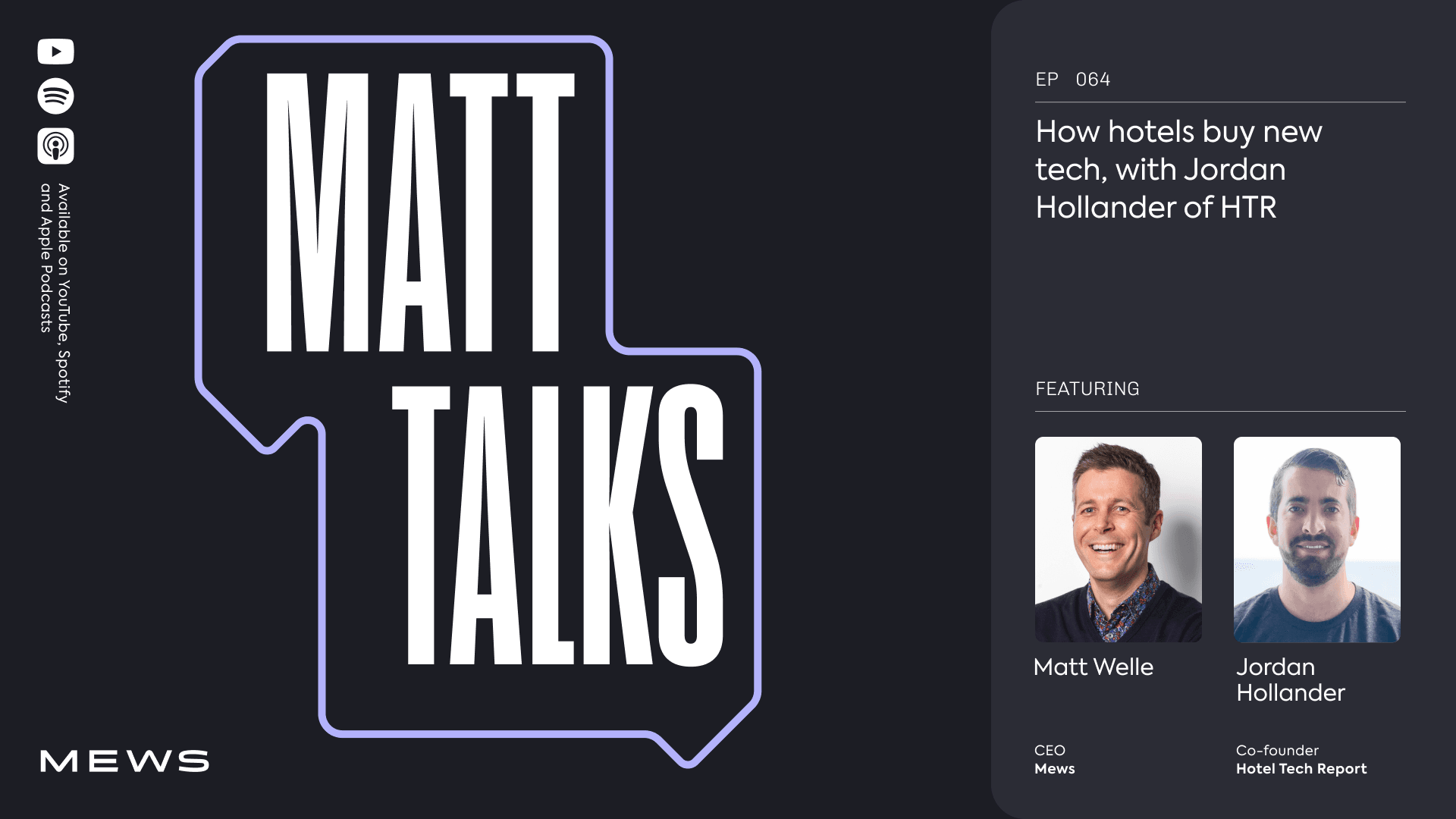
[00:00:19] Matt Welle: Hi, everyone. Welcome back to another Matt Talks Hospitality. Today's guest is Jordan Hollander. I know Jordan for about a decade now, and he's the cofounder of Hotel Tech Report, the company behind Hotel Tech Awards, where they rank technology using verified customer reviews, partner input integrations, and many other criteria. Jordan has spent years watching how hotels buy software, how vendors position themselves, and how much trust sits behind the ratings and the rankings. So, I'm really excited to have Jordan here. Mews just won best PMS in the world on their platform, and it's one of those awards that I care very deeply about because it's genuinely given to us because of the ratings that customers give us. Jordan, thank you so much for joining me.
[00:01:02] Jordan Hollander: Thanks for having me, man. It's great to be here.
[00:01:04] Matt Welle: In the pre-conversation, we briefly talked about, you know, when we met, and we met about nine and a half years ago. Can you talk to me about Jordan back then, and what was the problem you were looking to solve at that point? What was the problem you saw in the industry?
[00:01:17] Jordan Hollander: Adam and I had started a company called City Key. My business school friends affectionately called it shitty key, and it's appropriate because it was basically a shitty version of Oaky. Think of Oaky, but only selling off property experiences. So, we were working on this product, and we were kind of going door to door in the area. We'd sent out emails to all the GMs in the River North area around our office, and we weren't getting the response we wanted. But what we started to hear from these guys is they're like, we're getting like 200 emails a month from vendors, half of them tell us that they're the number one company in their space, and the other ones tell us that they're so unique there's nobody like them. And so we ended up kind of going down that path and trying to make it easier for hoteliers to make those decisions collectively. We're humans. We need a way to create an anchor to position a product and to compare products. And so that's essentially what we're helping hoteliers do. And then once they make a decision, and they have actual data behind what is the best product or what is the best solution set for what I'm looking for, there's never one specific product that you need to try, and as a fiduciary, you should always try multiple. But once you have that decision set, you can send around the data to your team. Instead of sending a sales deck, you say, “Hey, don't take my word for it. Don't just say, oh, I like Mews because, like, the sales guy was really cool, but, like, I like Mews. Don't take my word for it. Check out what other hotels like us are saying on Hotel Tech Report in an authenticated environment.” And now they can basically distribute that decision-making power, especially because there's so many cross-functional business decisions and purchase decisions happening in hotels. So, this could become a group decision. So now that GM, who was like, I only have a downside in this, is like, we could do this as a team, but you don't have to become a Mews expert to be part of this buying decision.
[00:03:02] Matt Welle: And when we started Mews, it was god-awful for those first few years. Like, honestly, I'm so thankful to those customers that trusted us in the beginning. I'm assuming you had the same experience. Like, when you launch something, it didn't work or, like, what was that first year like? How did you build a platform? How did you get traffic into it? And, like, was it god-awful like Mews was?
[00:03:21] Jordan Hollander: Oh, yeah. It was horrible. It was like a WordPress template that we customized with, like, a third-party agency and a $10,000, like, credit card bill, which actually, like, that's how you know how shitty it is that we built the product with 10 grand. We didn't have ways for buyers and sellers to connect, and we're a marketplace, but the reason that we didn't put that on the site was actually strategic because we had no traffic. So, we didn't want Mews to know that there was nobody here. So, when we started the business, like, when you're starting a two-sided marketplace, the thing that you always have to do is think of it as a single-player game. So, you have to add value for one side of the marketplace, independent of the other side arriving. Now, that isn't gonna last forever. It's kind of like the fake it till you make up. You're actually trying to add value. And so the thing that we did is we're like, okay, well, these, like, tier two, tier three companies can never get any exposure against the incumbents. And the incumbents obviously don't wanna participate in something like this early on because it's so experimental that we could get the really cool new companies to come on and they could be like, hey, like, look, you could see what my customers are saying and you could see what my competitors' customers are saying and you make a decision for yourself. So, it gave them a sense of credibility, and then it kind of just snowballed over time to everybody participating. But for those early years, the value to the single player games on one side of the marketplace was helping those companies who had very limited marketing budgets, that had really good products and not the same awareness, get more exposure and then kind of level up. And eventually, the point in the marketplace is to have ubiquity. Like, the value today is that everybody's on it, so it's a single kind of, like, trust currency across the industry, but it kind of evolved over time. So, it was, yeah, it was a piece of shit product early on, and we thank you for your patience with us.
[00:05:12] Matt Welle: Like, we immediately got excited about it because we're like, yeah, this is missing. Like, Capterra, it's just like, no one was on there, there was no reviews for our industry, and we were like, this doesn't need a platform because you're not gonna trust me because I'm selling my own product. Like, so that doesn't work. So, we need a platform for the industry. And I'm really glad that you've become kind of the standard now for reviews. I get so many emails like, oh, for $2,000, you can now win a prize. And I'm like, I don't want those awards, but the award we fight for, like, in Mews, we fight for, you know, best PMS from hotel tech awards, because it means a lot because it comes from real customers. How do you differentiate, I guess, your platform long term? Like, how do you retain the core platform in the long haul?
[00:06:01] Jordan Hollander: Yeah. Totally. I mean, from an awards perspective or from a core business perspective?
[00:06:07] Matt Welle: Well, like, there's probably many competitors to you, but, like, for some reason, the stuff you've done is the right thing you've done. But how do you make sure that you keep that lead position when there's competition going after you?
[00:06:19] Jordan Hollander: Yeah. Totally. I think, I mean, we've had so many, like, surprisingly hotel tech report copycats. I would say, like, part of it is, like, just being in a small TAM niche. We don't have as competitive of a market as Mews has, and so our competitors end up being less sophisticated, which kind of has helped us over the years to make a lot of mistakes and be okay and get through it. We've had, you know, Hotel Tech Report for Germany, for Dubai, for Italy, for Spain, like, all throughout the years, and they're just they keep positioning us as Hotel Tech Report for a region for some reason. We've had competition, obviously, with Gartner Digital Markets, which is kind of like software advice, Capterra, and then there's G2 that's come on the scene. So for us, it's just getting really granular on the hotel industry and continuously evolving. But I think, you know, to your point, the HT score is something that has made us really competitive, and we continue to evolve it similarly to the way that, like, Google has its algorithm. I'm not gonna sit here and claim to you that it's anywhere as advanced as Google's algorithm.
[00:07:22] Matt Welle: Sure, it is.
[00:07:23] Jordan Hollander: But we're looking at things like, and we'll talk about this more later. We're looking at, like, integration quality, we're looking at what peers, like, experts are saying in the industry, like, we're looking at, you know, the number of reviews that you have, which countries, what hotel sizes are you working with? So, we're looking at all this data that a generic review site wouldn't. And the other thing that's really cool about being vertical specific because I would say our most serious competitors, like, credible competitors are those, like, mainstream review sites. The really cool thing that we have is that across pretty much every review ecosystem, there's a huge, huge amount of fraud. And a lot of it is because you can't authenticate. Think about it. If it's Yelp, for example, or TripAdvisor, and you go and leave a review today of a restaurant down the street that you never were at, how the hell is Yelp supposed to know that? Number one, their volumes are crazy. Number two, you're doing it with your personal email. So, what we've done from day one is we've said you have to leave it with your professional email. So, when you leave a review with your professional email, you then have to click a verification link in that email so that it gets published to the site. So, we now know it's at, you know, Student hotel Amsterdam, and they click that link. So, it wasn't a Mews sales rep that filled this in. It was the hotelier who then got an email, who clicked that email. So, we have really rigorous authentication standards around our reviews. We have a lot of vendors complain to us, especially as they're getting started, like, this is impossible to get reviews because they've used other, like, review sites. I'm like, this is just not a way to, like, treat it. We don't wanna be a part of a time…
[00:08:50] Matt Welle: Reviews. Yeah.
[00:08:51] Jordan Hollander: And we're like, well, Mews has, like, 1,500 reviews. And these guys have reviews, like, it's doable. Like, it's our responsibility to really put up those guardrails or else the wheels come off the wagon. So, I think authentication and industry speciality, not just the content itself, but the actual nature of when you ask for a review, you have that verification, has led to, like, you know, a sustained competitive advantage for us.
[00:09:16] Matt Welle: It gets really hard to get reviews. Like, I remember we do these NPS scores where once every so often you get a question, like, how likely are you to recommend Mews as a platform to friends or family? And, like, someone wrote, like, “I don't go around recommending PMS to my friends and my family.” I thought it was such a valid comment. Like, yeah, to get a review from a customer, like, how do I get a customer to spend five minutes to write a review? It's really, really hard. But for us, we know that this is important, and it is important for hotels to get reviews as well. And it's a professional effort to do that. You have thousands of reviews on different platforms. What do you think is the driving factor behind the winning platforms? Like, what makes them stand out?
[00:09:55] Jordan Hollander: Yeah. I mean, I think, I won't use names, but in the early days, we had a customer who had found another company, sold it to a bigger hotel tech company, and the company that he sold, he was like, oh, well, this is so much better than this one that's ranked ahead of it. Like, clearly, this ranking system doesn't work, and lo and behold, that other incumbent, or sorry, the other challenger, kind of came in and ate their lunch. But I think the question around, like, how do you, like, authenticate, and how do you find the best companies? It's about that, I mean, it's the X factor. It's what Mews has, that relationship between buyer and seller. So, there's a level of trust and, like, getting people excited the same way that you guys get your team excited about working at Mews. It's like you want your customers to be excited about working with Mews. Like, they're a stakeholder. And so the companies that are able to do, do really well from a review perspective, are the ones with that energy, that momentum that has this excited ecosystem around them, and that's really what we're trying to validate. We're not like, oh, here's, like, the 15 features of Mews, and here's the 15 features of this one. And it's like, no, we're trying to figure out in real time and create a pulse of which companies are moving in the right direction, and our belief is that customers are the primary way to tell because, you know, I mean, we see it all the time when companies get, like, acquired by a conglomerate or something. You see this huge period where it's like they're doing fine, they're doing fine, and then the reviews drop off. And it's like, well, we didn't, and then they'll tell us, like, eight, nine months later, we didn't have, we were changing a lot internally, and our customer success team left, and our product team was turning over. And we're like, well, yeah, that's why we wanna have a real-time, like, pulse of what's going on in the business via customer feedback because you could see that pretty quickly as someone gets acquired or, you know, and it's not the right fit or they're figuring themselves out. Sometimes there's a change period. So, yeah, again, it's like in terms of what makes a company successful, it's deep relationships with their customers. But that gets harder and harder the bigger you get. I'm sure. Like, I don't need to tell you this.
[00:11:54] Matt Welle: It is.
[00:11:55] Jordan Hollander: But it's like, yeah, it's really easy when it's like Richard and Matt, like, grabbing reviews or…
[00:11:58] Matt Welle: I’ll write you an email. Can you please leave me a review? But, like, yeah. I can't do a thousand of those emails anymore.
[00:12:03] Jordan Hollander: Exactly. Exactly. And so as you get bigger, it's harder and harder to maintain those relationships, that trust, that enthusiasm with your customers and your employees. And so you get to this point where, you know, the startups are complaining to us. It's not fair, like, they have so many more customers to get reviews from. And then the really huge enterprises are like, it's not fair, we have too much bureaucracy. We have no relationship with our customers. So, there's kind of that balance in the middle of, like, how do you retain a relationship with a customer at scale, get them really excited about the innovation you're building. You're building the right integrations for them, having the right uptime, the right support, and providing all those resources in a way that they're excited to leave a review for you. Like, I know it's like leaving a software review is never really like, you know, an adrenaline rush or a dopamine hit. Maybe that's something we need to work on is, like, how to make that happen, but yeah. They're like, you know what? These guys are so effing awesome for my business. Like, yes, I'm happy to leave them a review, and yeah, help their business.
[00:12:55] Matt Welle: You know, this year, we won, I think, number one POS for restaurants as well in the POS category, and that's in a product we acquired, I think, three or four years ago. And we really invested into it because, you know, it wasn't in the ranking a couple of years ago, but we believe that if we're truly a product company and we do acquisitions, we're not gonna run that like a private equity where you have all these kinds of systems. Like, they all have to become new systems, and they all have to be best of breed. And it's really exciting to see some of those acquired products kind of get into the top 3s now or even winning in the POS category, because we have such pride in just really putting out really, really good tech. So, that was my highlight out of this year, to be honest.
[00:13:39] Jordan Hollander: For sure. And you guys, so your acquisition strategy has been so cool. I love how you guys kind of started with the bolt-ons of these regional players, and it's like it's not easy to integrate those, but it's like everyone's talking about there's 700 BMS in the world. Like, how could there, like, would you have, like, a CRM just for Croatia? Like, no. Like, you have, like, global software companies that can invest in innovation. And so how do you kind of solve that problem? And then how do you start layering on more features and functionality and products that can add more and more value over time for your customers in a smart way, but without closing your ecosystem? I think it's really cool what you guys been doing.
[00:14:12] Matt Welle: Thanks, because I'd love to talk about some of the legacy software vendors out there. So, you know, I looked at the winners this year or even in the top five categories, and most of them were, like, leading new companies that have, like, come up in the last decade. The layers, like the really big companies, the kind of more legacy companies that have our industry still at a chokehold, they weren't really there. So, if customers love these new platforms, but they're still buying the old ones, what does that say about hospitality?
[00:14:41] Jordan Hollander: Yeah. I mean, I think it goes back to just human behavior. Like, it's really hard to switch, like, inertia, especially when you have a system that's, I mean, you know, the LTV, I think, in PMS is, like, 6.7 years on average. Probably longer for Mews, shorter for some of the incumbents.
[00:14:58] Matt Welle: It's one of the pros. Yeah.
[00:15:00] Jordan Hollander: But it's really hard to switch any software, like, that you've used for a long time as a single user. Now, when you blow that up to, like, you know, 50, 100 users on a system, and you're like, okay, well, not only am I switching software. So, now it used to be a huge barrier, like, oh my God, how am I gonna get my data from system A to system B? Now you have RPA that can make this much easier. The switch over of the systems is faster, but you still have the people switch. So, you need to have really good, like, solutions consultants that will go in and help the hotel kind of handhold at a certain scale. Obviously, some hotel deals are not gonna warrant that, but it's like there's just this momentum and inertia that comes with using software, especially, like, multi-user software that it's really hard. And this is why investors love this space, because it's really hard to have people switch. So we are seeing it happen quite a bit. There's a few incumbents that have, I like to take some credit for, like Hotel Tech Report, like, turning things around, of, like, how people perceive these incumbents and then just, like, oh, wow, like, there's a place for them to, like, voice that, like, the Better Business Bureau effect. Like, we better fix this, and we've always said, like, our goal is to, we never wanna bring negativity to the industry, we wanna always be positive, we wanna help the best companies shout from a rooftop about how awesome they are, and we wanna help the less, better, shitty companies figure out what's wrong and fix it and then shout on the rooftop, so.
[00:16:21] Matt Welle: Have you seen examples of that where people weren't ranked very high, but then they got the feedback, and they started improving and climbing up?
[00:16:29] Jordan Hollander: For sure. 100%. Yeah. Correct.
[00:16:31] Matt Welle: That's so good.
[00:16:32] Jordan Hollander: Yeah. I mean, yeah. We saw, I'm not gonna name names, but we saw companies that were known for, you know, integrations as a huge problem, and it's so costly, and they're not open. It's, like, completely changed the strategy around that. And, obviously, there's some technical developments to happen along the way that allowed for that change, but we've seen companies that kind of, like, go in that direction and tighten things up for their existing customers, which is cool too.
[00:16:57] Matt Welle: How is AI changing the way that people, you know, go into your website and explore, and, like, how is AI changing your business model?
[00:17:06] Jordan Hollander: Yeah. Totally. I mean, LLMs are certainly how so many people kind of buy in everyday life, you know, I think there's been a lot of challenges still with LLMs that have, we thought things were gonna move faster towards LLMs than they have, but there's been so many critical errors. I'll give, like, a stupid example from yesterday. We're looking for some silly, like, light fixture in our house, and I was asking ChatGPT about it. I was like, we really like the look of this one, but it won't fit our space. And then it spits out, like, 5 fixtures that look nothing like the one that I input. I'm like, okay, well, not gonna go back to, like, just browsing Google and look or, like, you know, Wayfair or whatever. And so I think the same thing has happened with software, and software is such a more important purchase. It's like you search, like ChatGPT. How many times, like, when you're making a software decision, first of all, these aren't happening every day like consumer decisions are. So, you're not gonna be like, oh, like, I looked for a recipe for a grocery list, and it wasn't good yesterday, but let me try again today. It's like for software, you're in this kind of, like, buying mode for a fixed period of time, and then you kind of go out of it for a while. You go dormant. So, the people who have tried buying in the last 2, 3 years on ChatGPT, they got pretty shitty answers for the most part. Now I think there's gonna be this kind of, you know, this period where AI eventually kind of fixes itself, and you have kind of this epiphany moment where everything works. But I think, kind of going back to why don't people switch to new software when they have bad software, it's like it's inertia. It's human behavior. We're used to buying a certain way. If you, you know, two years ago tried to search ChatGPT for PMSs and you were looking for features and reviews and all this stuff, and it was serving you bad information, well, in three years, when you go to do it, you might give it another try. But you might also be like, I'm not really gonna go down that approach. So, I think it's still used as a discovery tool. It's still a great tool to kind of, like, stress test, ask questions, but there's still even when you put in this, like, Peter Thiel, like, be this horrible critic and, like, you wanna prove me wrong about everything that I'm saying, like, I don't know it verbatim, but I have it at my GPT. It still validates you. It still provides you bad information, and so we haven't seen it move as much as we thought. So, there's still a ton of, like, googling happening and trying to get source information. But one of the things that we wanna do is start ingesting source information. So, like, the first thing that we did with AI was, I mean, obviously, as a review site, we summarize reviews. We come up with semantic keywords. A lot of the stuff that kind of features and functions you see on TripAdvisor, Amazon, these are, like, really easy ways to incorporate it into the buying process because who's gonna read, like, 1,500 reviews, you know, and, like, scroll through the pagination? It's like a pain in the ass. So, we're trying to surface that as much as possible. But, yeah, we'll likely roll out an LLM kind of chatbot. It's something that we've kicked the tires on, but commercialization is really hard. I'm like, how do you monetize that? Do you just, like, stick an old school, like, banner out on the side of it, like, while people are chatting? So, do you stick links in it, but then are the links gonna be, like, you know, biased based on the ads?
[00:20:03] Matt Welle: So, you wanna talk and chat with a bot that you trust?
[00:20:06] Jordan Hollander: Yeah.
[00:20:07] Matt Welle: If it starts, like, selling you shit, then you're like, I'm not sure if this is..
[00:20:10] Jordan Hollander: 100%. And so we haven't built it yet, but that's something that we would definitely consider. Yeah. So, LLMs are something that exposure perspective is really important for everyone, you know, to be thinking about as sellers and because buyers are using them. But I don't think they're quite at the level of getting the information that we need. And I think it's just a matter of getting the right content in there, training the LLMs on the right data. They have no feedback response at all, basically. It's like, okay, so they served you, like, bad PMS recommendations or whatever, just average, and then you went and did a bunch of research on Google. They have no idea that was, like, a bad recommendation. So, I think it's just gonna take time for them to get the information correct, and then it's gonna take time for buyers to kind of trust them in a way that I don't think today.
[00:20:57] Matt Welle: If you look at the winning categories this year, were there any major surprises?
[00:21:01] Jordan Hollander: There's always a few surprises. I would say there's a company called Mara Solutions out of Germany in the reputation management category. I think reputation management in general is about to have a resurgence, just because it kind of, like, went through this phase where it was, like, you know, Revihotel nate and TrustYou and ReviewPro, and it was like they got this huge scale with this, and then they kind of all dropped their prices. So it was, like, near free to use reputation management software. It's adding much of value because you're getting exposure on these third-party platforms. And then it kind of got commoditized, and all those companies kind of, like, shifted their focus onto other stuff. But I think with the advent of LLMs, it's like now review data is really critical. Like, if you can get that information in-house and you could provide actionable recommendations to your team based on specific feedback that you're getting in real time, I think, and then you could use that for CDP segmentation and email campaigns, and you could use it to say, okay, well, like, our room quality is going down in the eyes of consumers, and we're getting bad reviews. So, maybe we should have a slightly less aggressive rate strategy so that their expectation of the room is lower until we do that renovation in two years. So, I think there's a lot of cool stuff happening there.
[00:22:13] Matt Welle: And what I love about Mara is that they actually built a two-way integration because these used to be one-way integration. So, these review platforms would want to know from the PMS who are the guests that stayed with us yesterday, so that I can target them for reviews? But when the guest actually leaves clicks on the link in their email and leaves the review, we get the review data back from Mara. So, it stores in the PMS because the PMS is now the system of action where we use LLMs to basically summarize, like, in a short toolset, actually saying, “Hey, this customer wasn't happy last time. Be careful.” And it's really valuable for those review sites to to to feedback into Mews. And not all of them do it. But when you start to see it, the LLMs get really good inside the PMS system.
[00:22:54] Jordan Hollander: Totally. Totally. So, I think that's having a resurgence. We saw Inflow win in the accounting software category for the first time, which is really cool. They, I mean, they raised a bunch of money. All the VCs are looking for their next Mews. They're all looking for the next accounting software after an incumbent there. And so Inflow's kind of, like, really taken the industry by storm with, like, a little more modern UI than the incumbents. Obviously, hotels have really specific kinds of accounting needs, reporting needs, taxation needs, as you guys know. And so I think that's been a really interesting one. The other one that I'd never heard of before, like, because, you know, we're not in, you know, we're used to, we moderated, I don't know, we moderated reviews for the first, I think, like, five or six years of the business, a little too long, but we don't see all the data coming in and all that stuff today. We have a team that does that. But Okra parking management, so it's like a parking management solution that's getting more legs with hotels. And, obviously, I know Mews and some of these PMSs have integrated kind of spaces, and you could kind of create your own modular offering, which could include parking. But that was a cool one to see too.
[00:23:58] Matt Welle: Any AI-native companies that you've seen come up?
[00:24:01] Jordan Hollander: No. You know, I've been really surprised by it. I mean, when you look at that, I think Richard actually sent me an article about this, but it's like vertical market software. Like, the thing you need is that feedback loop. And so I was like, if you wanna create a CRM, it's easy. Just, like, connect into, like, the team's email inbox and, like, create this, like, you know, this chat interface instead of a UI wrapper, you know, in terms of, like, logging deals and taking notes and everything. When it comes to, like, vertical market software, like, this data's inside Mews. So, it's like you can't just come and build something off of Mews data. And so all the innovation has been happening from the companies that are big enough to have the data at scale, but not too big to be bureaucratic and built on legacy tech stacks. And so, I've been really surprised. I thought there were gonna be more. We were kind of looking at investing in some, and it's just like nobody really had the right kind of, like not product market fit because we were investing really early, but, like, nobody was really moving in the right direction that we needed to see, at least yet. I hope that evolves over time. I also think there's, I think of, like, these, like, vertical market software, like, funding cycles as, like, vintages. And it was like, you know, this is the age of, like, Mews and Canary and Lighthouse, and like these, and Duetto. Like, these companies are, like, coming to scale that kind of all started around the same time. And I think that as you guys, like, exit in the next few years, basically, all these companies will have to have some sort of financial outcome. But as the founders walk away, typically, something slips, and the customer closeness kind of ends up slipping in some of these cases. I think that might end up opening room for innovation from the outside. Not that you guys are, like, gatekeeping. It's just you guys are too good. And I think it's really hard. Like, how are you gonna come in and, like, recreate what Canary's doing when they've got, you know, this stronghold on, you know, the chains and they've got a really great product and a really great vision and leadership. It's like some they have to slip up somewhere to, like, make room for someone else to come in and kind of build that. And so I think, you know, the vintage of funded companies right now is really exciting, you know, getting to levels that, like, you know, uses recent valuation. Like, VCs ten years ago would have said, nope, you're never gonna do that in hotel.
[00:26:10] Matt Welle: When we met in San Francisco many years ago. We were out there trying to find funding, and it was hard because some of these investors, like, yeah, you're not horizontal. Meaning, you can't go across many industries. You're just in the travel vertical, and we're like, but it's huge. And they're like, yeah, it's not interesting to us. And we were booted out of many investor rooms because we were in a vertical, and that narrative has completely shifted with AI now, because horizontal can be displaced very easily through AI-native platforms. But vertical is really hard because it's hard-coded, like, workflows that we are trying to fix, build, and, like, we're in a very different position fundraising today than we were a couple of years ago because we were just, like, you know, always competing with horizontal software, and it's a nice place to be right now.
[00:26:54] Jordan Hollander: Yeah. Now, nobody wants to touch horizontal because of the AI disruption. They only want vertical, and they love the LTVs. And so it's crazy how that's flipped.
[00:27:02] Matt Welle: What are your predictions for this year? Anything exciting that you're looking at?
[00:27:06] Jordan Hollander: Yeah. I mean, I think predictions-wise, we're probably gonna be looking at a lot, you know, more innovation coming from, you know, the, I would say, semi incumbents. Like, I don't look at you guys really as an incumbent still. Like, these companies that are sitting on data, that have the engineering teams and the product vision to, like, go and take a little more risk and move a little quicker. In terms of predictions, I think, like, integrations has been this problem that the industry has talked about for, like, a decade, but it's like with AI. I think the cost of integrations is eventually gonna go to zero. You know, if you're on the Mara engineering team with, you know, with an LLM, you could say, when someone checks in, checks out in Mews within 45 minutes, you send them, you know, a checkout survey. And so I think integrations cost is gonna go down. I still don't know what that means for point solution versus platform, but I think some of this stuff, I don't think it's gonna, like, manifest fully in 2026, but there's, like, an argument to be made that's like, okay, so the cost of development goes down and the cost of integrations goes down, so it'll be easier to build and atomize in the future. But then there's an argument to be made that's like, okay, you couldn't be Mews ten years ago and effectively compete on revenue management system, and operation software, and POS. But it's like with the cost of development going down, you could now manage those product road maps in a much more efficient way. So, a platform has an advantage in the sense that this platform approach that you couldn't do before is now much more feasible. So I don't know, like, where that plays out. I'm sure it'll be some blend where there'll be some exciting new kind of, like, micro SaaS point solutions that kind of take hold. I mean, can already start it as what, like, digital authorization at the front desk. Like, I remember when Harmon, like, told me about the idea. I just really didn't get it. I was like, but isn't this just something you do at the PMS? Or, like, you know, I didn't really fully understand it, but I think there will be some kind of, like, Trojan horse product like that that will solve a need that's AI native, get huge scale, and then probably, like, branch out. It depends. I don't know whether they're gonna be in operations or whether they're gonna be in guest experience or marketing, but I think some of those solutions will start to surface themselves eventually. I'm honestly not bullish that it's gonna happen in 2026. I think it's still a little bit early.
[00:29:14] Matt Welle: And any category that you think will be in trouble?
[00:29:17] Jordan Hollander: I mean, like, to that point, like, I do think that if you're not adding unique value, like, if there's nothing that you can do differently and you plug into a PMS, like, there's a real risk. Because, again, like, for Mews with a ton of resources, with, you know, a great product vision, like, you now have the capability to basically cover more breadth than you could before. And so I think point solutions really need to think about, like, if I'm a, you know, guest messaging platform, like, what is the thing that I am gonna provide that's unique and different to the market? And some of that might be go-to-market, some of it might be pricing, but some of it might be innovation. But I think kind of we're all at risk. I mean, you know, I'm sure you've heard, I think, it's Satya Nadella from Microsoft saying software is going away. It's like, hey, I don't wanna bet against that guy, but, like, there's gonna be no software anymore? Like, I can't really picture what that world looks like. But so I don't think, I mean, I think we're at risk with that. I think everybody's kind of, we're in this interesting time where we're like competing against each other in a sense. I mean, not like Mews and Hotel Tech, but we're competing against other software companies or marketplaces or channels for, you know, eyeballs for us. But we're also competing against, like, just innovation and, like, the, you know, the wave of time. Like, I just really don't know who's safe in this environment. I went from finance to, you know, that hotel tech to the horizontal tech. Like, it's really, I mean, actually, you know who is the safest, is hotels. Like, because people still wanna stay in hotels, and we still wanna dine at restaurants. So it's like, I think to be a hotel owner, it's a really interesting time because you're getting, like, more efficient from a technical perspective, like a technological perspective. You're shifting your labor cost into technology cost, and you're getting better at demand generation. And you're having a lot of demand come in from people who are, like, really tired of seeing, like, AI-generated memes, and they want, like, a human experience, and they want to be with their family and unplug, or, like, you're going to Thailand in a few hours. Like, they want to have that kind of unplugged experience, and I think the hotel industry is really well-positioned for that.
[00:31:20] Matt Welle: Yeah. I agree. I think it's one of the most exciting times for hotels because we finally get to automate all the boring stuff that no one wants to do. Oh, no human wants to do the stuff that we make them do. But, like, now use the humans to really go back to hospitality. I was talking yesterday to someone, and he said, why did you start in hotels? And I said, I remember when I was four, the first hotel experience I had, it was just a small family hotel. I walked in, and it was just like, I was like, what is this wonderful place? And it was so warm, and there was a chocolate on the pillow every night. And I was like, that was such a small thing. And I think now with LLMs, we can go, like, really surprising the live customers, but you need the hoteliers that embrace that creativity and allow their teams to get really creative. But I think it's one of the most magical times that's coming, hopefully, for hospitality.
[00:32:07] Jordan Hollander: Totally. I mean, it's a really cool time, and I think to my point about Mews as a platform having capabilities to go further, I think hotels are the same. It's like you used to have, like you know, and you still obviously do, but revenue manager, market director of marketing and sales and marketing. I don't know why those are together because they're completely not the same function at all, or a skill set, you know, like, MICE manager, etcetera. And it's like the GM can kind of turn it. And, by the way, like, all these roles are mostly underpaid for what they're doing. A lot of them are unhappily in an office in a basement somewhere, in certain hotel groups that are, like, subscale, don't have a corporate office. And so I think we're gonna move from, and we have this labor problem because people are like, I don't really wanna do that anymore. And so I think we're at a time with technology where it's like the GM can kind of turn into a product manager, and they could be managing revenue management, and marketing, and sales if they're really good. Obviously, you're still gonna have those resources that you're gonna need. Maybe it's more outsourcing, that the GM's kinda managing an outsourced role versus in-house. But I think you're gonna have less jobs, but they're gonna be better jobs, they're gonna be more exciting, more upward mobility, more pay. I still remember when we were selling our last product, like, the GM of the Hard Rock in Chicago was telling me his salary. And I was like, oh my gosh. You're like you're running, like, a 60-million-dollar business, and you're getting paid as if it's, like, you know, a 500-thousand-dollar business. It's crazy, but you know, that's just the market-based economics of that role, but I think they're gonna get more favorable over time and bring in more talent into this industry.
[00:33:36] Matt Welle: Like, if we wanna get that talent in that's gonna innovate, you gotta pay above market. And some of the areas are getting to that realization where, you know, we're just all complaining about the lack of talent. We don't have a problem as a tech company. But, yes, we pay high salaries, but because of that, we get better talents in, who are 10x-ing the output of the company. And I think the hotel world needs to realize that maybe above market is painful initially, but the people you can attract for it will transform your business long term. And once they get on that, like, kind of, like, new direction, and they understand this, it's exciting.
[00:34:11] Jordan Hollander: Yeah. Totally.
[00:34:14] Matt Welle: Jordan, thank you for everything you're doing for the industry. Like, I love watching you guys thrive, and just the engagements on the platform is so positive. And the way you spoke here, like, you know, I'm not calling out names, and we wanna focus on the positive. It's very much how I kind of stand in life. I think we should celebrate the great achievements of companies, and you have built one of those companies. And I'm really happy that you've done this for the industry because we really needed a platform to come out and just make sure that we create this transparency about which are the good platforms and read the customer reviews. So, a massive thank you for everything you're doing for the industry. Thank you for sharing all your insights, and I'm hoping that we'll have you back on next year when we win another time; the best PMS in the world.
[00:34:56] Jordan Hollander: For sure. Thanks for having me on, Matt. Yeah. Like, a review system is never perfect. It's always, like, you're going directionally, like, to create an effect. And for us, like, one more thing before you hop off is just, you know, we started the first thing we built was an NPS tool. Like, we joked about NPS earlier. But the first thing we built is an NPS tool. Like, what if we could get every company in the industry to, like, publish their NPS? That was, like, our North Star. Nobody touched it for obvious reasons. I know you guys wouldn’t want that either. Like, nobody wants their, like, public information out before it's internal, but that's kind of where we're going. It's never gonna be, like, a perfect system, but we're constantly evolving and iterating, and it's a community approach. Like, guys like you or Richard come to us and say, “Hey. Like, this is, like, really wonky of, like, how this ranking works in this out in this variable.” We always think about Hotel Tech Report as a utility for the community, and we want everyone to have a say in it, like, kind of like a DAO. Like, obviously, those aren't really in fashion anymore, but, like, we just wanna be the arbiters of that DAO. Like, we don't wanna be, like, picking winners and, like, analyzing features. So, thank you for having me on and letting us tell the story, but yeah, it's still very much an open book, and we're excited to have people like you as part of telling the future of that story.
[00:36:09] Matt Welle: Nice. Thank you.


