Key takeaways
- Hotel key cards have evolved from magnetic stripe cards to RFID and NFC for faster, more reliable access.
- RFID and NFC key cards offer better security and durability than traditional swipe cards.
- Modern hotel key cards can be used beyond room access to support amenities and other guest services.
- Contactless key cards improve the guest experience by making access quicker and more convenient.
- The right key card system depends on each hotel’s needs, including size, budget and technology goals.
Hotel key cards, NFC, magnetic stripe and RFID cards are various kinds of cards that ease hotel room entry. They also offer a range of other functionalities – from increasing the average daily spend to providing extra safety. Besides, they're harder to duplicate, and you can deactivate them remotely in case of loss.
Let's look at hotel key cards in more detail to find the best solution for your hotel. Ready to better manage the hotel experience and improve guest security?
What is a hotel key card?
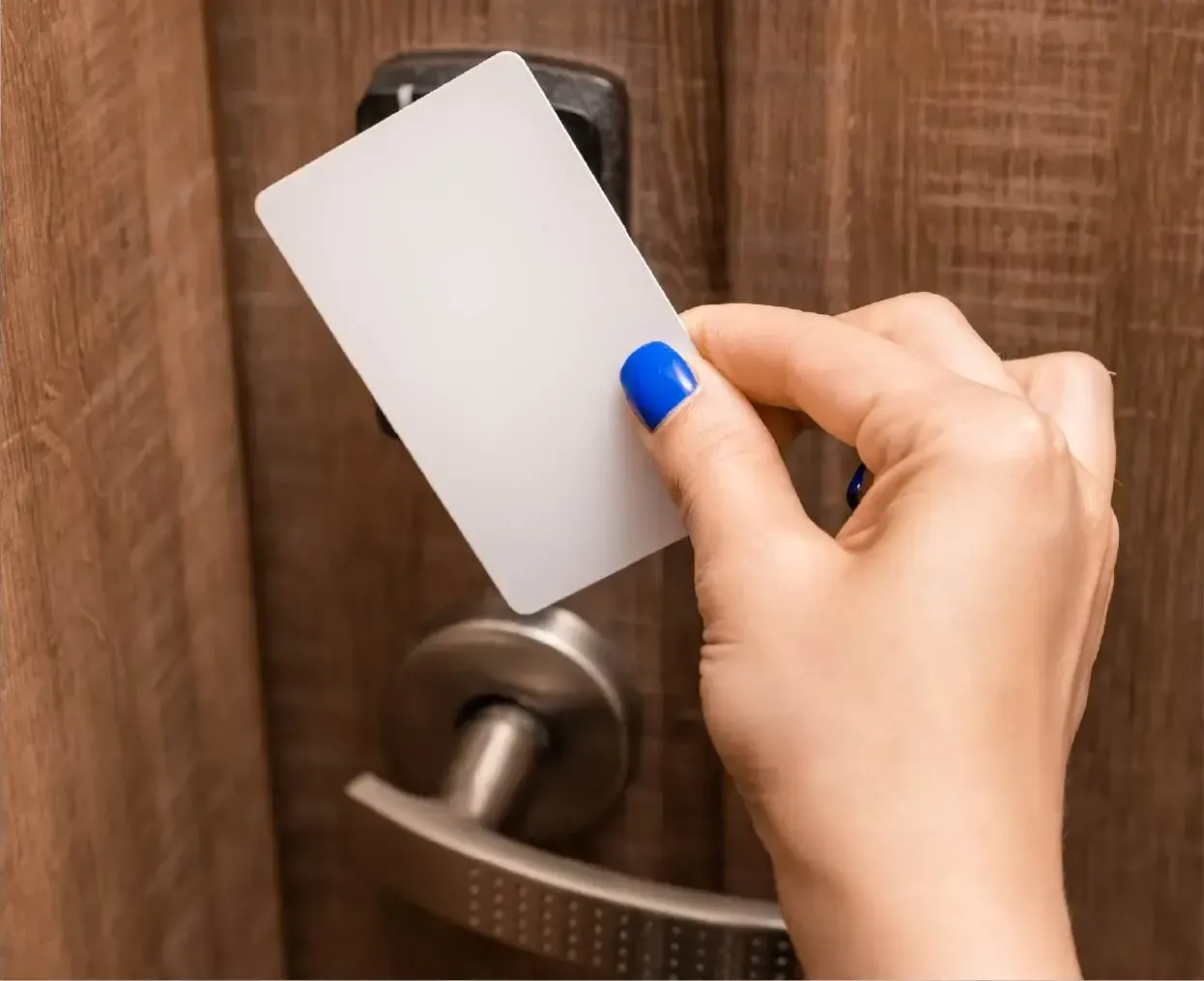
A hotel key card has a magnetic stripe, works with Near-Field Communication (NFC) technology, or is embedded with an RFID (Radio-Frequency Identification) chip. The aim is to simplify hotel room access, payments, information transfer and coupon storage. Hotel key cards are an alternative to traditional keys, are generally safer and provide more convenience for guests.
Why do hotels use key cards instead of keys?
Hotels use key cards instead of physical keys because they are more secure, easier to manage and better suited for modern hotel operations. Key cards can be quickly issued, deactivated or reprogrammed without changing locks, which reduces security risks from lost keys and saves staff time. They also integrate with other hotel systems, allowing properties to control access to rooms, amenities and restricted areas while supporting a smoother, more convenient guest experience.
How do hotel key cards work?
At a basic level, key cards store or reference an access credential that's linked to a specific guest reservation. When the card is presented to the door lock, the reader checks that credential against the room and stay dates on file – if it matches, access is granted.
The main difference between card types is how that credential gets read. Magnetic stripe cards require a swipe or insert, while RFID and NFC cards work on tap, using contactless chips for faster, more convenient entry.
Key cards and digital keys can also integrate with a property management system, so access permissions update automatically as reservations change – a guest who extends their stay or upgrades rooms gets their credential adjusted without a trip to the front desk.
The main types of hotel key cards
You've seen how different key cards work – how do you choose the best one for your hotel? It all depends on your property's size and requirements. While NFC and RFID cards are more technologically advanced, straightforward choices like magnetic stripe cards and hole cards can also do the trick.
NFC Card
An NFC card uses Near-Field Communication to access rooms without touching the door. It's usually the first step in moving towards smart rooms. The card's embedded circuits can communicate with various electronic devices – you can use it for payments and accessing rooms, the gym, the sauna and the rooftop.
Storing coupons allows loyalty program members to access their benefits and settle payments anywhere. Along with integrated payment terminals, they introduce more upselling chances, driving up the average daily spend through easy payments. NFC cards double as a payment method and a room key card, which benefits guests and your hotel.
RFID Cards
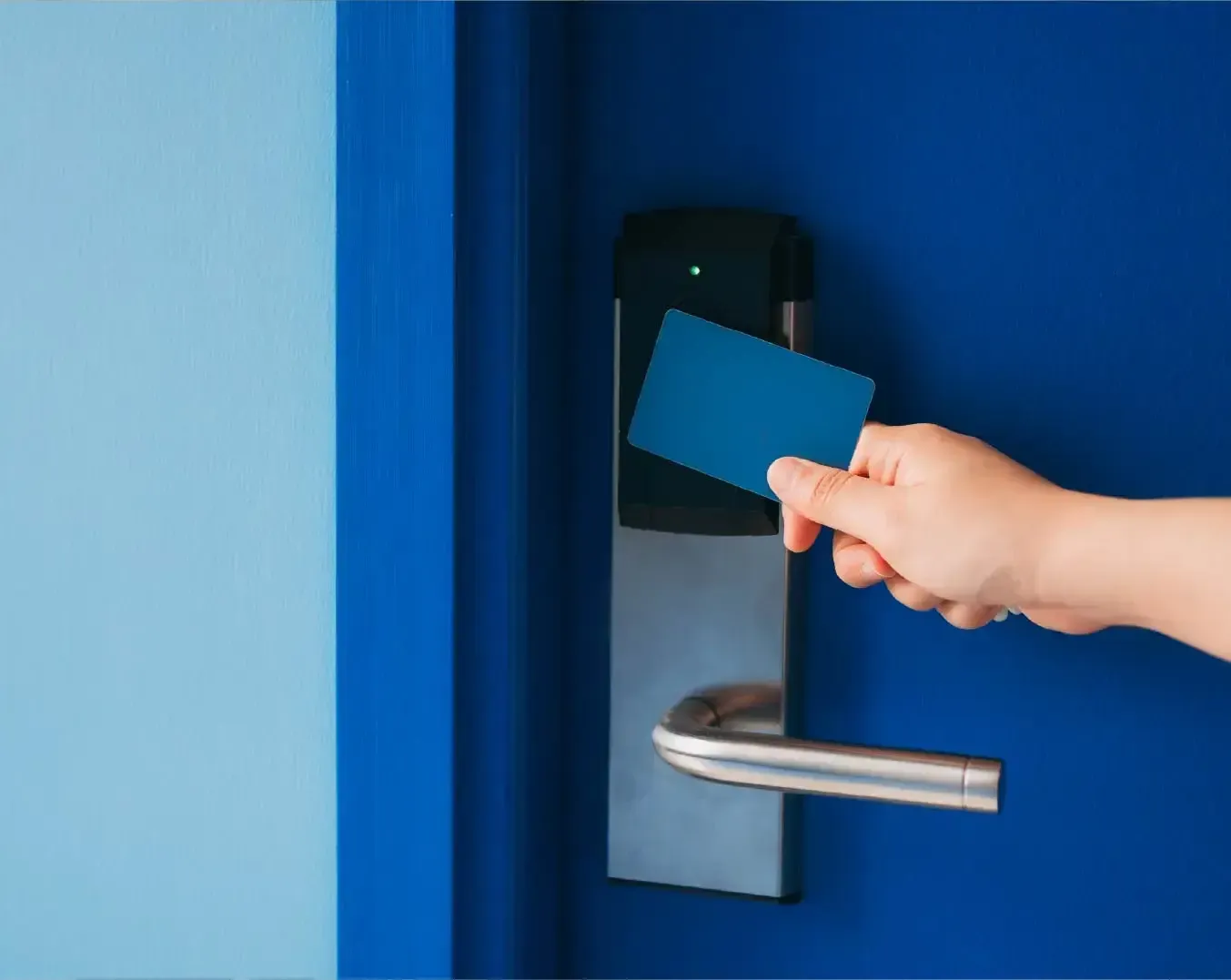
RFID cards allow hotel guests to enter rooms without touching the key card system. It's because the tags inside the card communicate with the card system via radio waves. Similar to modern car keys, when the card is close to the door, guests can access their rooms.
Unlike magnetic stripe cards, RFID cards can't be easily duplicated, making them a safer choice. In case of loss or theft of the room card, the front desk can deactivate it remotely.
Magnetic stripe card
Magnetic stripe cards are recognizable by their black metal stripe and are probably the most common hotel key cards. When swiped or inserted into a card reader, they grant room access. Remember to warn guests to keep them away from other cards, as they can become demagnetized.
These cards are also easier to duplicate. On the other hand, magnetic stripe cards are convenient for small properties, as they're easy to set up. Another benefit is that guests are already super accustomed to this type of technology.
Hole cards
As their name suggests, hole cards have specific hole patterns detected by the card reader. Although they're less well-known, these cards provide a straightforward way for guests to access communal areas and hotel rooms.
What information is stored on hotel key cards?
Hotel key cards store encrypted data that tells the hotel’s locking system which rooms and areas a guest is allowed to access and for how long. This information typically includes a unique identifier linked to the reservation, the room number, the check-in and check-out dates, and any permitted access to amenities like gyms, pools, or parking areas.
Most modern key cards do not store personal guest details, instead relying on secure hotel systems to manage sensitive information and reduce privacy risks if a card is lost.
What are the advantages of hotel key cards?
Hotel key cards offer several advantages that make them a better option than traditional keys for both hotels and guests. They improve security by allowing hotels to instantly deactivate lost cards and control access to specific rooms or areas. Key cards are also easier for staff to manage, since they can be issued, reprogrammed or replaced in seconds without changing locks.
For guests, key cards provide faster and more convenient access to rooms and amenities, especially when using contactless technology. Modern key card systems can also integrate with other hotel technology, supporting features like amenity access, cashless payments and a more seamless overall guest experience.
Common challenges with hotel key cards
Switching to or maintaining a key card system comes with a few operational hurdles hoteliers should plan for:
- Demagnetization: magnetic stripe cards lose data when stored near phones, other cards or magnetic clasps, leading to repeat visits to the front desk
- Upgrade costs: moving from magnetic stripe to RFID or NFC requires new card stock, encoders and sometimes new door locks, which is a bigger investment for larger properties
- Guest confusion: some guests are unfamiliar with tap-to-enter technology and default to swiping, which slows check-in at the door
- Plastic waste: single-use key cards contribute to a property's environmental footprint, prompting some hotels to shift toward reusable or digital alternatives
- Card duplication risk: magnetic stripe cards are easier to clone than RFID or NFC, which is a security consideration for properties in high-traffic urban locations
Cost and ROI of hotel key card systems
Magnetic stripe cards remain the lowest-cost option per unit, but the ongoing cost of replacing demagnetized cards adds up over time, particularly in high-occupancy properties. RFID and NFC cards cost more upfront – both in card stock and reader hardware – but reduce reissue frequency and front desk time spent on access issues.
The stronger return, though, comes from what NFC and RFID enable beyond access: fewer lost-key incidents, faster check-in and the ability to layer in payment and amenity functions without adding new hardware. Properties evaluating the switch should weigh the one-time hardware cost against the ongoing labor savings and incremental revenue opportunity outlined below.
How to choose the right key card system
The best system depends on property size, budget and how guests expect to interact with your hotel.
Property size and layout
Smaller properties with a single entry point often do well with magnetic stripe cards, since setup costs are low and staff training is minimal. Larger properties with multiple access points – gyms, pools, parking, elevators – benefit more from RFID or NFC, which can be programmed for tiered access without adding separate card types.
Budget
Magnetic stripe systems have the lowest upfront cost but higher long-term replacement costs due to demagnetization. RFID and NFC systems cost more to install but reduce card reissues and staff time spent troubleshooting access issues.
Guest experience goals
Properties positioning themselves as premium or tech-forward should prioritize NFC, since contactless access and mobile integration align with guest expectations at that tier. Budget and mid-scale properties may find magnetic stripe sufficient, particularly where guests are less likely to expect contactless technology.
Existing technology stack
A key card system should integrate with your existing hospitality operating system rather than operate separately. This avoids manual reconciliation between access control and guest data, and keeps check-in, room assignment and access permissions synced from a single platform.
The key to success
Smart cards and digital keys remove a major friction point in the guest journey – no front desk queue, no physical card to lose, just a phone tap or a pre-loaded card that gets guests into their room in seconds. For hoteliers, that speed translates directly into fewer check-in bottlenecks and higher guest satisfaction scores.
Modern access technology also raises the bar on convenience and security together. Digital hotel keys let guests bypass the front desk entirely, while encrypted, single-use credentials close the vulnerabilities of traditional magstripe cards – a property switching from magstripe to mobile key removes the risk of cloned cards while cutting average check-in time.
Mews, a hospitality operating system, connects this access technology to the rest of the guest journey – so a digital key issued at booking works the same way at self-check-in, the room door and any connected amenity, without staff managing separate systems for each. If you want to see Mews in action, get a demo today.
Ready to take the next step with your hotel tech? Discover how kiosks can boost revenue and service.
Download our guide "Mews Kiosk: 6 creative uses for properties of all types"

Are hotel key cards secure for modern hotels?
Are hotel key cards secure for modern hotels?
Yes, hotel key cards support secure access control by using encrypted data and can be instantly deactivated or updated through the hotel’s management system.
Do hotel key cards store guests' personal information?
Do hotel key cards store guests' personal information?
Most modern key cards do not store personal guest data and instead rely on centralized hotel systems to manage sensitive information securely.
What happens if a guest loses their key card?
What happens if a guest loses their key card?
Lost key cards can be immediately deactivated and replaced by staff without changing locks or disrupting the guest experience.
How do hotel key cards integrate with other hotel systems?
How do hotel key cards integrate with other hotel systems?
Key card systems can integrate with a hotel’s PMS and other technology to manage room access, amenity permissions and stay durations from one centralized platform.
Are physical key cards still relevant with mobile and digital access?
Are physical key cards still relevant with mobile and digital access?
Yes, physical key cards remain important even as hotels adopt mobile access, giving properties flexibility to support different guest preferences and operational needs.
Written by

Eva Lacalle
Eva has over a decade of international experience in marketing, communication, events and digital marketing. When she's not at work, she's probably surfing, dancing, or exploring the world.