
Key takeaways
- Full-service hotels provide a complete hospitality experience under one roof, with on-site dining, room service, meeting facilities, concierge support and recreational amenities.
- Full-service properties generate revenue from multiple streams beyond room sales, including food and beverage (F&B), event hosting, spa services and ancillary guest charges.
- Managing the complexity of a full-service hotel requires a hospitality operating system that connects every department, automates routine tasks and gives your team real-time visibility across operations.
What does a guest expect when they book a full-service hotel? Usually, far more than a room. They expect on-site dining, room service, concierge support, meeting spaces, a fitness center and often a spa or pool, all without leaving the property. When any part of that experience falls short, it shows up in reviews, loyalty scores and repeat bookings.
Delivering on that promise takes a larger team and a more complex operational setup than any other property type, leaving little room for error. That's why you need to understand what running a full-service hotel actually demands.
In this article, we'll cover the meaning of full-service hotels, how the model compares to limited-service properties and how the right technology can help you run one profitably.
Full-service hotel meaning
A full-service hotel is defined by the range of amenities and staff needed to support them under one roof. Beyond rooms, guests get restaurants, bars, room service, banquet and meeting facilities, a fitness center and often a spa.
Supporting all of that requires a hotel organizational structure with dedicated departments for food and beverage (F&B), housekeeping, front office, sales and engineering, each reporting up through property leadership.
A 300-room convention hotel, for example, may run three restaurants, a full banquet team and a spa alongside standard front-desk operations, all coordinated through one organizational chart. That structure is what separates a full-service property from a limited-service hotel offering only rooms and breakfast.
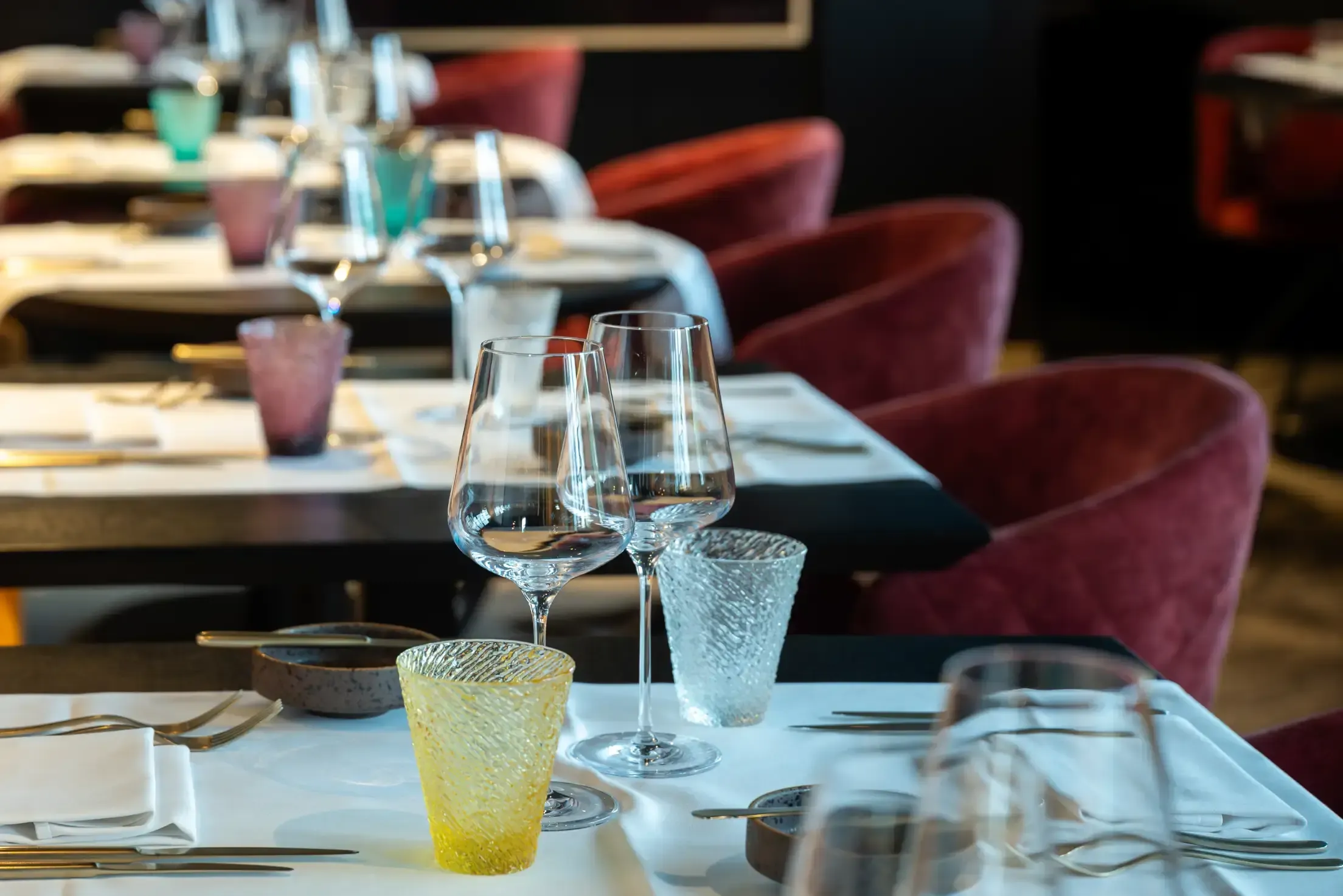
Core full-service hotel amenities and services
Full-service hotels bundle a wide set of amenities to keep guests on property for every part of their stay. That bundle typically spans the following core offerings:
- Restaurants and bars deliver on-site dining options for breakfast, lunch and dinner.
- Room service allows guests to order food and drinks directly to their room at any hour.
- Concierge staff arrange transportation, reservations and local recommendations for guests.
- Banquet and meeting spaces host conferences, weddings and corporate events.
- A fitness center gives guests access to workout equipment without leaving the hotel.
- A spa offers treatments such as massages, facials and body therapies.
- A pool provides a recreational space for leisure and family guests.
- Valet and bell staff handle luggage and parking for arriving and departing guests.
- Housekeeping teams maintain rooms and public spaces to a consistent standard throughout the stay.
Together, these services define the full-service experience that sets these properties apart from limited-service hotels.
Full-service hotel vs. limited-service property
Comparing full-service vs limited service hotel models comes down to what guests get without leaving the property.
The table below breaks down where the two models differ across key areas of operation:
Category
Full-service hotel
Limited-service property
Dining
On-site restaurants and bars with room service
Complimentary breakfast only
Staffing
Large team across F&B, housekeeping and concierge
Small front desk and housekeeping team
Meeting spaces
Banquet halls and conference rooms
Rarely available
Recreation
Fitness center, spa and pool as standard
Basic gym or none
Target guests
Business travelers and event planners
Budget and short-stay travelers
Operating costs
Higher, due to staffing and amenities
Lower, with a leaner structure
Which traveler profiles benefit most from full-service stays?
Full-service hotels serve a specific mix of guests who want more than a place to sleep. Understanding which traveler profiles rely on these amenities helps you plan staffing and services based on actual demand.
- Business travelers use meeting spaces and reliable Wi-Fi to work between appointments.
- Corporate event planners rely on banquet halls and audiovisual support to host on-site conferences.
- Wedding parties book full-service properties for the combination of lodging, catering and event space in one location.
- Long-stay guests value room service and on-site dining that reduce the need to leave the property daily.
- Leisure families choose full-service hotels for pools, fitness centers and recreational amenities that keep everyone occupied.
- Luxury travelers expect concierge support and spa access as part of a premium stay.

Hotel tiers that sit inside the full-service category
Full-service hotels span several chain-scale tiers, typically defined by average daily rate (ADR) and the depth of the guest experience. Importantly, chain scale and service model are distinct: chain scale reflects a hotel’s price positioning, while “full service” describes the range of on-site amenities and operations.
The tiers below focus specifically on true full-service brands, ranked from the top of the market downward.
Luxury tier
Luxury hotels occupy the top tier of the full-service category, offering multiple dining venues, full-service spas, extensive event spaces and high staff-to-guest ratios. Brands such as Ritz-Carlton and Four Seasons define this segment, combining personalized service and meticulous attention to detail with premium rates.
Upper upscale tier
Upper-upscale hotels offer a comprehensive full-service experience at a more accessible price point than luxury properties. Brands such as Marriott Hotels, Hilton Hotels & Resorts, Hyatt Regency, Sheraton and Westin typically provide on-site dining, meeting and banquet facilities, concierge services and fitness centers, catering to business travelers, event planners and leisure guests alike.
Upper midscale tier
Upper-midscale full-service brands offer core amenities such as on-site dining and meeting space, but with leaner operations and fewer premium touches than upscale or luxury hotels. Holiday Inn is a well-known example, appealing to travelers who want a genuine full-service experience without the higher rates typically associated with upscale or luxury properties.
Real-world examples of full-service hotels worldwide
Full-service hotels take different shapes depending on location, brand and guest base, but the core promise stays the same.
Here's how that plays out across a mix of independent Mews customers and globally recognized properties.
Wythe Hotel
Located in Brooklyn, New York, the Wythe Hotel delivers on-site dining, a rooftop bar and a guest portal that lets guests check in online before they arrive. Payment details are tokenized and stored securely once entered, so guests can charge additional purchases to their room throughout the stay without repeating the process at the front desk.
That combination of hospitality touches and behind-the-scenes automation lets the team focus on guest interactions instead of manual administrative work.
Terrace Bay Hotel
This waterfront U.S. property runs a premium restaurant, a cocktail lounge and a morning coffee shop, alongside add-on experiences like e-bikes and kayaks that keep guests engaged throughout their stay.
The team also runs personalized email and SMS campaigns before and during each visit, encouraging guests to book waterfront dinners, late check-outs and premium suite upgrades.
The Ritz Paris
Located in the heart of Paris, The Ritz Paris offers multiple restaurants, a spa, a cooking school and banquet halls for guests seeking a luxury experience at every turn.
The property also maintains a dedicated concierge team and event staff who coordinate everything from private dinners to large-scale galas, reflecting the organizational depth required to run a hotel of this caliber.
Marina Bay Sands
Located in Singapore, Marina Bay Sands houses more than a dozen restaurants, a rooftop infinity pool, a casino and an adjacent museum, all built to keep guests on property for their entire stay.
The resort also runs its own convention center, giving corporate groups access to meeting space and banquet halls without needing a separate venue.
Maximize revenue with Mews full-service automation
Full-service hotels run on many moving parts at once, from rooms and dining to spa bookings and event space. Managing all of that with disconnected tools makes it hard to price accurately or spot missed revenue.
That's where Mews comes in – a hospitality operating system with Mews PMS at the heart of your operations, unifying reservations, rate management, housekeeping and payments in one workspace instead of scattered spreadsheets and siloed systems.
Its core capabilities include the following:
- Centralized reservations and a unified timeline give staff a single view of every booking and room status.
- Mews RMS adjusts pricing across room types and channels without manual updates.
- Integrated payments reduce manual reconciliation and speed up front desk checkout.
- Reporting across Mews Business Intelligence connects revenue data across departments for faster, more informed decisions.
Book a demo to see how Mews helps you run every department from one system, so pricing and operations stay aligned as complexity grows.
Is room service guaranteed at every full-service hotel?
Is room service guaranteed at every full-service hotel?
No, room service is not guaranteed at every full-service hotel. While many full-service hotels offer room service, some have replaced it with limited in-room dining, grab-and-go options or restaurant takeout to meet changing guest preferences and reduce operating costs.
Do full-service hotels always include breakfast in the rate?
Do full-service hotels always include breakfast in the rate?
No, full-service hotels do not always include breakfast in the room rate. While some offer complimentary breakfast, others charge separately or include it only with specific rate plans or loyalty benefits.
Can limited-service hotels upgrade to full-service status?
Can limited-service hotels upgrade to full-service status?
Yes, a limited-service hotel can upgrade to full-service status by adding amenities such as a full-service restaurant, meeting and event spaces, room service and expanded guest services. However, achieving full-service status typically requires significant investment, operational changes and additional staffing.
Are resort fees common in full-service hotels?
Are resort fees common in full-service hotels?
Yes, resort fees are common at many full-service hotels, particularly in resort destinations. These mandatory fees typically cover amenities such as Wi-Fi, fitness center access, pool facilities or recreational activities and are charged separately from the room rate.
How do loyalty programs work at full-service stays?
How do loyalty programs work at full-service stays?
Loyalty programs at full-service hotels allow guests to earn points for eligible stays, which can be redeemed for free nights, room upgrades, dining or other rewards. Members may also receive benefits such as late check-out, complimentary breakfast or exclusive rates, depending on their membership tier.