
Key takeaways
- A hotel tech stack connects reservation, payment and operational tools into one system.
- Hotel property management systems (PMS) serve as the central hub for daily hotel operations.
- Cloud-based solutions offer faster implementation with greater control than legacy systems.
- Strategic technology adoption directly impacts revenue, efficiency and guest satisfaction scores.
Hospitality increasingly depends on connected technology. Guests expect convenient booking, flexible check-in and relevant communication, while hotel teams need systems that reduce manual work and make accurate information available when it matters.
A hotel tech stack is the collection of software and digital tools that supports reservations, operations, payments, distribution, revenue management and the guest journey. The number of tools matters less than how effectively those systems work together.
The right setup varies according to a property’s size, service model, existing processes and growth plans. This guide explains the core components of a hotel tech stack, how they connect and what hoteliers should consider when building or improving one.
What is a hotel tech stack?
A hotel tech stack is the collection of software systems and digital tools a property uses to manage operations, serve guests and drive revenue.
This infrastructure includes your property management system (PMS), booking engine, payment processing, revenue management tools and guest communication platforms. These systems work together to automate repetitive tasks and centralize your operational data.
Your hotel technology stack shapes every interaction. It determines how guests book rooms, how staff manage check-ins and how you optimize pricing.
What should a hotel tech stack include?
A hotel tech stack typically combines a core property management system with specialized tools for booking, distribution, pricing, guest relationships and on-property sales. The right configuration depends on the hotel’s size, services and commercial strategy, but these six systems form the foundation of many modern hotel operations.
1. Property management system (PMS)
The PMS is the operational center of the hotel tech stack. It manages reservations, room assignments, check-in and checkout, guest profiles and billing while providing other systems with essential property and reservation data.
A modern PMS may also include capabilities such as reporting, staff communication, payment processing and guest messaging or connect with specialized tools through integrations.
2. Online booking engine
An online hotel booking engine allows guests to view availability and reserve directly through the hotel’s website. It connects with the PMS to keep rates, restrictions and inventory current.
A strong booking engine should provide a fast, mobile-friendly experience and support secure payments, multiple languages and currencies, packages and relevant add-ons.
3. Channel manager
A hotel channel manager distributes rates, restrictions and availability across OTAs and other booking channels. Reservations are returned to the PMS, reducing the need for teams to update each channel manually.
Keeping distribution and property systems connected can reduce availability errors, support rate consistency and give hotels greater control over where their inventory is sold.
4. Revenue management system (RMS)
A revenue management system analyzes hotel and market data to support pricing and inventory decisions. It can help revenue teams respond to changes in demand, booking pace, occupancy and other commercial conditions.
Connecting the RMS with the PMS reduces manual data transfers and allows approved pricing recommendations or automated rate changes to flow into hotel operations.
5. Customer relationship management system (CRM)
A hotel CRM organizes guest data and supports communication before, during and after a stay. It can help teams segment audiences, personalize messages and manage marketing campaigns based on reservation history, preferences and engagement.
The CRM should connect with the PMS so campaigns use accurate guest information and communication reflects the traveler’s relationship with the property.
6. Point-of-sale system (POS)
A hotel POS system manages transactions across restaurants, bars and other on-property outlets. Depending on the platform, it may also support digital ordering, inventory management, menu controls and sales reporting.
When the POS connects with the PMS and payments, staff can post eligible purchases to guest accounts and maintain a more complete view of spending across the property.
Capabilities such as analytics, mobile access, internal communication, reputation management and upselling remain important, but they do not always require separate systems. Hotels should first determine whether their core platforms already provide these functions before adding another tool to the stack.

Why hotel technology integrations matter
A collection of high-quality tools can still create a poor technology environment if those tools do not exchange information reliably. Disconnected systems can lead to duplicate data entry, inconsistent guest records, delayed updates and fragmented reporting.
Integration should therefore be evaluated as a business capability, not merely as a box on a vendor’s feature list.
When reviewing an integration, ask:
- What information moves between the systems?
- Does data move in one direction or both directions?
- Are updates made in real time or on a schedule?
- Which system is the source of truth for reservations, inventory, guest profiles and payments?
- What happens when the connection is interrupted?
- Who supports and maintains the integration?
- Are setup, transaction or ongoing integration fees required?
How to audit your existing hotel tech stack
Before purchasing another tool, document what the current stack already does. This helps expose genuine gaps while preventing overlapping functionality and unnecessary complexity.
Map systems to business outcomes
List each system and identify the operational or commercial outcome it supports, such as:
- Accurate availability and reservations.
- Faster guest processing.
- Secure payment workflows.
- Direct booking conversion.
- Pricing and revenue optimization.
- Housekeeping coordination.
- Guest communication.
- Reporting and decision-making.
Identify manual work and data gaps
Document where staff must copy information, reconcile systems or rely on spreadsheets. Repeated manual intervention may indicate a missing integration, an underused feature or a system that no longer fits the operation.
Review adoption and ownership
A system provides little value if teams do not understand or consistently use it. Identify who owns each system, who administers it and whether staff have adequate training.
Look for overlapping tools
Multiple systems may provide similar reporting, messaging, payment or guest-profile functions. Determine whether that overlap provides necessary flexibility or simply increases cost and administration.
Prioritize the most consequential gap
Do not add technology solely to make the stack appear more sophisticated. Prioritize problems that affect revenue, guest service, staff workload, data reliability or the ability to scale.
How to avoid a fragmented hotel tech stack
Fragmentation rarely arrives all at once. It builds up one disconnected tool at a time, until the problems above – duplicate data entry, inconsistent guest information, manual reconciliation – start compounding across departments.
Before adding another product, determine whether the capability already exists within your current technology. If a new system is necessary, evaluate how it will exchange data with the PMS, who will manage the integration and whether it introduces another interface, contract or training requirement.
The goal is not necessarily to use fewer tools, but to create a connected environment in which each system has a clear purpose. A hospitality operating system can provide that foundation by bringing core functions together while allowing specialized technology to connect through established integrations. This reduces fragmentation without limiting the hotel’s ability to choose the tools that fit its needs.
How to build and scale a high-performing hotel tech stack
Strategic implementation determines whether technology accelerates growth or creates bottlenecks. Follow these steps to build infrastructure that delivers immediate value and supports long-term expansion:
Define objectives and identify gaps
Start with a clear understanding of where your operations stand today:
- Assess operational pain points affecting staff productivity.
- Identify revenue opportunities being missed.
- Document manual processes that slow down workflows.
- Highlight data silos that prevent informed decision-making.
- Prioritize tools that address your most expensive inefficiencies first.
Select scalable solutions
Choose systems that can support growth without forcing future migrations:
- Opt for cloud-native systems over legacy systems.
- Ensure the solution can scale from single to multi-property operations.
- Review vendor product roadmaps for long-term alignment.
- Confirm continuous product development and integration expansion.
- Avoid tools with fixed capacity limitations.
Plan for a smooth rollout
Implement technology in a way that minimizes disruption and encourages adoption:
- Introduce one system at a time.
- Train staff thoroughly before launch.
- Communicate clear benefits to reduce internal resistance.
- Use phased deployment to manage integration risks.
- Start with core systems before adding specialized tools.
Evaluate and scale for growth
Technology requires ongoing review to remain effective:
- Monitor performance metrics monthly.
- Track user adoption and feature usage.
- Identify optimization opportunities early.
- Conduct annual technology reviews.
- Ensure systems remain aligned with evolving business goals.
Hotel tech stack evaluation checklist
Before selecting or renewing a system, confirm:
- The business problem is clearly defined.
- Required capabilities are separated from optional ones.
- The system connects with the operational source of truth.
- Data ownership and synchronization are understood.
- Security and compliance requirements are met.
- Implementation and training resources are available.
- Total cost of ownership has been calculated.
- The technology can support the hotel’s growth plans.
- Vendor support and product development have been evaluated.
- Success metrics and an internal owner have been assigned.
Build a future-ready hotel tech stack with Mews
Building the right hotel technology stack starts with a system that connects every operational component. Mews offers a cloud-native hospitality operating system designed to eliminate inefficiencies and support growth across single- or multi-property operations.
With Mews, you can:
- Centralize operations with a PMS that brings reservations, check-ins, payments and guest communications into one workspace.
- Optimize revenue automatically using Mews RMS, powered by Atomize, which applies AI-driven pricing to maximize RevPAR.
- Enhance the guest experience through mobile check-in, digital key access and virtual concierge services.
- Scale across multiple properties with centralized data and unified reporting.
- Connect your tools via the Mews Marketplace, featuring 1,000+ integrations and open API architecture.
Book a demo to see how Mews delivers a fully integrated tech stack that supports growth and operational efficiency.
Alternatively, download our guide below to explore key tools and strategies for modern hotels.
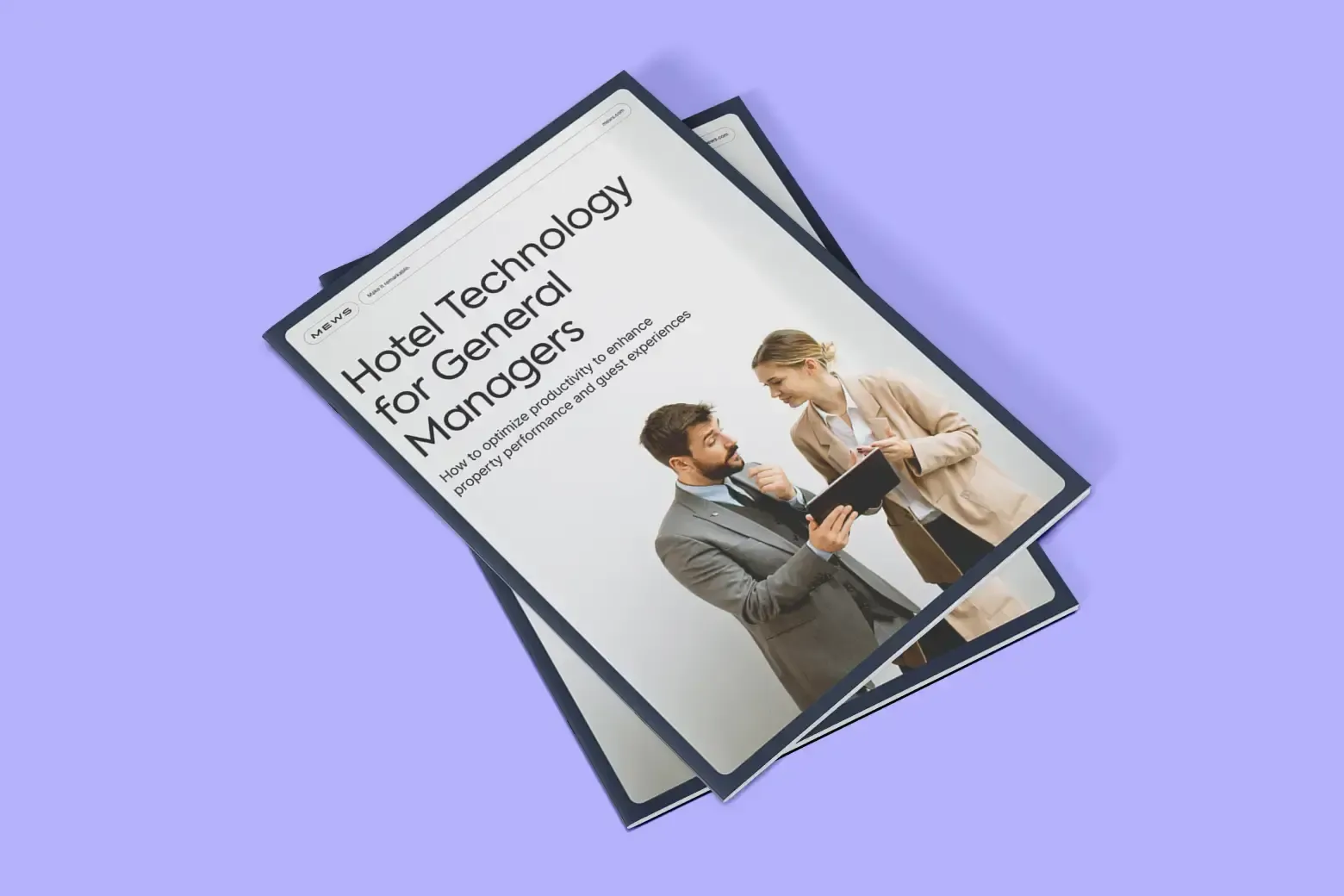
Download our guide "Essential hotel technology for general managers"
What software should be at the center of a hotel tech stack?
What software should be at the center of a hotel tech stack?
A hospitality operating system like Mews commonly serves as the operational center of a hotel tech stack. It maintains essential reservation, guest, inventory and billing information and connects with systems responsible for distribution, payments, pricing and guest experiences.
What is the difference between a PMS and a hotel tech stack?
What is the difference between a PMS and a hotel tech stack?
A PMS is one system within the hotel tech stack. It supports core property operations, while the broader stack may also include a booking engine, channel manager, payment processing, revenue management, analytics, housekeeping and guest communication technology.
Should a hotel choose an all-in-one system or best-of-breed tools?
Should a hotel choose an all-in-one system or best-of-breed tools?
The right approach depends on the hotel’s needs and internal resources. An integrated system may reduce complexity, while specialized tools may provide deeper capabilities. Hotels should compare functionality, integration quality, ownership, support requirements and total cost rather than choosing solely by category.
How do you know whether hotel software integrates properly?
How do you know whether hotel software integrates properly?
Confirm which data is exchanged, whether updates move in one or both directions and how quickly synchronization occurs. Hotels should also understand which system owns each data field, how errors are handled and who supports the connection.
How does a hotel tech stack improve operational efficiency beyond revenue management?
How does a hotel tech stack improve operational efficiency beyond revenue management?
A hotel tech stack eliminates manual data entry and reduces staff time spent on administrative tasks. Automation handles routine processes like room assignments and guest communications while teams focus on personalized service.
What role does a hotel tech stack play in enhancing guest experience?
What role does a hotel tech stack play in enhancing guest experience?
A hotel tech stack enables personalized service through centralized guest data and preferences. Mobile capabilities give guests control over check-in, room access and service requests, creating convenience that drives satisfaction and reviews.
How can small or independent hotels build a cost-effective tech stack?
How can small or independent hotels build a cost-effective tech stack?
Small and independent hotels should start with a cloud-based PMS that includes a booking engine and payment processing capabilities. You should also add specialized tools gradually as revenue grows, prioritizing systems that address your most expensive operational bottlenecks first.
What are the risks of using outdated or disconnected hotel technology?
What are the risks of using outdated or disconnected hotel technology?
Outdated or disconnected hotel technology creates data silos that prevent informed decision-making and slow operations. Manual processes increase error rates while competitors using modern platforms capture more direct bookings and optimize revenue automatically.
How often should hotels evaluate or upgrade their tech stack?
How often should hotels evaluate or upgrade their tech stack?
Hotels should conduct comprehensive technology reviews annually to assess whether current systems support business objectives. They should also monitor vendor product roadmaps quarterly to stay informed about new capabilities that could improve operations or guest experience.
Written by

Eva Lacalle
Eva has over a decade of international experience in marketing, communication, events and digital marketing. When she's not at work, she's probably surfing, dancing, or exploring the world.